Disclosure: Some links in this guide are affiliate links. If you book or buy through them, we may earn a small commission at no extra cost to you — it helps keep our guides free.
Ten days in Cambodia comfortably covers 4 bases: 4 nights in Siem Reap on a 3-day Angkor Pass, 2 in Phnom Penh, 2 in Kampot and a final night by the sea in Kep. That is three more nights than a week allows, and they buy you the slow south coast most Australians skip.
Fly into Siem Reap, out of Phnom Penh, and travel overland between them on daytime buses of 4 to 6 hours.
| Day | Base | Highlights |
|---|---|---|
| 1–4 | Siem Reap | Angkor Wat sunrise, Bayon, Ta Prohm, Banteay Srei or Beng Mealea |
| 5 | Phnom Penh | 6-hour bus, riverside walk |
| 6 | Phnom Penh | Tuol Sleng, Choeung Ek, Royal Palace |
| 7–8 | Kampot | Pepper farm, Bokor Mountain, river sunset |
| 9 | Kep | Crab market, Rabbit Island |
| 10 | Fly out | Morning bus to Phnom Penh’s Techo airport |
Days 1–4: Siem Reap on a 3-day Angkor Pass
There are no direct flights from Australia, so connect through Singapore, Kuala Lumpur or Bangkok. From Sydney or Melbourne it is about 10 hours including the stop. Give day 1 to rest and an early night.
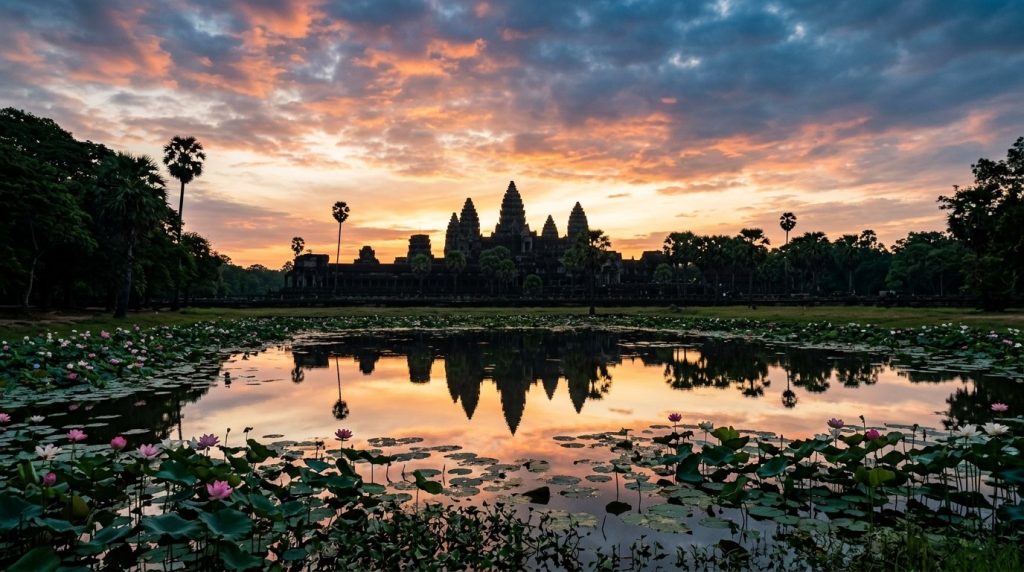
Buy the 3-day pass at AUD 86 · USD 62 from the official Angkor Enterprise ticket site. It covers any 3 days within 7, so a pool day in the middle costs nothing. A 1-day pass is AUD 51 · USD 37, so the 3-day is the obvious buy.
– Day 2: Angkor Wat at sunrise, then Angkor Thom and the faces of the Bayon before the midday heat.
Back to the hotel by 1pm. – Day 3: The small circuit: Ta Prohm early, Ta Keo, Banteay Kdei, and Srah Srang late afternoon. – Day 4: Banteay Srei for the carving detail, or the jungle ruin of Beng Mealea, which needs its own AUD 14 · USD 10 ticket and is not on the Angkor pass.
Hire a tuk-tuk driver by the day rather than cycling in the heat.
Days 5–6: Phnom Penh, the hard history and the riverside
Giant Ibis runs Siem Reap to Phnom Penh several times a day on a 320 km run that takes about 6 hours, with a driver-swap stop in Kampong Thom. Take the 8:45am departure and you are on the riverfront in time for a sundowner. Timetables are on the Giant Ibis schedule page.
Day 6 is the heavy one. Start at Tuol Sleng Genocide Museum (S-21), AUD 7 · USD 5, then take a tuk-tuk out to the Choeung Ek killing fields, AUD 4 · USD 3, where the audio guide does the talking. Keep the afternoon light: the Royal Palace area and a walk along Sisowath Quay.
Days 7–8: Kampot, pepper farms and Bokor Mountain
The bus from Phnom Penh to Kampot covers 150 km in about 4 hours, through Kampong Speu and Takeo provinces. Giant Ibis leaves at 8am and 2:45pm and drops you opposite Kampot Park.
Kampot is the reason to choose ten days over seven: a slow riverside town of French shophouses. Spend day 7 at a pepper farm and finish with a sunset boat on the Praek Tuek Chhu river.
On day 8, hire a driver up to Bokor Mountain, about 42 km and 1 to 1.5 hours away. The abandoned church and French-era hill station are often wrapped in mist, so take a jacket.
Days 9–10: Kep crab market, Rabbit Island and the flight home
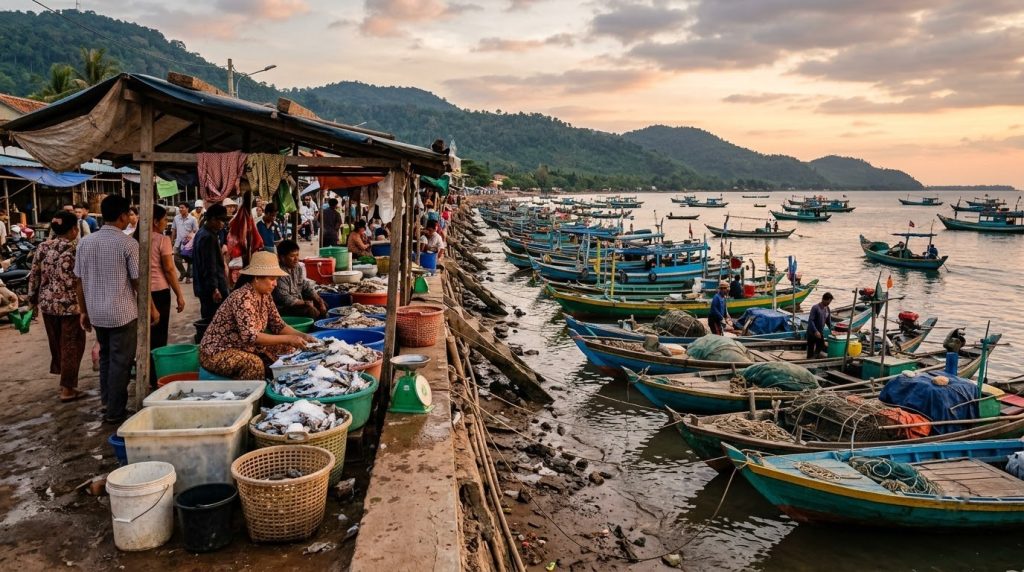
Kep is only 25 km from Kampot, about 35 to 45 minutes by tuk-tuk. Go straight to the Kep crab market and order crab fried with fresh green Kampot pepper. In the afternoon, the boat to Rabbit Island (Koh Tonsay) takes 20 to 30 minutes and costs AUD 11–14 · USD 8–10 return, depending on the boat. Expect hammocks and seafood shacks, not Thai-island polish.
On day 10, Giant Ibis leaves Kep for Phnom Penh at 7:30am. Book an evening flight out of Techo International Airport (KTI), which opened in September 2025 south of the city, because the bus and airport road both run long.
Swapping in Battambang: avoid the routes near the Thai border
Older itineraries add Battambang after Siem Reap. In 2026 that needs care. Smartraveller rates Cambodia overall at “exercise a high degree of caution”.
It also says do not travel to areas within 50 km of the Thai border in Banteay Meanchey, Oddar Meanchey, Preah Vihear, Battambang, Pailin, Pursat and Koh Kong provinces. The reasons are the risk of armed conflict and the landmines and unexploded ordnance left in the area.
All land crossings into Thailand are closed, so there is no overland link to Bangkok either. We break down what that means for the rest of the country in our guide to whether Cambodia is safe right now.
The practical catch is the road. The Giant Ibis bus from Siem Reap to Battambang stops at Sisophon in Banteay Meanchey, which is close to that zone. If you still want Battambang, the Sangker River boat from Siem Reap is the better way in.
It takes 5 to 9 hours, costs around AUD 35–42 · USD 25–30, and only runs when the water is high enough, roughly July to March. Stay inside the town, skip any tour heading west towards the border, and check the live Smartraveller map before you book.
For most first-timers, our pick is to leave Battambang out and spend those nights on the coast.
What to cut if you only have 7 days
Drop Kep and one Kampot night first, then trim Siem Reap to three nights. That leaves Angkor, Phnom Penh and a quick taste of the coast, which is essentially our 7-day Cambodia itinerary. If you have 12 days instead, add a night in Kep or a 2-night island stop.
October is the tail of the wet season: green temples, running river boats, short afternoon storms. From December the coast is drier and busier. Our breakdown of the best time to visit Cambodia covers the months season by season.
Daily costs: what 10 days actually costs
A budget traveller sticking to guesthouses, local meals and tuk-tuks rather than private cars should plan on roughly AUD 35–69 · USD 25–50 a day, and that figure holds reasonably steady across Siem Reap, Phnom Penh, Kampot and Kep.
Travellers happy to eat only street food and skip paid extras can bring that down to about AUD 21–35 · USD 15–25 a day, while a mid-range trip with air-conditioned hotels, some private transport and a nicer restaurant most nights sits around AUD 111–208 · USD 80–150 a day.
A boutique hotel room on its own, before food or activities, runs about AUD 139–416 · USD 100–300 a night, which is the main reason the mid-range and budget figures pull apart (2026 figures).
Transport is the cost that changes shape at every stop. A short tuk-tuk hop across town, in Siem Reap, Phnom Penh or Kampot, costs about AUD 2.80–7 · USD 2–5, while hiring a driver for a full day of temple-hopping around Angkor typically runs AUD 35–62 · USD 25–45, and it is usually cheaper per day if the same driver is booked across all 3 days of the Angkor pass rather than hired fresh each morning.
In Phnom Penh, a private car and driver for day trips tends to cost more than a tuk-tuk over the same distance, since Tuol Sleng, Choeung Ek and the riverside sit further apart than Angkor’s temple cluster.
Cambodia runs on both US dollars and riel side by side: dollars for anything above a dollar or two, riel for the small change that comes back from a purchase. Bring a stock of smaller US bills, since tuk-tuk drivers and market stalls rarely carry change for a USD 50 or USD 100 note.
ATMs are easy to find in all 4 towns on this route, but most charge a withdrawal fee that can run above AUD 7 · USD 5 per transaction, so fewer, larger withdrawals work out cheaper than several small ones.
What to eat along the way
Khmer food changes a little by region, but a handful of dishes turn up at every stop on this route. Fish amok, a steamed curry mousse usually made with freshwater fish and coconut milk, is the dish most associated with the country and costs about AUD 5.60–11 · USD 4–8 at a sit-down restaurant.
Beef lok lak, stir-fried beef served over salad with a lime-and-Kampot-pepper dip, runs close behind at AUD 5.60–9.70 · USD 4–7, and both are easy to find from Siem Reap through to Phnom Penh.
For something cheaper and more local, look for bai sach chrouk, grilled pork over rice usually eaten at breakfast, at about AUD 2.10–4.20 · USD 1.50–3, or nom banh chok, rice noodles in a green fish-based curry sauce, closer to AUD 1.40–2.80 · USD 1–2 from a market stall.
Kuy teav, a clear noodle soup usually served with pork, sits in a similar bracket, and all 3 are more likely on a breakfast stall than a restaurant menu.
Kampot earns its reputation through pepper rather than one dish: crab fried with fresh green Kampot pepper at the Kep crab market is the meal worth timing a day around, and it is the reason most itineraries route through Kep rather than heading straight back to Phnom Penh from Kampot.
Wash any of the above down with Khmer iced coffee, sweetened condensed milk over strong coffee and ice, at roughly AUD 1.40–2.80 · USD 1–2 from a street stall.
Temple dress code and what to pack
Angkor enforces a modest dress code at every temple: shoulders and knees covered for everyone, no see-through or sleeveless tops, and no headwear once you step inside a temple building.
Shorts are fine as long as they sit at or below the knee; the gym-style shorts that work fine on a Kep beach will not pass some of the stricter staff at Angkor Wat or Angkor Thom.
Pack at least one breathable long-sleeve layer and a pair of lightweight trousers or a long skirt for temple days, and keep them separate from the shorts and singlets you will actually want in Kampot and Kep.
A few other items earn their space on this specific route. Bokor Mountain’s summit is regularly wrapped in mist even on a dry day on the coast below, so a light jacket belongs in the daypack for day 8 regardless of the season.
Reef-safe sunscreen and a hat matter for the open boat crossing to Rabbit Island, where there is no shade once you are on the water. Reliable walking shoes or sandals cover everything from the uneven stone at Ta Prohm to the pepper farm’s dirt paths outside Kampot.
A handful of smaller items are easy to forget: insect repellent for riverside evenings in Kampot, a portable phone charger for the longer bus legs, and a stock of small US dollar notes picked up before or soon after arrival, since change for large bills is often the hardest part of paying for anything on this trip.
Staying connected between stops
Cellcard and Smart are the two networks locals recommend to visitors, and both sell tourist SIM cards at kiosks in the arrivals area of Siem Reap International Airport and Phnom Penh’s Techo International Airport, as well as at phone shops in town.
A tourist SIM with enough data for the full 10 days costs roughly AUD 8–14 · USD 6–10, and coverage holds up well along this route, including on the bus between towns, since all 4 bases sit on Cambodia’s main highway network rather than anywhere remote.
Hotel and guesthouse Wi-Fi is reliable in Siem Reap and Phnom Penh, less consistent in the smaller guesthouses of Kampot and Kep, which is one more reason to have a local SIM active before heading to the coast rather than relying on the next hotel’s password.
Where to stay in Siem Reap, Phnom Penh and Kampot
– Siem Reap, around the Old Market and the river: best for first-timers. Everything is walkable. Book a pool for after 5am starts. – Phnom Penh, Riverside or BKK1: Riverside puts you near the Royal Palace and the Giant Ibis terminal.
BKK1 is quieter, leafier and better for couples and food lovers. – Kampot riverside and Kep hillside: Kampot river guesthouses suit couples and budget travellers. Kep’s hillside resorts suit families who want a pool and space.
For visa, money and SIM basics before you lock in dates, start with our Cambodia travel guide.
Find your Cambodia hotel on the map
Live prices from Booking, Airbnb and more — move the map or change dates to compare stays across Cambodia.
Frequently Asked Questions
Is 10 days enough for Cambodia?
Yes. Ten days covers the three things most first-timers come for: three days at Angkor, a day of Khmer Rouge history in Phnom Penh, and a few slow days in Kampot and Kep. You will not see the far north-east or the islands off Sihanoukville. Those need a second trip or another four to five days.
How much is the Angkor Pass in 2026?
The official prices are AUD 51 · USD 37 for 1 day, AUD 86 · USD 62 for 3 days and AUD 100 · USD 72 for 7 days. The 3-day pass can be used on any three days within a week. Buy it only from Angkor Enterprise, online or at the official ticket centre.
Can I travel from Thailand to Cambodia overland?
Not at the moment. Land border crossings between Thailand and Cambodia are closed, and Smartraveller advises against travel within 50 km of the border in several provinces. Fly between Bangkok and Siem Reap or Phnom Penh instead, and check the advice again before you book.
Should I go to Kampot or Battambang?
On a 10-day trip in 2026, pick Kampot. It is easy to reach from Phnom Penh by a 4-hour bus, it adds Kep and Rabbit Island, and it is far from the Thai border zone. Battambang is lovely, but its province sits partly inside the do-not-travel area and the main road in passes close to it.