Disclosure: Some links in this guide are affiliate links. If you book or buy through them, we may earn a small commission at no extra cost to you — it helps keep our guides free.
The best time to visit Cambodia is the dry season from November to February, when Siem Reap gets as little as 10 millimetres of rain in January and daytime highs sit around 30°C rather than the wet season’s afternoon storms.
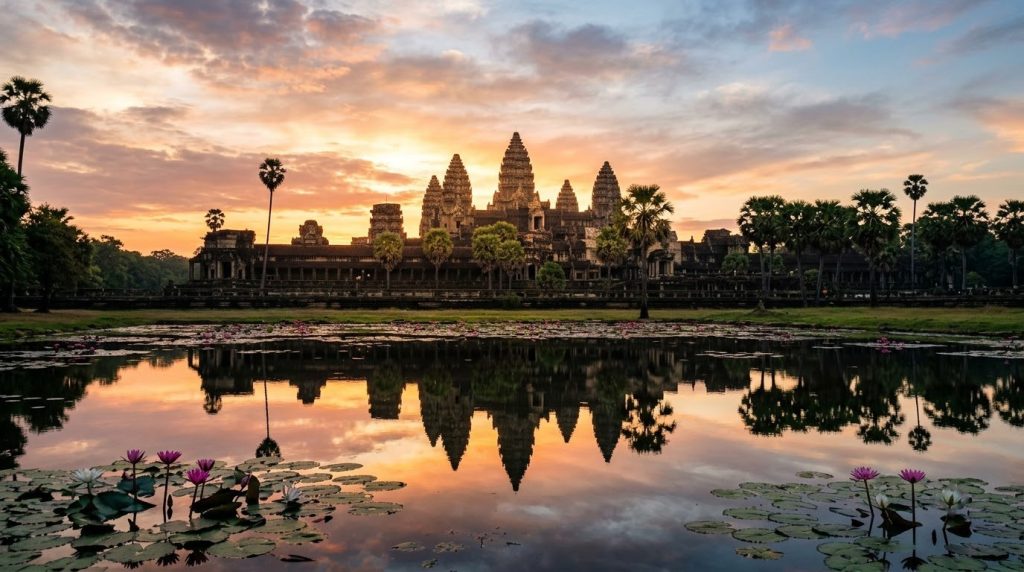
Angkor Wat itself photographs differently across the year, because the reflection pools that make its sunrise shot famous hold far more water in the wet season than during those popular cool, dry months. Deciding which country to give the trip to is covered in Thailand vs Cambodia.
| Month | Weather | Angkor conditions | Crowds | Verdict |
|---|---|---|---|---|
| November | Dry season begins, days cooling | Pools still hold monsoon runoff | Building | Excellent transition month |
| December | Coolest, driest, sunny | Pools starting to recede | Peak | Best all-round weather |
| January | Cool and dry, lowest rainfall | Pools and moat at their lowest | Peak | Ideal comfort, highest prices |
| February | Warming, still dry | Pools shallow, some patches dry | Peak | Great weather, book ahead |
| March | Heat building fast | Pools low, dusty stonework | Thinning | Shoulder – hot but fewer people |
| April | Hottest month of the year | Pools mostly empty before rains | Low, except Khmer New Year | Toughest weather, festival spike |
| May | Hot, first storms arrive | Pools beginning to refill | Low | Transition, unpredictable rain |
| June | Wet season starts | Pools refilling steadily | Low | Green season begins, good value |
| July | Regular afternoon downpours | Pools filling further | Low | Lush and quiet |
| August | Consistent rain | Pools close to full | Low | Good value, dramatic skies |
| September | Wettest month of the year | Pools and moat at their fullest | Low, but Pchum Ben crowds locally | Heaviest rain, best reflections |
| October | Rain easing | Full moats, calmer skies | Rising again | Sweet spot – green with fewer storms |
The dry season (November to February) – cool, comfortable, peak crowds
November to February is the most comfortable stretch of the Cambodian year, and it draws the biggest crowds for exactly that reason. Humidity drops, skies clear, and Siem Reap’s rainfall bottoms out at roughly 10 millimetres in January, its driest month.
Daytime temperatures stay in the high 20s to low 30s Celsius, cool enough to walk the causeway at Angkor Wat at midday without needing a long break indoors. The trade-off is price and crowding: this is when flights, hotels, and tuk-tuk drivers charge the most, and popular sunrise spots at Angkor Wat fill up well before dawn.
If comfort matters more than budget or solitude, book accommodation well ahead, because December and January rooms in Siem Reap sell out weeks in advance.
How the season changes Angkor Wat itself
Angkor Wat’s reflecting pools hold noticeably more water in the wet season than in the dry season, which changes the temple’s most photographed view from a shallow, sometimes muddy basin into a full mirror of its five towers.
The pools flanking the western causeway, along with the wider moat, are fed by rain and monsoon runoff rather than a managed water supply, so they fill through June to September and drain down through the dry months that follow.
By February and March, sections of the northern reflection pool can sit dry or reduced to a thin puddle, which is why the postcard “perfect reflection” photograph is actually easier to get in the green season than in the popular cool months.
Visitors chasing that shot should aim for June through September, accepting a higher chance of rain in exchange for full pools and a quieter causeway at sunrise. For a full breakdown of temple-by-temple conditions, see the Angkor Wat temple guide and the dedicated Siem Reap seasonal weather guide, which goes deeper on this trade-off than a country-level overview can.
The hot season (March to May) – and why it thins crowds
March to May is Cambodia’s hardest season for comfort, and that discomfort is precisely what keeps the temples emptier. Heat builds through March, peaks in April as the hottest month of the year, and only starts breaking with the season’s first storms in May.
Midday sightseeing becomes genuinely taxing, so most travellers who do visit shift to dawn starts and long indoor breaks after lunch.
The one exception is mid-April, when Khmer New Year (Chaul Chnam Thmey) brings a short but sharp spike in domestic travel and temple visitors around the country, so hotel prices and crowd levels jump for that week even though the surrounding weeks are quiet.
Outside the festival window, March and early May reward travellers willing to sweat for near-empty causeways and lower room rates than the peak dry season.
The green season (June to October) – cheap, lush, wet
June to October is Cambodia’s cheapest and greenest season, and the wet weather is more manageable than its reputation suggests. Rain typically arrives as a heavy but short afternoon downpour rather than an all-day soak, leaving clear mornings for temple visits and rice paddies turning a vivid green across the countryside.
September is the wettest month of the year, with rainfall in Siem Reap and Phnom Penh both averaging well over 250 millimetres, so travellers with flexible dates may prefer the edges of the season.
Hotel rates drop noticeably, flights are easier to find, and the crowds at Angkor Wat thin out enough that a sunrise spot no longer requires arriving an hour early. October is the standout month for many repeat visitors, because the heaviest storms have usually passed while the moats and reflection pools are still full from the preceding months.
When NOT to visit Cambodia
Late September through Pchum Ben, which runs 27 September to 11 October in 2026, is the trickiest window to plan around despite falling in an otherwise appealing shoulder period.
This 15-day ancestor festival sends large numbers of Cambodians home to their provinces and toward Angkor Wat itself, so intercity buses and shared taxis fill up fast and Siem Reap sees a domestic crowd on top of the international one.
Layer that on top of September’s status as the wettest month of the year, with the highest rainfall totals anywhere on the calendar, and it becomes the one stretch where both weather and crowding work against a first-time visitor.
Families juggling swimming, beach time, and temple visits should also avoid pairing an April trip with midday Angkor Wat sightseeing, since the combination of peak heat and Khmer New Year crowds is the single hardest week to enjoy the park comfortably.
Best time for Cambodia’s coast and islands
Everything above covers Siem Reap and Angkor Wat, but the calendar looks noticeably different if your trip includes Sihanoukville, Koh Rong or Koh Rong Samloem.
The coast’s rainy season runs from around mid-May to early November, slightly longer than the wet stretch inland, and it brings more than just afternoon downpours: boat operators regularly cancel or delay ferry crossings to the islands during storms, and authorities have advised travellers and fishermen to stay off the water entirely during the worst weather windows.
Even when boats run, the crossing itself turns genuinely rough and seasick-inducing once wind and swell pick up, which is a different kind of unpleasant to a missed sunrise at Angkor Wat.
The same November-to-February stretch that suits Siem Reap is also the safest and most reliable window for island hopping, with calmer seas, dependable ferry schedules and the best chance of the white-sand, clear-water days the islands are known for.
If your itinerary pairs Angkor temples with island time, booking the coast leg for the dry season and treating a wet-season island add-on as genuinely optional, rather than a quick extension of a Siem Reap trip, avoids losing a day or two to a cancelled crossing.
Shoulder months either side of the rainy season, such as early May or November, can still work for the coast but carry more risk of a disrupted ferry schedule than committing fully to the December-to-March window.
Mainland beaches that do not require a boat crossing, such as Otres Beach near Sihanoukville, are a safer fallback during the wetter months, since a cancelled ferry simply means a quieter beach day rather than a missed island altogether.
The coast also sits inside the wider South China Sea typhoon season, which peaks roughly from July to October; authorities have at times advised travellers and fishermen to stay off the water entirely for several days when a storm system tracks close to the coast, so it is worth checking the local forecast a day or two out rather than assuming a booked crossing will run on schedule.
Timing a Cardamom Mountains or jungle trek
Cambodia’s interior, including the Cardamom Mountains in the southwest, runs on the same broad dry-and-wet pattern as Siem Reap, but the practical effect on a trek is bigger than it is on a day at Angkor Wat.
The normal hiking season is the cooler, drier stretch from roughly November to February, when trails are at their firmest and river crossings are shallow enough to wade rather than wait out.
Outside that window, and especially through the heart of the wet season from June to September, trails turn muddy and slippery, river crossings rise and can flash-flood without much warning, and multi-day treks that rely on fixed camp locations become harder to run safely.
The trade-off is the same one that applies to the green season at Angkor: the Cardamoms are at their lushest and most dramatic, with waterfalls running at full force, exactly when the trekking itself is hardest and least predictable.
Anyone planning a guided multi-day trek rather than a short day walk should lean toward the November-to-February window specifically for this region, even if the rest of the itinerary is flexible on season, since a cancelled or shortened trek is a bigger loss to a trip than a quieter temple visit.
Operators running trips into the Cardamoms typically scale back or pause the toughest routes during the wettest months for exactly this reason, so availability itself is a useful signal of how passable the trails currently are.
Chi Phat, a community-based ecotourism village on the southern edge of the Cardamoms, is the established gateway for independent trekking, mountain biking and multi-day forest camping, with locally guided trips organised through the village’s own ecotourism office rather than through a commercial operator in Siem Reap or Phnom Penh.
Even within the dry season, mornings in the Cardamoms run humid and cooler than Angkor Wat, and leeches are a normal, if unpleasant, part of any trek that crosses streams or wet undergrowth regardless of season, so gaiters or long socks tucked into boots are worth packing alongside standard trekking gear.
Plan your Cambodia trip
Once the season is settled, the Angkor Archaeological Park pass is the next real decision, since it sets the pace for everything else.
A one-day pass costs AUD 51 · USD 37 (approx. KHR 150,000), a three-day pass costs AUD 86 · USD 62 (approx. KHR 251,000), and a seven-day pass costs AUD 100 · USD 72 (approx. KHR 291,000); Cambodia prices these tourist passes in USD, so that figure is the one to budget against.
The three-day pass, valid for any three days within a week, suits most first-time visitors better than the one-day option, since three individual day passes would cost more in total.
Pair the pass with a structured route rather than winging it: the three-day Siem Reap itinerary covers the temple complex in depth, while the seven-day Cambodia itinerary extends the trip to Phnom Penh and the south coast for travellers with more time. Use the map below to compare hotel locations and live prices before locking in dates.
Find your Cambodia hotel on the map
Live prices from Booking, Airbnb and more — move the map or change dates to compare stays across Cambodia.