Complete Penang Travel Guide: Everything You Need to Know
By TravelguidestipUpdated 14 min readHow we earn
Hotel buttons open Stay22 (Booking.com, Agoda and others) and tour buttons open GetYourGuide. We may earn a commission at no extra cost to you.
- Best months
- November–April drier northeast monsoon season
- Daily budget
- 150-300 MYR about $32-64
- Entry
- Visa-free 90 days US, UK, EU, Australia passports
- Trip length
- 3-4 days George Town, hawker food, Penang Hill
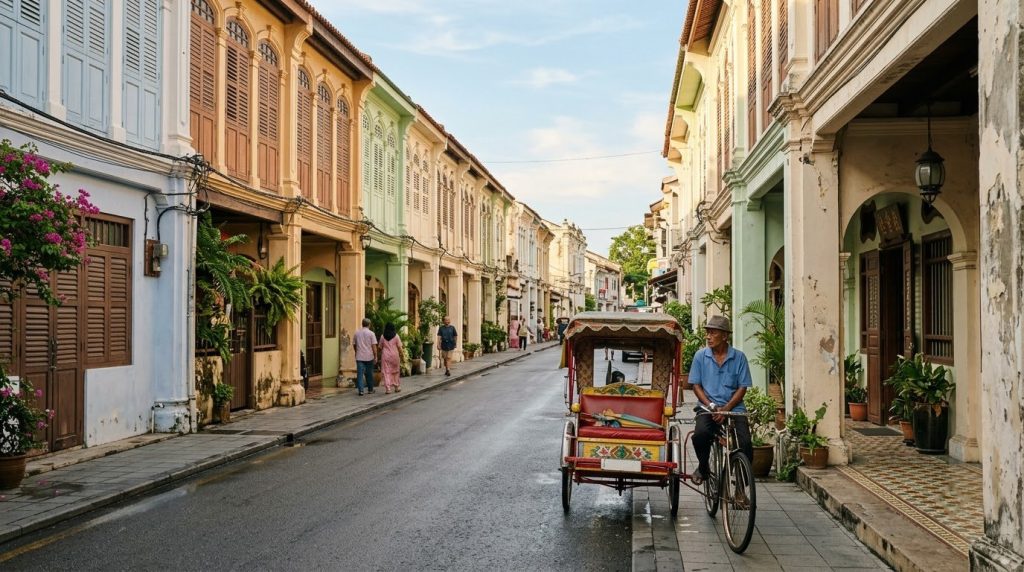
Quick answer: Penang is a compact, food-focused island in northern Malaysia where 3-4 days is enough to cover George Town’s UNESCO heritage streets, the island’s famous hawker food, and Penang Hill. Base yourself in walkable George Town, budget around 150-300 MYR (AUD 44–89 · USD 32–64) a day, and visit between November and April to avoid the wettest months.
Key Takeaways: Penang is Malaysia’s most compelling destination — a UNESCO World Heritage city, Asia’s undisputed street food capital, and a blend of Chinese, Malay, and Indian cultures unlike anywhere else in Southeast Asia. George Town is compact enough to explore on foot in a day but rich enough to reward a week. Budget: 150-300 MYR/day (~AUD 44–89 · USD 32–64).
Best time: November to April. Getting there: fly into Penang International Airport (PEN) or ferry from Butterworth on the mainland. No visa required for most Western passports (up to 90 days). You can compare flights on Aviasales to find the cheapest dates and routes.
Penang receives over 4 million domestic visitors and 3.5 million international visitors annually. George Town’s UNESCO World Heritage listing (2008) covers a 1.58 sq km inner zone with over 5,000 pre-war shophouses — the most intact example of 19th-century Southeast Asian trading port architecture in the region. Malacca shares that UNESCO listing, and whether Malacca is worth the detour depends on timing, since its Jonker Street night market only runs Friday to Sunday.
Penang punches above its size. The island is just 293 sq km — smaller than Singapore — but packs UNESCO heritage streets, the region’s most celebrated street food scene, colonial hilltop retreats, and beach resorts into a compact, easily navigated space. This guide covers everything you need to plan a visit. Stay connected: grab a travel eSIM from Airalo before you go so you have data the moment you land.
Why Visit Penang? — Penang Travel Guide
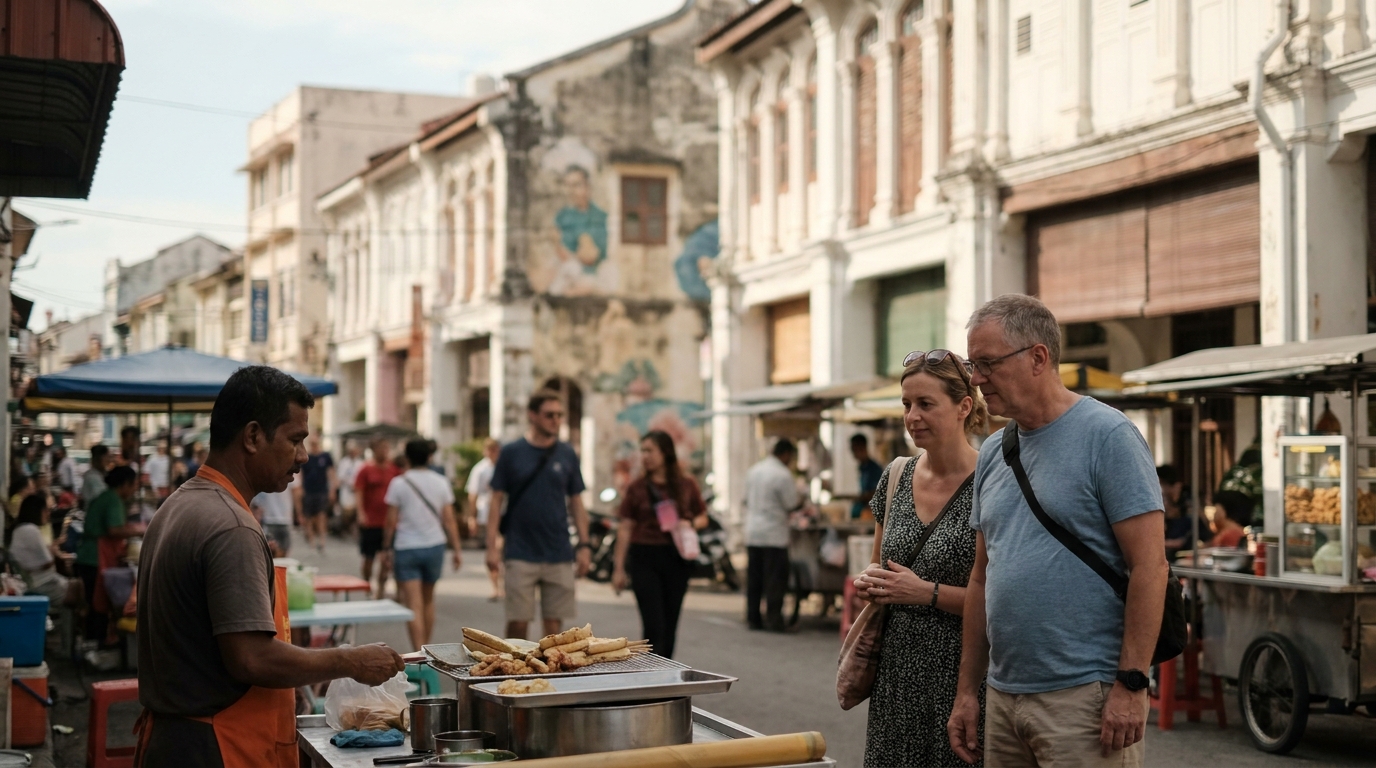
- George Town — A UNESCO World Heritage Site with colonial shophouses, clan temples, and street art that attracts visitors from across Southeast Asia
- Street Food — Char kway teow, assam laksa, nasi kandar, and cendol that food writers consistently rank among Asia’s best
- Multicultural character — Three-way Chinese-Malay-Indian cultural fusion visible in food, architecture, temples, and festivals
- Value — One of Southeast Asia’s best-value destinations; a world-class meal costs under 15 MYR (AUD 4.4 · USD 3.20)
- Accessibility — Direct flights from major Southeast Asian hubs; easy overland connections from Kuala Lumpur and Thailand
Essential Facts
| Capital | George Town (UNESCO World Heritage) |
| Currency | Malaysian Ringgit (MYR); 1 USD ≈ 4.70 MYR |
| Language | Malay (official), Hokkien Chinese, English widely spoken |
| Best time | November-April (drier northeast monsoon season) |
| Avoid | October (wet season peak) |
| Visa | Visa-free 90 days for US, UK, EU, Australia passports |
| Airport | Penang International Airport (PEN), 16km from George Town |
| Time zone | GMT+8 (same as Malaysia, Singapore) |
When to Go
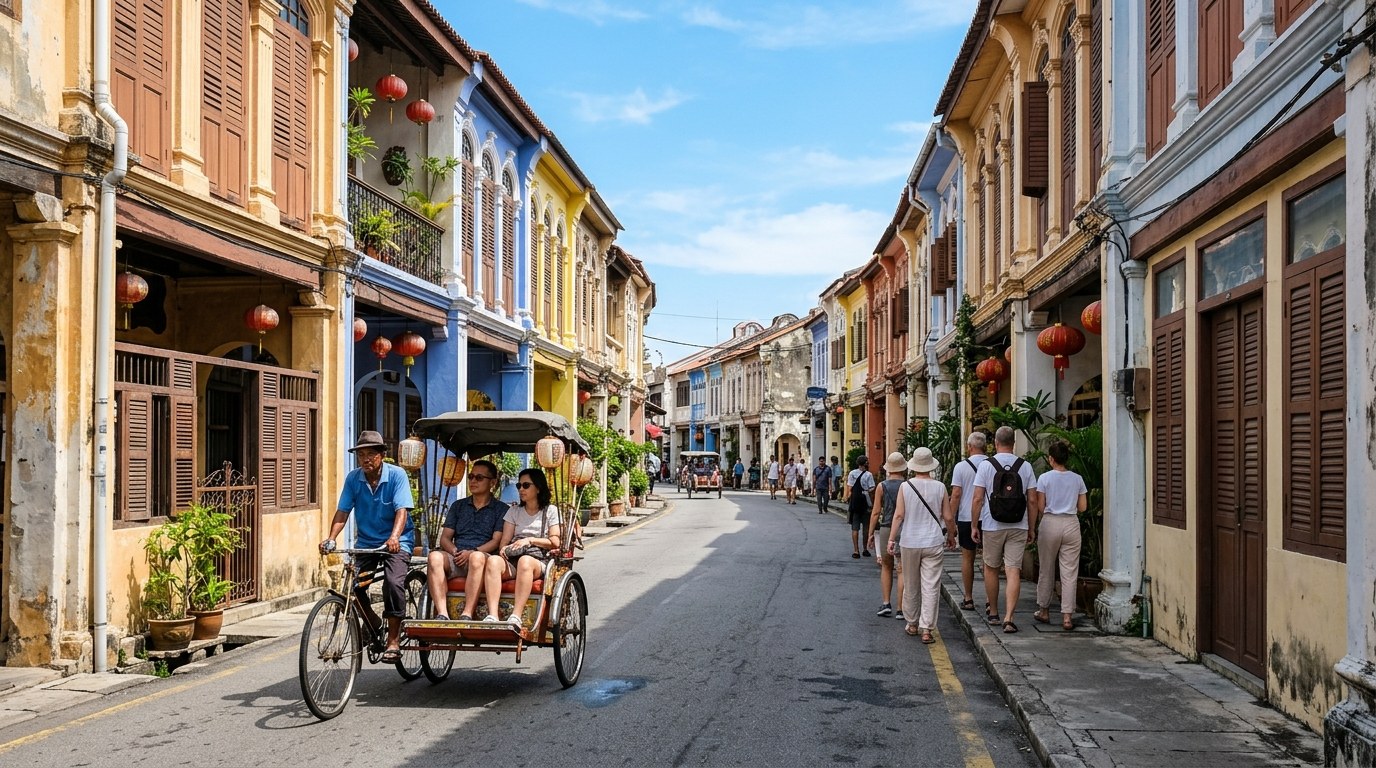
Penang’s best months are November to April. The island sits on the Strait of Malacca side of the Malay Peninsula, which gives it a drier northeast monsoon season while the west coast of the peninsula gets heavier rain.
- December-February: Best weather, lower humidity, occasional brief showers. Chinese New Year (Jan/Feb) brings spectacular festivals but also crowds and higher prices.
- March-May: Warm, generally dry, and cheaper. Excellent time to visit.
- June-September: Hotter and more humid. Still manageable — not a full monsoon season like the Andaman Coast.
- October: Wettest month. Heavy afternoon rains are common but rarely all-day.
See Best Things to Do in Penang and Where to Stay in Penang for seasonal planning.
Getting to Penang
By Air
Penang International Airport (PEN) is served by:
– AirAsia: Direct from Kuala Lumpur (55 min), Bangkok, Singapore, Jakarta, Bali
– Malaysia Airlines: Direct from Kuala Lumpur, Singapore, Taipei
– Firefly: From Kuala Lumpur Subang
– Budget from KL: Fares from ~50-100 MYR one-way on AirAsia
From Bangkok: ~1.5 hour direct flight on AirAsia from Don Mueang. Alternatively, overnight train + ferry (12-14 hours total, very cheap at 800-1,200 THB).
By Train/Bus from KL
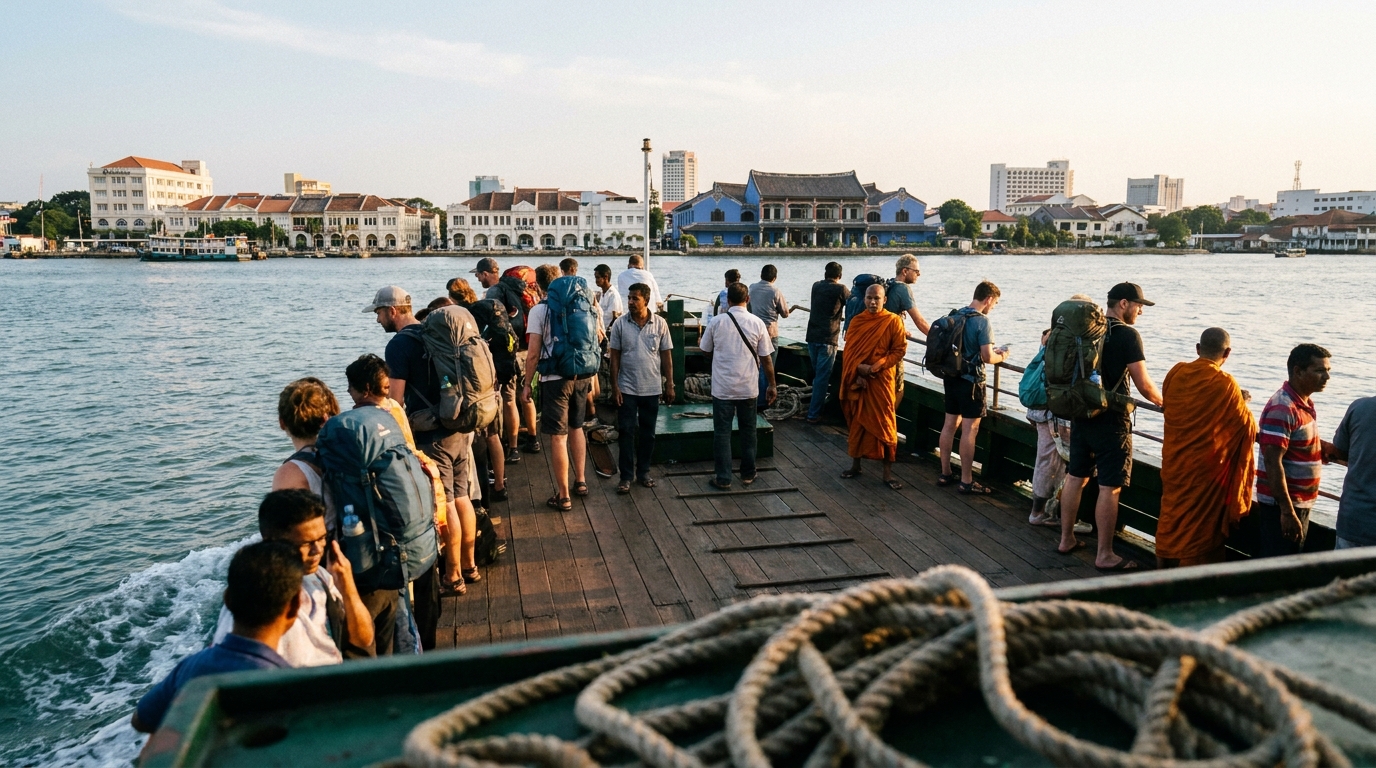
ETS (Electric Train Service) from KL Sentral to Butterworth: ~3.5 hours, from 35-80 MYR. Then a 5-minute ferry from Butterworth to George Town (1.20 MYR / ~AUD 0.36 · USD 0.26). One of the cheapest and most scenic approaches to the island.
Ferry from Butterworth
The Penang Ferry runs 24/7 between Butterworth (mainland) and George Town. 12 minutes crossing, 1.20 MYR for passengers (vehicles extra). Departs every 15-30 minutes.
Getting Around Penang
- Walking: George Town’s UNESCO zone is entirely walkable (1-2 km across)
- Grab: Reliable and cheap — ~8-20 MYR for most inner-city trips
- Bicycle/e-scooter rental: Popular in George Town, ~25-40 MYR/day
- Rental car: Necessary for Penang Hill, Batu Ferringhi, and southern Penang. From ~80 MYR/day
- Bus (Rapid Penang): Inexpensive but slower — ~2 MYR per journey
Top Experiences in Penang
George Town Heritage Walk
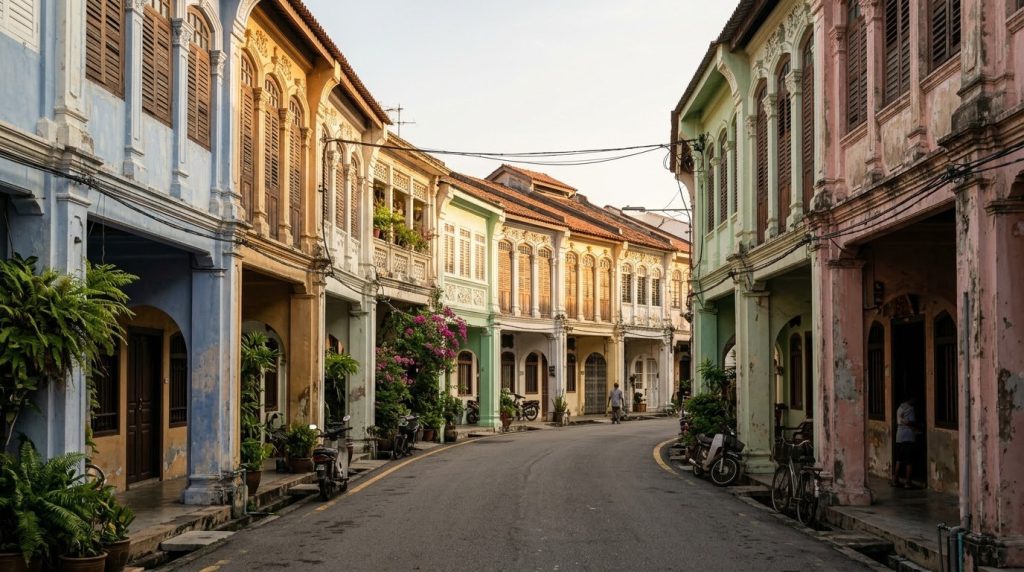
The UNESCO inner zone covers Armenian Street (Lebuh Armenian), Love Lane, and the clan jetties. A self-guided walk through these streets takes 2-3 hours and costs nothing. The famous Penang Street Art pieces (by artists including Ernest Zacharevic) are scattered throughout this area.
Penang Hill (Bukit Bendera)
At 821m, Penang Hill offers sweeping views over George Town and the Strait of Malacca. Take the funicular railway from the base station (2.5 km from the city center). Open daily 6am-11pm; ticket 30 MYR adult return. Cooler temperature (21-23°C vs 32-35°C at sea level).
Kek Lok Si Temple
The largest Buddhist temple in Southeast Asia, built over 30 years starting in 1890. The 30m statue of Kuan Yin is lit up at Chinese New Year. Free to enter the lower temple; 2 MYR cable car to the upper pagoda. Located 6km from George Town in Air Itam.
Batu Ferringhi Beach
Penang’s main beach, 12km from George Town on the north coast. Long stretch of sand, water sports, and beachfront hotels. Best for swimming October-May; Batu Ferringhi Night Market runs nightly.
The Clan Jetties
Seven wooden stilt villages extending over the harbor, each founded by a different Chinese clan. Chew Jetty is the largest and most visited. Still inhabited — walk the boardwalk past family homes, shrines, and cats. Free, 10-15 minutes from George Town.
Penang National Park
Penang National Park sits past Batu Ferringhi at the island’s northwest tip, with its main entrance near the fishing village of Teluk Bahang, the same village that borders the Tropical Spice Garden covered in day-trip guides to this coast.
Declared in April 2003, the park protects roughly 2,563 hectares of forest, beach and sea, and surveys inside its boundaries have recorded 417 flora species and 143 fauna species.
Nine beaches line the park’s coastline, including Teluk Duyung, better known to visitors as Monkey Beach for the long-tailed macaques that forage along its sand.
One of the park’s more unusual features is a seasonal meromictic lake, a type of lake whose layers of water do not mix, leaving the deeper water starved of oxygen and largely lifeless, a phenomenon rare enough to draw researchers as well as hikers.
Reaching the furthest beaches on foot means a multi-hour coastal trail with little shade, so many visitors instead take a boat from near the park entrance out to Monkey Beach and walk only one leg of the route; confirm current boat timings locally rather than assuming a fixed schedule.
Pack more water than feels necessary and start early if walking any part of the trail, since the forest canopy gives shade in sections but the beaches themselves sit fully exposed to the midday sun described in the practical tips above.
George Town heritage sites beyond the murals
The murals pull the crowds, but the old town’s trading-port history is easier to read in its clan houses, mosques and merchant homes. Most sit within a few streets of each other, so one slow morning covers several.
- Khoo Kongsi. A clan temple and association hall on Cannon Square, built in 1906. Visitor guides disagree on admission, so check the fee at the gate or with the site before you queue.
- Kapitan Keling Mosque. Built in 1801 by Penang’s early Indian Muslim settlers on Jalan Masjid Kapitan Keling. Dress modestly, with shoulders and knees covered, and respect prayer times.
- Cheong Fatt Tze (the Blue Mansion). A 38-room 19th-century Chinese merchant’s home, now a heritage hotel and a venue for guided visits. Its own website lists tour times.
- Pinang Peranakan Mansion. A museum-style house showing the Straits Chinese (Peranakan) way of life. Tickets are sold on its official site.
- Fort Cornwallis. Some visitors rate the fort as a modest stop, best fitted in while walking between the waterfront and the old town rather than as a destination of its own.
Start early. Midday heat in George Town is fierce, and the indoor sites are far more pleasant before lunch. Fees and opening hours change, so confirm them on each site’s own channel.
Street Art in George Town
The George Town Heritage Walk section above already mentions Ernest Zacharevic’s street art without much detail; his work is the reason George Town’s murals became a destination in their own right rather than a side note to the heritage buildings.
Zacharevic painted a series of six murals for the George Town Festival in 2012, and two of them, “Children on Bicycle” and “Boy on Motorcycle,” became the most photographed pieces in the whole UNESCO zone, each now marked with its own plaque.
“Boy on Motorcycle” mixes a painted wall with a real motorcycle built into the scene, a combination of installation and painting that lets visitors sit on the bike for a photo rather than just stand in front of a flat mural.
The series brought Zacharevic international attention, and the BBC later called him “Malaysia’s answer to Banksy,” a line that stuck and is still repeated in most coverage of George Town’s street art scene today.
Expect a queue at the two most famous murals during the day, especially on weekends; visiting the Armenian Street cluster right at opening time, before the heritage walk described earlier gets busy, is the simplest way around the wait.
Balik Pulau: Rice Paddies and Durian Orchards
Balik Pulau sits about 12.7 kilometres southwest of George Town’s city centre, on the quieter, rural side of the island; the name itself translates from Malay as “the back of the island.”
This is where Penang’s best-known produce actually grows: nutmeg, cloves and durian orchards cover much of the surrounding countryside, and the area is said to hold the last remaining rice paddy fields anywhere in George Town’s municipal boundaries.
Durian season draws day-trippers out from George Town specifically for orchard visits and roadside stalls, a different kind of food trip from the hawker-centre crawl covered earlier in this guide, built around one fruit rather than a whole cuisine.
Six Rapid Penang bus routes, numbered 401, 401E, 403, 404, 501 and 502, connect Balik Pulau to the city centre, Penang International Airport, Queensbay Mall and Bayan Baru, so the area is reachable without a rental car, even if a car makes stopping at individual farms easier.
Balik Pulau pairs naturally with a half-day loop rather than a dedicated full day: the rural roads, paddy views and orchard stalls make for a scenic drive back toward George Town or onward to Penang National Park on the island’s northwest side.
A stop at a roadside durian stall here is a different experience from the hawker-centre meals covered earlier in this guide: sellers typically let buyers taste a variety before committing, and prices move with the day’s harvest rather than sitting on a fixed menu.
What to eat in Penang and where to find it
Eating is the organising principle of most Penang days. The dishes below cover the core of the local repertoire, and the neighbourhoods named are where visitor guides most often point.
Noodles and soups
- Asam laksa. A tangy tamarind fish noodle soup. A well-known stall in Air Itam operates on weekends only, and Lebuh Keng Kwee is another recommended address.
- Lemak laksa. The richer, coconut-based cousin, found around the Pulau Tikus market.
- Char koay teow. Smoky stir-fried flat noodles, also found at Pulau Tikus market.
- Curry mee. A spicy noodle soup, with one popular stall near the Penang Hill base.
Rice, snacks and sweets
- Nasi kandar. Rice with a choice of curries, with Line Clear a frequent suggestion.
- Rojak. A sweet-sour fruit and fritter salad, popular at the Gurney Drive hawker centre.
- Chendol and ice kachang. Shaved-ice desserts; the shops on Keng Kwee Street are well regarded, and a cafe at the top of Penang Hill serves ice kachang with the view.
- Apom manis. Thin, sweet pancakes with peanuts, sold at Pulau Tikus market.
After dark
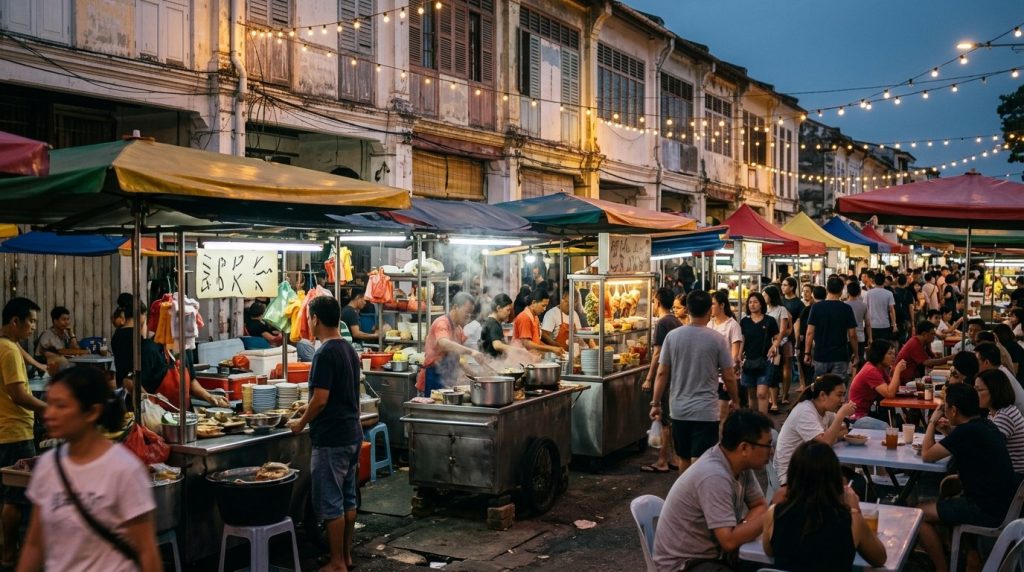
Chulia Street’s night market and the Batu Ferringhi night market (known for grilled fish, ikan bakar) suit a later dinner. Seafood and prawn fritters are also sold around the clan jetties.
Go hungry, share plates, and order small portions at several stalls instead of a large meal at one. Carry cash, since most stalls do not take cards.
Day trips by public bus
You do not need a rental car for most of Penang’s out-of-centre sights. Rapid Penang buses cover them, and the fares are low. Route numbers and timings can change, so check at the Komtar terminal or in a transit app.
- Penang Hill and Kek Lok Si. Bus 204 (or 203) from Komtar runs to the Air Itam area, about 45 minutes. The funicular is listed at RM30 return (AUD 9 · USD 6.40), and the temple entry at RM2.
- Balik Pulau. Bus 502 takes about an hour and costs about RM5 (AUD 1.50 · USD 1.06). Bus 401E takes closer to 90 minutes for about RM4 (AUD 1.20 · USD 0.85).
- Snake Temple. Bus 102, 401 or 401E.
- Batu Ferringhi and Teluk Bahang. Buses 101 and 102 pass the butterfly park, spice garden and the beaches. Some routes also reach Penang National Park.
- Botanical Gardens and Waterfall Hill Temple. No direct bus, so use a ride-hailing app.
Free shuttle buses also circle central George Town and are useful for hopping between sights without a fare. Daily transport within the city rarely tops about RM10 (AUD 3 · USD 2.10) by ride-hailing, according to one visitor guide.
4-Day Penang Itinerary (Summary)
See the detailed Penang Itinerary for the full day-by-day plan.
| Day | Theme | Highlights |
|---|---|---|
| 1 | George Town Heritage | UNESCO streets, street art, clan jetties, hawker dinner |
| 2 | Temples & Hill | Kek Lok Si, Penang Hill, Batu Ferringhi sunset |
| 3 | Food Deep Dive | Morning hawker breakfast, Gurney Drive, Penang food tour |
| 4 | Day Trip or Departure | Kek Lok Si morning / Escape theme park / depart |
Penang Travel Budget
| Category | Budget | Mid-Range |
|---|---|---|
| Accommodation (per night) | 60-150 MYR | 200-400 MYR |
| Food (per day) | 40-80 MYR | 80-200 MYR |
| Transport (per day) | 20-40 MYR | 40-100 MYR |
| Activities | 0-30 MYR | 50-150 MYR |
| Daily total | ~150-300 MYR | ~370-850 MYR |
| USD equiv. | ~AUD 44–89 · USD 32–64 | ~AUD 110–251 · USD 79–181 |
Penang is one of Southeast Asia’s best value destinations for food specifically. George Town’s hawker stalls serve dishes at 5-10 MYR (AUD 1.39–2.78 · USD 1–2) that would cost 30-50 MYR in a sit-down restaurant in Kuala Lumpur. A full day of eating — breakfast, two lunches, dinner, and a dessert — costs under 60 MYR (AUD 18 · USD 13) if you eat exclusively at hawker centers and food courts. Daily budgets by travel style are broken down in our Penang travel cost guide.
Find your Penang hotel on the map
Live prices from Booking & Airbnb — tap a pin to compare stays around George Town and beyond.
Where to Stay
George Town is the best base for first-time visitors. The UNESCO heritage area, food hawker centers, and most cultural sights are all walkable.
- Budget: Heritage guesthouses in George Town from 60-100 MYR/night
- Mid-range: Boutique hotels in restored shophouses, 200-350 MYR/night
- Luxury: Eastern & Oriental Hotel (historic landmark), Shangri-La Rasa Sayang (Batu Ferringhi), from 600-1,200+ MYR/night
See Where to Stay in Penang for specific hotel recommendations by area.
Browse Penang hotels on Booking.com
Which area of Penang should you stay in?
George Town suits most first-timers, but four areas are worth comparing, and each trades something away.
George Town
Walkable, dense with food, street art and heritage sites, and close to the free shuttle buses. The trade-off is heat and traffic noise, and the sea is not on your doorstep.
Batu Ferringhi
The resort strip on the north coast, with beach-front hotels, a night market and seafood at sunset. One writer describes the beach as busy, eroded and prone to jellyfish at times, so check conditions rather than expecting a postcard stretch.
Hotel rates listed by one guide ranged from about AUD 31 · USD 22 for a homestay-style villa to over AUD 308 · USD 220 for a four-bedroom holiday home (rates converted at 1 USD = 1.388 AUD), with resort rooms in between.
Gurney Drive
An upscale seafront district beside a well-known hawker centre and several malls. It suits travellers who want comfort and food within a short walk, rather than heritage streets.
Tanjung Bungah
Quiet, comparatively expensive and light on nightlife. It works for a work-and-rest trip, less so for a food-and-culture one.
Whichever area you pick, check whether the hotel has a shuttle or a nearby bus stop, because evenings in George Town are hard to leave once dinner is booked.
Practical Tips
- Mobile data: Celcom, Maxis, or Digi tourist SIM from airport (~25-50 MYR for 7-30 days)
- Cash: George Town’s hawker stalls are cash-only. Get MYR from airport ATMs (better rates than currency counters)
- Dress: Temples require covered shoulders and knees. Carry a light scarf.
- Heat: Penang’s humidity is high year-round. Mornings are best for walking; afternoons after 2pm are intense.
- Tipping: Not customary at hawker stalls; optional at sit-down restaurants (5-10%)
Frequently Asked Questions
How many days do you need in Penang?
3-4 days covers George Town, Penang Hill, Kek Lok Si, and the beaches. 2 days is the minimum for a meaningful visit. A week is comfortable for those who want to explore beyond the tourist trail.
Is Penang worth visiting?
Yes — Penang is widely regarded as one of the top food and heritage destinations in Southeast Asia. George Town’s street food scene alone justifies a visit.
Is Penang safe for tourists?
Yes. Penang is one of Malaysia’s safest states. Petty crime exists in tourist areas — keep valuables secure and use Grab instead of unlicensed taxis at night.
Do I need a visa for Penang/Malaysia?
US, UK, EU, and Australian passport holders get 90 days visa-free on arrival. Check your specific nationality at the Malaysian Immigration Department website.
We only recommend services we’ve researched and trust.
Sources:
1. Penang Global Tourism — annual visitor statistics and heritage zone data, 2025, 2025
2. UNESCO World Heritage — George Town, Penang listing and management plan, 2024
3. Tourism Malaysia — Penang state tourism statistics and travel information, 2025
More Penang Guides
- Best Day Trips from Penang 2026: 8 Top Excursions Worth Taking
- Best Penang Hotels 2026: Top Picks for Every Budget
- How to Get to Penang 2026: All Transport Options Compared
- Penang on a Budget 2026: Complete Guide to Cheap Travel
- Best Time to Visit Penang 2026: Month-by-Month Weather Guide
- Best Food in Penang 2026: 15 Must-Try Dishes & Where to Eat