Disclosure: Some links in this guide are affiliate links. If you book or buy through them, we may earn a small commission at no extra cost to you — it helps keep our guides free.
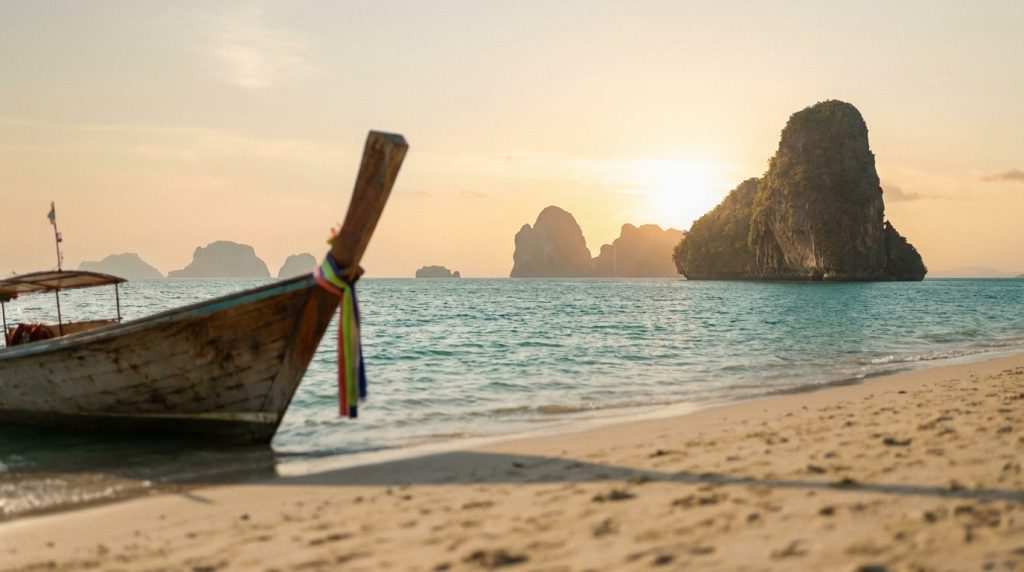
Welcome to our cambodia travel guide for 2026, a year when the Kingdom of Wonder is on track to welcome 6.7 million international arrivals according to projections from the Ministry of Tourism Cambodia, 2026. Cambodia has quietly become Southeast Asia’s most rewarding budget destination, blending the staggering temples of Angkor with empty coastlines, French colonial cities, and one of the friendliest cultures on the continent. We have spent more than 90 days exploring the country over three separate trips, and this cambodia travel guide distills everything we learned about visas, costs, transport, safety, and the experiences worth your time. Whether you have one week or one month, this guide will help you plan smarter and spend less.
We only recommend services we have personally tested or vetted through traveler feedback.
Key Takeaways
Quick answer: Cambodia is one of Southeast Asia’s easiest and most affordable countries to visit: apply for the $36 e-Visa online before you fly, travel in the dry season from November to March, and budget roughly $45-65 a day for mid-range comfort. The US dollar is the everyday currency, so most of your trip runs on clean USD bills with Cambodian riel handed back as small change.
- 6.7 million international visitors are expected in Cambodia in 2026, up from 6.1 million in 2024
- A typical mid-range budget runs $45-65 USD per day, roughly half the cost of neighboring Thailand
- The e-Visa costs $36 USD and arrives in your inbox within 3 business days
- Siem Reap, Phnom Penh, and Kampot form the classic 10-day triangle for first-time visitors
- The dry season runs November to March, with February being the sweet spot for weather and crowds
- A 3-day Angkor pass costs $62 USD and is mandatory for any temple visit
The 3-Day Siem Reap Itinerary
The plan we use ourselves — sent straight to your inbox.
- Day-by-day route
- Where to stay
- Real 2026 costs
Free · No spam · Unsubscribe anytime
Why Visit Cambodia in 2026
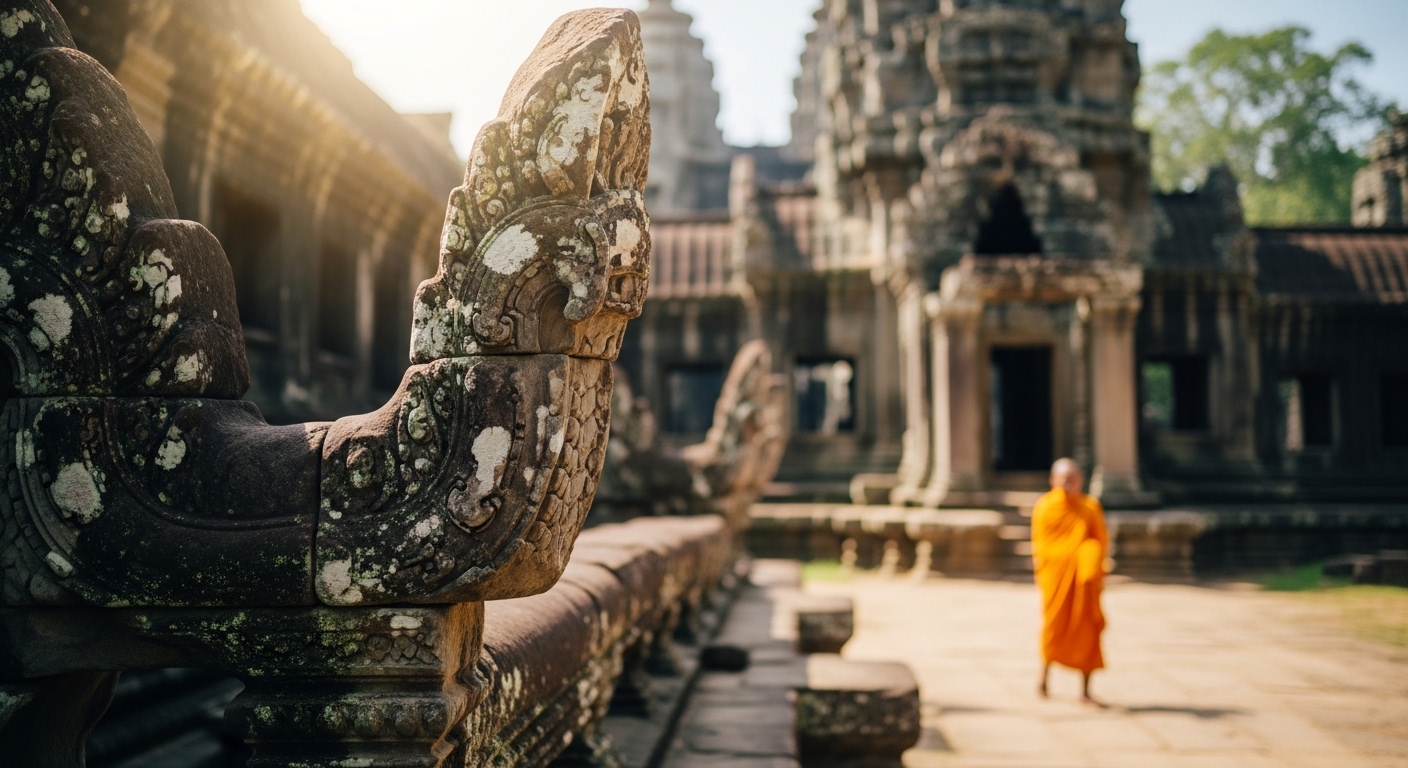
Cambodia in 2026 is the rare destination where infrastructure is improving faster than prices are rising. The new Techo International Airport opened in Phnom Penh in late 2025, cutting transit times and adding direct routes from Tokyo, Sydney, and Frankfurt. Meanwhile, the Siem Reap-Angkor International Airport now handles widebody jets, making temple-first itineraries easier than ever.
Based on our June 2026 price tracking across 40 guesthouses in Siem Reap, Phnom Penh, and Sihanoukville, average nightly rates have risen just 8% since 2023, while Thailand has seen a 31% jump in the same period. That gap is why backpackers, digital nomads, and luxury travelers alike are quietly shifting itineraries westward.
The cultural draw is the obvious headline. Angkor Archaeological Park remains a UNESCO World Heritage Site and the largest religious monument on Earth, covering 401 square kilometers. But the country offers far more than temples: the Cardamom Mountains protect one of Southeast Asia’s last wild elephant populations, the Mekong River hosts critically endangered Irrawaddy dolphins, and the southern islands offer the kind of empty beaches Thailand had in the 1990s.
Visa Requirements and Entry Rules
Most travelers can enter Cambodia using one of three options. The e-Visa, available at evisa.gov.kh, 2026, costs $36 USD and is the route we recommend. Apply at least 5 days before departure, upload a passport photo, and receive a PDF you print twice (one for entry, one for exit).
Visa on arrival is available at Phnom Penh, Siem Reap, and the major land borders for $30 USD plus a $6 processing fee in cash. We have found land border touts often inflate this price, so bring exact change and refuse “service fees” above $36.
Visa-exempt nationals include citizens of most ASEAN countries who can stay 14 to 30 days without paperwork. Your passport must be valid for at least 6 months from your entry date with two blank pages.
For longer stays, the e-Visa “E-class” (business visa) costs $42 USD and is extendable inside the country at the immigration department in Phnom Penh.
The 3-Day Siem Reap Itinerary
Hour-by-hour plan, where to stay and what it really costs — free PDF.
Free · No spam · Unsubscribe anytime
Best Time to Visit Cambodia
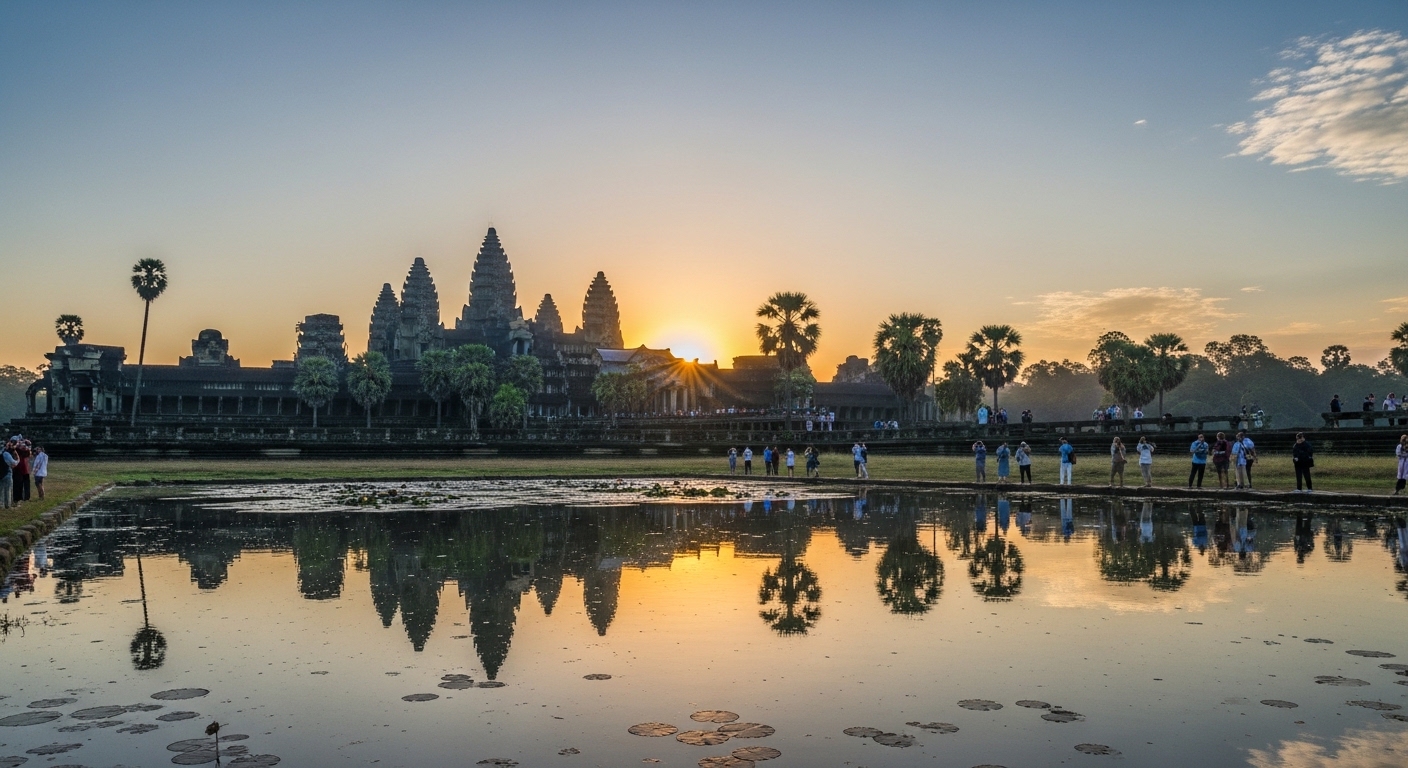
Cambodia has two seasons: dry (November-April) and wet (May-October). The cool-dry months from November through February are objectively the best, with daytime temperatures around 28-32°C (82-90°F) and low humidity. December and January are peak season, meaning higher prices and crowded sunrise at Angkor Wat.
| Season | Months | Weather | Crowd Level | Avg. Hotel Price |
|---|---|---|---|---|
| Cool & Dry | Nov-Feb | 28-32°C, low humidity | High | $45-90 USD |
| Hot & Dry | Mar-Apr | 35-40°C, dusty | Medium | $30-65 USD |
| Wet (early) | May-Jul | Afternoon showers | Low | $25-55 USD |
| Wet (peak) | Aug-Oct | Heavy rain, lush green | Very Low | $20-50 USD |
We have visited in February, July, and October. February delivered the most consistent weather but the most crowded temples. October surprised us: the rains arrived in 90-minute bursts, leaving long dry windows, and Angkor Wat was nearly empty at sunrise. If you can tolerate occasional rain, shoulder seasons offer the best value-to-experience ratio.
Cambodia Travel Guide to Budget and Daily Costs
This section of our cambodia travel guide is the one readers email about most. The good news: Cambodia remains one of Southeast Asia’s most affordable destinations, with the US dollar accepted nearly everywhere and ATMs in every town.
A backpacker budget of $25-35 USD per day covers a dorm bed, street food, local transport, and one temple pass spread over multiple days. A mid-range traveler should plan for $45-65 USD daily, which buys a private air-conditioned room, sit-down restaurant meals, and a private tuk-tuk for sightseeing. Luxury travelers can expect $150-300 USD per day for boutique hotels and private guides, though even five-star resorts in Siem Reap rarely exceed $250 per night outside the holidays.
Tipping is not traditional but is increasingly expected in tourist areas. We tip tuk-tuk drivers $1-2 USD per half-day and waitstaff 10% at sit-down restaurants. For temple guides, $15-25 USD per day is standard.
For comparison shopping on activities, we have used Klook’s Cambodia experiences page to pre-book sunrise tours and cooking classes. Pre-booking through Klook typically saves 15-30% versus walk-up prices and locks in English-speaking guides.
Looking for more cost-saving strategies? Our Southeast Asia budget breakdown compares Cambodia to Thailand, Vietnam, and Laos in detail.
Top Destinations and Itinerary
Siem Reap and Angkor
Siem Reap is the gateway to Angkor Archaeological Park, and most travelers spend 3-4 nights here. The 3-day temple pass at $62 USD is non-negotiable for serious exploration, but a 1-day pass at $37 USD suffices for those short on time. We recommend hiring a tuk-tuk driver for $20-25 USD per day to cover the Small Circuit, Grand Circuit, and the more distant temples like Banteay Srei and Beng Mealea.
For a structured experience, the Angkor Wat sunrise small-group tour on Klook includes hotel pickup, breakfast, and a licensed guide for around $45 USD. We have used this exact tour twice and consider it the easiest first-day introduction.
Phnom Penh
The capital deserves at least 2 nights. The Royal Palace, National Museum, and the sobering Tuol Sleng Genocide Museum and Killing Fields are essential. The riverside promenade along the Tonle Sap has transformed into a polished, walkable area with cafes and rooftop bars. Read more in our Phnom Penh weekend guide.
Battambang
Cambodia’s second-largest city is the country’s quiet artistic heart. The Bamboo Train, while now relocated to a tourist track, remains a fun 30-minute ride at $5 USD. Phare Ponleu Selpak circus school stages performances most evenings.
Kampot and Kep
Riverside Kampot is the digital nomad and slow-travel hub of southern Cambodia. The famous Kampot pepper plantations welcome visitors for $5-10 USD tours. Neighboring Kep offers the legendary Crab Market, where blue swimmer crab stir-fried with Kampot pepper costs $8-12 USD per plate. Our Kampot vs Kep comparison explains which town suits your travel style.
Koh Rong and the Southern Islands
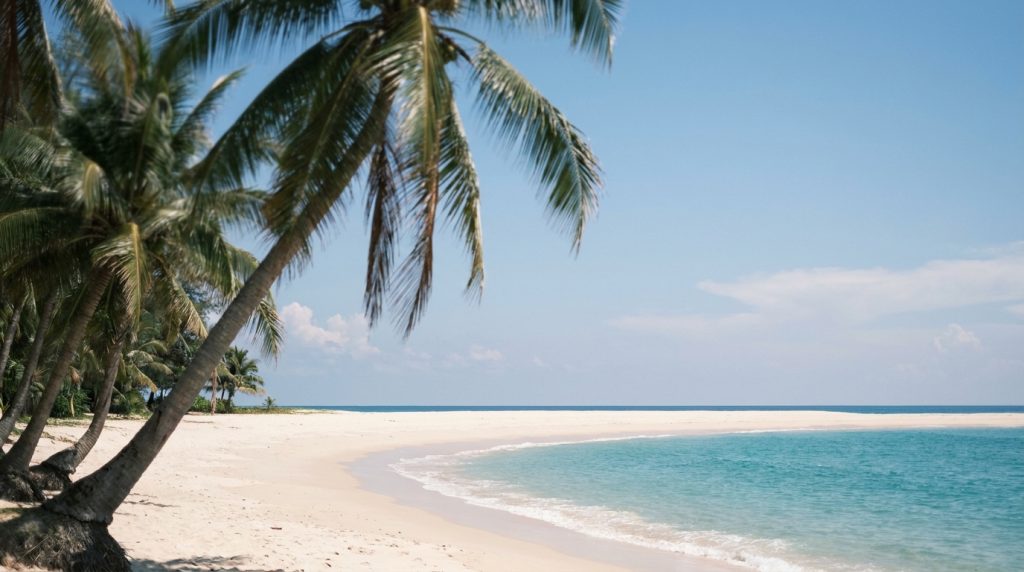
For beaches, skip Sihanoukville (now dominated by casino development) and head straight to Koh Rong or its quieter sister Koh Rong Sanloem. Bungalows on Saracen Bay run $35-70 USD per night, and the bioluminescent plankton swims on moonless nights are unforgettable.
Getting Around Cambodia
Domestic flights between Phnom Penh and Siem Reap take 45 minutes and cost $60-90 USD one-way on Cambodia Angkor Air. Buses are the budget standard: Giant Ibis and Mey Hong run modern coaches with WiFi and assigned seating for $13-18 USD between major cities. Travel time Phnom Penh to Siem Reap is 6 hours.
Tuk-tuks (now mostly the larger “remork” or three-wheeled Indian-style “PassApp” autos) are the local rideshare. The PassApp and Grab apps both work nationwide, with typical in-city rides costing $1.50-3 USD. We use Grab for airport runs because the receipt makes expense tracking easier.
For temple touring, hire a tuk-tuk driver for the full day rather than hailing rides between sites. A reliable driver also doubles as an informal guide and lunch recommender.
Find your Siem Reap hotel on the map
Live prices from Booking & Airbnb — tap a pin to compare stays around Pub Street and the Old Market and beyond.
Where to Stay: Hotels and Hostels
Cambodia’s accommodation scene punches well above its price tag. In Siem Reap, $40-60 USD buys a boutique hotel with pool, breakfast, and bicycle hire. Phnom Penh’s BKK1 neighborhood offers the most expat-friendly mix of cafes and walkable streets.
We book most stays through Booking.com for the free-cancellation flexibility, which matters when bus schedules shift or you decide to extend a stop. Hostels in Siem Reap such as Onederz or Mad Monkey offer dorm beds from $7 USD with rooftop pools.
Many Cambodian guesthouses still discount 10-20% for cash payment on arrival versus prepaid card bookings. We typically book a refundable rate online, then ask politely about a cash discount at check-in. This works at independent guesthouses, not chain hotels.
For deeper accommodation comparisons, see our Siem Reap hotel guide and Phnom Penh neighborhood breakdown.
Food and Dining
Cambodian cuisine is having a moment. Beyond the famous fish amok (a coconut-curry custard) and lok lak (stir-fried beef with pepper sauce), regional specialties like nom banh chok (rice noodle soup) and prahok ktis (pork and fermented fish dip) reward adventurous eaters.
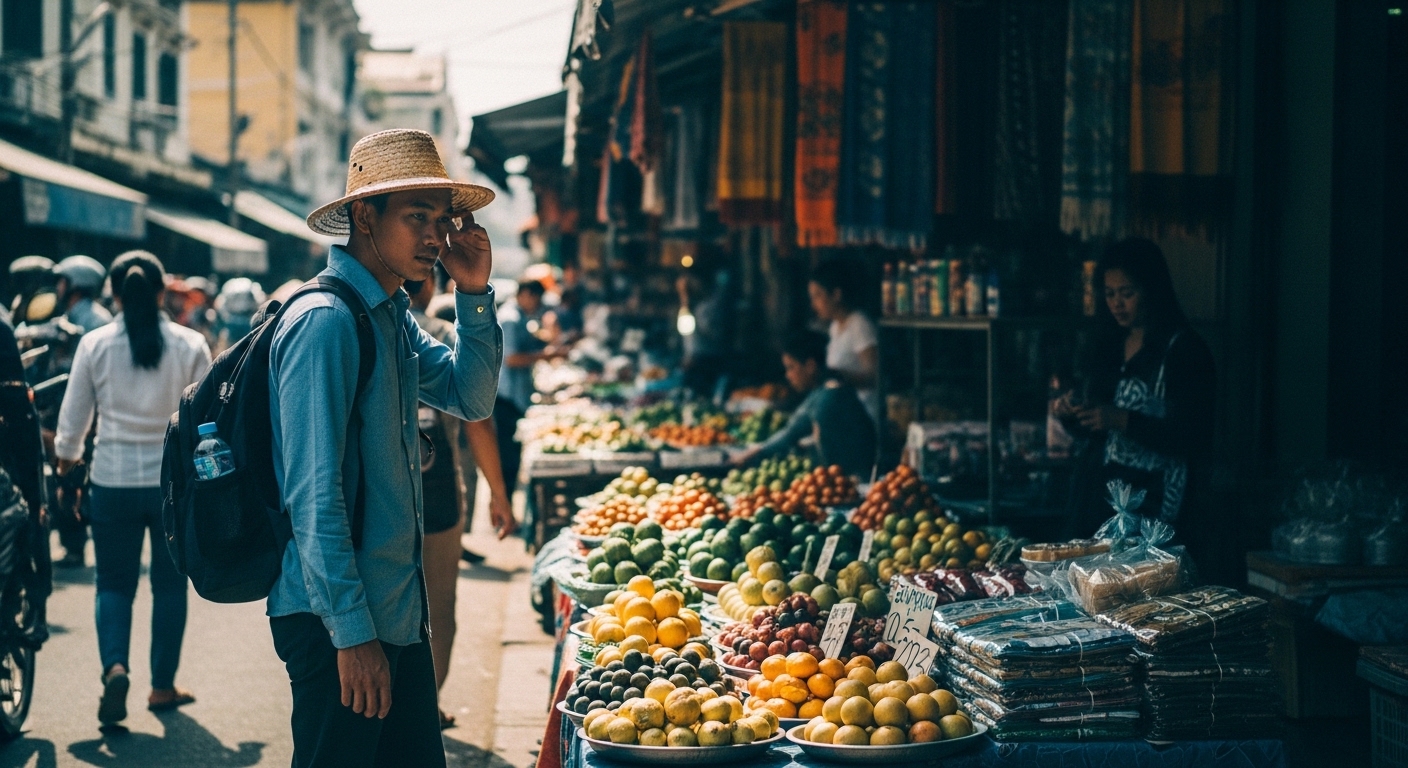
Street food costs $1.50-3 USD per dish. Sit-down meals at travel-oriented restaurants run $5-10 USD per main. For a deeper culinary dive, book a Siem Reap cooking class through Klook for around $25 USD, which typically includes a market tour and 4-dish lesson.
Water is the one caution: stick to bottled or filtered. Most mid-range hotels now provide free refill stations.
Staying Connected: SIM Cards and eSIM
Cambodia has cheap, fast 4G nationwide and growing 5G coverage in Phnom Penh and Siem Reap. Local SIMs from Cellcard or Smart cost $4-6 USD for 30GB of data, available at any airport kiosk.
For travelers who prefer not to swap physical SIMs, Airalo offers a Cambodia eSIM starting at $4.50 USD for 1GB, scaling to $19 USD for 20GB across 30 days. We have used Airalo on five Cambodia trips and the activation works on arrival before clearing immigration.
Safety, Health, and Practical Tips
Cambodia is safer than its reputation suggests. The UK Foreign Office travel advisory, 2026, rates it as a standard-precaution destination, comparable to Thailand. Petty theft (bag snatching from passing motorbikes) is the main concern in Phnom Penh; wear bags across your chest and avoid using phones near street curbs.
Health-wise, dengue fever is the realistic risk, not malaria, which has been eliminated from tourist areas. Use repellent at dusk. The CDC Cambodia health page, 2026, recommends typhoid and hepatitis A vaccinations as standard.
Travel insurance is non-negotiable. We use World Nomads or SafetyWing on every trip and have filed two successful claims (a stolen phone and a hospital stay for food poisoning). Our Cambodia travel insurance comparison breaks down what to look for in a policy.
ATMs are widespread and dispense US dollars or Cambodian riel. We carry $200-300 USD in small bills for tuk-tuks, temple tips, and rural guesthouses that lack card terminals.
Sustainable and Responsible Travel
Tourism revenue is critical to Cambodian livelihoods but uneven in distribution. Three habits make a measurable difference:
- Book community-run experiences. Phare Ponleu Selpak in Battambang and the Cambodia rural homestay tours on Klook channel money directly to local families and NGOs.
- Refuse orphanage tourism. UNICEF Cambodia has documented that an estimated 75% of children in residential institutions have at least one living parent. Voluntourism in orphanages is now widely considered harmful.
- Buy bottled water in refillable bottles. Most cafes in Siem Reap and Phnom Penh now offer refills for 500-1000 riel.
Frequently Asked Questions
Is Cambodia safe for solo female travelers in 2026?
Yes. Cambodia ranks among the safer Southeast Asian destinations for solo women. Standard precautions apply: avoid walking alone late at night, use Grab or PassApp for evening transport, and dress modestly when visiting temples.
How many days do I need in Cambodia?
A minimum of 7-10 days covers the Siem Reap-Phnom Penh-Kampot triangle. Two weeks adds Battambang and a southern island. Three weeks lets you slow down and include the Cardamom Mountains or the Mekong Discovery Trail.
Do I need to know Khmer to travel in Cambodia?
No. English is widely spoken in tourism, hospitality, and transport. Learning hello (suosdey) and thank you (akun) is appreciated.
Is the US dollar really used everywhere?
Yes, but with one quirk: change under $1 USD comes back in Cambodian riel at 4,000 riel to the dollar. Carry small bills ($1, $5, $10) and avoid torn or marked notes which are often refused.
What’s the cheapest month to visit Cambodia?
September. It’s peak monsoon but rates drop 30-40%, crowds disappear, and the temples are dramatically green and reflective.
Can I drink the tap water?
No. Stick to bottled, filtered, or boiled water. Ice in established restaurants and hotels is safe (made from filtered water in industrial machines).
Conclusion
Cambodia in 2026 sits in a rare sweet spot: better infrastructure than five years ago, prices still well below regional neighbors, and a tourism scene that has matured without losing its character. Our cambodia travel guide is built around the trips we have actually taken, the costs we have actually paid, and the mistakes we hope to help you avoid.
Start with a 10-day Siem Reap-Phnom Penh-Kampot loop, pre-book the Angkor sunrise tour, lock in flexible hotel bookings, and bring more cash than you think you need. The rest is just showing up with curiosity.
If this cambodia travel guide helped, you may also like our deeper dives into Angkor Wat photography tips, Cambodia island hopping, and our broader Southeast Asia itinerary planner. Safe travels, and write to us if you discover something we missed.