Disclosure: Some links in this guide are affiliate links. If you book or buy through them, we may earn a small commission at no extra cost to you — it helps keep our guides free.
Halong Bay Cruise Guide 2026: Day vs 2-Day vs 3-Day
A Halong Bay cruise in 2026 costs roughly $23-120 per person for a day boat, $105-450 for a standard 2-day/1-night trip, and $220-700+ for 3-day/2-night sailings, with the biggest price jumps coming from cabin class and which bay you sail.
Halong Bay proper draws 8,000-10,000 visitors and 200-250 tour boats on a busy day, while the quieter Lan Ha and Bai Tu Long bays share the same karst scenery with a fraction of the traffic (Jungle Boss Tours, 2026). That single choice — bay and route — shapes your trip as much as star rating does.
This guide breaks down the three durations side by side, the four price tiers you will actually be quoted, the differences between the Halong, Lan Ha and Bai Tu Long routes, and exactly what a cruise fare does and does not cover.
If you are still deciding whether to sail at all, start with our Halong Bay travel guide for the wider picture, then come back here to lock in the cruise.
Key Takeaways
- Day cruises run $23-70 budget and $90-120 for luxury 8-hour boats — good for a taste, but you miss sunrise, the best caves, and the quiet evening hours.
- The 2-day/1-night trip is the sweet spot: 3-star from $105-160, 4-star $145-250, 5-star $250-450 per person, transfers usually included.
- 3-day/2-night sailings ($220-700+) reach the remote karst and add a second morning of kayaking, but eat two nights of your itinerary.
- Lan Ha Bay has 3-5m water visibility versus Halong’s 1-2m, roughly 80-100 boats daily against Halong’s 200-250, and pollution levels about 70% lower (Jungle Boss Tours, 2026).
- Budget an extra 15-30% on top of the fare for drinks, tips ($3-5/person/day), and optional kayaking or spa.
We have sailed Halong three times since 2019 — once on a $110 budget junk out of Tuan Chau, once on a mid-range 4-star, and last on a Lan Ha route from the Hai Phong side. The Lan Ha morning was the one we still talk about: we kayaked into a hidden lagoon with maybe two other boats in sight, while the classic Halong route had felt like a floating car park at the cave jetties.
How much does a Halong Bay cruise cost in 2026?
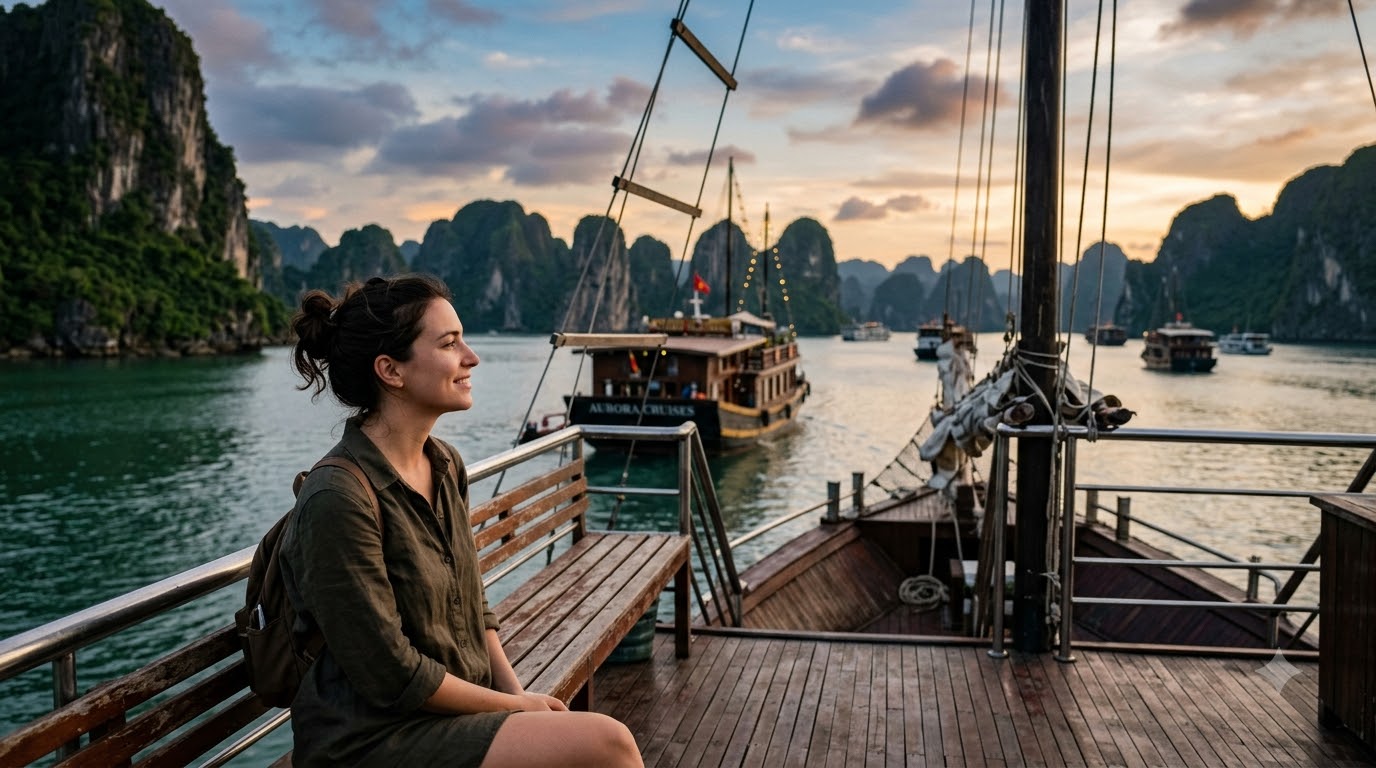
A Halong Bay cruise splits into four price tiers, and knowing them up front stops operators from anchoring your expectations to a photo of a suite you will never book. On our last booking round in early 2026, quotes for the same 2-day route swung by more than $300 per person purely on cabin class and cruise brand. The numbers below reflect published 2026 rates from Vietnamese operators and cruise aggregators.
- Budget / 3-star ($105-160 for 2D1N): shared-style service, plated set meals, one kayaking session, older or refitted wooden junks.
- Mid-range / 4-star ($145-250 for 2D1N): multi-course meals, en-suite cabins with balconies, kayak plus Tai Chi, a proper sundeck bar.
- Luxury / 5-star ($250-450 for 2D1N): fine-dining tasting menus, larger cabins, jacuzzis on premium ships, smaller guest counts.
- Ultra-luxury / 6-star ($450-980+ for 2D1N): boutique vessels, private balconies, spa, and near-personal service ratios.
| Cruise duration | Budget (per person) | Mid-range (per person) | Luxury (per person) |
|---|---|---|---|
| Day cruise (6-8 hrs) | $23-70 | $75-90 | $90-120 |
| 2-day / 1-night | $105-160 | $145-250 | $250-450 |
| 3-day / 2-night | $220-300 | $300-400 | $400-700+ |
Sources: Day Trips Vietnam (2026), Halong Bay Tours (2026). Low season (roughly May-September) sees the deepest discounts; high season (October-April) firms prices up.
Prices are per person on twin-share; solo travelers usually pay a supplement of 60-100% of the cabin rate. We have found the sharpest value sits in the 4-star band during shoulder months, when 5-star ships quietly discount into 4-star territory to keep cabins full.
Day trip vs 2-day vs 3-day: which duration wins?
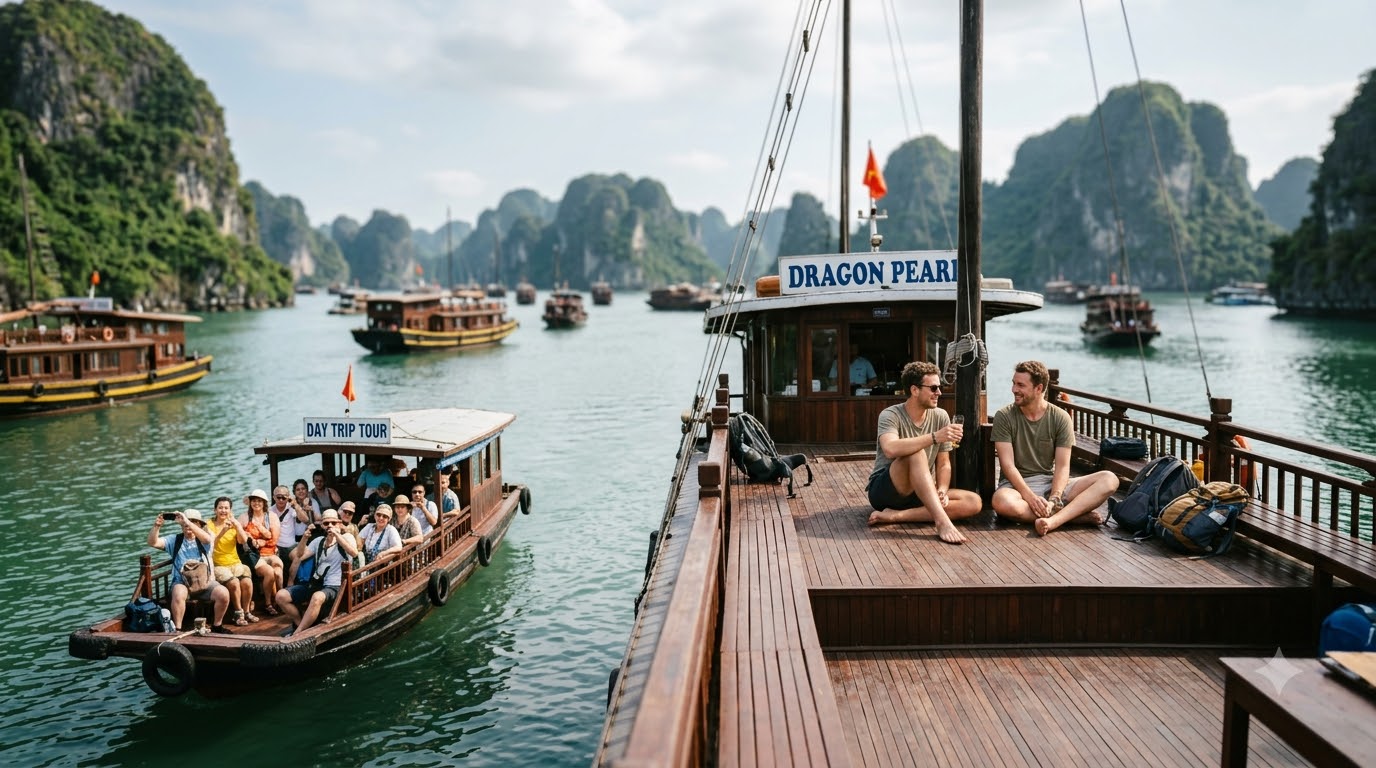
The 2-day/1-night cruise wins for most travelers because it captures the two things day trips cannot buy: sunset from the sundeck and sunrise Tai Chi before the day boats arrive. A day cruise is a reasonable call only if you are tight on time in Hanoi or nervous about sleeping on the water.
The 3-day/2-night trip is for people who genuinely want to slow down and reach the far karst that shorter loops skip.
Here is how the three durations trade off against each other on the factors that actually change your day.
| Factor | Day cruise | 2-day / 1-night | 3-day / 2-night |
|---|---|---|---|
| Time from Hanoi (round trip) | Full day, ~5 hrs driving | Overnight | Two nights |
| Sunset & sunrise on the bay | No | Yes (one of each) | Yes (two of each) |
| Caves & islands visited | 1-2 | 2-3 | 3-5 + remote areas |
| Kayaking sessions | 0-1 | 1 | 2 |
| Best for | Time-poor, first taste | Most travelers | Slow travel, photographers |
| Typical price band | $23-120 | $105-450 | $220-700+ |
A few standalone facts to weigh before you pick:
- A day cruise gives you roughly 3-4 hours actually on the water after the two-way transfer, so half the “day” is a coach seat.
- A 2-day trip typically visits Sung Sot (Surprise) Cave and Titop Island on the classic Halong route, plus one kayak or bamboo-boat session.
- A 3-day trip is the only format that reaches the quiet northern karst of Bai Tu Long without feeling rushed.
- Overnight boats anchor in designated sheltered zones after roughly 4pm, which is when the bay empties of day traffic and goes still.
If a day trip is all your schedule allows, our dedicated Halong Bay day trip from Hanoi breakdown covers the fastest routes and the honest trade-offs of skipping the overnight.
Which route is best: Halong, Lan Ha, or Bai Tu Long Bay?
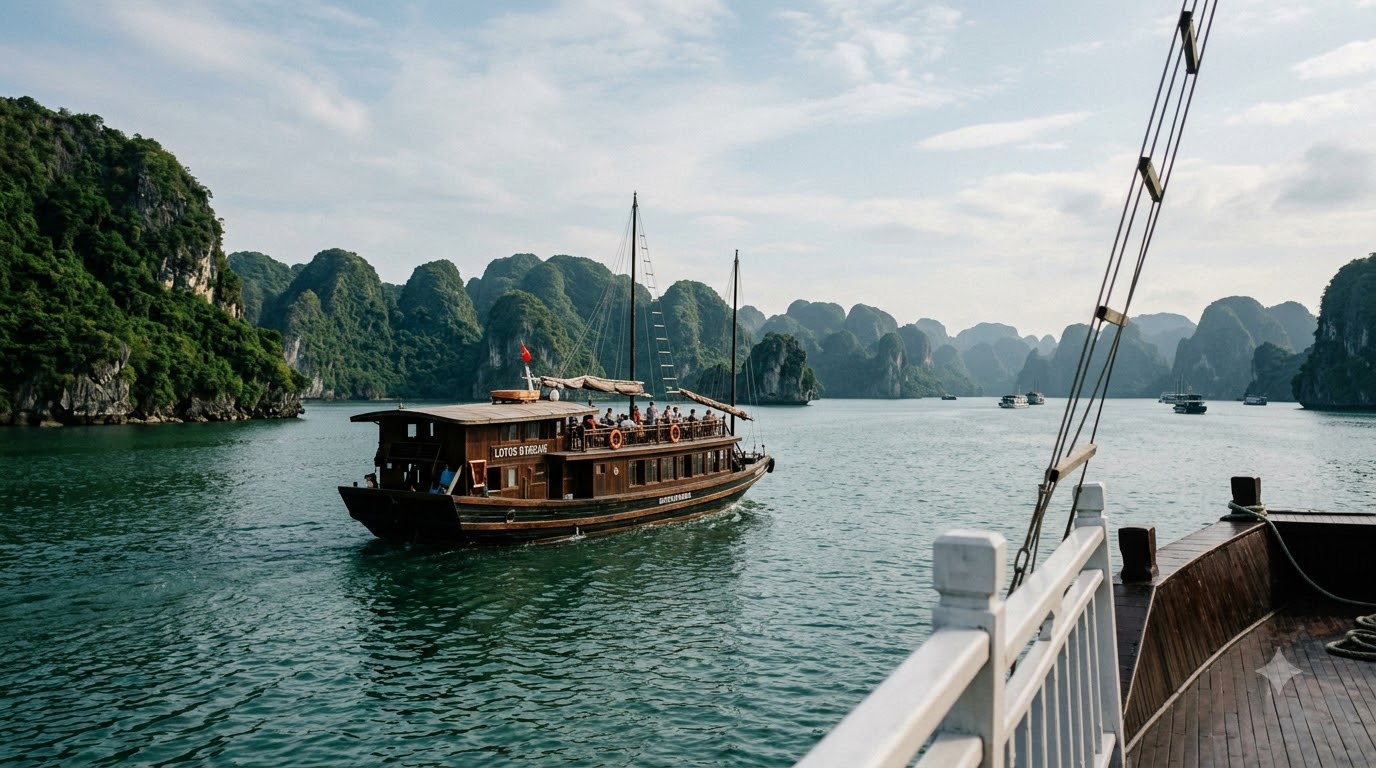
Lan Ha Bay is the best all-round route for 2026 travelers who want the famous scenery without the famous crowds, while Bai Tu Long suits those chasing maximum solitude and classic Halong Bay suits first-timers who want the postcard shot. All three sit inside the same UNESCO-listed karst system and look nearly identical from the deck — the real difference is traffic, water quality, and where the boat launches from.
- Halong Bay (classic route): 4.5 million visitors a year, 200-250 boats daily, water visibility around 1-2 meters; launches from Tuan Chau near Halong City (Jungle Boss Tours, 2026).
- Lan Ha Bay: about 1.2 million visitors a year, roughly 80-100 boats daily, 3-5 meter visibility, pollution levels around 70% lower than Halong; launches from the Hai Phong / Got Pier side.
- Bai Tu Long Bay: caps near 1,000 visitors on a busy day, the quietest and least developed, slightly pricier because fewer operators run it; launches further north.
| Route | Daily boats (approx.) | Water visibility | Crowd level | Best for |
|---|---|---|---|---|
| Halong Bay | 200-250 | 1-2 m | High | First-timers, iconic views |
| Lan Ha Bay | 80-100 | 3-5 m | Moderate | Beaches, kayaking, value |
| Bai Tu Long Bay | Fewer than 100 | Clear | Low | Solitude, photographers |
Source: Jungle Boss Tours (2026); Seek Sophie (2026).
We booked Lan Ha specifically for the swimming — on our July visit the water was noticeably clearer than the classic route we had done years earlier, and the small beaches on the outer islands were nearly empty by late afternoon. If you get seasick easily, note that Bai Tu Long’s longer transit to the northern islands means more open-water time.
What’s included in a Halong Bay cruise price?
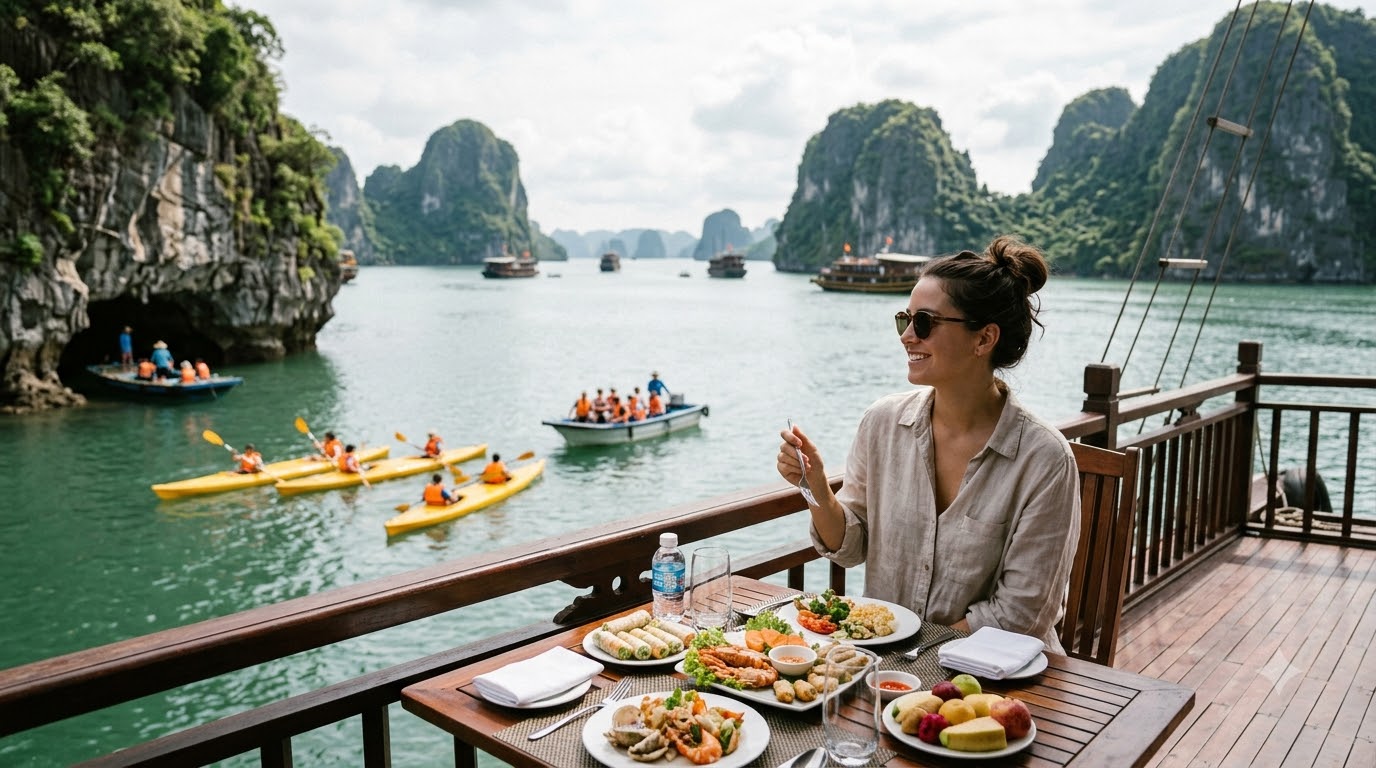
Most overnight Halong Bay cruise fares are close to all-inclusive for the core experience, which is why the sticker price looks high next to a day trip. A standard 2-day fare bundles the round-trip Hanoi transfer, your cabin, all meals on board, guided cave and island stops, and at least one activity like kayaking. What it does not cover is where the bill quietly grows.
Included in a typical mid-range 2-day fare:
- Round-trip shuttle transfer from Hanoi (usually a shared coach; private cars cost $40-80 extra).
- All onboard meals — commonly lunch, dinner, and breakfast, plated multi-course on 4-star and up.
- Guided visits to caves such as Sung Sot and viewpoints like Titop Island.
- One kayaking or bamboo-boat session and morning Tai Chi on the sundeck.
- En-suite cabin with the star rating you booked.
Not included — budget an extra 15-30% on top of the fare:
- Drinks: beer $3-5, cocktails $8-12, wine bottles $25-60.
- Crew tips: commonly $3-5 per person per day.
- Optional extras: extended kayaking $5-10, one-hour spa massage $25-60, cabin upgrades $30-100.
- Travel insurance and any private transfer upgrade.
A nominally $145 mid-range cruise realistically lands past $200 per person once drinks and tips are in (Day Trips Vietnam, 2026). On our budget junk years back, the “free” welcome drink was the only free drink of the trip — everything after was cash on a paper tab settled at checkout.
When is the best time for a Halong Bay cruise?
October to April is the best window for a Halong Bay cruise, delivering cool, dry, clear-sky days that make the karst photograph well, while May to September brings warm swimming water but a real risk of storm cancellations. There is no perfect month; you are trading crowds and price against weather and sea state.
- October-November: dry, mild, arguably the best all-round conditions; book early.
- December-February: cool and often hazy, fewer crowds, lowest sea temperatures for swimming.
- March-April: warming up, generally clear, a strong shoulder choice.
- May-September: hot, best for swimming, but the typhoon season can force itinerary changes or same-day cancellations.
We sailed once in late July and hit a half-day of rain that cut a kayaking session; the operator swapped it for a cave visit without fuss, but it is a reminder that summer itineraries flex with the weather. Cruises do cancel for safety when the port authority closes the bay, so pad your Hanoi schedule with a buffer day in storm season.
How to get to the cruise port from Hanoi
Nearly every Halong Bay cruise includes a transfer, and the drive from Hanoi runs about 2.5 hours each way via the CT.06 expressway to the Halong or Hai Phong port areas. You rarely need to arrange your own transport — but knowing the timing helps you plan the rest of your Vietnam route.
- Shared shuttle (included): hotel-area pickup in Hanoi’s Old Quarter, one comfort stop, roughly 2.5-3 hours.
- Private car (add $40-80): faster, flexible pickup, worth it for families or early check-ins.
- Departure ports: Tuan Chau for classic Halong, the Hai Phong / Got Pier side for most Lan Ha routes, further north for Bai Tu Long.
Because the cruise eats a full day at each end, we always treat Halong as a two- or three-night detour from Hanoi rather than a same-day dash. If you are building the wider trip, our Hanoi travel guide lays out where to base yourself and how the cruise slots into a week in the north, and the full Halong Bay travel guide covers everything beyond the boat.
Frequently Asked Questions
Is a 2-day or 3-day Halong Bay cruise worth it over a day trip?
For most travelers, yes. A day trip gives you only 3-4 hours actually on the water after transfers and misses sunset, sunrise, and the quiet evening hours after the day boats leave. A 2-day/1-night cruise ($105-450 per person) is the sweet spot; a 3-day trip is worth it mainly if you want to reach the remote northern karst and prefer slow travel.
How much should I budget in total for a Halong Bay cruise?
Take the fare and add 15-30%. A mid-range 4-star 2-day cruise advertised around $145-250 per person realistically costs $200-300 once you add drinks (beer $3-5, cocktails $8-12), crew tips ($3-5 per person per day), and any optional kayaking or spa. Solo travelers should expect a single supplement of 60-100% of the cabin rate.
Which bay is best — Halong, Lan Ha, or Bai Tu Long?
Lan Ha Bay is the best all-round pick for 2026: similar scenery to classic Halong but roughly 80-100 boats a day instead of 200-250, clearer 3-5 meter water, and good beaches. Choose classic Halong for the iconic first-timer views, and Bai Tu Long if solitude matters most and you do not mind a longer transit.
What is included in the cruise price?
A standard overnight fare includes the round-trip Hanoi transfer, your en-suite cabin, all onboard meals, guided cave and island visits, and usually one kayaking session plus morning Tai Chi. Drinks, tips, spa treatments, private-car transfer upgrades, and travel insurance are extra.
What is the best time of year to cruise Halong Bay?
October to April offers the driest, clearest conditions and the best photography, though December-February can be hazy and cool. May to September has the warmest swimming water but carries a real risk of storm-related cancellations, so build a buffer day into your schedule if you sail in summer.
Find your Halong Bay hotel on the map
Live prices from Booking, Airbnb and more — move the map or change dates to compare stays around Halong Bay.
Final thoughts
The right Halong Bay cruise is less about chasing the highest star rating and more about matching duration, bay, and budget to how you actually travel.
If you want the postcard and you are short on time, a classic day boat does the job; if you want the bay to go quiet around you, spend the extra night on a Lan Ha or Bai Tu Long route and let the day traffic disappear.
Whatever you choose, the karst looks just as improbable from a $110 junk as it does from a suite — the water is the same water.