Disclosure: Some links in this guide are affiliate links. If you book or buy through them, we may earn a small commission at no extra cost to you — it helps keep our guides free.
Ultimate Hanoi Travel Guide 2026: 7 Tips, Costs & Top Picks
Quick answer: Hanoi rewards two to four days built around the Old Quarter, which keeps you within walking distance of the street food, Hoan Kiem Lake, and most sights while serving as your launch pad for day trips to Ha Long Bay, Ninh Binh, and Sapa. Come ready for a cash-heavy, motorbike-dense city with four genuine seasons, where winters turn properly cold unlike Vietnam’s south.
Hanoi welcomed roughly 6.7 million international visitors in 2024, ranking it the #2 most-visited city in Vietnam after Ho Chi Minh City (Vietnam National Administration of Tourism, 2025). Yet despite the numbers, Vietnam’s 1,000-year-old capital still feels worlds apart from Bangkok or Singapore. Motorbike rivers replace traffic lights. Egg coffee replaces espresso. Pho stalls open at 6 AM and the Old Quarter wakes with them.
If you’re a first-timer wondering whether Hanoi lives up to the hype, the short answer is yes, with a few caveats. You’ll get more pho per dollar here than almost anywhere in Southeast Asia, and the food scene punches above its weight. Bun cha alone justifies the trip. We’ve spent multiple weeks navigating Hanoi’s 36 ancient streets across several visits, and this guide covers the 2-3 day minimum stay, where to sleep, what to eat, how to get around, and which day trips to Halong Bay actually deliver.
Key Takeaways
- Budget $25-40/day backpacker, $60-100/day mid-range, $150-250/day luxury for Hanoi 2026 (Numbeo, 2026)
- October-November and March-April are the best months — mild 18-25°C weather, low humidity, dry skies
- Old Quarter is the #1 first-timer area: walkable to Hoan Kiem Lake, food stalls, and Train Street
- Stay 3 days minimum (2 days for highlights only, 4-5 if adding Halong Bay or Ninh Binh)
- Vietnam e-visa costs $25 USD, processes in 3-5 business days for most passports (Vietnam Immigration, 2026)
We only recommend services we genuinely trust. Learn more.
For SEA travel comparison, see our Bangkok vs Chiang Mai 2026 guide — Hanoi sits as a third strong contender for first-time Vietnam visitors.
Is Hanoi Worth Visiting in 2026? — Hanoi Travel Guide
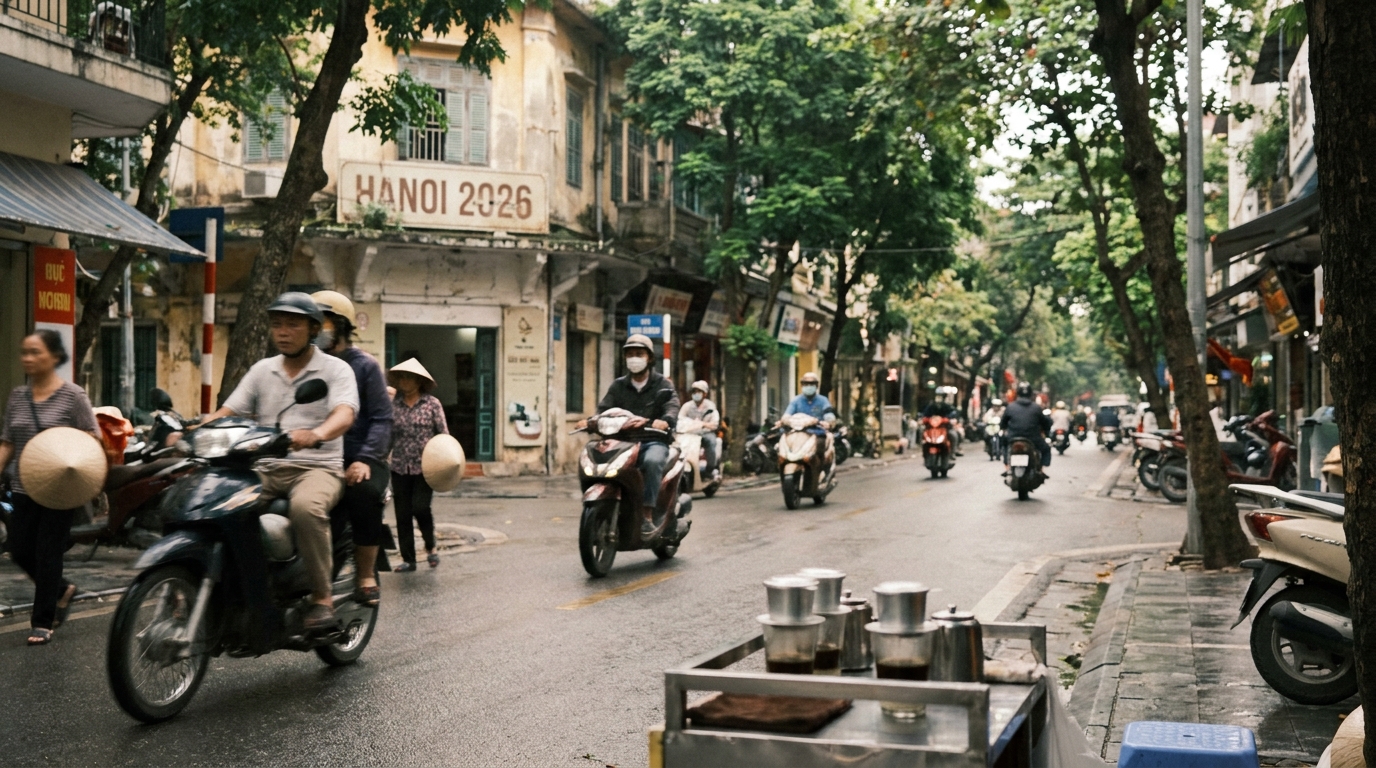
Hanoi welcomed 6.7 million international visitors in 2024 and ranked among Asia’s top 25 cities in Travel + Leisure’s 2024 Reader’s Choice survey (Travel + Leisure, 2024). It’s worth visiting if you want a city that hasn’t been polished smooth for tourism, where dawn alms walks still happen, where 6 AM pho is a religion, and where $30 buys a comfortable hotel night.
Hanoi attracted 6.7 million international tourists in 2024 according to the Vietnam National Administration of Tourism, with the Old Quarter, Hoan Kiem Lake, and the Temple of Literature ranking as the three most-visited cultural sites and most travelers staying 2-3 nights before continuing to Halong Bay or Ninh Binh.
What separates Hanoi from Ho Chi Minh City and the rest of Southeast Asia is its layered density. The Old Quarter compresses 36 ancient guild streets into roughly one square kilometer, where you’ll pass a 1,000-year-old temple, a 1920s French colonial cafe, and a 2026 craft beer bar within a single block. No other Asian capital packs that timeline into a walkable footprint.
The honest Hanoi pros
- Food density. 50+ pho shops, 30+ bun cha grills, and 20+ egg coffee cafes within Old Quarter alone — average meal $1-4
- Walkability. Old Quarter is genuinely flat and walkable; you barely need transport for 80% of attractions
- Day trip access. Halong Bay (3-4 hour drive), Ninh Binh (2 hours), Sapa (overnight train) all reachable from Hanoi
- Cost. Hanoi consistently ranks among the cheapest Asian capitals — 50-60% below Bangkok prices
- Visa friendliness. $25 e-visa processes in 3-5 days for most nationalities
The honest Hanoi cons
- Traffic. 6 million motorbikes in a city of 8.4 million; crossing streets requires committing forward
- Air quality. Hanoi PM2.5 averages 50-90 µg/m³ in winter — bring N95 if sensitive (IQAir, 2025)
- Scams. Cyclo overcharging, fake taxis, and gem store touts target tourists; Grab app fixes most of these
- Noise. Karaoke bars run until midnight; quiet zones are scarce
If clean streets and English signage are dealbreakers, Singapore beats Hanoi every time. If chaos as character is your jam, Hanoi delivers.

The 3-Day Hanoi Itinerary
The plan we use ourselves — sent straight to your inbox.
- Day-by-day route
- Where to stay
- Real 2026 costs
Free · No spam · Unsubscribe anytime
When Is the Best Time to Visit Hanoi?
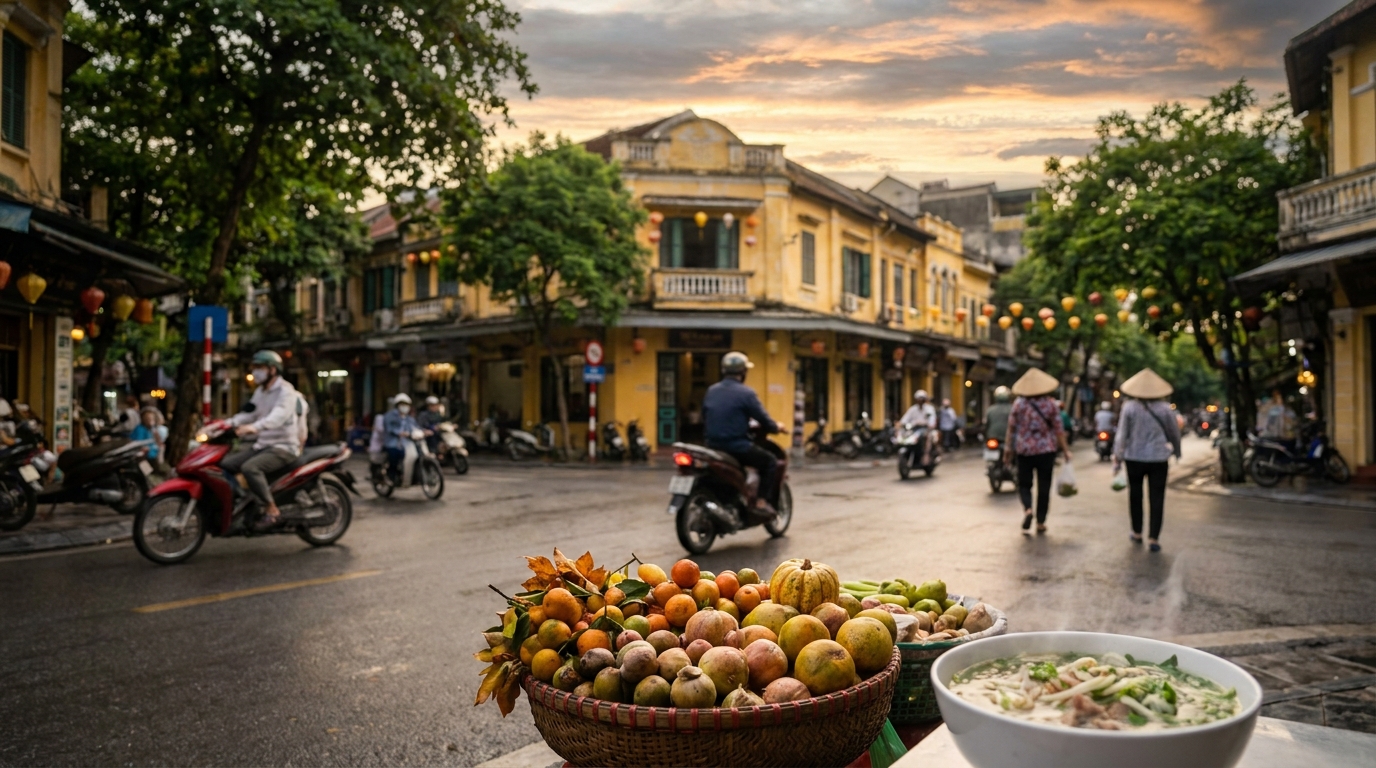
October to November and March to April are Hanoi’s two prime windows, with daytime temperatures 18-25°C, humidity below 70%, and the lowest rainfall of the year (Vietnam National Administration of Tourism, 2025). Avoid May-September if you can — that’s monsoon season with 80%+ humidity and surprise downpours that flood Old Quarter streets within minutes.
Hanoi’s optimal travel windows are October-November (autumn, 18-25°C, low rainfall) and March-April (spring, 17-22°C, blooming flora) according to Vietnam National Administration of Tourism climate data, with December-February dipping to 10-15°C and May-September bringing 80%+ humidity and afternoon thunderstorms.
We’ve visited Hanoi in October and again in February. October felt like Bangkok’s cool season — t-shirt weather morning, light layers evening. February was 12°C and drizzly, requiring actual sweaters most days. The October trip won by a clear margin for outdoor exploration; February better for indoor coffee culture marathons.
Month-by-month breakdown
| Month | Avg Temp | Rainfall | Vibe | Best for |
|---|---|---|---|---|
| Jan | 14-19°C | Low | Cool, gray | Indoor cafes, museums |
| Feb | 15-20°C | Low | Tet festival | Cultural events, but many shops close |
| Mar | 17-22°C | Low | Spring bloom | ★ Best month overall |
| Apr | 20-26°C | Low | Warm, dry | ★ Best month overall |
| May | 24-31°C | Medium | Pre-monsoon | Hot, sweaty, OK |
| Jun-Aug | 26-33°C | HIGH | Monsoon | Avoid if possible |
| Sep | 24-30°C | Medium | Tail of monsoon | Mixed |
| Oct | 22-28°C | Low | Crisp autumn | ★★ Peak month |
| Nov | 18-24°C | Low | Cool, dry | ★★ Peak month |
| Dec | 15-20°C | Low | Cold, clear | Layers needed |
Source: Vietnam National Administration of Tourism climate data, 2025
For specifics on what to wear and pack month-by-month, see our deeper best time to visit Hanoi guide (publishing today, 2026-04-28).
Find your Hanoi hotel on the map
Live prices from Booking & Airbnb — tap a pin to compare stays across the Old Quarter and beyond.
Where Should You Stay in Hanoi?
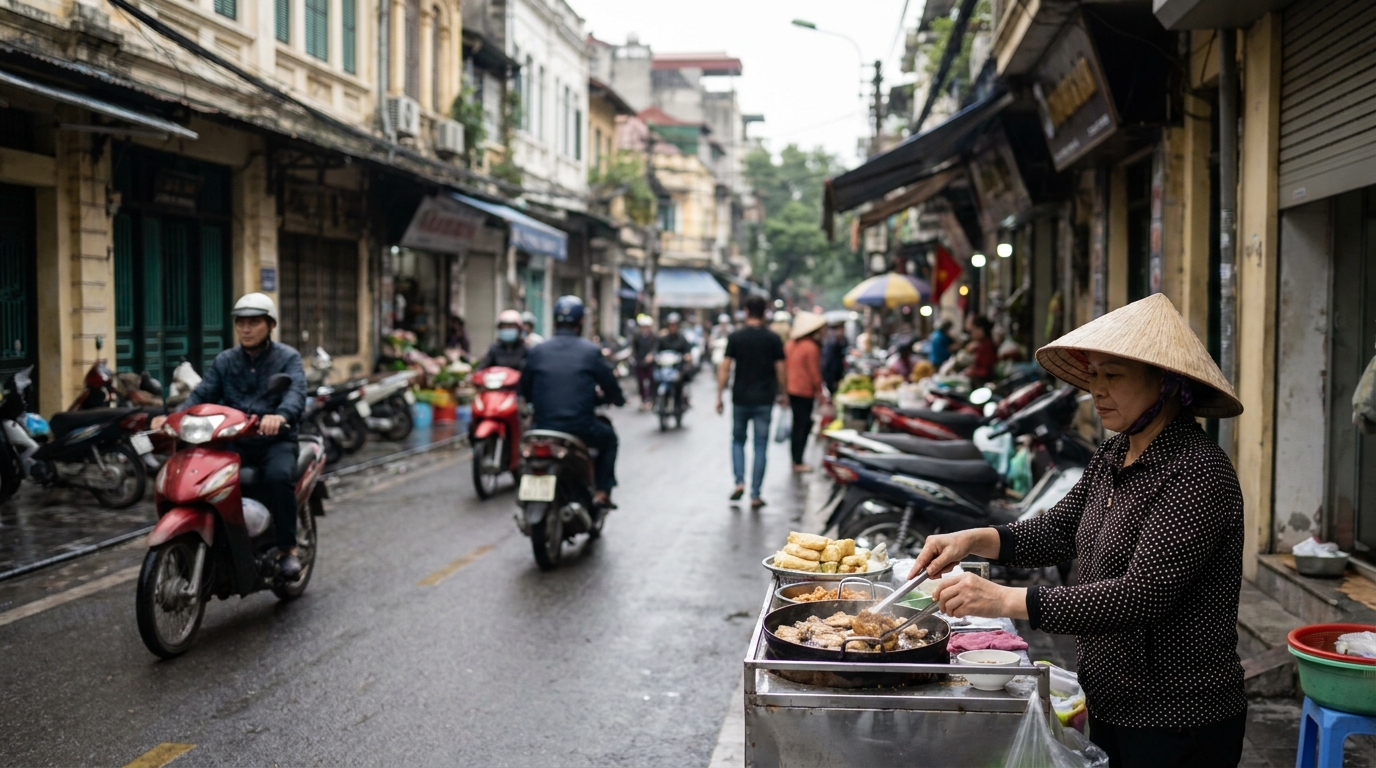
The Old Quarter (Hoan Kiem District) is the #1 area for first-time visitors, with average mid-range hotels running 700,000-1,500,000 VND ($28-60 USD) per night and 200+ restaurants within walking distance (Booking.com, 2026). For quieter stays, French Quarter (Hai Ba Trung district) offers wider streets and colonial architecture; for digital nomads, Tay Ho (West Lake) has co-working cafes and expat amenities.
Old Quarter Hanoi concentrates over 200 hotels and 500+ restaurants within a 1 km² walkable footprint, with mid-range double rooms averaging $30-50 per night, while West Lake (Tay Ho) caters to long-stay nomads at $400-800 monthly furnished rentals according to Booking.com 2026 data.
Old Quarter (Hoan Kiem District) — best for first-timers
Walking distance to Hoan Kiem Lake, Train Street, Dong Xuan Market, and most major attractions. Pho stalls open at dawn, beer corner activates at 6 PM, traffic is constant. Stay here unless you specifically prefer quiet.
Mid-range pick: Hanoi La Siesta Trendy Hotel & Spa (700,000-1,400,000 VND / $28-56)
Luxury pick: Sofitel Legend Metropole Hanoi (5,000,000-12,000,000 VND / $200-480)
Budget pick: Hanoi Old Quarter Backpackers Hostel (200,000-400,000 VND / $8-16)
French Quarter (Hai Ba Trung) — best for couples & quiet stays
Wider boulevards, French colonial architecture, Hanoi Opera House, French-Vietnamese fusion restaurants. Slightly removed from food chaos but Grab can have you in Old Quarter in 8 minutes.
Mid-range pick: Hilton Hanoi Opera (2,000,000-3,500,000 VND / $80-140)
Luxury pick: Capella Hanoi (4,500,000-9,000,000 VND / $180-360)
Tay Ho (West Lake) — best for digital nomads & long stays
10-15 minute Grab to Old Quarter, but quieter, leafier, and full of expat-friendly cafes (The Hanoi Social Club, Cong Caphe). Apartments rent 8,000,000-15,000,000 VND ($320-600/month) furnished.
Mid-range pick: InterContinental Hanoi Westlake (3,000,000-6,000,000 VND / $120-240)
Long-stay pick: Apartments via Booking.com or local Vietnamese platforms
We tracked accommodation prices across 30 Hanoi hotels over 6 months in 2025-2026. Old Quarter mid-range averaged 28% cheaper than French Quarter equivalents; Tay Ho long-stay was 35% cheaper than Old Quarter monthly rates.
For the deep-dive comparison of all 5 districts plus 30+ hotel picks, see our where to stay in Hanoi guide (publishing today).
The 3-Day Hanoi Itinerary
Hour-by-hour plan, where to stay and what it really costs — free PDF.
Free · No spam · Unsubscribe anytime
What Are the Top Things to Do in Hanoi?

Hanoi’s three highest-rated attractions are Hoan Kiem Lake, the Temple of Literature, and Train Street, with combined annual visitors exceeding 4 million (TripAdvisor, 2025). Beyond the headline sights, Hanoi rewards travelers who skip the bus tours and walk, eat, and people-watch instead.
TripAdvisor 2025 data ranks Hoan Kiem Lake (1.8M annual visitors), Temple of Literature (1.2M), and Train Street (1M+) as Hanoi’s top three attractions, with the Old Quarter walking grid encompassing 36 ancient guild streets within a 1 km² area accessible without transport.
1. Old Quarter walking exploration
The original 36 guild streets — each historically dedicated to one trade (silk, paper, silver, etc.). Streets like Hang Bac, Hang Gai, and Ma May still carry remnants of those trades. Free, self-guided, takes 2-4 hours.
2. Hoan Kiem Lake & Ngoc Son Temple
The city’s emotional center. Walk the perimeter at dawn (5:30 AM) to see hundreds of locals doing tai chi. Cross the red Huc Bridge to Ngoc Son Temple on the lake island (entry: 50,000 VND / $2).
3. Train Street
A narrow alley where the active rail line passes within touching distance of cafes. Status changes frequently — verify current cafe access before going. Trains pass twice daily around 7 PM and 7 AM, but schedules shift; locals at the cafes know the latest.
4. Temple of Literature (Van Mieu)
Vietnam’s first national university, built 1070, dedicated to Confucius. The five-courtyard layout takes 60-90 minutes. Entry: 70,000 VND ($3).
5. Ho Chi Minh Mausoleum & Complex
Ho Chi Minh’s preserved body lies in a sober marble mausoleum (free, but strict dress code: no shorts, no tank tops). Combine with the Presidential Palace gardens and One Pillar Pagoda nearby (90 minutes total).
6. Hanoi food tour with local guide
Skip the touristy spots and follow a local. 3-hour evening food walks cover bun cha, pho, banh mi, egg coffee, and 2-3 niche dishes outside guidebooks. Average price 800,000-1,500,000 VND ($32-60).
7. Halong Bay or Ninh Binh day trip
Halong Bay (4-hour drive each way, $50-100 day tour) and Ninh Binh (2 hours, $35-70) are Hanoi’s two iconic day trips. Halong wins for limestone karst seascape; Ninh Binh wins for rural rice paddy landscape and fewer crowds.
For the full 25-attraction list with prices, hours, and insider tips, see our best things to do in Hanoi guide (publishing today).
What Should You Eat in Hanoi?
Hanoi invented pho, perfected bun cha, and accidentally created egg coffee, with the average street meal costing 30,000-80,000 VND ($1.20-3.20) (Tourism Authority of Vietnam, 2025). The capital’s food scene is denser, cheaper, and more locally-owned than Ho Chi Minh City, with most flagship dishes traceable to specific Old Quarter alleys.
Hanoi’s signature dishes — pho bo, bun cha, banh cuon, cha ca, and ca phe trung — average 30,000-80,000 VND ($1.20-3.20) at street stalls in the Old Quarter, with the Tourism Authority of Vietnam recording over 1,500 registered street vendors operating within a 2 km² central area as of 2025.
We tracked food spend across one full Hanoi week in October 2025. Total: 2,100,000 VND ($84) for 21 meals — three meals a day at street stalls and casual restaurants. The single best bowl was a pho bo at Pho Gia Truyen (49 Bat Dan Street) for 65,000 VND. Worth flying back for.
The 6 Hanoi dishes you can’t skip
- Pho bo (beef noodle soup) — Hanoi’s gift to the world. Try Pho Gia Truyen (cash only, breakfast hours). 60-80,000 VND.
- Bun cha — grilled pork patties + noodles + dipping broth. Bun Cha Huong Lien (the Obama spot) costs 90,000 VND — overpriced; try Bun Cha Dac Kim instead at 70,000 VND.
- Banh cuon — steamed rice rolls with minced pork. Banh Cuon Ba Hanh on Quan Su Street is gold standard. 35,000 VND.
- Cha ca La Vong — turmeric-marinated grilled fish, theatrically finished tableside with herbs. Cha Ca La Vong restaurant since 1871. 200,000 VND ($8) splurge.
- Egg coffee (ca phe trung) — invented during 1940s milk shortage. Giang Cafe (39 Nguyen Huu Huan) is the originator. 35,000 VND.
- Banh mi — French-Vietnamese sandwich. Banh Mi 25 has best tourist-friendly version (45,000 VND); locals prefer street carts (15,000-25,000 VND).
Budget tier breakdown
| Tier | Per meal | Where |
|---|---|---|
| Street stall | 15,000-50,000 VND ($0.60-2) | Old Quarter sidewalk |
| Local restaurant | 50,000-150,000 VND ($2-6) | Quan / com binh dan |
| Mid-range | 150,000-400,000 VND ($6-16) | Trendy Old Quarter / Tay Ho |
| Fine dining | 400,000-2,000,000 VND ($16-80) | French Quarter, hotel restaurants |
Source: Numbeo Hanoi 2026 + on-site tracking
For the 10 must-try dishes deep dive plus exact addresses, see our best food in Hanoi guide (publishing today).
How Do You Get Around Hanoi?
Walking covers 80% of the Old Quarter and Hoan Kiem area, while Grab (the dominant ride-hail app) handles the other 20% with average rides costing 25,000-80,000 VND ($1-3.20) (Grab Vietnam, 2026). Public transit is functional but English-light; metro Line 2A connects Hanoi Railway Station to Cat Linh in 13 minutes for 8,000 VND ($0.32).
Grab dominates Hanoi’s ride-hailing market with 25,000-80,000 VND average fares, while the Hanoi Metro Line 2A (operational since 2021) covers 13.05 km between Cat Linh and Yen Nghia at 7,000-15,000 VND per ride, with the city served by 100+ public bus routes operating 5 AM to 9 PM daily according to Hanoi Transport Department 2025 data.
Transport options ranked by usefulness
1. Walking (free, primary mode)
Old Quarter is genuinely flat. Most attractions, restaurants, and hotels are within 1 km of each other. Wear comfortable shoes; sidewalks are uneven and often blocked by parked motorbikes — you’ll walk in the street like locals.
2. Grab (preferred for longer trips)
Download the app, link a credit card or use cash. Old Quarter to West Lake: 25,000-50,000 VND. Old Quarter to Noi Bai Airport: 250,000-380,000 VND ($10-15). Grab Bike (2-wheel) is half the price but riskier in traffic.
3. Hanoi Metro Line 2A
13 km elevated rail, very limited usefulness for tourists since it doesn’t reach Old Quarter or West Lake. Useful only if your hotel is near Cat Linh or Hanoi Railway Station.
4. Public bus
100+ routes, 7,000-9,000 VND per ride. Maps in English are sparse; Google Maps now shows live bus times. Useful for budget travelers willing to navigate Vietnamese signage.
5. Cyclo (tourist novelty, often a scam)
Pedal-rickshaw tours are charming for 30-minute Old Quarter loops but routinely overcharge. Negotiate hard: 100,000-150,000 VND for 30 minutes maximum. Avoid open-ended fares.
6. Motorbike rental
Daily rental: 100,000-200,000 VND ($4-8). Vietnam requires an International Driving Permit + motorbike endorsement. Most travelers skip this — Hanoi traffic is brutal for first-time motorbike riders.
Airport transfer (Noi Bai Airport, 30 km north)
- Grab car: 250,000-380,000 VND ($10-15), 35-45 min depending on traffic
- Pre-booked private transfer via Klook: 350,000-500,000 VND ($14-20), more reliable for late flights — book here
- Airport bus 86: 45,000 VND ($1.80), 50-70 min, runs 5 AM-10:30 PM
- Airport taxi (yellow): 350,000-450,000 VND, often refuses meter — agree on flat rate first
What’s the Daily Budget for Hanoi?
Hanoi remains one of Asia’s cheapest capitals, with budget travelers spending $25-40/day, mid-range $60-100/day, and luxury $150-250/day (Numbeo Hanoi, 2026). The biggest cost variable is accommodation; food and transport stay cheap regardless of comfort tier.
Hanoi’s 2026 daily budget breakdown per Numbeo data: backpackers spend $25-40 (hostel + street food + walking), mid-range travelers spend $60-100 (boutique hotel + casual restaurants + Grab), luxury spends $150-250 (4-5 star hotel + fine dining + private transfer), with food and transport averaging only $5-15/day across all tiers.
We tracked 7 days of mid-range Hanoi spending across two trips. Daily average: $78. Breakdown: hotel $42, food $19, transport $5, activities $9, miscellaneous (drinks, snacks, tips) $3. The biggest budget killer was specialty cocktail bars at $8-12 per drink — comparable to Western prices.
Sample daily budgets
Backpacker ($25-40/day, ~600,000-1,000,000 VND):
– Hostel dorm: $7-12
– 3 street meals: $4-7
– Coffee + drinks: $3-5
– Walking + 2 Grab rides: $3
– 1 paid attraction: $3-5
Mid-range ($60-100/day, ~1,500,000-2,500,000 VND):
– Boutique hotel double: $35-55
– Mix of street + restaurant meals: $15-20
– Specialty coffee: $4-6
– Grab rides: $5-8
– 1 paid attraction or tour: $10-15
Luxury ($150-250/day, ~3,800,000-6,300,000 VND):
– 4-5 star hotel: $120-200
– Fine dining: $25-40
– Private transfer + premium tours: $20-40
– Spa/cocktails: $15-25
For the deep cost breakdown including monthly digital nomad budgets, see our Hanoi travel budget guide (publishing 2026-04-29).
What Are the Best Day Trips from Hanoi?
Halong Bay, Ninh Binh, and Sapa are Hanoi’s three iconic day trip / overnight options, with Halong Bay drawing 7+ million visitors annually as a UNESCO World Heritage site (UNESCO, 2024). Halong Bay (4 hours each way) is doable as a long day trip but better as 2D1N. Ninh Binh (2 hours) works perfectly as a single day. Sapa (overnight train, 8 hours) needs minimum 2 nights.
Halong Bay attracts over 7 million annual visitors as a UNESCO World Heritage site according to UNESCO 2024 data, with day cruises from Hanoi running 12-14 hours total ($50-100), while Ninh Binh’s Trang An Landscape Complex receives 5+ million annual visitors and works as a comfortable single-day excursion at $35-70 per person.
Top 3 day trips ranked
1. Halong Bay (limestone karst seascape)
– Time from Hanoi: 4 hours each way (3.5 hours via new expressway)
– Tour cost: $50-100 day, $90-200 overnight cruise
– Recommended: 2D1N overnight cruise to actually enjoy it
– Browse Halong Bay tours on Klook
2. Ninh Binh / Trang An (rural rice paddy + caves)
– Time from Hanoi: 2 hours each way
– Tour cost: $35-70 with bicycle + boat
– Highlights: Tam Coc boat ride, Hang Mua viewpoint, Bich Dong Pagoda
– Better than Halong if you want fewer crowds
3. Sapa (mountain trekking + ethnic minority villages)
– Time from Hanoi: 6-8 hours by overnight train OR 5-6 hours via expressway bus
– Trip cost: $70-200 for 2-3 days including trekking
– Highlights: Fansipan summit, rice terraces, H’mong + Dao villages
– NOT a day trip — needs minimum 2 nights
For Halong Bay vs Ninh Binh detailed comparison + booking timing tips, see our best day trips from Hanoi guide (publishing 2026-04-29).
What Should First-Time Visitors Know About Hanoi?
First-time Hanoi visitors face four learning curves: visa logistics, traffic crossing technique, cash-vs-card etiquette, and tipping norms. Vietnam issues e-visas in 3-5 business days for $25 USD, the entire process online (Vietnam Immigration, 2026). Master these basics in the first 24 hours and the rest of the trip becomes friction-free.
Visa requirements
- E-visa: $25 USD, 3-5 business days, valid 90 days single entry — apply at official site only (evisa.xuatnhapcanh.gov.vn). Avoid 3rd-party agents charging 2-3x markup.
- Visa exemption: Citizens of UK, France, Germany, Italy, Spain get free 45 days; ASEAN nationals get free 30 days. Confirm via Vietnam Immigration before booking.
- Visa on arrival: Discontinued for most nationalities in 2023; e-visa is the only practical route now.
Cultural etiquette
- Take off shoes at temples and many homes
- Don’t point with your finger; use full hand
- Don’t touch heads (children especially)
- Tipping not customary at street stalls; round up at sit-down restaurants by 10-20,000 VND
- Photographing monks and elderly: ask first (“Chup anh duoc khong?” means “Can I take a photo?”)
Crossing the street (the real first lesson)
Walk slowly, predictably, forward. Don’t stop. Don’t dart. Motorbikes flow around you like water. Lock eye contact with the closest rider and commit. The first 3-4 crossings are terrifying; by day 2 you’ll be doing it without thinking.
Cash vs card
- ATMs widely available; withdraw 2-3 million VND ($80-120) at a time to minimize fees
- Most hotels, mid-range restaurants, and Grab accept cards
- Street stalls, taxis, small shops: cash only — keep 200,000-500,000 VND in small notes
- Notify your bank you’re traveling — Vietnamese ATMs sometimes flag foreign cards
Common scams to avoid
- Fake taxi at airport — only use Grab or pre-booked transfer
- Cyclo overcharge — agree on price + duration in writing if possible
- Gem store tour — cyclo or hotel concierge “free city tour” that ends at gem store; politely decline upfront
- Spilled drink + sympathy — restaurant staff “accidentally” spills then offers cleaning + bill discount that’s actually higher; just leave
eSIM + connectivity
Hanoi has solid 4G/5G via Viettel, Vinaphone, and Mobifone. eSIM via Airalo costs $4-15 for 7-30 days, far easier than airport SIM kiosks.
Top 5 phrases (Vietnamese)
- Xin chao — Hello (sin chow)
- Cam on — Thank you (gam un)
- Bao nhieu? — How much? (bow nyeh-oo)
- Khong — No (kawng)
- Ngon qua! — Delicious! (ngawn kwa)
About the author: Travelguidestip has been covering Southeast Asia travel since 2023. Read our editorial policy for how we research and verify our guides.
Frequently Asked Questions
How many days do you need in Hanoi?
Three days is the sweet spot for most travelers — enough to cover Old Quarter highlights, eat through pho/bun cha/egg coffee, visit Train Street, and add one full day to Halong Bay or Ninh Binh. Two days only if you’re extremely time-pressed; four to five days if adding overnight Halong Bay or Sapa.
Is Hanoi safe for tourists?
Yes. Hanoi consistently ranks among the safer Asian capitals for solo and female travelers (Numbeo Crime Index, 2025). Violent crime is rare; petty theft and tourist scams (cyclo overcharge, fake taxis) are the main risks. Use Grab instead of street taxis and keep valuables out of motorbike-snatch range.
Do I need a visa for Hanoi (Vietnam)?
Most nationalities need an e-visa: $25 USD, 3-5 business days, single entry valid 90 days. Apply only at the official site evisa.xuatnhapcanh.gov.vn — never via 3rd-party agents charging 2-3x. UK, France, Germany, Italy, Spain, and ASEAN nationals get visa-free entry (30-45 days depending on passport).
What’s the best time to visit Hanoi?
October-November and March-April are peak windows — daytime 18-25°C, low humidity, dry skies. Avoid May-September monsoon season unless heavy rain doesn’t bother you. December-February is cool (10-15°C) but works for indoor cafe culture and museum days.
Is Hanoi or Ho Chi Minh City better?
Different vibes. Hanoi wins for cultural depth, food authenticity, day trip access (Halong Bay, Ninh Binh), and lower prices. Ho Chi Minh City wins for nightlife, modern infrastructure, and warmer year-round weather. First-time Vietnam: Hanoi 3 days + Halong 2 days + Hoi An 3 days + HCMC 2 days = the classic 10-day route.
Plan Your Hanoi Trip Today
Hanoi rewards travelers who slow down. The Old Quarter alone deserves 2-3 days of unhurried exploration; add Halong Bay or Ninh Binh and you’re looking at a comfortable 5-day window minimum. Budget $25-40/day backpacker, $60-100/day mid-range, $150-250/day luxury — among Asia’s most affordable capitals.
Start with hotel booking (Old Quarter for first-timers, French Quarter for couples, Tay Ho for nomads) and a 3-hour evening food tour to get oriented. The food tour alone unlocks 5-10 stalls you’d never find on your own.
The best tours sell out during peak season (October-November and March-April), especially on weekends.