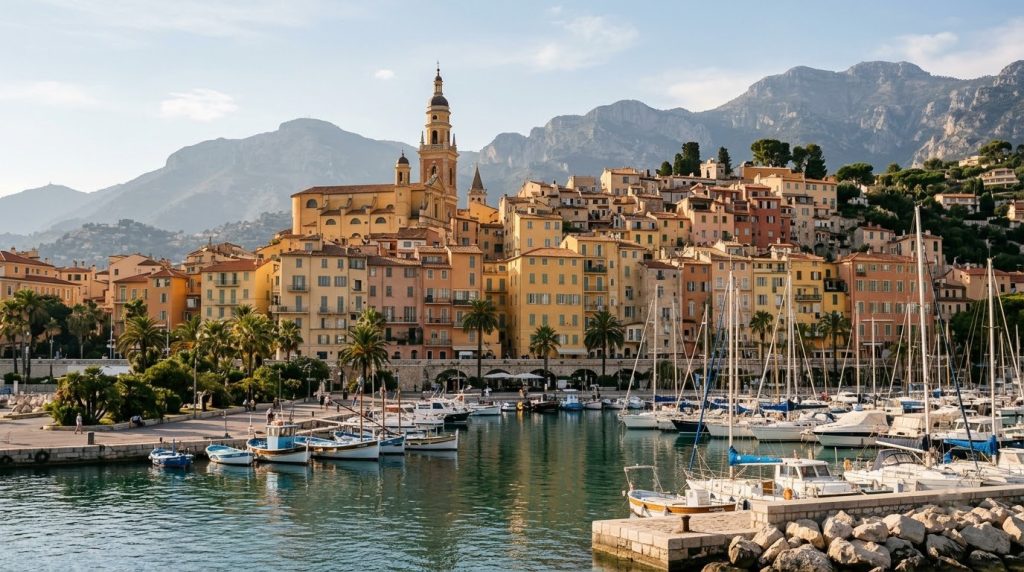
Best Menton Travel Guide 2026: The Hidden Pearl of the French Riviera
By TravelguidestipUpdated 2 min readHow we earn
Hotel buttons open Stay22 (Booking.com, Agoda and others) and tour buttons open GetYourGuide. We may earn a commission at no extra cost to you.
In short
- Menton’s microclimate is unique: 316 days of sunshine per year (Meteo France, 2025), warmer winters than anywhere else on the Riviera, and the reason lemons grow here while they freeze in Nice.
- The Lemon Festival (Fete du Citron) runs three weeks every February with citrus sculptures weighing up to 15 tons, parades, and 240,000 visitors. Book accommodation for festival dates at least two months ahead.
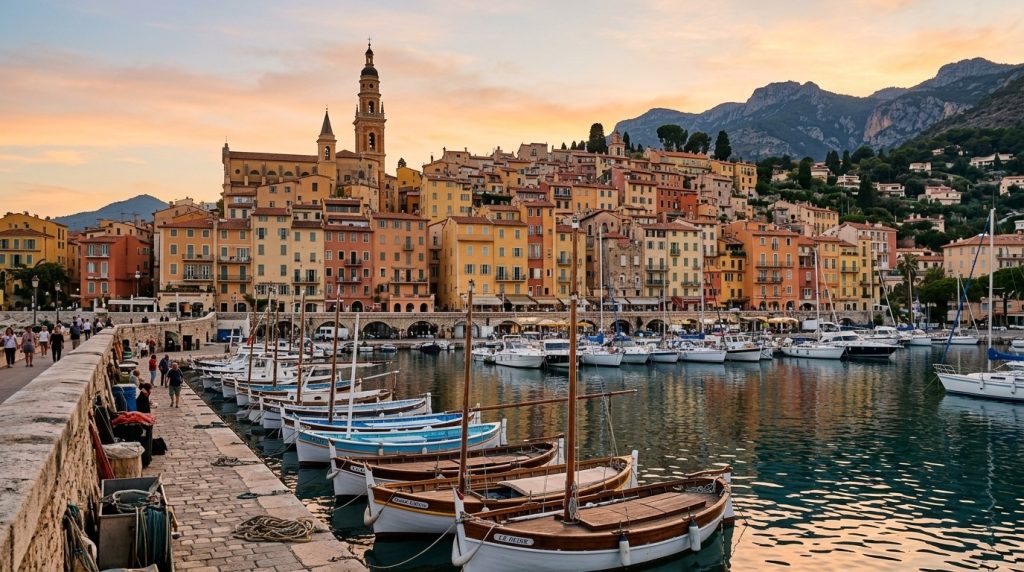
- The Old Town (Vieux Menton) is a vertical maze of pastel facades, trompe-l’oeil murals, and staircases that climb from the sea to the Cemetery of the Old Chateau. This is the visual heart of Menton, and every alley delivers a different shade of ochre, salmon, gold, and rose.
- Menton is 30-40% cheaper than Nice for comparable hotel rooms and restaurant meals. A three-course dinner for two costs 50-70 EUR versus 80-120 EUR in Nice’s old town.
- The Italian border is a 15-minute walk. The train to Ventimiglia takes 8 minutes and costs 3.20 EUR. Friday market in Ventimiglia is the largest in Liguria and a Menton morning well spent.
Quick answer: Menton is the last French Riviera town before the Italian border, a warm, pastel-Italianate old town wrapped in citrus gardens that stays calmer and cheaper than Nice or Monaco. Base yourself here for two to three days, ride the coastal train for day trips along the coast, and time a mid-to-late February visit around the Fete du Citron lemon festival if that is on your list.
Menton sits at the eastern edge of the French Riviera, pressed between the Mediterranean Sea and the foothills of the Alps, so close to the Italian border that you can walk into Ventimiglia for lunch. This is the town that Nice and Monaco overshadow, and that is precisely the point.
While 10 million visitors crowd into Nice each year and Monaco’s harbor fills with superyachts, Menton remains what the Riviera used to be: pastel-colored, lemon-scented, and genuinely slow.
This Menton travel guide covers why the last town before Italy deserves your Riviera time, the best things to do, the famous Lemon Festival that draws 240,000 visitors every February (Menton Tourism Office, 2026), the most beautiful photo spots, and how Menton stacks up against Nice and Monaco.
We only recommend services we have experienced or thoroughly researched. Learn more.
In early March, the lemon festival sculptures still stand on the Promenade du Soleil and the mimosa trees are in full yellow bloom. The recommendations below come from direct experience walking every staircase in the old town.
Why Menton Is the French Riviera’s Best Secret
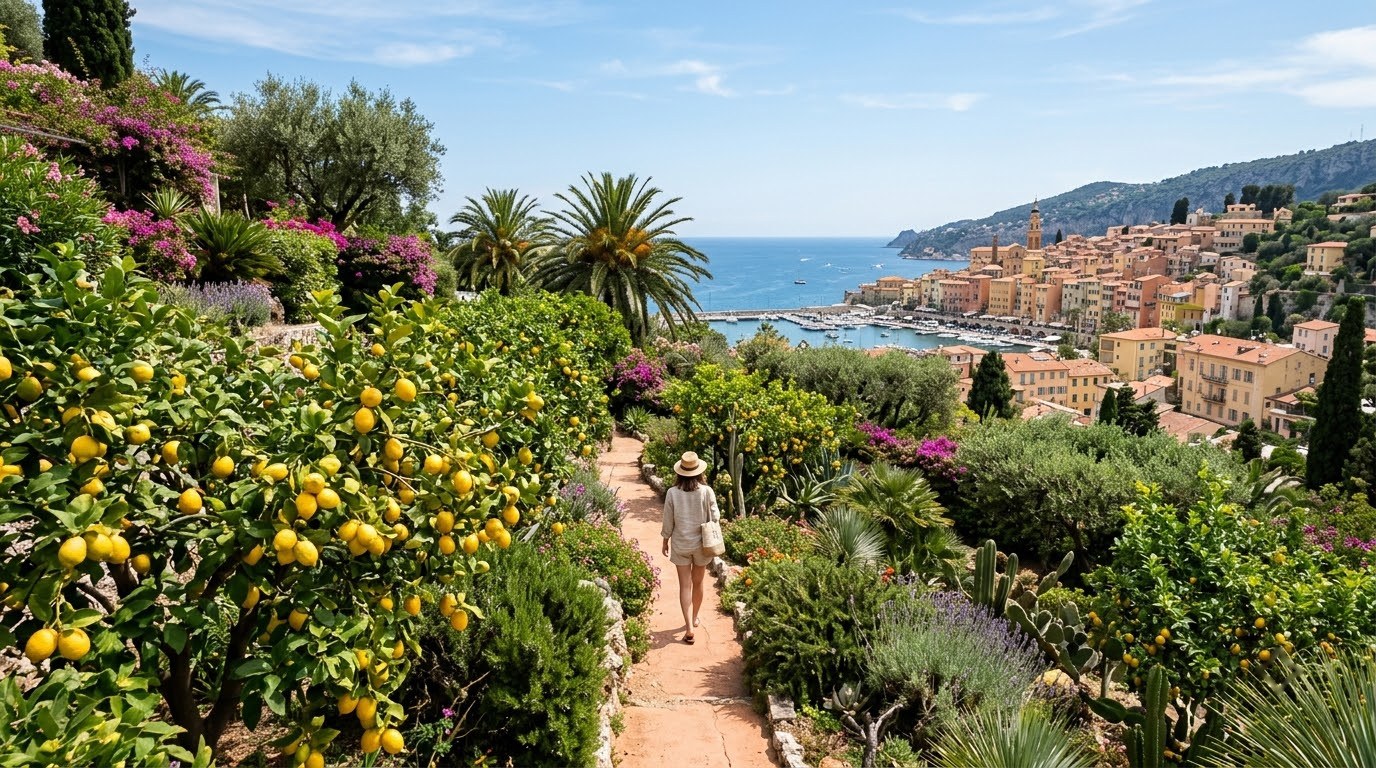
Menton exists in a climatic pocket. The Alps curve around the town in a natural amphitheater that blocks the mistral wind and traps the Mediterranean sun. This microclimate produces the warmest winters in continental France and the only commercial lemon groves on the French Riviera (Meteo France data, 2025).
The result is a town that feels simultaneously French and Italian, with baroque churches and pasta on every menu, where the buildings are painted in shades that Nice’s planning department would never approve. Menton does not have a Promenade des Anglais. It has a Promenade du Soleil, lined with palm trees and citrus planters, facing a bay where the water stays swimmable into October.
Jean Cocteau spent his final years here, decorating the wedding hall in the town hall (the Salle des Mariages, free entry) with murals depicting Orpheus and Mediterranean mythology. He called Menton “the pearl of France” and then proceeded to spend a decade proving the point by painting the town’s walls himself.
Best Things to Do in Menton
The Old Town (Vieux Menton)
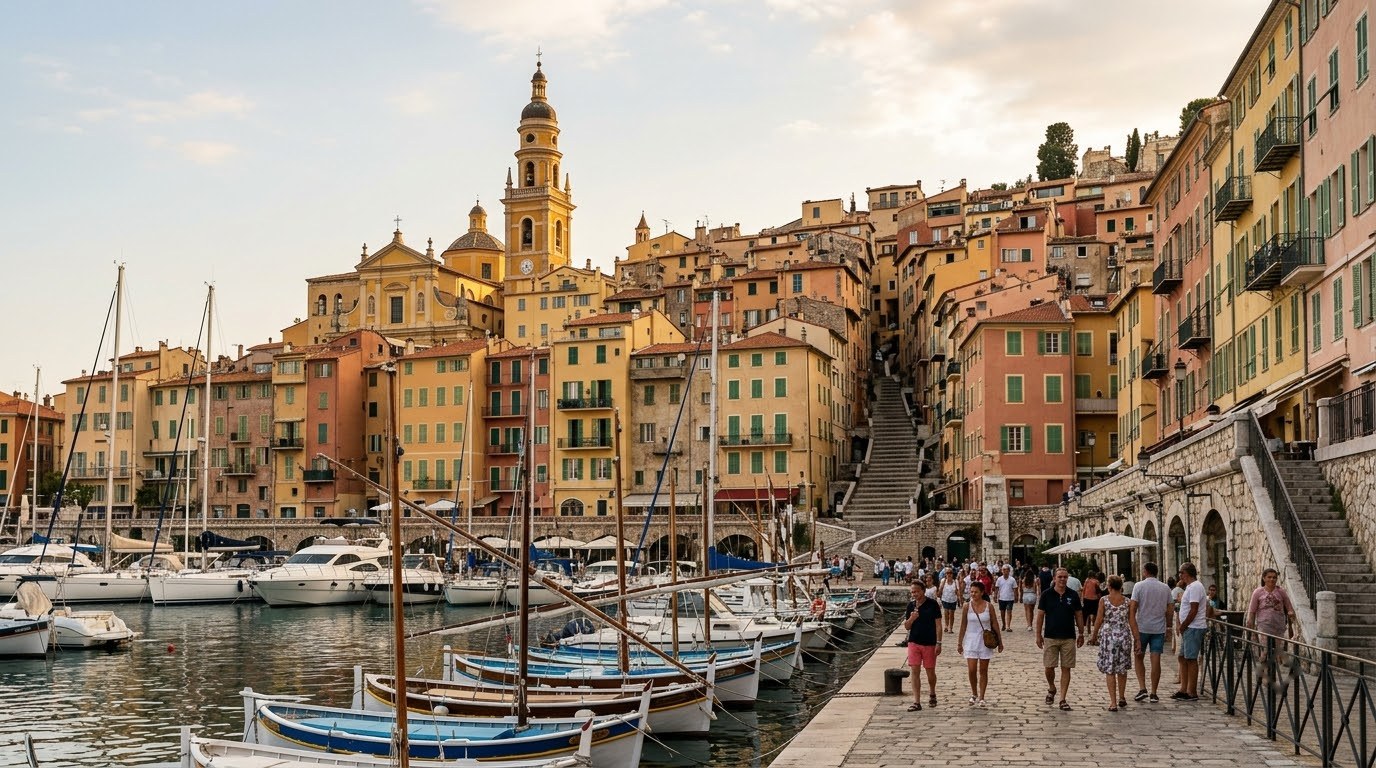
The old town climbs from the sea in a series of staircases, archways, and sudden piazzas. Every building is a different pastel shade: ochre, salmon, butter yellow, dusty rose. The streets narrow as you climb. Window boxes spill geraniums. Laundry hangs from wrought-iron balconies at improbable angles.
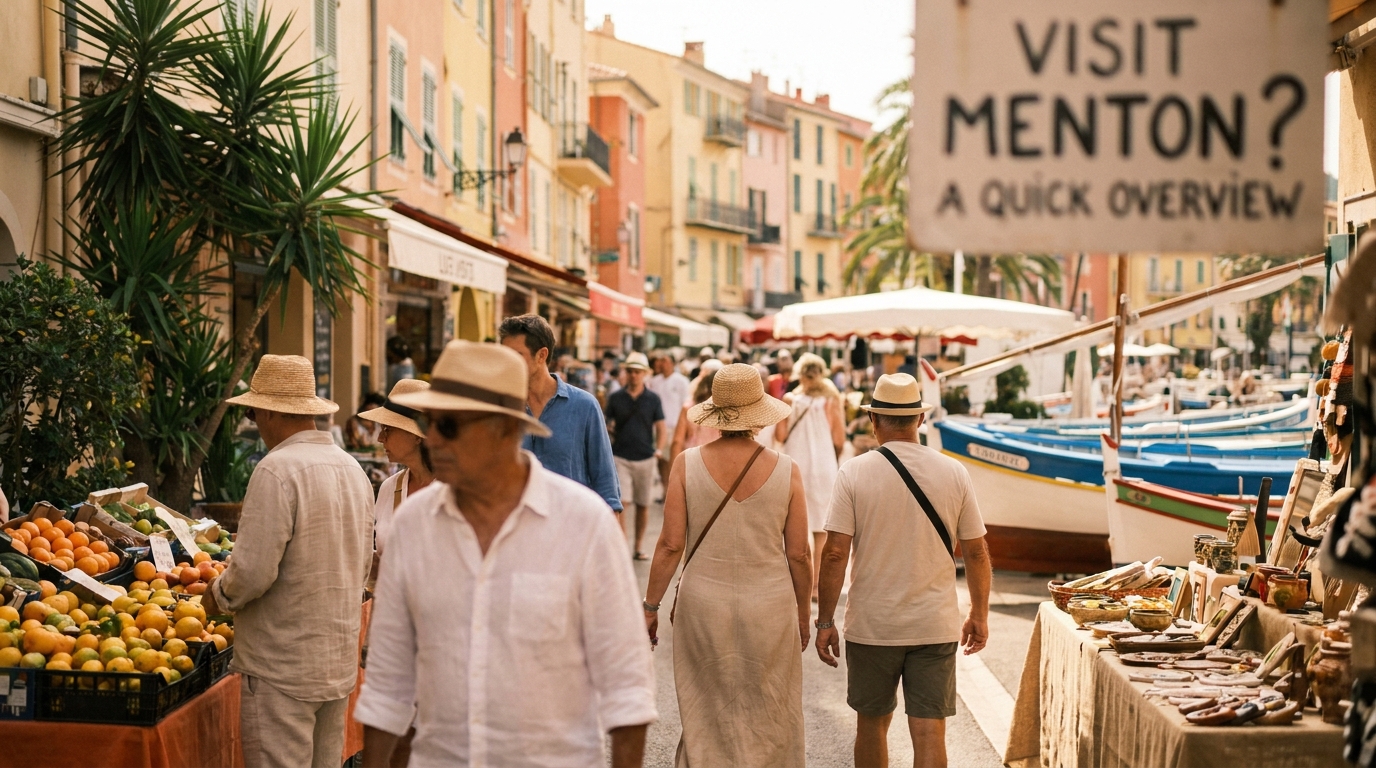
Start at the Basilique Saint-Michel Archange, a baroque church from 1675 whose bell tower dominates the skyline from every angle in town. The interior is a riot of gold leaf and marble. The square in front fills with the morning market (Tuesday and Friday) selling socca (chickpea flatbread, 3 EUR a slice) and pissaladiere (caramelized onion tart with anchovies and olives).
Continue upward through the Rue Longue, the oldest street in Menton, lined with artisan shops and the occasional glimpse of the sea through a gap between buildings. The Cemetery of the Old Chateau at the summit of the old town commands a view across the Menton bay to the Italian Riviera.
The cemetery itself is a terraced garden of cypress trees and marble tombs, and the panorama from the top terrace is the single best view in Menton.
Jean Cocteau Museum
The Bastion, a 17th-century fort on the seafront, was converted by Cocteau himself into a museum of his work. The collection spans drawings, ceramics, tapestries, and the pebble mosaics he designed for the floor. The building is small — 30 minutes covers it thoroughly — and the entry fee of 3 EUR makes it the best value museum on the entire Riviera.
Entry: 3 EUR. Open Wednesday-Monday, 10:00 AM-6:00 PM. Closed Tuesdays. The adjoining Severin Wunderman collection (a separate building, same ticket) covers Cocteau’s later years and his film work.
The Gardens
Menton’s climate supports a collection of gardens that would not survive anywhere else in France. The Serre de la Madone, a 20-minute walk from the old town, was created by Lawrence Johnston (the mind behind Hidcote Manor in England) in the 1920s. Rare plants from South Africa, Australia, and South America thrive on terraces overlooking the valley. Entry is 8 EUR.
The Val Rahmeh Botanical Garden (7 EUR) specializes in tropical and subtropical species, including a water lily pond that blooms in July and August. The Maria Serena Garden (free) on the seafront is a palm garden with 140 species of palm trees and a view of the old town from sea level.
The Famous Lemon Festival
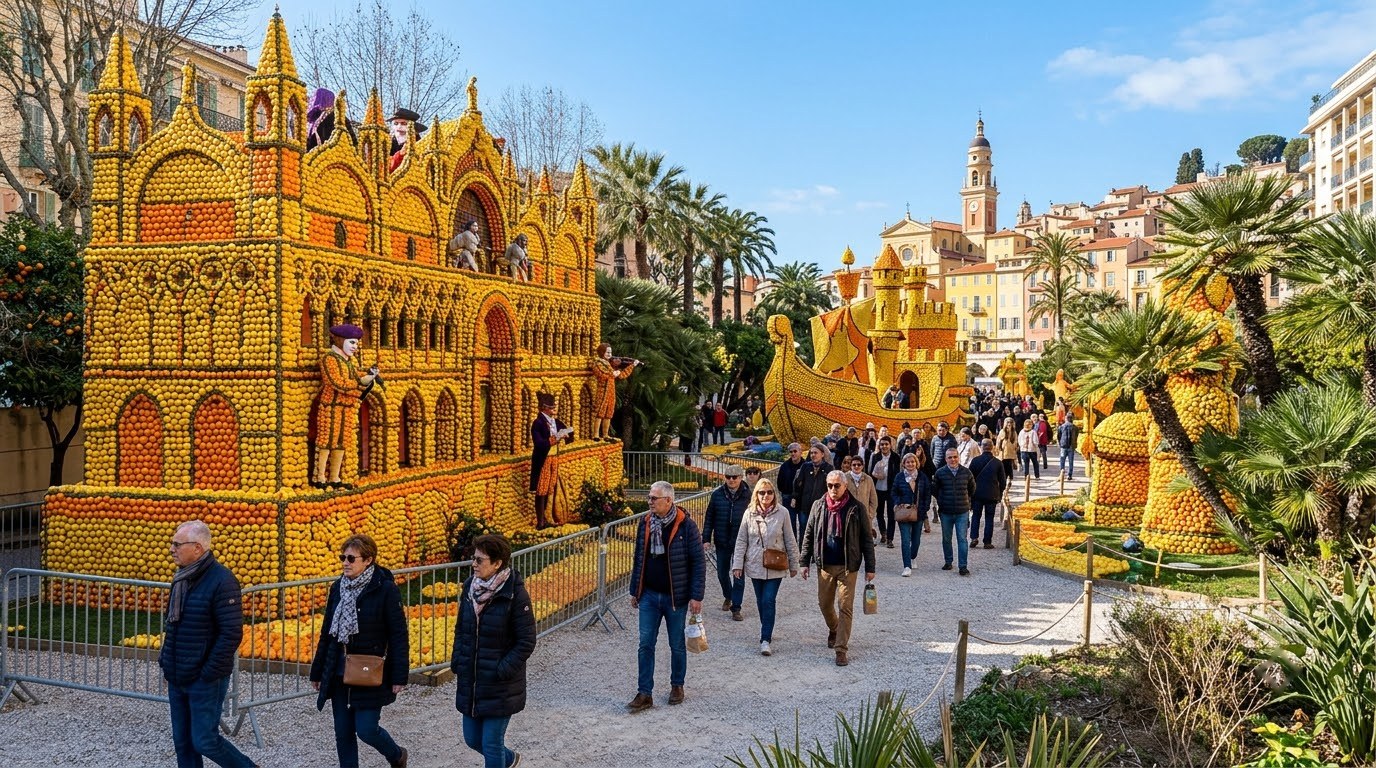
The Fete du Citron has been running since 1934, and it is the most wonderfully absurd festival on the French Riviera. For three weeks every February, the Promenade du Soleil fills with giant sculptures made entirely of citrus fruit. A Tyrannosaurus rex. The Taj Mahal. A full-size locomotive. All constructed from lemons and oranges pinned to wire frames by volunteers in yellow overalls.
The festival draws roughly 240,000 visitors across its three-week run (Menton Tourism Office, 2026). The Golden Fruit Parade on Sunday afternoons features floats covered in citrus, marching bands, and confetti cannons that blanket the crowd in biodegradable orange paper. Evening parades add fireworks over the bay.
Practical: Festival dates for 2026 run February 14 through March 4. Book accommodation at least two months ahead. Day visitors can park at the festival lots outside town and take the free shuttle. Entry to the sculpture gardens on the Promenade costs 12 EUR. The parades cost 10-15 EUR for standing tickets, 25 EUR for grandstand seats.
Skip the parade crowds on opening weekend. The second weekend has smaller crowds, and the citrus sculptures hold their color for the full three weeks because the organizers spray them with a natural preservative.
Find your Menton hotel on the map
Live prices from Booking & Airbnb — tap a pin to compare stays around Menton centre and beyond.
Most Beautiful Photo Spots in Menton
The Classic: Escalier des Sarcophages
The yellow staircase climbing from the Rue Longue to the old chateau cemetery is the most photographed spot in Menton. The steps are painted a yellow so saturated it seems artificial, framed by peeling pastel walls on both sides. Photograph from the bottom looking up, ideally with a person on the steps for scale. Morning light (before 10:00 AM) hits the staircase directly from the east.
The Reflection: Vieux Port
Menton’s old port is a working harbor with colorful fishing boats called pointus, their wooden hulls painted in red, blue, and green. The water is calmest in the morning. The pastel buildings of the old town reflect in the harbor basin when the wind is still. Photograph from the western quay looking toward the old town and the basilica above.
The Panorama: Cemetery Terrace
From the top terrace of the Cemetery of the Old Chateau, the view spans the entire Menton bay, the Cap Martin peninsula, the Italian coastline beyond, and on clear days, the mountains of Corsica on the horizon. A 24mm wide-angle captures the full sweep. The best light is late afternoon when the sun drops behind the cemetery cypresses and the sea turns silver.
The Detail: Trompe-l’oeil Murals
Menton’s old town walls are painted with dozens of trompe-l’oeil murals: windows that are not windows, balconies that are not balconies, figures leaning from imaginary sills. The best concentration is on Rue des Soeurs and the alleys leading off it. A 50mm lens isolates the details.
The murals were commissioned by the city in the 1990s as a public art project, and they have aged into the old town’s fabric so naturally that you now have to look twice to spot the illusion.
Menton vs Nice vs Monaco: Which to Visit
Choose Menton If…
You want charm over spectacle, quiet over crowds, and a genuinely lived-in old town rather than a tourist corridor. Menton has better food prices, warmer winters, and a pace that the rest of the Riviera lost somewhere around 1985. The beach is free (unlike much of the Cote d’Azur) and the water is clean.
The train to Nice takes 30 minutes (6.80 EUR) and runs every 30 minutes, so you can day-trip the big-city attractions without sleeping there.
Choose Nice If…
You want museums (Matisse, Chagall, Modern Art), proper nightlife, and the energy of a real city. Nice has the Promenade des Anglais, the Cours Saleya flower market, and a vastly better restaurant scene at the high end. Hotel prices are 30-50% higher. The beach is pebbles, not sand. Nice is a city that happens to be on the Riviera. Menton is a town that is entirely of the Riviera.
Choose Monaco If…
You want to see a country the size of a golf course that has more billionaires per square meter than anywhere else on Earth. Monaco is worth a half-day: the Oceanographic Museum (19 EUR, founded by Jacques Cousteau), the Prince’s Palace, and a walk around the marina to see boats the size of apartment buildings.
Then take the 8-minute train back to Menton for dinner at half the price. Monaco is a spectacle, not a destination. Menton is a destination, not a spectacle.
Frequently Asked Questions
How many days do I need in Menton?
Two to three days. One day for the old town, the Cocteau Museum, and the port. One day for the gardens and a morning trip to the Ventimiglia market. Three days allows a day trip to Nice or Monaco by train. Menton rewards slowing down more than rushing through a checklist.
Is Menton expensive compared to the rest of the French Riviera?
Menton is one of the most affordable towns on the Cote d’Azur. Hotels average 80-140 EUR/night, roughly 30-40% cheaper than equivalent rooms in Nice. A three-course dinner for two runs 50-70 EUR. A cafe creme at a waterfront terrace costs 3.50 EUR — it would be 6 EUR in Cannes.
What is the best time to visit Menton?
February for the Lemon Festival. March through May for mild weather, blooming gardens, and fewer crowds. June through August for beach days and 28-32 degrees C (82-90 F) temperatures. September and October for the best swimming weather and autumn light on the old town facades. Menton has 316 sunny days per year. There is no bad month. There are only slightly less good months.
How do I get to Menton?
Menton has a train station on the Marseille-Ventimiglia line. Trains from Nice take 30 minutes (6.80 EUR). From Monaco, 8 minutes (3.20 EUR). From Ventimiglia, Italy, 8 minutes (3.20 EUR). The nearest airport is Nice Cote d’Azur (45 minutes by train or bus). You can compare flights on Aviasales to find the cheapest dates and routes.
Which is better: Menton or Eze?
Eze is more dramatic visually with its hilltop medieval village and exotic garden. It is also more crowded, more expensive, and harder to reach without a car. Menton offers a more complete experience (old town, beach, gardens, restaurants, train access) spread across two to three days rather than a two-hour visit. Visit Eze as a half-day trip from Menton by bus (Bus 100, 30 minutes, 1.50 EUR).
Is Menton worth visiting outside the Lemon Festival?
Absolutely. The Lemon Festival is the busiest three weeks of the year. The other 49 weeks offer the same pastel old town, the same Mediterranean light, and significantly smaller crowds. Many regular visitors prefer Menton in May or September, when the town feels like it belongs to itself again.
Menton does not try to compete with Nice or Monaco. It sits at the edge of the country, growing lemons, painting its walls pastel, and quietly being the most beautiful town on the French Riviera that most visitors never reach. The train from Nice takes 30 minutes. The train back can wait until tomorrow.
Continue your Riviera journey with our upcoming guides to Nice and Monaco. For more European inspiration, explore our guides to Interlaken in Switzerland and Bruges in Belgium.
Sources: Menton Tourism Office (2025-2026), Meteo France (2025), SNCF train schedules (2026). Book: GetYourGuide for Riviera tours, Booking.com for hotels, Airalo for France eSIM from $6.
More European Travel Guides