Disclosure: Some links in this guide are affiliate links. If you book or buy through them, we may earn a small commission at no extra cost to you — it helps keep our guides free.
Best Positano Travel Guide 2026: Italy’s Dreamiest Coastal Town
Quick answer: Positano is a vertical cliff village on the Amalfi Coast best reached by ferry (roughly April to October) or the SITA bus rather than by car. Expect constant stairs, high prices, and midday day-trip crowds, so pack light, wear flat shoes, and stay overnight to have the town before and after the crowds.
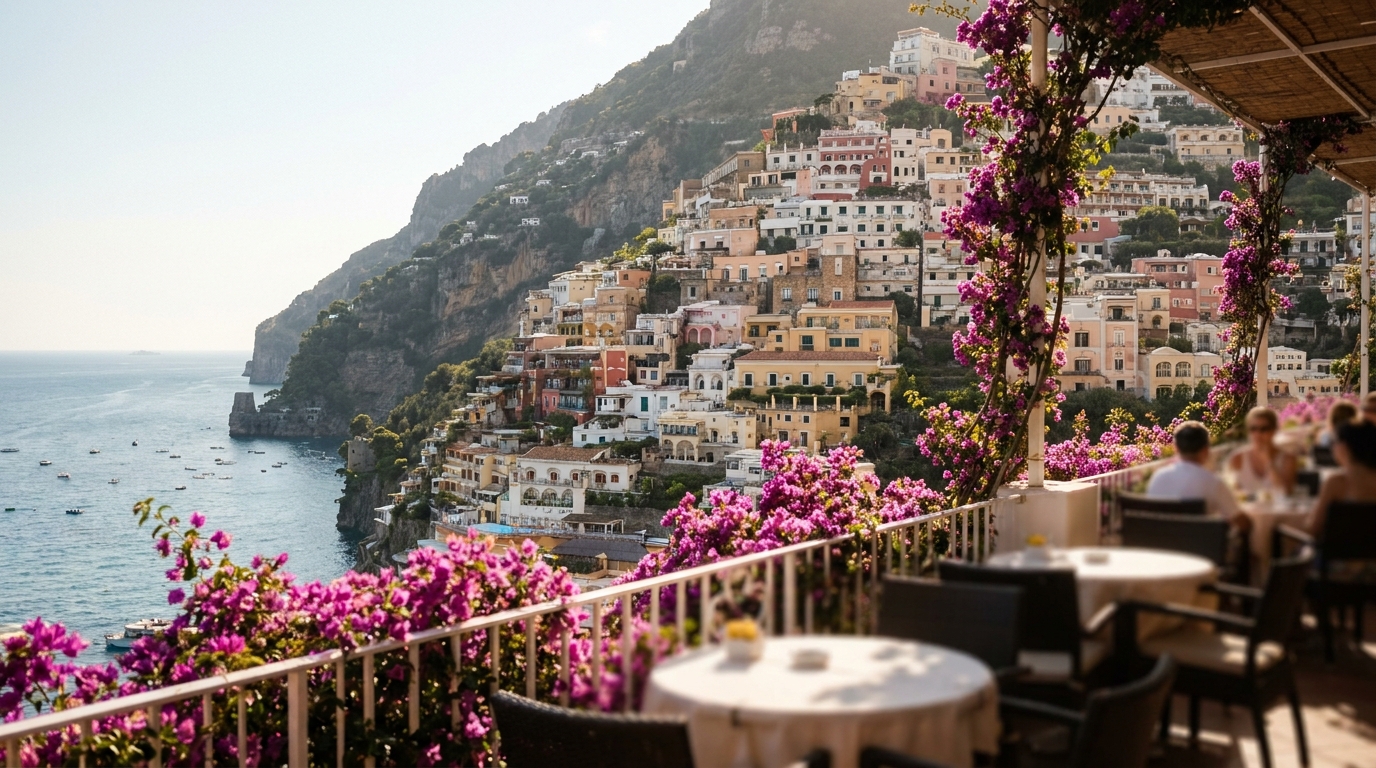
Positano does not sit on the Amalfi Coast so much as cascade down it. Pastel houses in lemon yellow, coral pink, and faded terracotta stack on top of each other like a vertical amphitheater facing the Tyrrhenian Sea. Bougainvillea spills over every wall. The dome of the Church of Santa Maria Assunta, covered in green and yellow majolica tiles, catches the Mediterranean sun from every angle. John Steinbeck wrote in 1953 that Positano “bites deep,” and nearly 75 years and several million visitors later, the bite has not faded.
This Positano travel guide covers why this vertical village is worth the hype, the best things to do, the most Instagrammable spots, where to stay for the best views, and the beaches in and around town.
Key Takeaways
– Positano is a vertical village of roughly 4,000 steps connecting the upper town to the beach. The stairs are the transport system. Pack light. The porter service from the ferry dock to your hotel costs 10 EUR per bag and is worth triple.
– Spiaggia Grande is the main beach and the most photographed stretch of sand on the Amalfi Coast. A sunbed and umbrella costs 25-30 EUR per day. The free public section at the eastern end of the beach is small but adequate.
– Positano is the most expensive town on the Amalfi Coast with hotels averaging 250-500 EUR/night in high season (June-September). Book 3-4 months ahead. November through March brings 40-50% lower rates and far fewer visitors.
– The Path of the Gods (Sentiero degli Dei) begins above Positano and delivers the best coastal hike in Italy, 7 kilometers of clifftop trail between Positano and Nocelle with views stretching to Capri.
– Parking costs 30-50 EUR per day. Do not drive to Positano unless you enjoy navigating hairpin turns in a Fiat Panda while Italian buses approach from the opposite direction. The ferry from Salerno or Amalfi is the better way to arrive.We only recommend services we genuinely trust. Learn more.
**** We have stayed in Positano across three visits, most recently for four nights in late May. The town at 7:00 AM, before the ferries start arriving, is a different universe from the town at 1:00 PM. Wake up early. Descend to the empty beach. Watch the morning light hit the dome of Santa Maria Assunta. The rest of the day can be whatever it wants to be. You already got the best of it.
Why Positano Is Worth the Hype

Positano was a quiet fishing village until the 1950s, when Steinbeck’s essay in Harper’s Bazaar introduced it to the American imagination. The transformation from fishing village to global destination happened across two generations, and the evidence is visible in every boutique hotel that occupies a former fisherman’s house and every restaurant terrace that commands a sea view once reserved for drying nets.
The vertical geography is the defining feature. Positano is built into the side of the Lattari Mountains at an angle that seems to defy physics. The main road (Via Pasitea, one-way, perpetually clogged) winds downward in a series of switchbacks. The pedestrian routes are staircases — narrow, steep, and endless. You will climb more steps in a day in Positano than in a week in most other destinations. The calf workout is included in the room rate.
The payoff for the stairs is the view. Every terrace, every window, every staircase landing frames the same composition: turquoise sea, pastel houses, green mountains, the dome of Santa Maria Assunta, and on clear days, the island of Capri floating on the horizon like a mirage. The view never gets old. The stairs do.
The 3-Day Positano Itinerary
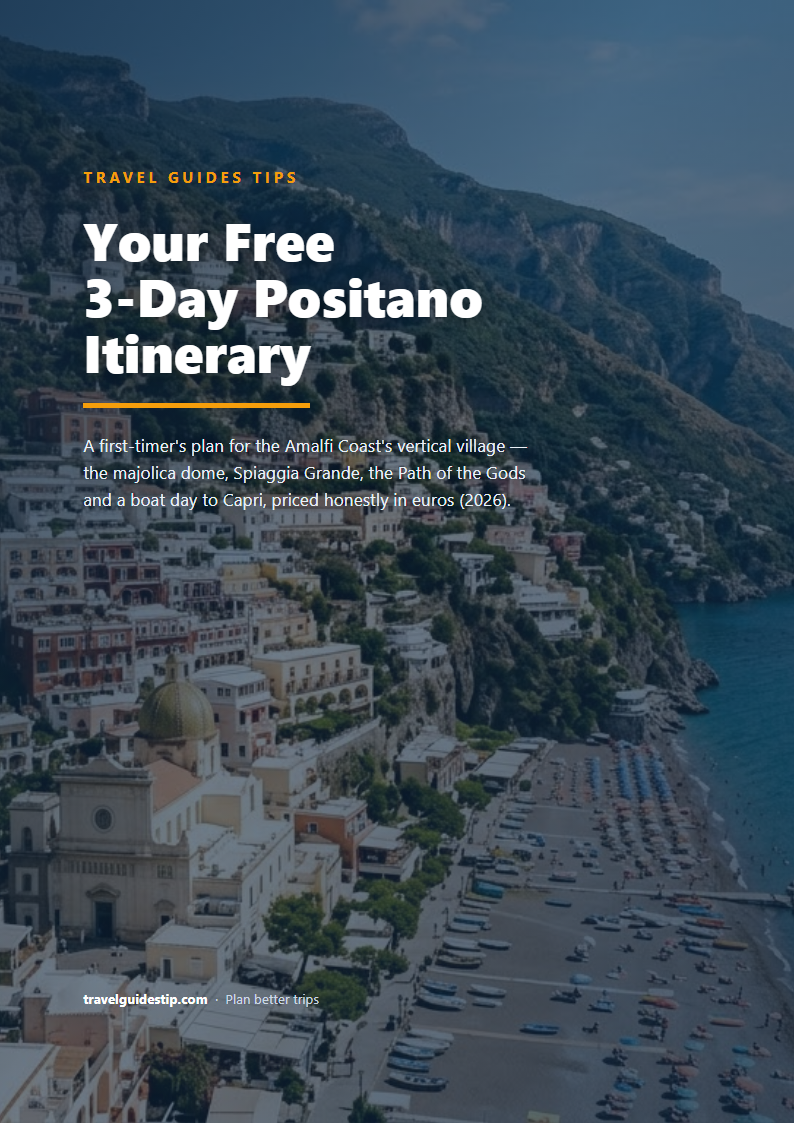
The plan we use ourselves — sent straight to your inbox.
- Day-by-day route
- Where to stay
- Real 2026 costs
Free · No spam · Unsubscribe anytime
Best Things to Do in Positano
Church of Santa Maria Assunta
The majolica-tiled dome of Positano’s main church is visible from every angle in town, a green and yellow half-sphere that catches the light and reflects it back at the sea. The interior holds a 13th-century Byzantine icon of the Black Madonna, brought to Positano by sailors who survived a storm in the Mediterranean while the icon was aboard. The story goes that the sailors heard a voice saying “Posa, posa” (put down, put down), interpreted as an instruction to leave the icon in the village. The town’s name derives from this legend.
The church is free to enter. The crypt beneath the altar has Roman-era columns and fragments of mosaic floor from a villa that stood on the site before the church was built. Open daily, pause for midday services.
Shopping the Vertical Streets
Positano’s shopping scene is concentrated along the pedestrian paths leading down from Via Pasitea toward the beach. The specialty is Positano fashion: linen dresses and shirts in white and neutrals, handmade leather sandals, and ceramics painted with lemons and Mediterranean motifs. The boutiques are small, family-run, and expensive for what they sell. The linen dress that costs 180 EUR in Positano costs 60 EUR in Naples. You are paying for the setting: trying on clothes in a whitewashed room with a sea view and a breeze carrying the scent of bougainvillea.
Maria Lampo (Via dei Mulini) is the best sandal shop, where sandals are made to measure in 20 minutes while you wait (from 40 EUR). Ceramica Assunta (Via Cristoforo Colombo) sells hand-painted ceramics in traditional Amalfi Coast patterns, including the iconic lemon designs (from 15 EUR for a small plate).
Boat Tour to Capri or the Grottos
A small-group boat tour along the Amalfi Coast from Positano stops at sea caves, hidden coves, and swimming spots accessible only by water. The Grotta dello Smeraldo (Emerald Grotto, 7 EUR separate entry) near Conca dei Marini is flooded with iridescent green light from an underwater opening. Tours to Capri (full day, 80-120 EUR) include stops at the Faraglioni rocks, the Blue Grotto, and free time on the island.
Most Instagrammable Spots in Positano
The Classic: From the Sea
The most iconic Positano photograph is taken from the water, looking back at the town with the pastel houses and the church dome stacked vertically against the mountain. The ferry from Amalfi or Salerno provides this angle for free. A 70-200mm lens compresses the layers. Morning light (before 10:00 AM) illuminates the facades directly. Late afternoon creates deep shadows that emphasize the vertical structure of the town.
The Secret: Via dei Mulini Above the Beach
From the top of the staircase leading down to Spiaggia Grande, where Via dei Mulini dead-ends at the pedestrian path, the view looks down on the beach umbrellas, the turquoise water, and the pastel houses climbing the opposite hillside. A 35mm lens captures the full scene. Go at 8:00 AM for empty beach umbrellas and clear morning light.
The Balcony: Le Sirenuse Hotel Terrace
The terrace of Le Sirenuse, Positano’s most famous hotel, faces directly across the town toward the church dome and the sea. Even if you are not a guest, the Champagne Bar is open to non-residents. A 20 EUR Aperol spritz buys you the best balcony view in Positano and a valid reason to linger for an hour. Go at sunset. The spritz comes with olives and the view comes free.
The Beach: Spiaggia Grande at Dawn
The main beach filled with orange umbrellas is a composition that appears on every Amalfi Coast guidebook cover. At 7:00 AM, before the sunbeds fill, you can photograph the empty beach with the town rising behind it. The angle from the western end of the beach, near the ferry dock, captures the full sweep of the coastline.
The 3-Day Positano Itinerary
Hour-by-hour plan, where to stay and what it really costs — free PDF.
Free · No spam · Unsubscribe anytime
Find your Positano hotel on the map
Live prices from Booking & Airbnb — tap a pin to compare stays around Positano centre and beyond.
Where to Stay for the Best Views
Le Sirenuse — The Icon
Location: Via Cristoforo Colombo, central Positano | From 900 EUR ($970 USD) | Rating 4.9/5
The most famous hotel on the Amalfi Coast occupies a former summer villa built in a style that blends Italian palazzo and Moorish influences. The pool terrace faces the church dome and the sea. The Michelin-starred La Sponda restaurant is lit by 400 candles each night. Every room has a sea view. At these prices, it should.
Best for: Honeymooners and travelers who want the Positano fantasy at its fullest expression. Book via Booking.com.
Hotel Poseidon — Mid-Range Terrace
Location: Via Pasitea, upper Positano | From 350 EUR ($375 USD) | Rating 4.7/5
The pool terrace at Hotel Poseidon delivers the same view as Le Sirenuse at roughly 40% of the price. The hotel is family-run since the 1950s. The terrace bar serves limoncello spritzes as the sun sets behind the church dome. Rooms with sea-view balconies book out months ahead.
Best for: Couples who want the Positano view without the Positano price tag (relatively speaking).
Buca di Bacco — Beachfront Mid-Range
Location: Spiaggia Grande waterfront | From 280 EUR ($300 USD) | Rating 4.5/5
The only hotel directly on Spiaggia Grande, Buca di Bacco has a restaurant terrace that extends over the sand. Wake up, walk ten steps, and your feet are in the Mediterranean. Rooms are comfortable rather than luxurious, but the beachfront location is unbeatable.
Best for: Beach lovers and anyone who does not want to climb stairs to get home at night.
Best Beaches in and Around Positano
Spiaggia Grande
The main beach is 300 meters of dark volcanic sand and pebbles with water that transitions from turquoise to deep blue within 30 meters of shore. Sunbeds and umbrellas cost 25-30 EUR per day from L’Incanto or Pupetto. The free public section at the eastern end is crowded by 10:00 AM in summer. The water is clean, the swimming is excellent, and the view of the town from the water is the Poseidon photograph you came for.
Fornillo Beach
A 10-minute walk along a coastal path from Spiaggia Grande (west of the ferry dock), Fornillo is smaller, quieter, and favored by locals. The Fornillo Beach Club (20 EUR for a sunbed and umbrella) serves lunch directly to your lounger. The water here is slightly cooler because a freshwater spring empties into the bay. The view looks west toward the Galli Islands, where Ulysses was said to have encountered the Sirens.
Arienzo Beach
Reached by 300 steps descending from the Arienzo bus stop at the eastern edge of Positano, Arienzo Beach is the most photogenic of the Positano beaches. The beach club (Da Adolfo, 25 EUR sunbed, book ahead at daadolfo.com) serves grilled seafood on wooden tables directly on the sand. The water is crystal-clear. The walk back up 300 stairs in the afternoon heat is the price of admission. A free shuttle boat runs from the main pier in summer.
Frequently Asked Questions
How many days do I need in Positano?
Three full days is the sweet spot. Day one for the town, the church, and Spiaggia Grande. Day two for a boat tour and shopping. Day three for the Path of the Gods hike and Fornillo Beach. Two days feels rushed. Four days allows a day trip to Capri or Ravello.
How do I get to Positano?
The easiest way is ferry from Salerno (70 minutes, 12 EUR) or Amalfi (25 minutes, 8 EUR), Travelmar ferries running April-October. The SITA bus from Sorrento (40 minutes, 1.80 EUR) winds along the coastal road in a vehicle that regularly confronts oncoming traffic on a road barely wide enough for one vehicle. The bus is an experience. The ferry is transport.
Is Positano expensive?
Yes. Positano is the most expensive town on the Amalfi Coast with hotels averaging 250-500 EUR/night in high season. Budget at least 300-500 EUR ($325-540 USD) per day for two people including mid-range hotel, meals, and activities. Budget travelers should stay in nearby Praiano (5 km west, 30-40% cheaper) and bus or walk into Positano.
What is the best time to visit Positano?
May, June, and September are ideal with 22-28 degrees C (72-82 F), full ferry schedules, and manageable crowds. July and August bring peak crowds and peak prices. April and October are quieter with the risk of rain. November through March is the low season with 40-50% lower hotel rates, many closed restaurants, and far fewer visitors.
Is Positano walkable?
Positano is only walkable if you can handle stairs. The town is built vertically, connected by pedestrian staircases rather than roads. There is no flat route between the upper town and the beach. Walking from the top parking lot to the beach involves roughly 400 steps down, and 400 back up. The stairs are part of the Positano experience.
Positano bites deep, as Steinbeck wrote. The stairs will exhaust you. The prices will deplete you. The crowds at midday will frustrate you. And then you will wake up at dawn, walk to your terrace, watch the first light hit the majolica dome and the turquoise sea, and understand completely why everyone keeps coming back.
For more Amalfi Coast inspiration, explore our guides to Amalfi town, Ravello, and the best coastal towns in Italy. For more European coastal beauty, read our Menton guide on the French Riviera.
Sources: Positano Tourism (2025-2026), Travelmar ferry schedules (2026). Book: GetYourGuide for boat tours, Booking.com for hotels, Airalo for Italy eSIM from $6.
More European Travel Guides
- Menton Travel Guide
- Ljubljana Travel Guide
- Bergen Travel Guide
- Bruges Travel Guide
- Giardini Naxos Travel Guide
- Grindelwald Travel Guide