Thailand 2 Week Itinerary
By TravelguidestipUpdated 12 min readHow we earn
Hotel buttons open Stay22 (Booking.com, Agoda and others) and tour buttons open GetYourGuide. We may earn a commission at no extra cost to you.
- Split
- 3 + 4 + 7 days Bangkok, Chiang Mai, Andaman coast
- Daily spend
- AUD 90-160 · USD 65-115 per person, before shopping
- Visa
- Up to 30 days visa exemption on arrival for Australians
- Plugs
- Type O, 220V Australian three-pin plugs need an adapter
The short answer
14 days covers 3 regions well: roughly 3 days in Bangkok, 4 in the north and 7 on the coast, as a highlights run rather than an attempt to see everything.
A 14-day Thailand trip covers 3 regions well — Bangkok, the north around Chiang Mai, and the Andaman coast islands — if you treat it as a highlights run rather than an attempt to see everything.
Split roughly 3 days in Bangkok, 4 in the north, and 7 on the coast, and each region gets enough time to breathe without transit eating half the trip. Push past 3 regions in 14 days and you spend more hours on planes, trains and ferries than at any single place.
| Day | Region | What you do |
|---|---|---|
| 1 | Bangkok | Arrive, Chao Phraya riverside, Wat Arun at sunset |
| 2 | Bangkok | Grand Palace, Wat Pho, Chinatown food crawl |
| 3 | Bangkok | Chatuchak Market, overnight train north |
| 4 | Chiang Mai | Arrive early, Old City temples, night bazaar |
| 5 | Chiang Mai | Ethical elephant sanctuary half-day, Doi Suthep |
| 6 | Chiang Mai | Thai cooking class, Sunday Walking Street |
| 7 | Chiang Mai | Doi Inthanon day trip, fly south |
| 8 | Krabi | Arrive Krabi, transfer to Ao Nang or Railay |
| 9 | Railay | Beach, viewpoint hike or a climbing lesson |
| 10 | Krabi | 4 Islands longtail day trip |
| 11 | Krabi | Phang Nga Bay day trip |
| 12 | Krabi | Rest day, beach, spa |
| 13 | Krabi | Second island day trip or snorkeling |
| 14 | Bangkok | Fly back to Bangkok, departure |
Bangkok: 3 days to land, adjust and hit the essentials
Three days in Bangkok is enough for the Grand Palace and Wat Pho, a Chao Phraya river run to Wat Arun, and one proper food crawl through Chinatown or Chatuchak, without trying to squeeze in every rooftop bar and museum on top. On a shorter trip, our one-week Thailand itinerary keeps those same 3 Bangkok nights and spends the other 3 on the beach or in Chiang Mai.
Arrive on Day 1 and go straight to a riverside area for the sunset over Wat Arun; jet lag from an Australian time zone is mild enough on this route that a light first evening works better than forcing a full day of sightseeing off the plane.
A mid-range hotel with air conditioning and a pool near Sukhumvit or Silom runs AUD 42-105 · USD 30–76 (THB 1,000-2,500) a night, and puts you close to the BTS for temple-hopping without relying on taxis in Bangkok traffic.
Readers building a longer stop here can go deeper with a dedicated 3-day Bangkok itinerary; on a 14-day trip, three days is the ceiling before it starts cutting into the north or the coast.
Bangkok to Chiang Mai: flight, sleeper train or bus
The first long leg of the route has three workable options. The right one depends on whether you value a saved hotel night, speed or price.
Flying
Flights take roughly 65 to 85 minutes in the air. Budget carriers Thai AirAsia, Nok Air and Thai Lion Air use Don Mueang (DMK), while Thai Airways, Thai VietJet and Bangkok Airways use Suvarnabhumi (BKK). Fares of about THB 1,000 or more (AUD 42 · USD 30) are typical when booked two to four weeks ahead, and the live range on one booking site ran from about THB 1,380 to THB 4,450 (AUD 58-185 · USD 42–135) depending on airport and date.
Check which airport your flight leaves from. Don Mueang and Suvarnabhumi are on opposite sides of the city.
Sleeper train
Overnight Special Express and Express sleepers run between the two cities, with second-class air-conditioned berths and first-class cabins on some services. Trains now use Krung Thep Aphiwat station in Bangkok, and every service also stops at Don Mueang station about 17 minutes before the terminus.
Tickets open 90 days ahead, a window the State Railway cut from 180 days in April 2026. Confirm the train number and times on the State Railway’s official booking site or by calling 1690, because some third-party sites still show older timetables.
Bus
Coaches run between Bangkok’s Mo Chit terminal and Chiang Mai’s Arcade terminal in roughly 9 to 12 hours, with online fares around THB 650-1,050 (AUD 27-44 · USD 20–32) depending on class. It is the cheapest option and the slowest.
For a 14-day trip, a flight or the sleeper is the sensible choice. The bus eats a day for a small saving.
North: 4 days in Chiang Mai for temples, elephants and food
Get from Bangkok to Chiang Mai on the overnight sleeper train, a classic first move that also saves a night of hotel cost — a second-class berth runs AUD 37-61 · USD 27–44 (THB 881-1,453), departing Bangkok’s Krung Thep Aphiwat Central Terminal (Bangkok’s long-distance rail hub) in the early evening and arriving the next morning.
Four days lets you cover the Old City’s temple cluster, Doi Suthep on the mountain above town, a half-day at an ethical elephant sanctuary — feeding and bathing only, never riding — at AUD 83-132 · USD 60–95 (THB 1,976-3,128) per person, and a cooking class or a day trip to Doi Inthanon National Park.
Check a best time to visit Chiang Mai guide before locking dates, since cool season (November to February) is when the north is at its best and busiest.
Optional stop: Sukhothai between Bangkok and Chiang Mai
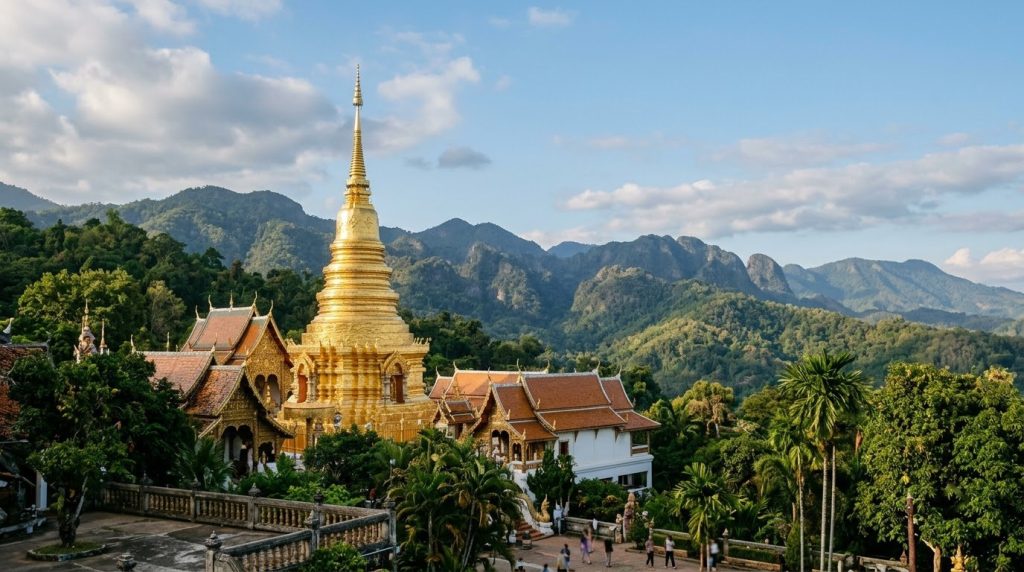
Travellers who want more history than Chiang Mai’s Old City can replace the direct leg north with a stop in Sukhothai. The Historic Town of Sukhothai and Associated Historic Towns was inscribed on the UNESCO World Heritage List in 1991, and it covers three ancient towns: Sukhothai, Si Satchanalai and Kamphaeng Phet.
UNESCO describes the towns as the earliest phase of Siamese art, architecture, language, religion and law, the base from which the first Thai state emerged. They shared a water-control system and were linked by a road called Thanon Phra Ruang. The protected area is large, at 7,000 hectares for Sukhothai alone, so the ruins suit a slow day on a bicycle rather than a rushed hour.
How it fits the 14 days
- Borrow one night from Chiang Mai or from the coast, since the Bangkok end is already tight at three days.
- Go north by the sleeper train or flight as planned, and treat Sukhothai as a stop on the road between the two, not a separate base.
- Skip it in the cool-season peak if transport is already booked solid. Sukhothai needs a spare day, and a missed connection here ripples into the island leg.
Anyone who would rather stay on the main route can swap Sukhothai for Ayutthaya, the older capital north of Bangkok and a long day trip from the city. Either choice replaces, rather than adds to, the Doi Inthanon or cooking class day in Chiang Mai.
South: 7 days on the Andaman coast, or swap to the Gulf
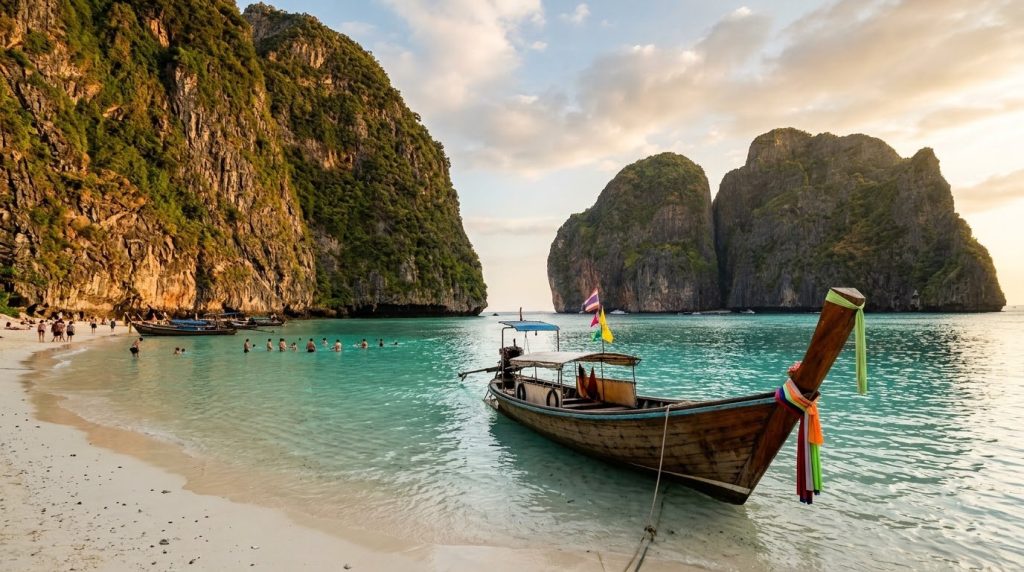
Fly from Chiang Mai back through Bangkok or on a seasonal direct route to reach the coast, then spend the remaining week on islands. This itinerary routes to Krabi and Railay Beach on the Andaman side, with a 4 Islands longtail day trip at AUD 25-34 · USD 18–24 (THB 600-800) and a second day trip to Phang Nga Bay.
The Andaman coast (Phuket, Krabi, Railay) runs driest from November to April, while the Gulf side (Koh Samui, Koh Phangan) has the opposite pattern, staying calmer from roughly January through September and taking its heaviest rain around October to December.
Travelling in the shoulder months, swap the back half of this itinerary to the Gulf instead of the Andaman coast and the pacing barely changes; travelling from June to September, Andaman islands are the safer bet even though it is technically their low season, since Gulf-side swells and ferry cancellations tend to cluster later in the year.
Check a best time to visit Thailand guide before you fix the island leg, since this is the one decision in the whole route where the calendar, not preference, should decide.
What two weeks in Thailand actually costs
Food is the easiest line item to underestimate. A plate at a street stall or simple local restaurant runs AUD 4-8 · USD 3–6 (THB 100-200), while a sit-down dinner for two at a mid-range restaurant lands around AUD 38 · USD 27 (THB 900), with a typical range of AUD 25-104 · USD 18–76 (THB 600-2,500) depending on the venue.
Stacking three meals a day at the cheaper end against the hotel, transport and activity prices already covered region by region gives most travellers a realistic daily spend of roughly AUD 90-160 · USD 65–115 per person, before any shopping or big-ticket day trips beyond the ones already built into this route.
Cash still matters outside hotels and malls. Thai ATMs commonly add their own fee on top of whatever a home bank charges, typically around AUD 8-11 · USD 6–8 (THB 200-250) per withdrawal, so fewer, larger withdrawals beat topping up every day or two.
| Region | Nights | Rough daily spend (food + local transport) |
|---|---|---|
| Bangkok | 3 | AUD 70-130 · USD 50–94 |
| Chiang Mai | 4 | AUD 85-150 · USD 61–108 (elephant sanctuary day higher) |
| Krabi & Railay | 7 | AUD 95-170 · USD 68–123 (island-tour days higher) |
Across 14 days, that puts a realistic all-in budget for one person, excluding international flights, somewhere from about AUD 1,700 at the lean end to AUD 3,200 for a comfortable mid-range trip, once accommodation, the elephant sanctuary, both day trips and the sleeper train are added to daily food and transport.
Travellers splitting a room or skipping the pricier tours can land under that range; anyone upgrading hotels along the Andaman coast or adding extra speedboat charters should expect to sit above it.
Travel insurance is worth budgeting for separately rather than skipping to save a few dollars. A policy that covers hospital treatment and medical evacuation matters more on a multi-region trip like this one, where a missed ferry or a clinic visit on an island can otherwise turn expensive fast.
Domestic flights and the sleeper train both get pricier and sell out faster the closer it gets to school holidays and the December-to-February peak, so locking in the Chiang Mai-to-coast flight and the overnight train berth weeks ahead protects both the budget and the itinerary.
What to cut if you have fewer than 14 days
Drop to 10 days and the north is the first thing to cut, not the coast: skip Chiang Mai entirely and spend the freed-up days as 4 in Bangkok and 6 on the islands, since the elephant sanctuary and Old City temples are the hardest single block to compress without rushing.
At 7 days, cut further and pick one region only — Bangkok plus a single island base, skipping the internal flight and train entirely.
A traveller with 12 days can keep all 3 regions but should shave a day each off Bangkok and the coast rather than touching the 4 days in Chiang Mai, since the north is the part of this route with the least slack once the elephant sanctuary, Doi Suthep and a cooking class are all in.
What should not get cut, even under time pressure, is the buffer day before an international flight home; islands run on ferry and flight schedules that slip in bad weather, and a same-day connection to an international departure is the itinerary mistake that causes the most missed flights on this route.
If you would rather keep the north, our Bangkok and Chiang Mai version pairs 3 Bangkok nights with 6 in Chiang Mai, linked by one short domestic flight.
Visa and money basics for Australians
Australian passport holders do not need to arrange a visa before flying to Thailand for a holiday. The visa exemption granted on arrival covers a stay of up to 30 days, which comfortably covers this 14-day route with plenty of room to spare if plans change.
Travellers wanting to stretch a trip past 30 days can apply for a single 30-day extension at an immigration office inside Thailand, rather than needing to arrange anything before departure.
Immigration can, in theory, ask arriving visitors to show proof of funds: the guideline is 10,000 THB per person (about AUD 420 · USD 303) or 20,000 THB per family (about AUD 841 · USD 606), in cash or an equivalent foreign currency.
Checks are inconsistent in practice, but having the cash or a card able to show an equivalent balance ready is worth the small effort.
Keep a saved or printed copy of the onward or return flight booking as well. It is occasionally requested at the immigration counter, and not having it on hand can slow down what is usually a fast arrival process.
A debit or travel card that does not charge foreign transaction fees is worth setting up before leaving Australia, since it is the one visa-and-money step that actually saves money every single day of the 14, rather than only mattering at the border.
Hold on to a copy of the hotel booking for the first few nights too. Immigration occasionally asks where arriving visitors plan to stay, and having an address ready, printed or on a phone, is enough to clear the counter without delay.
None of this paperwork is unusual or Thailand-specific, but a multi-region 14-day trip is exactly the kind of itinerary where a slow immigration queue on day one can eat into the first Bangkok afternoon, so having everything ready before boarding the flight is worth the ten minutes it takes.
Is this route safe in 2026?
Thailand sits at Smartraveller’s level 2 of 4, “exercise a high degree of caution,” as of September 2026, which covers the country broadly rather than flagging Bangkok, Chiang Mai or the Andaman islands specifically.
The one active “do not travel” zone covers land within 50km of the Cambodia border, a strip of country nowhere near Bangkok, Chiang Mai or the southern coast, so it does not touch this itinerary and is not worth building a route decision around.
What to pack for Bangkok, the north and the coast
This route crosses three different climates in 14 days, so packing light and layering beats packing for one environment. Bangkok and the coast are hot and humid year-round; Chiang Mai in the cool season (November to February) can feel genuinely chilly after dark.
A light long-sleeve layer earns its space for both the overnight train and temple visits, where shoulders and knees need to be covered at the Grand Palace, Wat Pho and the Chiang Mai temple cluster. Quick-dry fabrics handle the humidity better than cotton on the coast.
For the islands, pack reef-safe sunscreen, a dry bag for the longtail boat transfers to the 4 Islands and Phang Nga Bay, and sandals with a decent grip for wet jetty steps and limestone paths. A basic first-aid kit with rehydration sachets covers the most common travel upset without needing a pharmacy run.
One sarong or light scarf does double duty as temple cover-up, beach towel substitute and train blanket, and is lighter than packing three separate items for three separate regions.
- Bangkok and coast: light breathable fabrics, a rain shell for sudden showers, reef-safe sunscreen
- Chiang Mai cool season: one warmer layer for evenings, closed shoes for the Doi Inthanon day trip
- Temples (all regions): shoulders and knees covered, easy slip-on shoes for removing at entrances
- Islands: dry bag, snorkel-friendly sandals, a spare phone pouch for the longtail transfers
Power, plugs and staying connected
Thailand runs on 220V at 50Hz, and the standard socket is Type O, though most hotel sockets also accept the flatter two-pin plugs common across Asia and North America. Australian three-pin plugs do not fit without an adapter, so pack a universal travel adapter rather than relying on borrowing one.
An eSIM installed before departure avoids the airport SIM-card queue and works the moment the plane lands in Bangkok. Airalo’s Thailand eSIM runs about AUD 29 · USD 21 for 7 days of unlimited data, or about AUD 43 · USD 31 for 10 days, so a 14-day trip needs either two short plans or a longer pass bought ahead of time.
Coverage is strong in Bangkok and Chiang Mai and generally reliable around the main Krabi and Railay tourist areas, though it can drop out on remote stretches of the Andaman coast and during some boat transfers, so download offline maps for each region before leaving a hotel with working wifi.
A portable charger earns its weight on travel days. Between the overnight train, the flight south and a full day of island hopping, phone batteries rarely make it through without a mid-afternoon top-up.
Where to stay on the coast
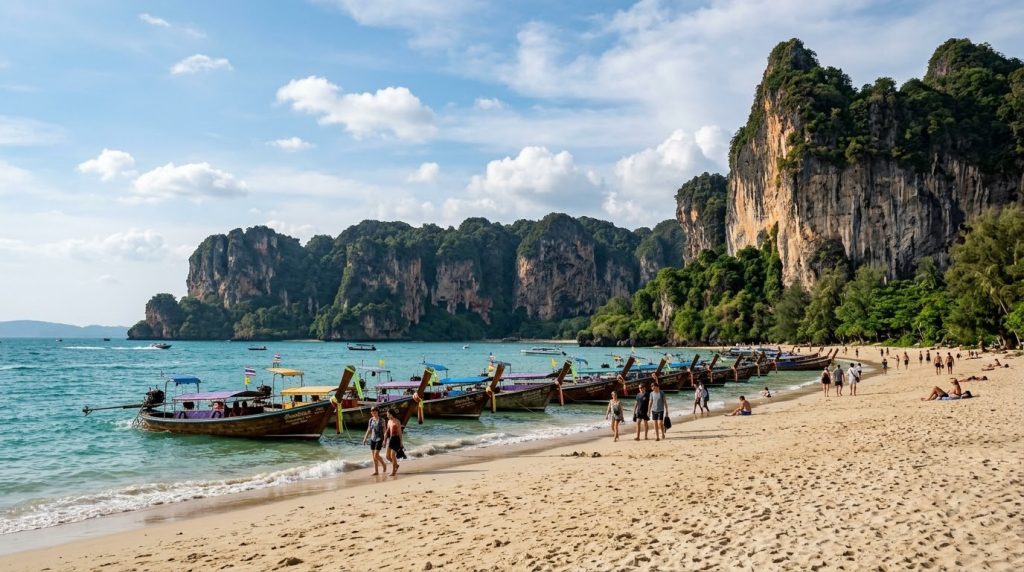
Krabi and Railay both work as a coastal base, and which one suits you depends on whether you want beach bars and easy transfers (Ao Nang, Krabi Town) or a quieter, boat-access-only stretch of limestone cliffs (Railay). Compare options in a Krabi hotels guide before booking, and use the map below to check live prices against where each day trip actually departs from.
Find your Bangkok hotel on the map
Live prices from Booking, Airbnb and more — move the map or change dates to compare stays before you build the rest of the route.