Disclosure: Some links in this guide are affiliate links. If you book or buy through them, we may earn a small commission at no extra cost to you — it helps keep our guides free.
Ten days in Thailand works best with 2 bases, not 4: spend 3 nights in Bangkok, then 6 nights either in Chiang Mai in the north or around Krabi on the Andaman coast, joined by a domestic flight of roughly 1h10 to 1h25.
Every extra base costs about half a day in transfers, which on a 10-day trip is the beach afternoon you flew all that way for. Choose your second base by month and the trip almost plans itself.
| Days | Route A: Bangkok + north | Route B: Bangkok + Krabi coast |
|---|---|---|
| 1–3 | Bangkok: Grand Palace, river, markets | Bangkok: Grand Palace, river, markets |
| 4 | Fly or overnight train to Chiang Mai | Fly to Krabi, shuttle to Ao Nang |
| 5–6 | Old City temples, Doi Suthep | Railay by longtail, beach time |
| 7–8 | Ethical elephant park, cooking class | Phi Phi or island-hopping day trip |
| 9 | Free day: markets, cafes, massage | Free day: kayaking or a quiet beach |
| 10 | Fly back to Bangkok for your flight home | Fly back to Bangkok or connect via Krabi |
Pick your second base by month, not by habit
The Andaman coast (Krabi, Phuket) gets the southwest monsoon from roughly May to October, peaking in September, so Route B shines from November to April. The north is coolest from November to February, but February to April is burning season in Chiang Mai, with smoke peaking in March. The Gulf islands such as Koh Samui are wettest from October to December. With only a week, a seven-day Thailand route uses the same rule: beach from November to April, Chiang Mai while the Andaman monsoon runs.
For Australians: September–October school holidays lean north while the Andaman is still wet; January suits either route; Easter trips suit Krabi far better than smoky Chiang Mai. Our guide to the best time to visit Thailand by region has the month-by-month detail.
Days 1–3: Bangkok, without burning out
Direct flights from Sydney take roughly 9h15 to 9h50 with Thai Airways or Qantas. From Suvarnabhumi, the Airport Rail Link reaches Phaya Thai in 26 to 30 minutes for AUD 1.90 · USD 1.35 (THB 45).
Entry rules changed recently: since 15 September 2026, Australians get 30 days visa-free instead of 60, and you must complete the Thailand Digital Arrival Card within 72 hours before arrival. Sort data before landing too; our Thailand eSIM guide for Australian travellers compares plans so you can book a Grab from arrivals.
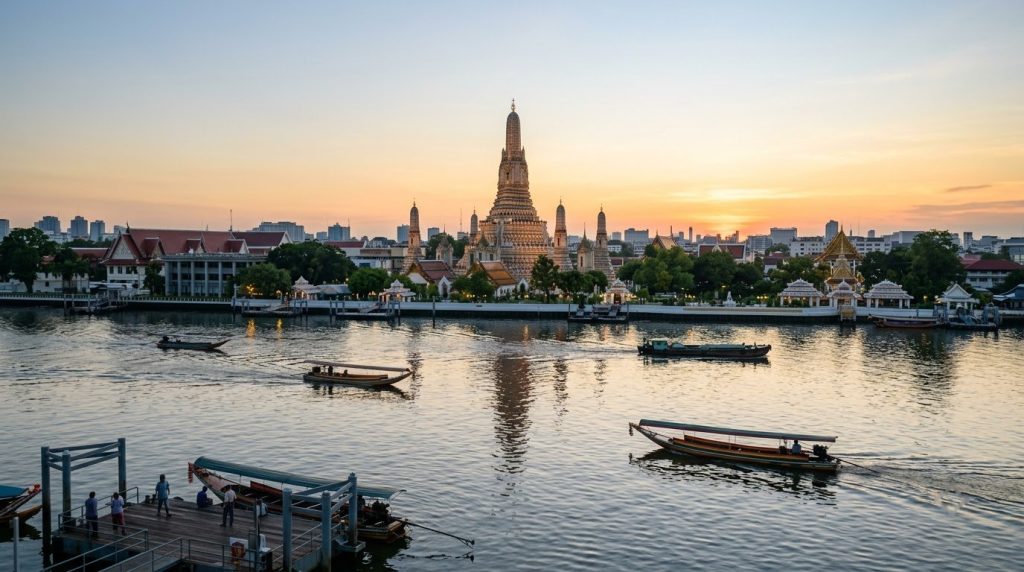
– Day 1: Arrive, street food, early night. – Day 2: The Grand Palace at 8:30am opening, before the heat. Entry is AUD 21 · USD 15 (THB 500) and covers Wat Phra Kaew. Walk to Wat Pho, then ferry across to Wat Arun at sunset. – Day 3: Chatuchak on a weekend, or Chinatown and a canal boat. Rest through the afternoon heat.
Route A, Days 4–10: Chiang Mai and the north
Getting there: Flights take about 1h10 to 1h25, with budget fares from around AUD 27–37 · USD 20–27 (THB 662–895). The alternative is the overnight sleeper from Krung Thep Aphiwat Central Terminal (it replaced Hua Lamphong for long-distance trains), taking about 13 hours. A second-class berth costs AUD 39–50 · USD 28–36 (THB 940–1,200). Sleepers sell out weeks ahead in peak season.
– Days 5–6: Old City temples on foot, then Wat Phra That Doi Suthep, where foreigner entry is quoted at AUD 1.25–2.10 · USD 0.90–1.50 (THB 30–50).
Climb the 306-step naga staircase or take the tram. – Days 7–8: An elephant sanctuary that offers no riding, plus a cooking class with a market tour. – Day 9: Sunday Walking Street or the night bazaar, and a long massage. – Day 10: Fly to Bangkok and connect home, leaving a generous buffer between flights.
Route B, Days 4–10: Krabi and the Andaman coast
Getting there: Bangkok to Krabi is about 1h25 in the air. The airport shuttle to Ao Nang costs AUD 6 · USD 4.50 (THB 150) and takes 55 to 60 minutes with hotel drop-offs.
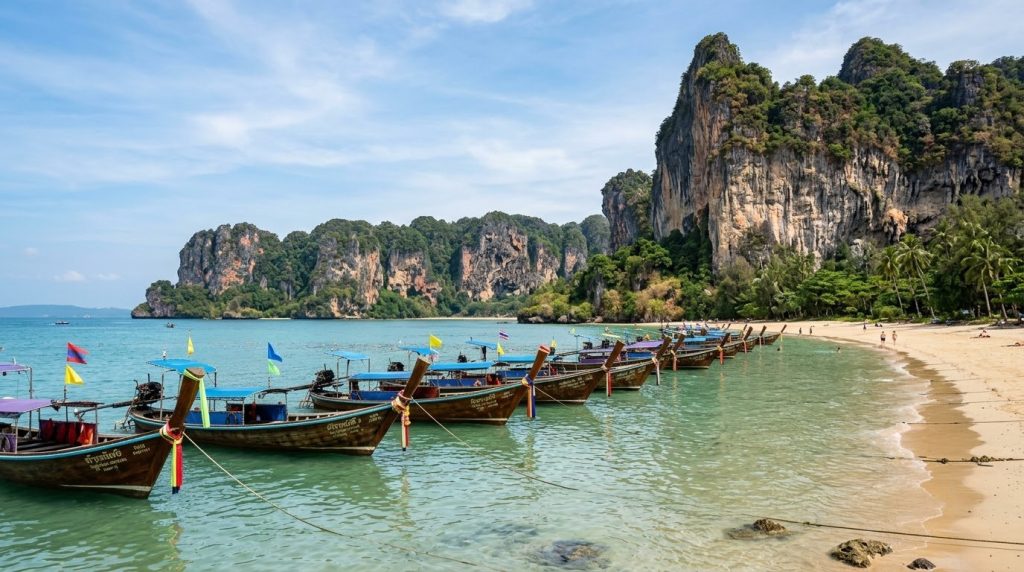
– Days 5–6: Shared longtails to Railay leave from Ao Nang beach, take 10 to 15 minutes and cost AUD 4 · USD 3 (THB 100) each way, more after 6pm.
Go early and swim at Phra Nang. – Days 7–8: Ferries to Koh Phi Phi from Nopparat Thara Pier take about 50 minutes, at AUD 25–37 · USD 18–27 (THB 615–900); park fees are extra. Do it as a day trip. – Day 9: Mangrove kayaking or a slow beach day. – Day 10: Fly from Krabi, connecting through Bangkok.
What to cut if 10 days starts feeling like 6
The classic mistake is Bangkok, Chiang Mai, Krabi and Koh Samui in 10 days: three internal flights, three check-outs and roughly two days lost to airports. Drop these instead:
– The third region. Pick north or coast. Want both? Use our two-week Thailand route. – Pai. It is a long, winding road from Chiang Mai each way. – Overnights on Phi Phi. A day trip gives the views without another packed bag. – A long Bangkok stay. City-averse? Cut it to 2 nights and give the spare night to your second base.
Still deciding on the country? Our Thailand vs Vietnam comparison explains why Thailand’s short domestic hops suit a two-base trip.
Staying safe on the road
Smartraveller rates Thailand “exercise a high degree of caution”, with “do not travel” for areas within 10km of the Thailand–Cambodia land border. Neither route goes near it. Everyday risks are scooters, jet skis and drink spiking, covered in our guide to whether Thailand is safe for Australians.
Where to stay in Thailand, base by base
– Bangkok, Riverside or Old Town: best for first-timers who want the Grand Palace and river ferries on the doorstep. – Bangkok, Sukhumvit (near BTS): better for couples who want rooftop bars, malls and the Skytrain. – Chiang Mai Old City or Nimmanhaemin: Old City for temples on foot, Nimman for cafes and a younger crowd. – Ao Nang or Railay: Ao Nang for easy restaurants and boats; Railay for car-free calm, though luggage transfers are by longtail.
Find your Thailand hotel on the map
Live prices from Booking, Airbnb and more — move the map or change dates to compare stays across Thailand.
Frequently Asked Questions
Is 10 days enough for Thailand?
Yes, 10 days is enough for Bangkok plus one region done properly. Three nights in Bangkok and six in Chiang Mai or Krabi gives you temples, food and beaches without living in airports. It is not enough to see the north, the Andaman coast and the Gulf islands together, so pick one second base and save the rest for another trip.
Should I choose Chiang Mai or the islands for 10 days?
Choose by month. From November to April, Krabi and the Andaman coast have their driest, calmest seas. From November to February, Chiang Mai is cool and clear, but February to April brings heavy smoke. In the wet months, the north handles rain better than a beach holiday, because temples and cooking classes still work in a downpour.
Do Australians need a visa for a 10-day Thailand trip?
No. Since 15 September 2026, Australians receive 30 days visa-free on arrival, down from 60, which easily covers 10 days. You must complete the Thailand Digital Arrival Card online within 72 hours before landing and show the QR code at immigration. Need longer? A one-time 30-day extension is available at immigration.
Is the overnight train to Chiang Mai worth it?
It is worth it if you enjoy the journey and book a lower berth early. Overnight trains from Krung Thep Aphiwat take about 13 hours and save a night of accommodation. If you only have 10 days, though, the roughly 1h15 flight leaves you more energy for Chiang Mai. Many travellers take the train north and fly back.