Bangkok 3-Day Itinerary (2026)
By TravelguidestipUpdated 10 min readHow we earn
Hotel buttons open Stay22 (Booking.com, Agoda and others) and tour buttons open GetYourGuide. We may earn a commission at no extra cost to you.

| Day | Area | Where to sleep | Price/night (AUD · USD) |
|---|---|---|---|
| 1 | Rattanakosin (Old City) | Riva Surya Bangkok | AUD 69–139 · USD 50–100 |
| 2 | Sukhumvit | S31 Hotel Sukhumvit | AUD 83 · USD 60 |
| 3 | Riverside/Silom | ibis Bangkok Riverside | AUD 76 · USD 55 |
This 3-day Bangkok itinerary covers Rattanakosin’s temples, Sukhumvit’s malls and nightlife, and the Riverside strip near Chinatown for about AUD 289 · USD 208 per person twin-share, including three hotel nights, meals, transit, and temple tickets. It suits Australian travellers with 3 to 4 days in Bangkok who want central sightseeing without the longer day-trips built into a 5-day trip. Extending well beyond the capital, our Thailand 2-week itinerary maps the full route.
How to Get to Bangkok
Suvarnabhumi Airport (BKK) is Bangkok’s main international gateway and the arrival point for most flights from Australia. The airport connects to the city rail network through the Airport Rail Link, which runs into the BTS Skytrain at Phaya Thai station.
Ticket prices on the Airport Rail Link follow the same distance-based tiers as the BTS fares used through this itinerary, so a single journey into the city costs a similar amount to the Skytrain hops used on Day 2.
Don Mueang Airport (DMK), north of the city, handles many regional low-cost carrier flights and connects to central Bangkok mainly by taxi or airport bus, rather than a direct rail line of its own.
Metered taxis queue outside both terminals and add a fixed airport surcharge plus any expressway tolls on top of the fare shown on the meter, so confirm the driver starts the meter rather than offering a flat quote.
Travellers arriving with check-in luggage or landing late at night often prebook a private transfer or hotel pickup instead, trading a slightly higher cost for a fixed price agreed before arrival and no queueing at the taxi rank.
How to Get Around Bangkok
The BTS Skytrain’s Sukhumvit and Silom lines cover most of the stops used on Day 2 and Day 3 of this itinerary, and fares are paid with a stored-value Rabbit Card or a single-journey ticket bought at the station.
The Rabbit Card also covers the Bus Rapid Transit (BRT) and works as a payment method at shops and restaurants affiliated with the BTS network, which makes it worth topping up on arrival rather than buying single tickets for every trip.
The MRT subway’s Blue and Purple lines run on a separate system and are not compatible with the Rabbit Card. Riders use either a single-journey token or a rechargeable MRT Plus card instead, and tapping a contactless bank card has been accepted on the MRT since January 2022, which is the simplest option for a short visit.
The MRT’s newer Yellow and Pink monorail lines, on the city’s outer edges, accept cash, contactless bank cards, and the Rabbit Card, so they are more flexible than the older Blue and Purple lines for travellers mixing fare systems in one day.
For the river stops on Day 1 and Day 3, the Chao Phraya Express Boat runs several commuter lines identified by flag colour rather than one flat fare. On weekdays, the Orange Flag line charges 19 THB, the Yellow Flag line 24 THB, and the Red Flag line a discounted 33 THB, down from a standard 50 THB.
These boats are a cheap, scenic alternative to a taxi along the river stretch of this itinerary, and the pier names match the stops already used on Day 1 and Day 3 above.
Grab and Bolt ride-hailing apps are widely used in Bangkok and remove the need to haggle with a metered taxi driver over a route or a flat fare, which is useful after dark or when carrying shopping bags back from Sukhumvit.
Best Time to Visit Bangkok
Bangkok runs on three broad seasons rather than four: a cooler dry season from November to February, a hot season from March to May, and a rainy season running from roughly May into October.
December is the coolest month, with an average low of about 23.2°C, which makes it one of the most comfortable stretches for the long outdoor stints at Grand Palace and Wat Pho built into Day 1 of this itinerary.
April is the hottest month, with an average high around 35.7°C and a recorded extreme of 41.0°C on 7 May 2023. Travellers visiting between March and May should move the Day 1 temple walk to the early morning and treat the afternoon as rest time rather than sightseeing time.
September is the wettest month, averaging around 336mm of rain, as the rains that begin in mid-May build toward their peak before easing off in October. The “When NOT to follow this itinerary” section above already flags June to October as the riskiest window for this exact loop, and the wettest point inside that window falls in September.
November through February is the best overall match for this itinerary: cooler temperatures suit the walking-heavy Day 1 route, and lower rainfall cuts the odds of a downpour cutting short time at Wat Arun or the river crossing on Day 3.
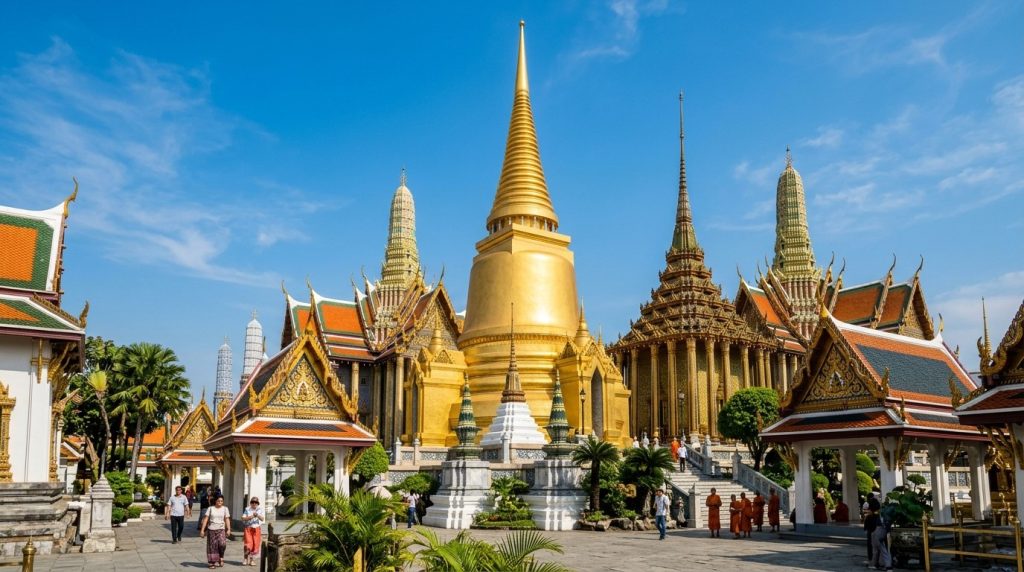
Day 1 — Rattanakosin: Grand Palace and Temple Loop
Grand Palace opens at 8:30am and charges 500 THB (AUD 21 · USD 15) entry, a ticket that also covers Wat Phra Kaew and the Queen Sirikit Museum of Textiles.
Wat Pho sits a 10-minute walk south and costs 300 THB (AUD 13 · USD 9) per person, home to the reclining Buddha hall and open daily from 8am to 6:30pm.
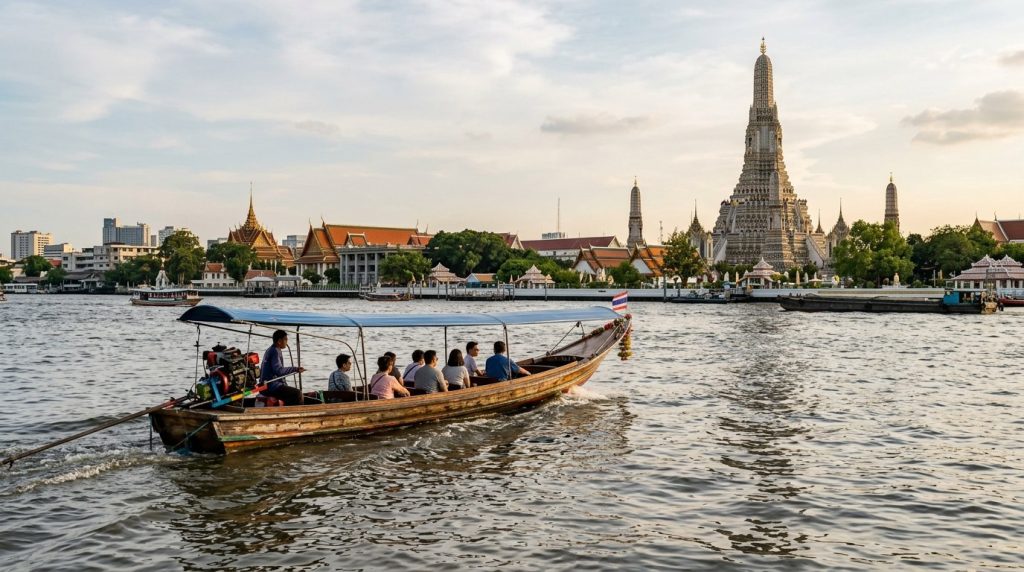
A cross-river ferry from Tha Tien Pier to Wat Arun costs 3–5 THB and takes about 3 minutes, and Wat Arun itself charges 200 THB (AUD 8 · USD 6) entry, open 8am to 6pm with last entry at 5:30pm.
Riva Surya Bangkok, a mid-range hotel in the Rattanakosin district, costs AUD 69–139 · USD 50–100 (THB 1,650–3,300) per night at September 2026 rates, with comparable Old City options listed in travelguidestip’s guide to the best hotels in Bangkok.
Dinner on Khao San Road runs 40–100 THB (AUD 2–4 · USD 1–3) per street-food dish, a 5-minute walk from the hotel.
Find your Rattanakosin (Old City) hotel on the map
Live prices from Booking, Airbnb and more — move the map or change dates to compare stays around Rattanakosin (Old City).
Day 2 — Sukhumvit: Shopping and Skytrain Bangkok
Sukhumvit sits one BTS line away from Rattanakosin, and a single Skytrain journey costs 17–65 THB (AUD 1–3 · USD 0.50–2) depending on distance travelled. Siam Paragon and CentralWorld charge no entry fee, two malls that cover air-conditioned shopping and food courts through the midday heat.
S31 Hotel Sukhumvit, on Soi 31, costs around AUD 83 · USD 60 (THB 1,980) per night at September 2026 rates, a short walk from Phrom Phong BTS station. Rooftop bars along Sukhumvit charge 280–600 THB (AUD 11–25 · USD 8–18) per cocktail, a price range consistent with travelguidestip’s own Bangkok cost data.
Terminal 21 mall, opposite Asoke BTS station, gives a final stop for a food-court dinner before Day 3.
Find your Sukhumvit hotel on the map
Live prices from Booking, Airbnb and more — move the map or change dates to compare stays around Sukhumvit.
Day 3 — Riverside/Silom: River Cruise and Chinatown
Chinatown’s Yaowarat Road sits a 15–32 THB (AUD 0.70–1.40 · USD 0.50–1) Chao Phraya Express Boat ride from the Riverside pier, with dim sum dishes costing 60–150 THB (AUD 3–6 · USD 2–4.50) each. Ibis Bangkok Riverside costs around AUD 76 · USD 55 (THB 1,810) per night at September 2026 rates, close to the Sathorn boat pier.
Asiatique The Riverfront charges no entry fee, a night market and riverside dining strip that covers dinner on the last night. A Thai massage before departure costs 200–300 THB (AUD 8–12 · USD 6–9) per hour, based on travelguidestip’s own Bangkok budget figures.
This loop keeps every stop a short boat or Skytrain ride from the next, unlike the wider day-trips built into a longer Bangkok trip.
Find your Riverside/Silom hotel on the map
Live prices from Booking, Airbnb and more — move the map or change dates to compare stays around Riverside/Silom.
Total cost breakdown
These figures total the mid-range, twin-share cost of the loop above, calculated at September 2026 exchange rates (1 USD is approximately 32.93 THB and approximately AUD 1.388).
This AUD 289 · USD 208 total sits well below the mid-range total published for the site’s own longer Bangkok trip, which runs USD 550–950 per person across five days and adds transport out to floating markets and Chatuchak Weekend Market.
Per day, this 3-day route averages AUD 96 · USD 69 per person, a rate that lands inside the mid-range daily estimate of USD 50–80 already published in the site’s Bangkok cost data. The gap between the two trips comes mainly from fewer hotel nights and no long day-trip transport, not from cheaper temple tickets or food.
Hotel quotes in the table above typically exclude a 7% VAT and 10% service charge added separately at checkout, a standard already noted on travelguidestip’s own Bangkok hotel pages.
Travellers who want to upgrade one dinner to fine dining should budget 1,000-8,000+ THB (AUD 42-337 · USD 30-243) per person for that single meal, well above the 150-500 THB casual-dining range used in the food line above.
| Category | AUD | USD | THB |
|---|---|---|---|
| Hotels (3 nights, twin-share) | 132 | 95 | 3,128 |
| Food (3 days, street food + casual dining) | 97 | 70 | 2,305 |
| Transport (BTS/MRT/ferry/Airport Rail Link) | 17 | 12 | 395 |
| Tickets (Grand Palace, Wat Pho, Wat Arun) | 43 | 31 | 1,021 |
| Total | 289 | 208 | 6,849 |
Source: figures calculated from travelguidestip’s own Bangkok budget guide and hotel data, plus verified 2026 attraction and transit fares (see Research Notes).
When NOT to follow this itinerary
Skip this route during the rainy season from June to October, when afternoon downpours cut short outdoor time at Wat Arun and Wat Pho. If you are unsure the city deserves even three nights, our take on whether Bangkok is worth visiting explains who should skip it entirely.
Skip it too on a budget under AUD 42 · USD 30 a day, the backpacker tier mapped out in travelguidestip’s Bangkok budget guide, since this loop’s mid-range hotels alone start at AUD 69 a night.
Families travelling with children under about 6 years old should slow the pace, since Grand Palace’s courtyards and Wat Pho’s steps cover several kilometres of walking with little shade before midday.
Both temples also enforce a strict dress code, requiring shoulders and knees fully covered before entry, and staff turn away shorts, sleeveless tops, and leggings worn as pants at the gate.
That dress code creates a real risk of a wardrobe delay on Day 1 alone, since Grand Palace and Wat Pho sit back to back on the morning schedule with no hotel stop in between.
Skip this exact route during Songkran, Thailand’s water festival held nationwide every April 13-15, since Khao San Road and the streets around it turn into a citywide water fight that makes the Day 1 walking route between temples slower and wetter than usual.
Travellers who want Chatuchak Weekend Market, a floating market day trip, or a Muay Thai night should add extra days rather than force those stops into this tighter 3-day loop.
If You Have 4 Days in Bangkok
A fourth day works best as a single add-on rather than a reshuffle of the three days above, since Day 1 through Day 3 already move in a logical loop between Rattanakosin, Sukhumvit, and the Riverside/Silom strip.
Ayutthaya, the former capital of Siam north of Bangkok, is the most common extra-day trip from the city. Its ruined temples and brick chedis were inscribed as a UNESCO World Heritage Site in 1991, and most visitors cover the main ruins as a single long day trip by train or an organised van tour rather than an overnight stay.
Travellers who would rather stay inside the city can use the extra day for Jim Thompson House, a teak house-turned-museum built by the American silk entrepreneur credited with reviving Thailand’s silk industry, and Wat Saket on the Golden Mount, an elevated temple platform that gives a rooftop-level view over the Old City without the entry queue at Grand Palace.
Both options slot in after Day 3 rather than before it, since they sit outside the compact loop this itinerary is built around and work better as a dedicated day than a stop squeezed between the existing three.
Either choice also pairs naturally with the 5-day itinerary linked in the Alternatives section below, since a fourth day spent on Ayutthaya or the Golden Mount leaves Chatuchak Weekend Market, the floating market day trip, and a Muay Thai night as fresh reasons to add a fifth.
Alternatives
Travellers with 5 days or more should follow the 5-day Bangkok itinerary, which adds Chatuchak Weekend Market, a floating market day trip, and a Muay Thai night that this shorter loop skips.
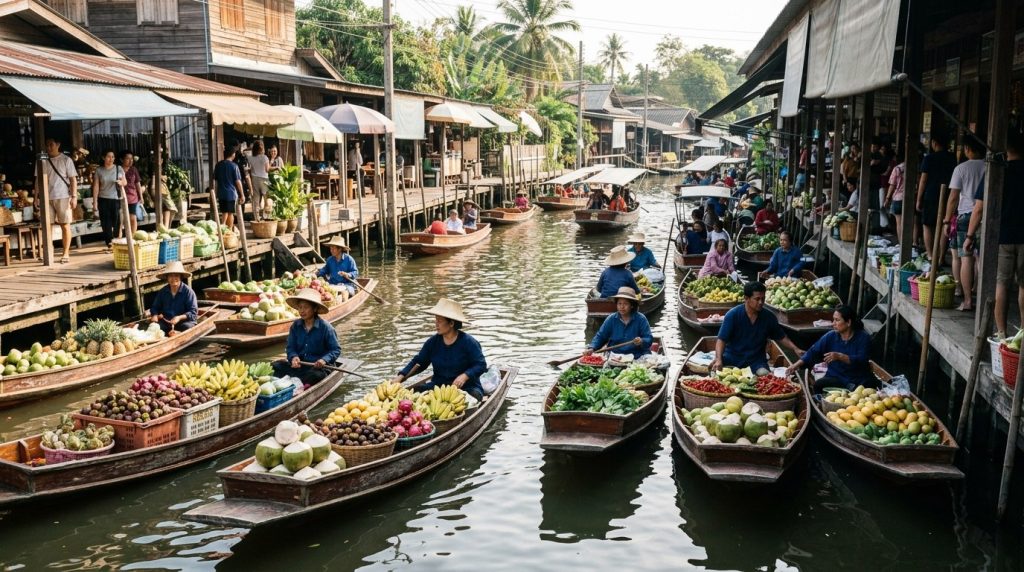
That longer route also spreads hotel nights across Sukhumvit, Silom/Sathorn, and Khao San Road rather than the three central areas covered here, and it swaps a portion of central sightseeing for a full day outside the city at the floating market.
Choose the 3-day version when flight connections or a stopover cap the trip at 3 or 4 nights, and choose the 5-day version when a Muay Thai match or a market day trip matters more than staying central.
Both versions start from the same Rattanakosin morning, so switching from one plan to the other mid-trip only means adding or dropping days from the back half of the schedule rather than rebuilding Day 1.
Those still deciding between Thailand and Vietnam altogether can compare cost and pace in Hanoi vs Bangkok, which found Bangkok drew over 22 million international visitors against Hanoi’s 6.7 million in 2024.