Disclosure: Some links in this guide are affiliate links. If you book or buy through them, we may earn a small commission at no extra cost to you — it helps keep our guides free.
Thailand is safe for the vast majority of its visitors: Smartraveller rates it Level 2, “exercise a high degree of caution,” and the World Health Organization attributes roughly 20,000 deaths a year nationwide to road accidents, not crime.
The one place to genuinely avoid is a narrow strip along the Thailand-Cambodia border, nowhere near Bangkok, Phuket, Chiang Mai, or any of the islands. How it compares with its neighbour on cost and safety is set out in Thailand vs Cambodia.
| Risk | How likely | How serious | What actually prevents it |
|---|---|---|---|
| Road and motorbike accidents | High | Severe — around 20,000 deaths a year nationwide | Valid licence, a real helmet, no riding at night or after drinking |
| Drowning and rip currents | Moderate, seasonal | Severe — 20 to 40 deaths a year in Phuket alone | Obey red and black flags, swim only at patrolled beaches |
| Scooter and jet-ski deposit scams | Common | Financial, rarely physical | Photograph existing damage, pay by card, never leave your passport |
| Drink spiking near nightlife strips | Occasional | Moderate to severe | Watch your own drink, leave with people you arrived with |
| Cambodia border conflict | Very low for tourists | Severe if ignored | Stay out of the 50 km border zone entirely |
| Everyday theft and street scams | Common | Low, mostly financial | Hotel safe, no unattended bags, standard caution |
The real dangers are traffic and water, not crime
Traffic and drowning cause far more harm to visitors in Thailand than crime does. The World Health Organization’s Global Status Report on Road Safety puts the national road toll above 20,000 deaths a year, with a rate of 25.7 deaths per 100,000 people in 2021 against a global average of 15.
More than four in five of those deaths involve a motorbike, compared with a global average of one in five, and the Thai Road Safety Collaboration ranks Thailand among the deadliest road networks in the world, second in Asia only to Nepal.
Violent crime against tourists is comparatively rare and gets disproportionate attention because it is dramatic, while road trauma is routine and gets none. Smartraveller’s Thailand advisory reflects the same balance: its specific warnings focus on road safety, scams, and the Cambodia border zone rather than street crime in Bangkok, Phuket, or Chiang Mai.
Walking through the main tourist districts after dark carries a materially lower risk than crossing the same street on a rented scooter. Anyone planning a Phuket itinerary should treat scooter and boat transport, not muggings, as the main hazard to plan around.
Scooters, licences and insurance
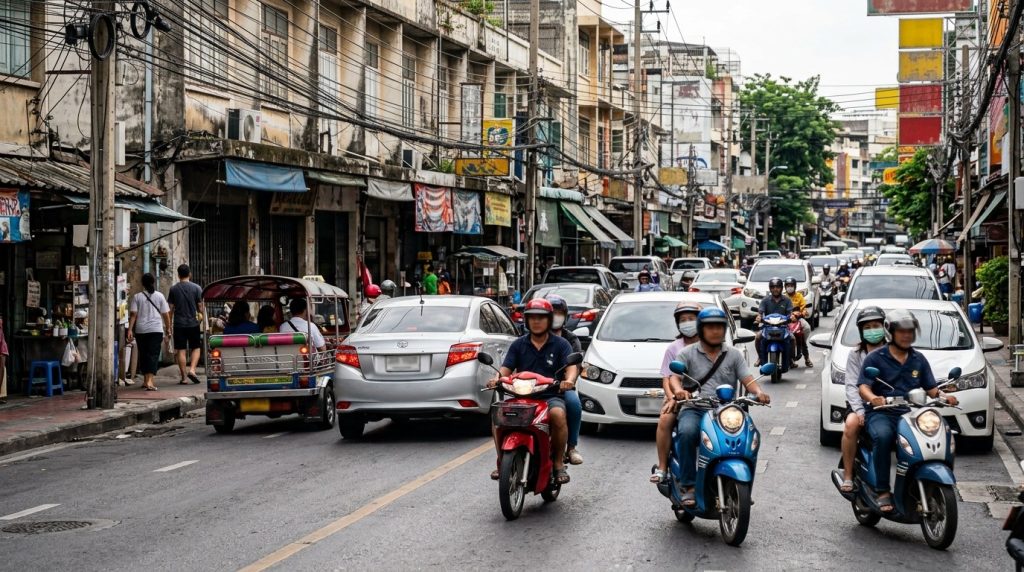
A scooter is the single riskiest thing most tourists do in Thailand. Riding without a valid motorcycle licence or International Driving Permit voids most travel insurance policies outright, so a minor spill can turn into a five-figure medical bill paid out of pocket.
Thailand’s 2026 traffic crackdown, run by the Royal Thai Police Traffic Management Centre from 1 April, quadrupled the maximum fine for riding without a helmet to AUD 84 · USD 61 (THB 2,000), up from THB 500, and helmet checks are now routine in tourist areas.
The safest version of Thailand includes a scooter only if you already hold the right licence at home; otherwise, taxis, Grab, and hotel transfers cost little enough to make the risk not worth taking.
Sorting the paperwork before you fly is simple: apply for an International Driving Permit through your state motoring body in Australia, and confirm directly with your travel insurer that motorcycle riding is covered rather than assuming a general policy applies.
Even experienced riders should expect wet, pot-holed rural roads and unpredictable oncoming traffic that behave differently from equivalent roads at home.
Scams and nightlife safety
Money scams are common in Thailand; violent crime against tourists is not. The classic version hands over a scooter or jet-ski with pre-existing damage, then demands cash for “repairs” once it is returned, which is why photographing every scratch before you ride off matters more than any contract.
Rental operators who ask for your passport as a deposit are a red flag on their own, since it gives them leverage a credit card hold does not.
Around nightlife strips in Bangkok, Pattaya, and the islands, Smartraveller and Thai police both warn about drink spiking, most often to enable theft rather than assault, so the same rules that apply at home apply here: watch your glass, and do not leave a bar with someone you only just met.
Two other patterns come up often enough to plan for in advance. Taxi and tuk-tuk drivers sometimes claim the meter is broken and quote a flat fare well above the metered rate, and gem or tailor shops pay commission to drivers for bringing tourists through the door, then apply heavy pressure to buy once inside.
Declining politely and walking back toward a main road resolves both situations without confrontation. Anyone building a Bangkok itinerary around Khao San Road or similar strips should budget for a licensed taxi home over a late-night walk.
The Cambodia border conflict, and why it does not affect your trip
The Thailand-Cambodia border conflict is real, but it is geographically irrelevant to almost every tourist itinerary.
Smartraveller’s “do not travel” advice applies within 50 km of the land border in Sa Kaeo, Buriram, Si Saket, Surin, Ubon Ratchathani, Chanthaburi, and mainland Trat, where armed clashes and landmines have made the area genuinely dangerous, and the land border crossings there are currently closed.
That zone sits nowhere near Bangkok, Phuket, Chiang Mai, or any of the islands, and none of it overlaps with a standard best time to visit Thailand trip plan. The confusion comes from headlines that say “Thailand-Cambodia conflict” without specifying that the affected area is a thin, remote strip most tourists never come within hundreds of kilometres of.
Other governments draw the same boundary rather than a country-wide one, which is a useful check whenever a headline makes the conflict sound nationwide. Unless a land border crossing into Cambodia is part of your plan, this advisory changes nothing about your trip.
Who should think twice about Thailand
A handful of specific travellers should reconsider parts of a Thailand trip rather than the whole country. Anyone who cannot legally ride a motorbike at home and plans to self-drive a scooter anyway is taking on the single biggest risk in this article, voided insurance included.
Parents of young children who intend to let them swim unsupervised during the May-to-October monsoon season are working against exactly the conditions that produce Phuket’s worst drowning months. Solo travellers planning heavy nightlife drinking and casual acceptance of drinks from strangers should treat that as the same risk it would be anywhere else, not a Thailand-specific one.
Anyone whose itinerary includes crossing the Thailand-Cambodia land border, or travelling within 50 km of it, should drop that leg entirely while the advisory stands.
Travellers who rely on a wheelchair or another mobility aid should also plan routes carefully, since Bangkok’s BTS stations and older Phuket footpaths are inconsistent for step-free access, which is a logistics problem rather than a safety verdict on the country.
Everyone else, sticking to Bangkok, Phuket, Chiang Mai, and the islands with a licensed driver and a helmet, fits comfortably inside Thailand’s Level 2 rating.
Choosing a safer base
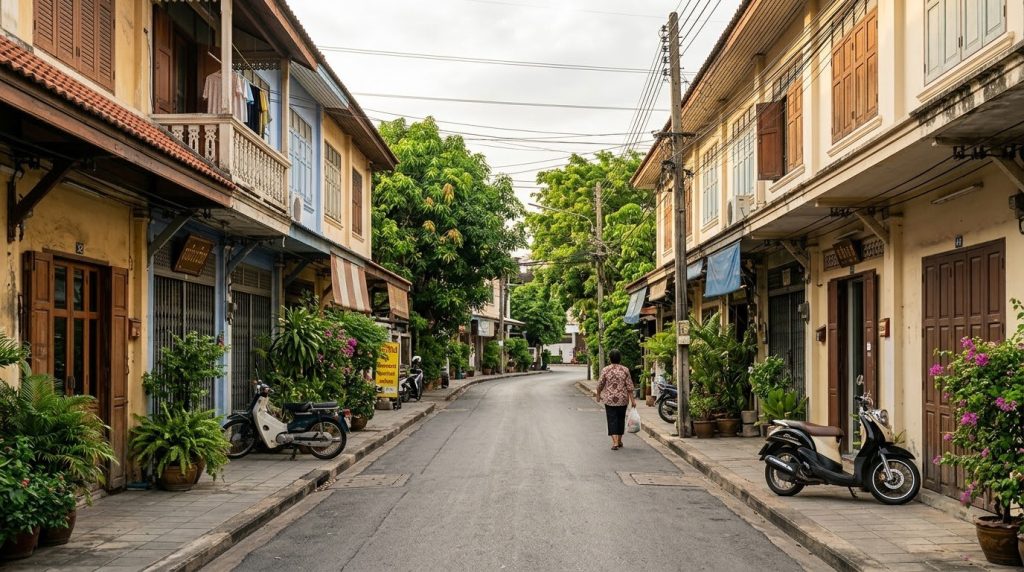
Where you base yourself changes your risk profile more than almost anything else in Thailand. Staying in an established tourist district with good lighting, licensed taxi access, and hotel security desks cuts down on both scams and late-night misadventures, which is why where to stay in Bangkok is worth deciding before you land rather than after.
A base near a BTS or MRT station in Bangkok, or a resort with a staffed reception desk in Phuket, does more for your safety than anything on a packing list, simply by shortening the distance between you and help if something goes wrong.
The map below pulls live listings across the country so you can compare a central Bangkok base against a Phuket beach base on one screen.
Find your Thailand hotel on the map
Live prices from Booking, Airbnb and more — move the map or change dates to compare stays across Thailand.