Is Phnom Penh Worth Visiting? An Honest Verdict (2026)
By TravelguidestipUpdated 10 min readHow we earn
Hotel buttons open Stay22 (Booking.com, Agoda and others) and tour buttons open GetYourGuide. We may earn a commission at no extra cost to you.
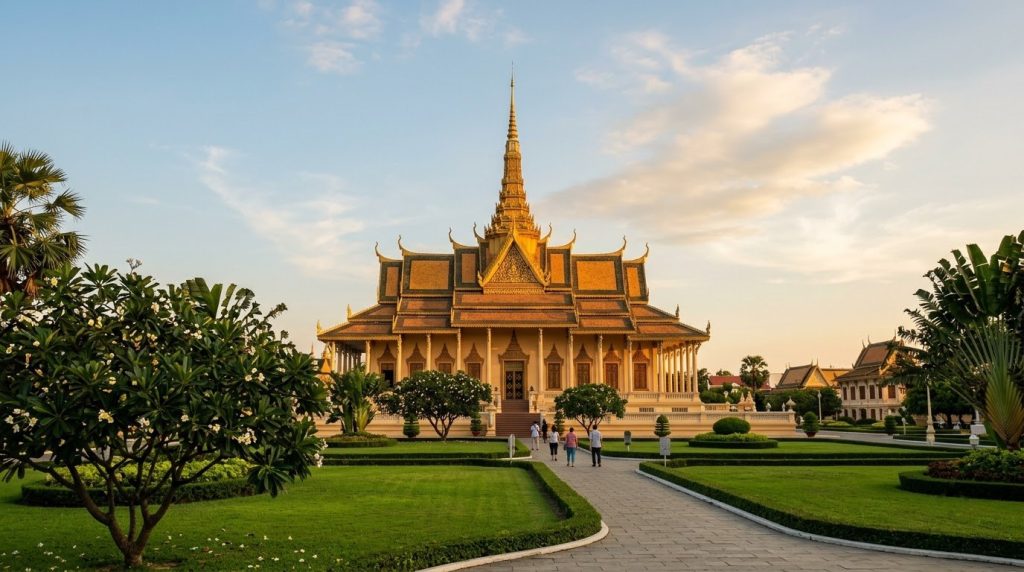
Yes, Phnom Penh is worth 1–2 nights for most travellers, because in 48 hours you can see the Royal Palace and Silver Pagoda, the Tuol Sleng (S-21) museum and the Choeung Ek killing fields, then eat well along the riverside. It is not a pretty city and it is not relaxing.
What it gives you is context: you will understand Cambodia far better than if you only see the temples. Budget travellers can do it cheaply, and nobody needs more than three nights.
| Question | Reality | What to do |
|---|---|---|
| How long? | 1–2 nights covers the essentials | Add a third night only for a Mekong island or cooking class |
| Main sights cost | AUD 14 · USD 10 palace, AUD 7 · USD 5 S-21, AUD 8 · USD 6 Choeung Ek | Carry small US notes, all three are cash only or cash-first |
| Getting in | New Techo airport is about 20 km south | Book a Grab or use the official taxi counter |
| Biggest downsides | Traffic, heat, phone snatching | Plan around the midday heat, keep phones away from the road |
| Who should skip | Temple-only or beach-only trips | Spend the nights in Siem Reap or Kampot instead |
The honest answer: what Phnom Penh does better than anywhere in Cambodia
Siem Reap has Angkor. Kampot has the river. Phnom Penh has the story of modern Cambodia: where the Khmer Rouge emptied the city in 1975, where S-21 operated, and where the country rebuilt itself into today’s loud, fast skyline.
Fly into Siem Reap, see the temples and leave, and you miss that entirely. Most Australians on a first trip do a loop of a week or ten days, and our 10-day Cambodia itinerary gives the capital two nights for exactly this reason.
Royal Palace and Silver Pagoda: the easy half-day
The palace complex is the city’s postcard: gold-tipped roofs, manicured gardens and the Silver Pagoda, whose floor is laid with silver tiles. Entry is AUD 14 · USD 10 per adult, cash, with the Silver Pagoda included.
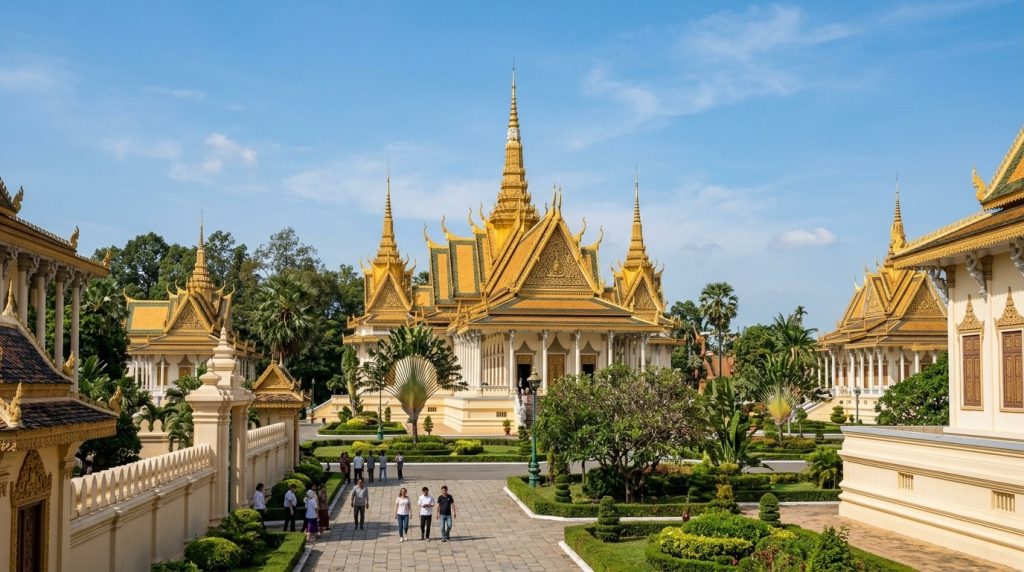
Two things catch people out. The palace closes for lunch (entry 8am to 11am, then 2pm to 5pm), and the dress code is checked after you buy your ticket: covered shoulders and knees, and a scarf over a singlet does not count. T-shirts and sarongs are sold at the gate. Ignore any tuk-tuk driver who says the palace is “closed today”.
Tuol Sleng (S-21) and Choeung Ek: how to visit respectfully
These two sites are the reason many travellers come, and they are hard going. Tuol Sleng was a high school turned into a prison where thousands were photographed, interrogated and tortured. Choeung Ek, the best-known of the killing fields, is where most S-21 prisoners were taken to be executed.
– Tuol Sleng: AUD 7 · USD 5 for adults, plus AUD 7 · USD 5 for the audio guide, open daily 8am to 5pm according to the official museum site. Get the audio guide; the rooms mean little without it. – Choeung Ek: AUD 8 · USD 6, which includes an audio guide narrated partly by survivors.
It is open 7:30am to 5:30pm and sits roughly 10–15 km south of the centre, about 45 minutes each way. A return tuk-tuk or taxi runs AUD 21–28 · USD 15–20.
Dress as you would for the palace, keep your voice down and skip the selfies. Many visitors find both in one day too much, so split them if you can.
A day that works around the palace lunch closure: Choeung Ek at opening, S-21 late morning, a long air-conditioned lunch, the palace at 2pm, then the riverside at sunset.
Riverside, markets and food: the lighter side
Sisowath Quay runs along the Tonle Sap where it meets the Mekong, and the promenade comes alive in the late afternoon with families, exercise classes and food carts. A sunset river cruise shows you the skyline without the traffic.
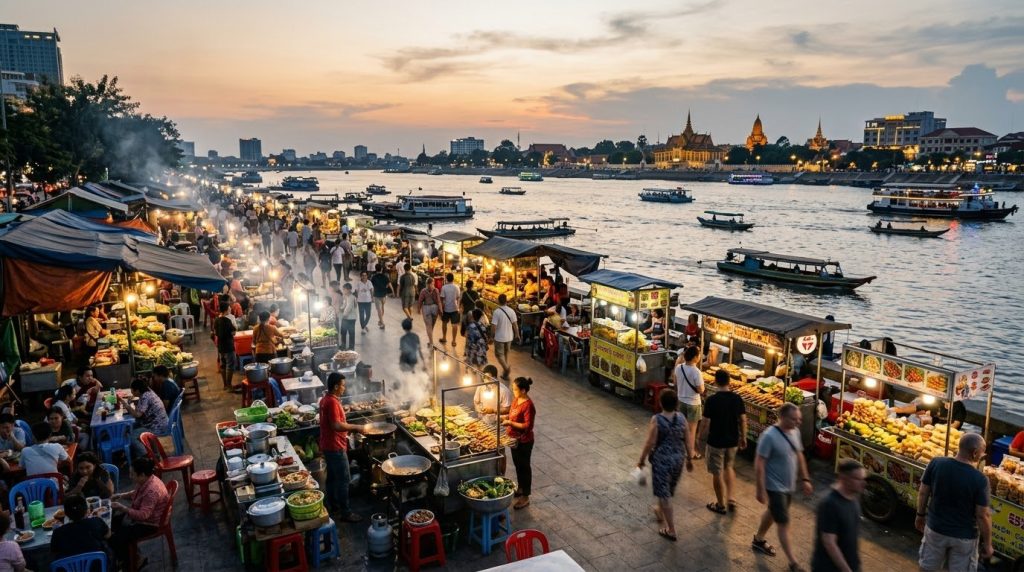
Central Market (Phsar Thmei), under its yellow art deco dome, is worth a wander, and the Russian Market (Tuol Tom Poung) is better for silk, handicrafts and cheap breakfast stalls.
This is also the best eating city in the country: fish amok, kuy teav noodle soup and num banh chok at street prices, plus a cafe scene Siem Reap cannot match. A cooking class or a cycle tour of the Mekong islands are the best add-ons for a spare half-day.
Day trips from Phnom Penh: Silk Island and beyond
If you have a spare half-day, Silk Island (Koh Dach) is the easiest escape from the capital’s traffic. A short ferry crossing over the Mekong puts you among silk-weaving villages, rice paddies and quiet lanes that are a world away from Monivong Boulevard.
Tour operators run it as a half-day or full-day trip by tuk-tuk, bicycle or e-bike, usually with a stop at a weaving house, and listed prices on booking sites range from roughly AUD 35 · USD 25 for a half-day tuk-tuk tour to AUD 97–111 · USD 70–80 for a full day with lunch and a guide, so compare a few operators before booking rather than taking the first quote at your hotel.
Udong, the former royal capital about an hour northwest of Phnom Penh, is a quieter half-day option: a hilltop stupa complex with sweeping views over the countryside and far fewer visitors than the city’s main sights. It works well paired with a private car or tuk-tuk for the return trip, since there is no useful public transport out there.
Both trips are easy add-ons to a two-night stay rather than reasons to add a third night on their own, unless you specifically want the slower pace of island life or a quiet temple without crowds. If dark history has already filled your one full day, save Silk Island or Udong for a return visit rather than rushing them in.
Both trips run best in the dry season, roughly November to April, when the Mekong is lower and calmer and the island’s dirt lanes are not churned up by rain. In the wet season, from around May to October, afternoon downpours can turn a Silk Island visit muddy and cut a day short, so a morning start gives you the best chance of finishing before the rain sets in.
Bring cash for both trips. Silk Island has only a handful of small shops and no reliable ATM, and Udong’s roadside stalls selling drinks and snacks near the stupa are cash-only too. A hat and water matter more on these trips than inside the city, since there is far less shade once you are off the main tourist routes.
The downsides you should know before you book
Phnom Penh is hot year-round, with April the hottest month and highs around 37°C. The wet season runs roughly May to October, so expect afternoon downpours. Traffic is chaotic, footpaths are blocked by parked motorbikes, and walking between sights at midday is miserable. That heat is one reason our Phnom Penh stay-length guide builds each of its two recommended days around a long lunch break.
Street theft matters most: phone and bag snatching from passing motorbikes, especially from open tuk-tuks. Our guide to whether Phnom Penh is safe covers it properly, so read that before you go.
One recent change: flights now land at the new Techo International Airport, which replaced the old airport in September 2025. It is about 20 km from the centre, and the airport’s transport page puts a taxi or Grab at AUD 14–28 · USD 10–20. There are no direct flights from Australia, so expect to connect through a hub such as Singapore.
Getting around Phnom Penh day to day
Grab operates throughout Phnom Penh and is the simplest way to move between sights: you see the fare before you ride, pay by card or cash, and avoid the haggling that comes with hailing a tuk-tuk on the street. It is the better option after dark or whenever you are unsure of a fair price.
Street tuk-tuks are still everywhere and can work out cheaper for very short hops once you have a sense of local rates, but agree the price before you get in, not after. Moto-taxis, riding on the back of a motorbike, are the cheapest option for a solo traveller comfortable with Phnom Penh’s traffic, though they are a poor choice with luggage or after a few drinks.
Walking works for short stretches along the riverside by day, but footpaths disappear under parked motorbikes in most other areas, and the heat makes anything beyond 15–20 minutes uncomfortable. For longer trips, such as out to Udong or Silk Island, a hired car or tuk-tuk for the full day is simpler than stringing together one-way rides, and most hotels can arrange one the evening before.
Traffic in Phnom Penh has no real rush-hour pattern to plan around the way some cities do; it is heavy from mid-morning until well after dark most days, so build extra time into any cross-town trip rather than assuming a quiet midday ride.
Zebra crossings are rare and rarely respected, so crossing a main road on foot means walking at a steady, predictable pace and letting motorbikes flow around you rather than stopping and starting.
If you hire a tuk-tuk or car for a full day, agree the plan and the total price before you set off, including whether waiting time at each stop is included, and keep the driver’s phone number in case you split up during a stop such as the markets.
Who should skip Phnom Penh, or cut it to one night
Not everyone needs the capital. Skip it, or keep it to a single night, if:
– You only have 4–5 days and came for Angkor. Put every night into Siem Reap.
Our Siem Reap vs Phnom Penh comparison goes through the trade-offs in detail. – You want a slow, quiet stay. Kampot is about 3–4 hours away by bus for around AUD 8–14 · USD 6–10, and suits travellers who want river sunsets and cycling instead of traffic. – You are travelling with young kids. The genocide sites are unsuitable for small children, and the heat makes the rest hard work. – Dark history is not for you. Without S-21 and Choeung Ek, one night is plenty.
If you have a week, the 7-day Cambodia itinerary uses Phnom Penh for two nights, then Siem Reap, with the 5–6 hour bus or a short flight between them.
What a day in Phnom Penh costs
Budget trackers that log real traveller spending put an average day in Phnom Penh at roughly AUD 69 · USD 50, covering a guesthouse room, three meals and local transport, though travellers sticking to dorms, street food and tuk-tuks report getting by on a good deal less.
Meals are the easiest place to save: a bowl of noodle soup or a plate of rice from a street stall or local eatery typically costs a few dollars, while sit-down restaurants aimed at tourists charge several times that for a similar dish.
Accommodation is the main swing factor. A simple guesthouse room runs a fraction of what a mid-range hotel in BKK1 or Tonle Bassac charges, so travellers stretching a budget can save the splurge for a nicer base in Siem Reap instead. Entry fees at the Royal Palace, Tuol Sleng and Choeung Ek are fixed and unavoidable, so they are a reliable constant rather than something you can trim.
Cards are accepted at hotels and many restaurants, but small eateries, markets and tuk-tuk drivers expect cash, so keep a stock of small US dollar notes alongside riel for day-to-day spending.
Drinks are where costs creep up fastest for visitors used to home prices. A local beer at a street-side stall costs a fraction of what the same bottle sells for at a riverside bar aimed at tourists, and cocktails at hotel rooftop bars sit at the very top of the scale.
Spending one evening at a rooftop for the view and sticking to local bars and restaurants the rest of the stay is the simplest way to keep a two-night visit affordable.
Souvenir shopping at the Russian Market or Central Market runs on negotiation rather than fixed prices, so the first number a stallholder quotes is rarely the final one; a polite counter-offer and a willingness to walk away usually settles on a fairer price within a minute or two.
Where to stay in Phnom Penh
– Riverside (Sisowath Quay and Daun Penh): walk to the palace and the night food scene. Best for first-timers on a short stay, though noisier and older. – BKK1 (Boeung Keng Kang): leafy, full of cafes and better-value mid-range hotels with pools.
Best for couples staying two nights or more. – Tonle Bassac and Bassac Lane: newer high-rises and the city’s best small bars. Suits travellers after rooftop pools and nightlife.
Find your Phnom Penh hotel on the map
Live prices from Booking, Airbnb and more — move the map or change dates to compare stays across Phnom Penh.
Frequently Asked Questions
How many days do you need in Phnom Penh?
Two nights is the sweet spot. That gives you one day for the Royal Palace, Silver Pagoda and riverside, and one for Tuol Sleng and Choeung Ek, which many people prefer not to rush. One night works if you are short on time and willing to skip a sight. A third night only makes sense for a cooking class or Mekong island trip.
Is it worth visiting the killing fields?
Yes, for most adults. Choeung Ek costs AUD 8 · USD 6 including an audio guide partly narrated by survivors, and it explains Cambodia in a way no temple can. It is emotionally heavy, so go early, give yourself quiet time afterwards, and avoid pairing it with lighthearted plans that afternoon.
Do you need cash in Phnom Penh?
Yes. US dollars are used alongside the riel, and the Royal Palace and Tuol Sleng take cash only. Carry small, clean US notes for entry fees and tuk-tuks, because torn notes are often refused. Cards work at mid-range hotels and many restaurants.
How do you get from Techo airport to the city?
Techo International Airport is about 20 km south of the centre. The simplest option is a taxi from the official counter or a Grab, which the airport lists at AUD 14–28 · USD 10–20 depending on your drop-off. Allow 30–60 minutes, more in peak-hour traffic.