Disclosure: Some links in this guide are affiliate links. If you book or buy through them, we may earn a small commission at no extra cost to you — it helps keep our guides free.
Phnom Penh sits inside Cambodia’s overall Smartraveller advisory, level 2 of Smartraveller’s 4 travel-advice levels, “exercise a high degree of caution,” and the country’s one higher-tier warning, a 50-kilometre do-not-travel zone along the Thai border, lies hundreds of kilometres north of the capital.
The real issue on the ground is snatch theft: riders on passing motorbikes grabbing phones and bags from pedestrians, tuk-tuk passengers and café tables, a pattern that gives the capital a genuinely higher snatch-theft rate than most Southeast Asian capitals.
| Risk | How likely | How serious | What actually prevents it |
|---|---|---|---|
| Phone/bag snatching from motorbikes | Common in central and riverside areas | Financial, occasional injury if you resist | Bag on the inside, phone off the road side, let go if grabbed |
| Tuk-tuk and taxi overcharging | Common, especially around Riverside and the airport | Financial only | Book through PassApp or Grab instead of flagging one down |
| Riverside/Street 51 nightlife petty crime and drink spiking | Occasional in bar strips | Financial, rarely a health scare | Never leave a drink unattended, ride home in an app-booked car |
| Traffic chaos | Constant exposure | Injury, rarely fatal | Cross with the flow of traffic, skip self-drive motorbikes without experience |
| Food and water hygiene | Common, usually mild | Discomfort, rarely serious | Bottled water, busy stalls with fast turnover |
| Dengue in wet season | Rising sharply in 2026 | Can be serious, rarely fatal | Repellent, cover up at dawn and dusk, screened windows |
| Thai border conflict zone | Not present in Phnom Penh | N/A, different region entirely | Phnom Penh is roughly 400km from the flagged zone |
Entry requirements and visa
Most visitors to Cambodia, including Australians, need a visa before arrival, and the Cambodian government’s e-visa is the most straightforward option for a Phnom Penh trip.
The official e-visa costs AUD 50 · USD 36, made up of a USD 30 visa fee (about AUD 42) plus a USD 6 processing fee (about AUD 8), and is typically issued within a few business days of applying online, well ahead of departure.
A visa on arrival is also available at Phnom Penh International Airport for a similar cash fee, but it adds a queue at the border that the e-visa avoids entirely, and payment there is sometimes pushed toward a slightly higher amount than the posted fee, so arriving with the e-visa already approved is the simpler route.
Both visa types typically grant a 30-day stay, and extensions can be arranged through a local visa agent or Cambodia’s immigration department before the stay expires; overstaying attracts a daily fine that increases the longer it runs, so travelers planning to stay beyond 30 days should sort an extension before the original visa lapses rather than after.
A passport valid for at least six months beyond the entry date is required, and immigration officials can ask for proof of onward travel or sufficient funds, though this is enforced inconsistently rather than for every arrival.
Carrying a printed copy of the e-visa approval alongside the passport, rather than relying solely on a phone screen, avoids delays if a phone battery dies or a data connection drops at the arrivals hall.
Children travelling on a parent’s passport may need their own visa depending on how the e-visa portal processes dependants, so checking the current requirement for minors before applying avoids a rejected application close to departure.
Phnom Penh is nowhere near the Thai-border warning zone
Smartraveller’s Cambodia advisory, last updated 30 April 2026, keeps the country overall at level 2 of 4, “exercise a high degree of caution,” driven mainly by the armed conflict along the Thai border earlier in 2026.
The one elevated warning sits within 50 kilometres of that border, where landmines, explosive remnants of war and the risk of renewed military activity make travel genuinely inadvisable, and land crossings remain closed.
Phnom Penh is not part of that zone: the capital sits roughly 400km south of the nearest flagged stretch, in a different province, and the border conflict does not change daily life in the city.
That distinction matters: the advisory’s headline can read as a blanket warning when it is not. Smartraveller’s own guidance on Phnom Penh and Sihanoukville names targeted petty theft as the top issue in both cities, not the border conflict, and recommends holding bags inward, keeping phones off the roadside and using ride-hailing apps at night.
For a country-wide view of where Cambodia’s risk concentrates, see is Cambodia safe, and for a fuller destination overview before booking, the Cambodia travel guide covers the country’s regions side by side.
Bag and phone snatching, the real Phnom Penh risk
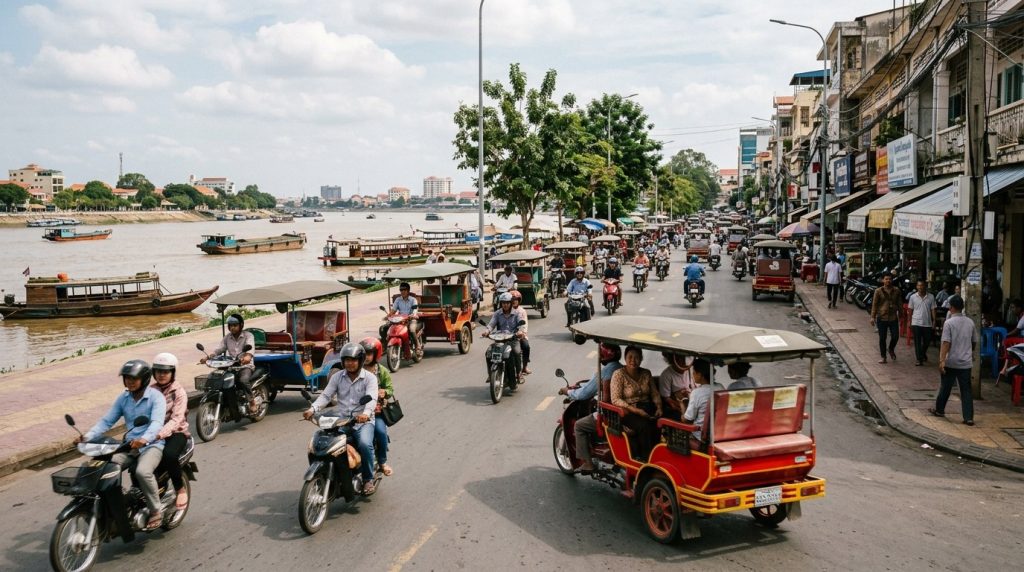
Snatch theft is the crime that actually shapes a Phnom Penh trip, and it looks different from ordinary pickpocketing. Pairs or solo riders on motorbikes cruise busy footpaths and riverside stretches, then grab a phone from a walker’s hand or a bag from a tuk-tuk passenger’s lap as they pass, sometimes cutting a strap first.
Traveller and expat reports describe it happening daily in the areas foreigners gather most, nearly always executed from a moving bike, harder to see coming than a market pickpocket on foot.
The defence is mostly about geometry: keep your phone in a pocket rather than in your hand near a road, wear a crossbody bag on the side away from traffic, and in an open tuk-tuk keep bags on the inside seat, not on your lap near the open side.
If a snatch happens anyway, official and local advice is the same: let go rather than fight for it. Robberies rarely turn violent unless a victim holds on and gets dragged trying to keep a bag or phone, so a stolen phone stays a bad afternoon rather than a dislocated shoulder.
Tuk-tuks, PassApp and Grab
Overcharging is Phnom Penh’s other everyday friction point, and it is a money problem, not a safety one. Drivers outside hotels, Riverside and the airport often quote two to three times the going rate to new arrivals, and negotiating on the street rarely lands on a fair price.
PassApp or Grab fix the fare before the ride starts and remove the negotiation entirely: a short hop across the city centre typically runs around AUD 3 · USD 2, while a fixed airport transfer into town runs closer to AUD 12 · USD 9.
Both apps also show a driver name, plate number and route on screen, useful for accountability and for tracing anything left behind, if not for traffic safety itself.
Riverside, Street 51 and drink spiking
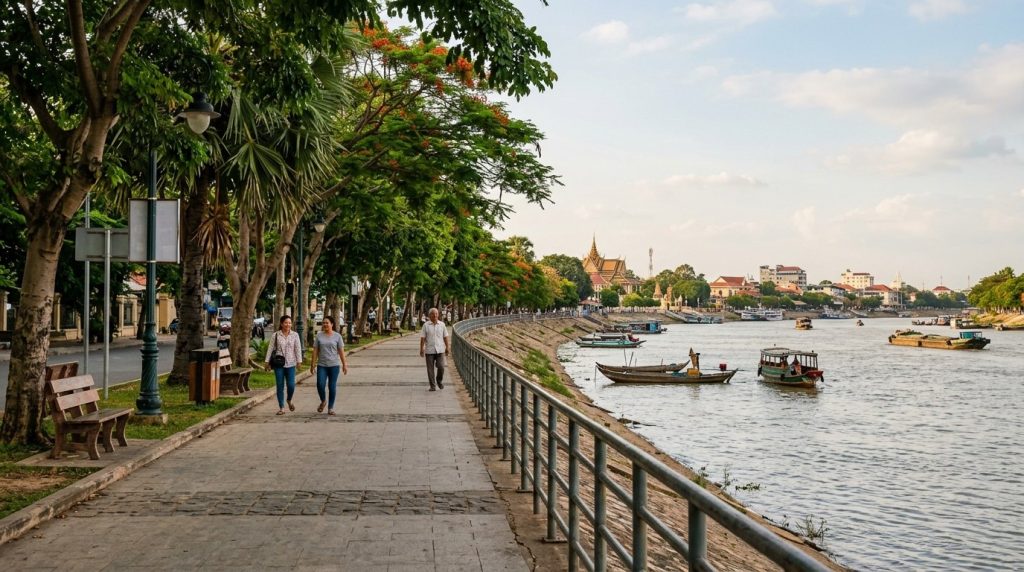
Phnom Penh’s nightlife concentrates along the Riverside strip and around Street 51, and both areas see the city’s standard petty-crime pattern after dark: snatch-and-grab attempts increase once footpaths thin out, and a handful of bars in the rougher end have had drink-spiking reports, almost always targeting solo drinkers who step away from a table or accept a drink from a stranger.
None of this is a Phnom Penh-specific epidemic; it’s the same nightlife caution that applies across Southeast Asia, worth taking seriously here because the quiet exit streets are exactly where snatch theft also concentrates. Keep drinks in sight, skip cheap unbranded spirits, and book a ride home through PassApp or Grab rather than walking back once the strip empties out.
Traffic, food and dengue: the everyday risks
Traffic causes more injuries than crime on a Phnom Penh trip, simply because it is constant. Motorbikes, tuk-tuks and cars share narrow lanes with few working lights at busy intersections; pedestrians cross by walking at a steady pace rather than waiting for a gap that may not come.
Renting a motorbike without prior riding experience is the single most avoidable way to get hurt in the city. Street food and market stalls are generally safe at busy vendors with fast turnover and bottled or boiled water; mild stomach upsets are more common than anything serious.
Dengue is the wet-season risk worth planning around. Cambodia recorded 28,074 dengue cases and 38 deaths by mid-July 2026, incidence up 58 percent on the same period in 2025, with transmission concentrated in the May-to-October rainy season, when standing water multiplies mosquito breeding sites across the city.
Repellent, covering up at dawn and dusk when dengue-carrying mosquitoes are most active, and screened windows or air conditioning cut the exposure meaningfully. If your dates are flexible, a best time to visit Cambodia guide is worth checking before booking, since the dry season carries a lower dengue load and more comfortable heat.
Health, vaccinations and medical care
No vaccinations are legally required to enter Cambodia from Australia under normal circumstances, but routine vaccinations should be up to date before any trip, and a travel doctor visit several weeks ahead of departure is the standard way to confirm what else is worth adding for a Phnom Penh itinerary specifically.
Hepatitis A and typhoid are often raised by travel doctors for Southeast Asia trips generally, and a consultation can confirm what applies to the specific stops on a given itinerary.
Malaria risk in Cambodia concentrates in forested, rural areas rather than in Phnom Penh itself, which health authorities class alongside Siem Reap city as a lower-risk area; travelers sticking to the capital generally face a lower exposure than those heading to remote, forested parts of the country, and anyone adding rural travel to a wider Cambodia itinerary should raise this specifically with a travel doctor.
Dengue, covered earlier on this page, is the more immediate everyday risk within the city itself, particularly during the wet season.
For anything beyond routine care, Phnom Penh has several private hospitals and clinics used to treating international visitors, generally a better first option than a public hospital for a traveler needing care quickly, though costs are often paid upfront and claimed back through travel insurance afterward rather than billed directly to an insurer on the spot.
Travel insurance that explicitly covers medical evacuation is worth checking before departure, since a serious injury or illness in Cambodia may need transfer to a hospital in Bangkok or Singapore rather than treatment locally.
Tap water should be treated as non-potable throughout the city; bottled or boiled water, already recommended for food and drink safety earlier on this page, extends to brushing teeth for travelers with sensitive stomachs.
Who should think twice about Phnom Penh
Phnom Penh is a poor fit for a specific handful of travellers, not for cautious people in general. Solo travellers who walk quiet riverside stretches alone late at night, past the point where footpaths empty out, are choosing the exact window when snatch theft is most likely.
Anyone who walks with a phone out for photos or navigation on a busy roadside, rather than checking it from a doorway or café table, should reconsider that habit: a phone in hand near traffic is the single most common target.
Travellers who flash cash, jewellery or an expensive camera around Riverside or Street 51 at night add avoidable risk to an otherwise manageable evening, and should scale back or leave valuables at the hotel. None of this means skipping Phnom Penh; it means adjusting the handful of habits that actually create the exposure.
Laws, scams and cultural etiquette
Cambodian drug law is far stricter than many visitors expect, and penalties apply regardless of nationality: trafficking more than 80 grams of an illicit drug can carry a life sentence under Cambodian law, and simple possession already carries real prison time rather than a fine.
Visitors should assume any recreational drug use carries a meaningful legal risk, not just a social one, and should be especially wary of anyone offering drugs unprompted in nightlife areas such as Riverside or Street 51, since this is also a known setup for extortion rather than a genuine offer.
Beyond drugs, the scams that actually affect most visitors are smaller and more mundane: tuk-tuk and taxi overcharging, covered earlier on this page, the “that temple or attraction is closed today, let me take you somewhere else” line used to redirect tourists toward a commission-paying shop or restaurant, and occasional requests for donations from people posing as monks, a practice genuine Buddhist monks in Cambodia do not follow.
Politely declining and walking on is the standard, effective response to all three, and none of them typically escalate if a traveler simply disengages.
Cultural etiquette matters most around temples and pagodas, where modest dress, shoulders and knees covered, is expected, along with removing shoes before entering a temple building.
Public displays of anger, including raised voices in a dispute over a fare or a bill, are considered more culturally jarring in Cambodia than in many Western countries and rarely help resolve the situation faster; a calm, firm tone gets a better outcome than an escalated one in nearly every reported dispute, whether with a tuk-tuk driver or a market vendor.
Photographing military checkpoints, government buildings or uniformed officials without permission is best avoided entirely, since this is one of the few situations where a minor misstep can escalate into an actual official problem rather than just an awkward moment.
Dress for temple visits is worth planning ahead rather than improvising at the gate, since some pagodas turn away visitors in shorts or sleeveless tops and a wrap or light trousers carried in a day bag solves the problem without cutting a visit short.
Choosing a base in Phnom Penh
Where you stay changes your daily exposure to snatch theft more than almost any other decision.
A base in BKK1 or around the Royal Palace keeps you closer to wider, better-lit streets and further from Riverside’s busiest stretches after dark, while a budget room directly on the strip puts you inside the city’s most theft-prone corridor every time you step outside.
If Phnom Penh is one stop on a wider trip, a Cambodia 7-day itinerary is worth checking before you book, since spacing the capital against Siem Reap or the coast usually means just one or two nights here, enough to enjoy the city without extended late-night exposure on the strip.
Find your Phnom Penh hotel on the map
Live prices from Booking, Airbnb and more — move the map or change dates to compare stays across Phnom Penh.