How Many Days in Phnom Penh? The Right Number of Nights (2026)
By TravelguidestipUpdated 10 min readHow we earn
Hotel buttons open Stay22 (Booking.com, Agoda and others) and tour buttons open GetYourGuide. We may earn a commission at no extra cost to you.
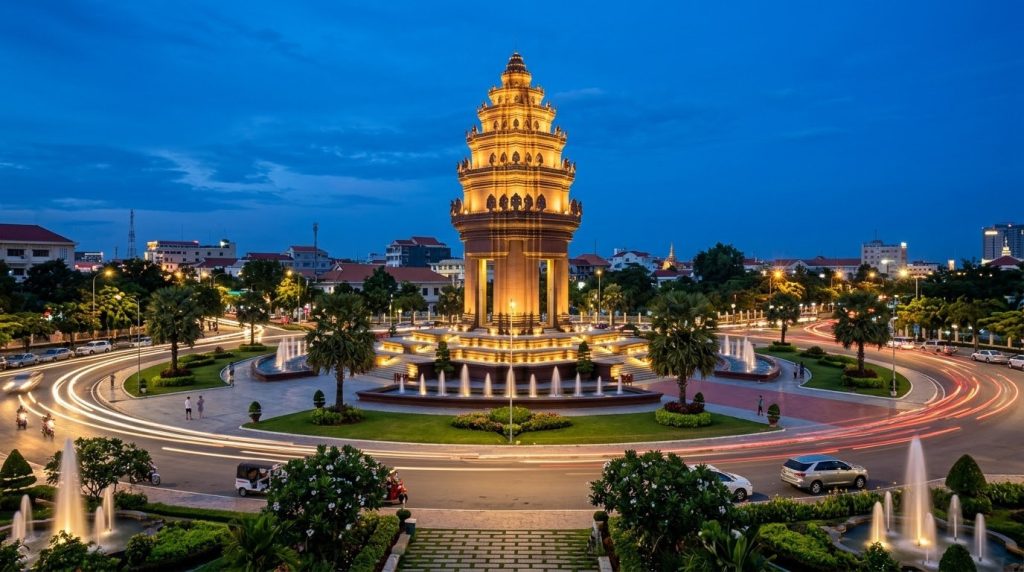
Spend 2 nights in Phnom Penh: that gives you 2 full days, one for the Royal Palace, National Museum and riverside, and one for Tuol Sleng and the Choeung Ek killing fields, which deserve a day without rushing. One night works if you are passing through between Siem Reap and Kampot and accept cutting a sight.
Three or more nights only pays off if you add a day trip to Oudong or a slow afternoon on Koh Dach, the silk island.
| Stay | What it covers | Who it suits |
|---|---|---|
| 1 night | Royal Palace and Silver Pagoda, Tuol Sleng, sunset on the riverside | Travellers in transit on a 7-day Cambodia loop |
| 2 nights | Everything above plus National Museum, Choeung Ek, Central and Russian Markets | Most first-timers |
| 3+ nights | Add Oudong (old royal capital) or Koh Dach by tuk-tuk and ferry, a cooking class, slower days | Return visitors, slow travellers, history buffs |
Why 2 nights is the sweet spot
The core sights are compact but the timetable is awkward. The palace closes for lunch, the genocide sites are draining, and the midday heat punishes walking. Two nights splits the city into a “royal” day and a “Khmer Rouge history” day, each with a long lunch break.
Still deciding whether the capital belongs on your trip at all? Read our honest verdict on whether Phnom Penh is worth visiting first.
Best time to visit Phnom Penh for your itinerary
Cambodia runs on two seasons, and which one you land in changes how comfortably a 2 or 3-night plan comes together. The dry season runs roughly November to April, with the coolest and most comfortable stretch from November through January, before the build-up to April’s heat.
The wet season runs roughly May to October, driven by the southwest monsoon, with the heaviest rain generally falling in the second half of that window rather than as constant all-day downpours.
For the itinerary above, the season matters most on Day 2. Choeung Ek and Tuol Sleng involve walking between outdoor memorial sites with limited shade, so a dry-season morning start, already recommended for the heat, is even more worth sticking to in the hottest months.
In the wet season, the same early start avoids the afternoon storm cells rather than the sun, and a light rain layer is worth keeping in the day bag rather than back at the hotel.
November through January is the easiest all-round window: dry, cooler and clear of the worst heat, which is also why it overlaps with busier, pricier weeks for flights and hotels. Travellers who can shift a visit into February, or the shoulder of October just before the wettest months, trade a little weather certainty for lighter crowds at the Royal Palace and the markets.
Humidity stays high year-round regardless of rainfall, so pack for sweat rather than cold even on a December night, when the temperature still rarely drops enough to need more than a light layer after sunset.
Whatever month you land in, the itinerary above does not need rescheduling for weather: a wet-season downpour is usually short enough to wait out over a coffee near Sisowath Quay, and the Royal Palace’s lunchtime closure already builds a natural break into the hottest part of any day, dry season or wet.
Day 1: Royal Palace, National Museum and the riverside
– Royal Palace and Silver Pagoda (8am): AUD 14 · USD 10, cash. Entry runs 8am to 11am, then 2pm to 5pm, and the dress code (shoulders and knees covered) is checked after you buy your ticket. Go at opening and give it 2 hours. – National Museum (late morning): next door, in the red sandstone building.
AUD 14 · USD 10 for adults, open 8am to 5pm with last tickets at 4:30pm.
The pre-Angkorian and Angkor-era sculpture here makes the Siem Reap temples far more meaningful, so do it before Angkor if your route allows. – Central Market (after lunch): the yellow art deco dome is good for a wander and cheap snacks. – Sisowath Quay at sunset: the riverside promenade fills with families and food carts once the heat drops.
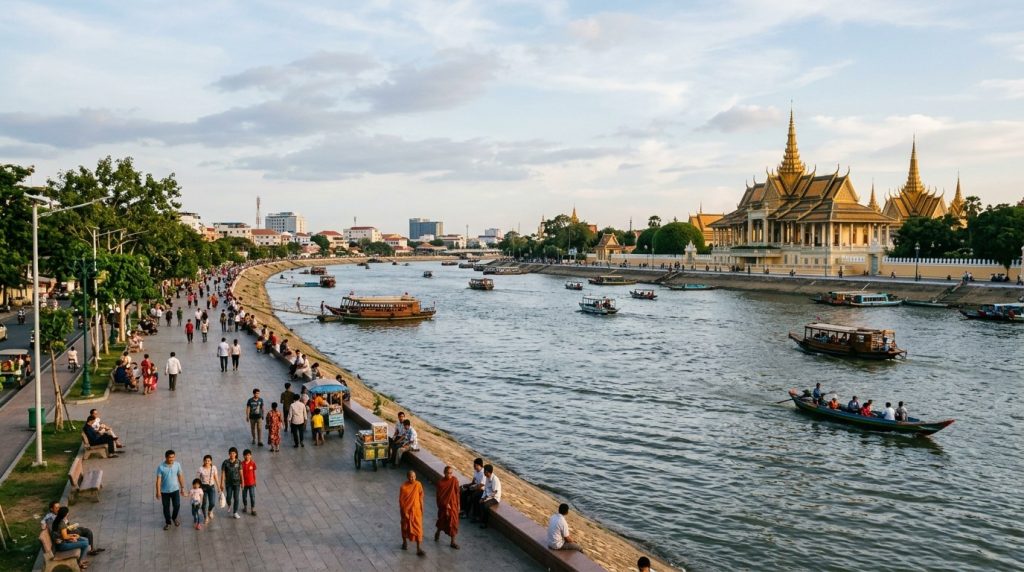
Day 2: Choeung Ek, Tuol Sleng and the Russian Market
Start early, because Choeung Ek opens at 7:30am and is cooler and quieter before 9am. Entry is AUD 8 · USD 6 including the audio guide, which mixes survivor testimony with history. It sits 10–15 km south of the centre, so hire a tuk-tuk for the return trip and have it wait.
Tuol Sleng (S-21), the former high school turned prison, is open daily 8am to 5pm. The official museum site lists AUD 7 · USD 5 for adults plus AUD 7 · USD 5 for the audio guide, cash in riel or US dollars only. Take the audio guide; without it the rooms mean little.
Most people need a quiet afternoon after these two. The Russian Market (Tuol Tom Poung), close to Tuol Sleng, is a gentler finish: silk, handicrafts and food stalls under a low tin roof that gets stifling by early afternoon.
Day 3 and beyond: Oudong or Koh Dach
A third full day is where Phnom Penh stops being a checklist.
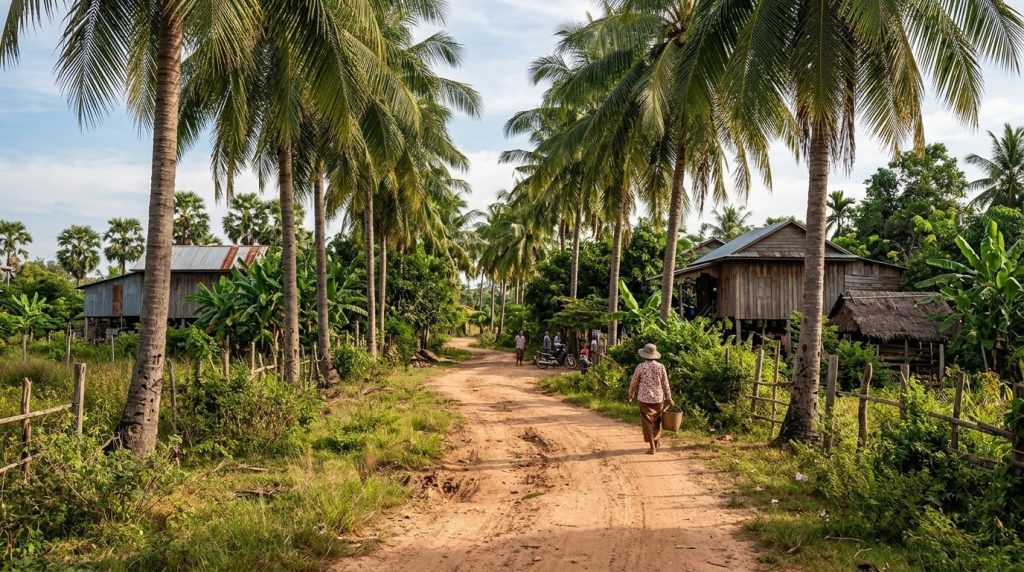
– Oudong: Cambodia’s royal capital from the 17th century until 1866, now a hilltop of stupas holding royal remains. It is 40–43 km north, and the drive takes 75 minutes to almost 2 hours depending on traffic. Expect about 500 steps to the top, free entry, and roughly AUD 42 · USD 30 for a tuk-tuk hired for the day.
Wear socks; the marble floors burn in the afternoon. – Koh Dach (Silk Island): a Mekong island 12–15 km from the centre, reached by tuk-tuk in 45 minutes to an hour plus a short ferry crossing. Weaving villages and rural lanes; an easy half-day to pair with a cooking class.
Respectful visits: dress code and etiquette at the Royal Palace and genocide sites
The Royal Palace and Silver Pagoda require shoulders and knees covered, and turn away visitors in singlets or short shorts, so plan the day’s outfit before leaving the hotel rather than counting on a sarong rental.
Hats come off inside the Silver Pagoda’s main buildings, and pointing your feet at a Buddha statue or image is considered disrespectful, so sit cross-legged or kneel rather than stretching your legs out if you take a seat on the floor.
Tuol Sleng and Choeung Ek call for a different kind of respect. Both sites are memorials to the Khmer Rouge period, and loud conversation, posed photography or treating the visit as a quick checklist item reads as disrespectful to Cambodians who lost family in that era.
The audio guide, already recommended on Day 2, is designed to be followed at a slower, quieter pace than a typical museum walkthrough, and that pace is part of what the sites are asking of visitors.
Photography is generally allowed at both sites, but check posted signage at specific rooms, since some areas restrict it out of respect for the people pictured. Flash photography, and photos that frame other visitors’ reactions rather than the exhibits themselves, are best avoided.
Outside these specific sites, the everyday etiquette is simpler: a slight bow with hands together, known locally as the sampeah, is a polite way to greet, though a handshake or nod is also accepted from visitors. Tipping is not compulsory but is appreciated for tuk-tuk drivers and guides, especially on longer day trips such as Oudong.
Swimwear and sleeveless tops are fine at a hotel pool or riverside restaurant, but not at the Central or Russian Markets, where modest, everyday clothing is the norm and tends to make bargaining go more smoothly.
What to cut if you only have 1 night
With a single night, drop the National Museum and either Choeung Ek or the markets. A workable plan: Tuol Sleng at 8am, the Royal Palace when it reopens at 2pm, then Sisowath Quay at sunset. If the killing fields matter more than the palace, swap them, but do not cram all four sights plus a bus arrival into one day.
Do not stay longer than 3 nights unless you have a reason. Beyond the day trips, there is little that Siem Reap or Kampot does not do better, and our Siem Reap vs Phnom Penh comparison explains where each night earns its keep.
Getting there: buses, the new airport and timing your arrival
From Siem Reap: buses take 5 to 6 hours in daylight, and night buses run about an hour slower. Fares start around AUD 14 · USD 10 on budget lines, with premium operators such as Giant Ibis charging more. Take a morning bus and you arrive mid-afternoon, in time for the riverside, so it does not cost you a sightseeing day.
From Kampot: 136 km, with buses from AUD 12 · USD 8.50 taking 3 to 4.5 hours and minivans around AUD 17 · USD 12 taking about 3 hours, according to GeckoRoutes. Each company uses its own station, so check the drop-off point.
Flying in: all flights now use Techo International Airport, which replaced the old airport in September 2025. The airport’s own transport page puts it about 20 km south of the city centre, with taxis and Grab at AUD 14–28 · USD 10–20. Allow 40–50 minutes in normal traffic, more at peak hour. That longer transfer is why a late-evening landing should not count as a sightseeing day.
Most Australians fold the capital into a longer loop; our 10-day Cambodia itinerary gives it 2 nights between Siem Reap and the south coast.
What to pack for Phnom Penh’s heat and temple visits
Lightweight, loose clothing that covers shoulders and knees earns its place in the bag before anything else, given the dress code already covered for the Royal Palace and Silver Pagoda. A light scarf or sarong doubles as a quick cover-up and as sun protection on the open-air walk between palace buildings.
Closed shoes that are easy to slip on and off matter more than sandals once temple floors are part of the day; several buildings at the palace and at Oudong require shoes off, and marble or tiled floors get hot in the afternoon sun, which is why socks are worth packing even in the tropics.
For the genocide sites on Day 2, pack a refillable water bottle and a hat rather than relying on buying drinks on site; Choeung Ek is largely outdoors with limited shade, and the audio guide experience runs longer than most visitors expect. A small packet of tissues is also worth having, since the subject matter at both Tuol Sleng and Choeung Ek affects most visitors more than they plan for.
Insect repellent and a basic first-aid kit cover the practical risks of a tropical city: mosquitoes are present year-round and worse near the river and Koh Dach’s irrigation channels, and cuts or scrapes from uneven footpaths are common enough to plan for.
Cash in small denominations, both US dollars and Cambodian riel, is worth carrying separately from cards, since most of the entry fees and tuk-tuk fares covered elsewhere in this guide are cash-only transactions.
A packable rain layer or poncho earns a spot even outside the wet season, since a Koh Dach ferry crossing or an open-air tuk-tuk ride to Oudong leaves you exposed if a stray shower passes through. The same open-air trips also mean more sun exposure than a day spent in the air-conditioned National Museum, so reapply sunscreen before any half-day outside the centre, not just once in the morning.
Where to stay in Phnom Penh
– Riverside (Sisowath Quay and Daun Penh): walking distance to the palace, the National Museum and the night food scene. Best for a 1 or 2-night stay, though older and noisier. – BKK1 (Boeung Keng Kang): leafy streets, cafes and better-value mid-range hotels with pools, 10 minutes by tuk-tuk to the Russian Market and Tuol Sleng.
Best for 3 nights or more. – Tonle Bassac: newer high-rises with rooftop pools and the city’s best small bars. Suits couples after nightlife.
Whichever area you pick, keep your phone away from the road side of a tuk-tuk; our guide on whether Phnom Penh is safe explains why bag snatching is the main risk.
Find your Phnom Penh hotel on the map
Live prices from Booking, Airbnb and more — move the map or change dates to compare stays across Phnom Penh.
Frequently Asked Questions
Is 1 day enough in Phnom Penh?
One full day covers the essentials if you plan around the palace lunch closure: Tuol Sleng at 8am, a long lunch, the Royal Palace from 2pm and the riverside at sunset. You will have to drop either Choeung Ek or the National Museum, and arriving the same day by a 5 to 6-hour bus makes it a rush.
Is 3 days in Phnom Penh too long?
Not if you use the third day well. Three nights gives you the two core days plus a trip to Oudong, the former royal capital 40–43 km north, or a half-day on Koh Dach. Without a day trip, the third day tends to drift into cafes and shopping.
How far is the new Phnom Penh airport from the city?
Techo International Airport sits about 20 km south of the centre, according to the airport itself. A taxi or Grab costs AUD 14–28 · USD 10–20 depending on your hotel, and the drive takes 40–50 minutes in normal traffic. Budget extra time when flying out.
Can you do Phnom Penh as a day trip from Kampot?
Technically, but it is a poor trade. Kampot is 3 to 4.5 hours away by bus each way, which leaves only 4 or 5 hours in the city. Spend at least one night so you can see Tuol Sleng and the palace without watching the clock.