Disclosure: Some links in this guide are affiliate links. If you book or buy through them, we may earn a small commission at no extra cost to you — it helps keep our guides free.
No, Thailand is not expensive for Australians: backpackers get by on AUD 38–64 · USD 28–46 a day (THB 900–1,500), and mid-range travellers spend AUD 106–170 · USD 77–123 (THB 2,500–4,000). At roughly 23.5 baht to the Aussie dollar, a street-food lunch costs less than a coffee in Sydney.
Where it bites is the islands, the rooftop bars, Christmas-to-New-Year hotel rates and the dual pricing at national parks. Here is what each costs and how to dodge it.
| Cost or risk | Reality in 2026 | What to do |
|---|---|---|
| Backpacker day | AUD 38–64 · USD 28–46 (THB 900–1,500) | Dorms, street food, local buses |
| Mid-range day | AUD 106–170 · USD 77–123 (THB 2,500–4,000) | Private air-con room, sit-down meals, one tour |
| Comfort day | AUD 255–511 · USD 184–368 (THB 6,000–12,000) | Resorts, transfers, rooftop drinks |
| Phuket and Samui | 25–50% above the mainland | Base on the mainland, island-hop for fewer nights |
| Festive season | Phuket 4-star rooms jump from THB 2,500–3,000 to THB 8,000–14,000 | Book by August or travel in November or February |
| Park fees | Foreigners pay up to 5 times the Thai price | Budget AUD 4–21 · USD 3–15 per park |
The honest daily budget, tier by tier
Backpacker (AUD 38–64 · USD 28–46). A hostel dorm runs AUD 11–26 · USD 8–18 (THB 250–600) and a street-food plate AUD 1.70–3.40 · USD 1.20–2.45 (THB 40–80). In Chiang Mai, three meals, a bed and a songthaew fit inside the lower number; a cooking class or a few Changs pushes you to the top.
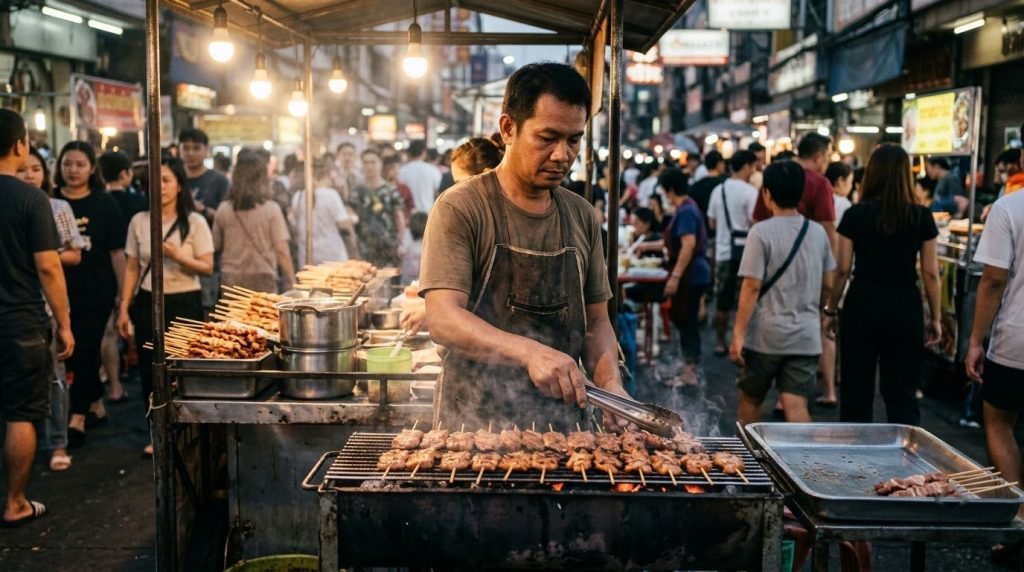
Mid-range (AUD 106–170 · USD 77–123). This is where most Australian couples land. A mid-range hotel costs AUD 64–170 · USD 46–123 a night (THB 1,500–4,000), and a meal at a proper restaurant is AUD 8.50–21 · USD 6–15 (THB 200–500). The daily figure is per person, sharing a room. Set against Japan, where a comparable day runs AUD 177-221, our Thailand versus Japan breakdown shows how much further that budget stretches.
Comfort (AUD 255–511 · USD 184–368). Beachfront resorts, private transfers and the odd tasting menu. Not cheap, just good value.
If you are planning the full loop, our two-week Thailand route with costs per stop shows how these tiers play out across Bangkok, the north and the south.
Where Thailand is not cheap (and how to cut the cost)
Phuket and Koh Samui. Expect to pay 25–50% more on the islands than on the mainland. Phuket’s metered airport taxi to Patong is AUD 34–43 · USD 25–31 (THB 800–1,000 including the airport surcharge), while the Smart Bus does the same run for AUD 4.30 · USD 3.10 (THB 100).
Samui is pricier again because Bangkok Airways owns the airport and is the only nonstop carrier from Bangkok, so one-way fares sit around AUD 97–201 · USD 70–145. Flying to Surat Thani and catching the bus-ferry combo roughly halves that.
Bangkok rooftop bars. At Sky Bar on the 63rd floor of lebua, cocktails run AUD 26–38 · USD 18–28 (THB 600–900), and the Hangovertini is AUD 64 · USD 46 (THB 1,500). Smaller rooftops such as Heaven or Unculture start at AUD 9–13 · USD 7–9 (THB 220–300). Have one drink at the icon for the photo, then move on.
Peak season. From late December to early January, Phuket’s four-star hotels that charge THB 2,500–3,000 in low season average THB 8,000–14,000 a night, according to The Nation’s report on Phuket festive rates. That is AUD 340–596 · USD 245–429 for a room you could get for AUD 106–128 · USD 77–92 in September. Aussie school holidays overlap this exact window, so families feel it most.
Tourist pricing at parks and temples. Thailand runs two price lists. National park fees for foreign adults are THB 100, 200, 300 or 500 depending on the park category, versus THB 20–100 for Thai adults. Phi Phi charges foreigners THB 400 (AUD 17 · USD 12) cash, and the Grand Palace is THB 500 (AUD 21 · USD 15).
The small costs that surprise first-timers
– ATM fees. Most Thai ATMs charge foreign cards a flat fee per withdrawal, so take out larger amounts less often and use a no-fee travel card. – Data. Buy before you land.
Our Thailand eSIM guide compares plans so you are not paying airport-kiosk prices. – Imported drinks and Western food. Wine is heavily taxed, so stick to Thai beer and Thai food. – The proposed entry fee. A flat THB 450 (AUD 19 · USD 14) tourist fee was approved in principle on 14 August 2026, but it is not being collected and has no start date yet.
Who should think twice about Thailand on a tight budget
If your idea of Thailand is two weeks in a Patong beachfront resort over Christmas with daily island tours, it will not feel cheap. Families locked into summer school holidays, and anyone set on Samui, should price the trip honestly before assuming it beats a domestic holiday. Flights from Sydney (about 9.5 hours nonstop) also cost more in December and January.
It stays great value if you travel in shoulder season, pair the mainland with one island and eat where Thais eat. Safety questions come up more often than cost, and our honest take on Thailand safety covers scams that also hit the wallet. Mainland-plus-one-region is also how our two-route plan for 10 days works, since every extra base costs about half a day in transfers.
Thailand vs Bali vs Vietnam on cost
On recent 2026 comparisons, Vietnam is the cheapest of the three, Thailand sits in the middle and Bali is the priciest.
| Daily spend | Vietnam | Thailand | Bali |
|---|---|---|---|
| Budget | AUD 35–56 · USD 25–40 | AUD 42–62 · USD 30–45 | AUD 49–69 · USD 35–50 |
| Mid-range | AUD 83–167 · USD 60–120 | AUD 90–194 · USD 65–140 | AUD 97–208 · USD 70–150 |
Vietnam wins for pure budget backpacking. Bali costs more mainly through villas and Western cafes in Canggu and Seminyak. Thailand gives the widest dorm-to-resort range. For a full head-to-head on beaches, food and flights, see our Bali vs Thailand comparison.
How much should you tip in Thailand?
Tipping is not a deeply rooted custom in Thailand the way it is in the US, so you will not offend anyone by not tipping, but a few habits are worth knowing.
At higher-end restaurants and hotels, a 10% service charge is often added to the bill automatically, in which case an extra tip is a bonus rather than an expectation. At casual, family-run restaurants without a service charge, rounding up or leaving AUD 0.85–2.10 · USD 0.60–1.50 (THB 20–50) for good service is appreciated but optional.
For a metered taxi, rounding the fare up to the nearest THB 10 or 20 is the norm; Grab and tuk-tuk fares agreed in advance do not need a tip on top.
Tour guides and private drivers on multi-day trips sit at the higher end of what locals consider normal, commonly in the AUD 4.15–8.35 · USD 3–6 (THB 100–200) per day range for a guide, less for a driver only.
Hotel bellhops and spa or massage therapists are usually tipped a small, flat amount per service rather than a percentage, and the better the venue, the more a tip is expected to match it.
None of this is enforced the way it is in the US, so treat all of these figures as a ceiling, not a rule, and never feel obliged to tip simply because a bill is presented in a leather folder the way it might be at home.
One habit worth dropping entirely: do not apply Australian or US tipping percentages by default. A traveller tipping 15 to 20% at every meal out of habit will spend noticeably more over two weeks than the local norms above would suggest, without making the trip any better for it.
Money-saving tips that actually make a difference
A handful of habits do more to control a Thailand budget than any single destination choice.
- Use the BTS, MRT and public buses over taxis wherever a station is close by. The fare difference on a single ride looks small, but it compounds fast across a two-week trip.
- Eat where locals eat. Street-food stalls and market food courts, including the food courts inside shopping malls, consistently undercut restaurants aimed at tourists for the same dishes, often by half or more.
- Get a fee-free travel debit or credit card before you leave Australia. Most Thai ATMs charge foreign cards a flat withdrawal fee regardless of the amount, so a card that at least skips the foreign transaction markup saves money on every withdrawal.
- Withdraw larger amounts less often rather than making frequent small withdrawals, since the flat ATM fee applies per transaction, not per dollar.
- Buy a local SIM or eSIM on arrival rather than relying on hotel Wi-Fi and guesswork. Reliable maps and ride-hailing data cut down on the overpaying that comes from not knowing a fair taxi or tuk-tuk price.
- Travel in the shoulder months either side of the December to January peak, when hotel rates, especially on Phuket and Koh Samui, can be a fraction of festive-season pricing.
- Buy drinking water and snacks at 7-Eleven or a local minimart rather than from a hotel minibar or a beachfront kiosk, where the same bottle can cost several times more.
- Book island flights and ferries ahead rather than on arrival, since last-minute fares between Bangkok and Phuket or Koh Samui are usually the most expensive way to make the same trip.
None of these require sacrificing comfort; they mostly just avoid the small, repeated costs that add up fastest for first-time visitors, and they apply whether you are backpacking or travelling mid-range.
Where to stay in Thailand
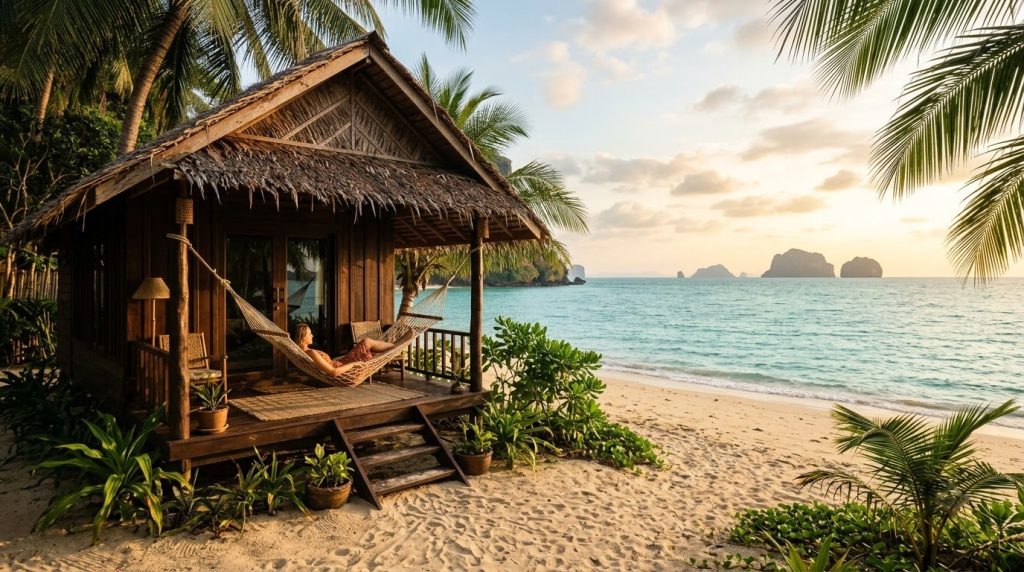
– Bangkok, Sukhumvit or Silom: best for first-timers, with BTS access and every price tier from hostels to high-rises. – Chiang Mai Old City: the best value base in the country for backpackers and slow travellers. – Phuket’s Kata and Karon: calmer and usually cheaper than Patong for families and couples who want a beach week.
Find your Thailand hotel on the map
Live prices from Booking, Airbnb and more — move the map or change dates to compare stays across Thailand.
Frequently Asked Questions
How much money do I need per day in Thailand?
Backpackers need AUD 38–64 · USD 28–46 a day (THB 900–1,500), mid-range travellers AUD 106–170 · USD 77–123 (THB 2,500–4,000), and comfort travellers AUD 255–511 · USD 184–368. Add 25–50% if you spend most of the trip on Phuket or Koh Samui, and more again over Christmas and New Year.
Is Thailand cheaper than Bali for Australians?
Generally yes. 2026 comparisons put a Thailand budget day at AUD 42–62 · USD 30–45 against AUD 49–69 · USD 35–50 in Bali, mostly because Thai guesthouses and street food undercut Bali’s villa and cafe scene. Flights from Australia are shorter to Bali, which narrows the gap on short trips.
Is Phuket more expensive than Bangkok?
Yes. Island prices run 25–50% above the mainland, and transport is the biggest jump: a Phuket airport taxi to Patong costs AUD 34–43 · USD 25–31, while Bangkok’s trains and Grab rides cost a fraction of that.
Do foreigners pay more to enter Thai national parks?
Yes. Foreign adults pay THB 100–500 depending on the park category, while Thai adults pay THB 20–100. Phi Phi, for example, charges foreigners THB 400 (AUD 17 · USD 12). Fees are cash only and usually not included in island tour prices, so carry baht.
What is the cheapest month to visit Thailand?
The cheapest months are in the wet season, roughly May to October, when hotel rates in Phuket can be less than a third of the festive-season peak. Shoulder months like November and February give better weather for less than the late-December to early-January spike.