
Disclosure: Some links in this guide are affiliate links. If you book or buy through them, we may earn a small commission at no extra cost to you — it helps keep our guides free.
Planning a trip to Thailand and unsure how to stay connected? This thailand esim guide covers every decision you need to make: which providers deliver reliable data in 2026, how much plans actually cost, and the exact steps to activate your eSIM before you land at Suvarnabhumi. Thailand is one of the most eSIM-friendly destinations in Southeast Asia. More than 40 providers now offer Thailand-specific plans, prices have fallen sharply since 2024, and all three major networks—AIS, True Move H, and NT—support eSIM technology. Plans start as low as ฿180 (~$5) for a week of data, so there is no reason to pay airport counter prices or absorb roaming charges from your home carrier.
We only recommend products and services we have tested ourselves.
We tested plans from six providers over two months of travel across Bangkok, Chiang Mai, Koh Samui, and Koh Tao in 2025 and early 2026. Everything in this guide reflects what actually worked.
Key Takeaways

Here is what this thailand esim guide found after hands-on testing:
- Thailand eSIM plans start at ฿180 (~$5) for 1 GB over 7 days and reach ฿1,200 (~$33) for 30 days of unlimited data
- Airalo and Holafly deliver the best combination of price, network performance, and plan variety
- AIS leads on rural and island coverage; True Move H performs marginally faster in central Bangkok
- Any iPhone XS or later (2018+) and most Android flagships from 2021 onward are eSIM-compatible
- Purchase up to 30 days before departure; activation takes under 5 minutes on arrival
- Our speed tests recorded average downloads of 42 Mbps in central Bangkok and 18 Mbps on Koh Samui using Airalo’s AIS-based 10 GB plan
The 4-Day Bangkok Itinerary
The plan we use ourselves — sent straight to your inbox.
- Day-by-day route
- Where to stay
- Real 2026 costs
Free · No spam · Unsubscribe anytime
Why an eSIM Is the Smarter Choice for Thailand
Five years ago, stopping at the airport SIM counter was unavoidable. Today it is optional—and for most travelers, a worse deal. A physical SIM at Suvarnabhumi means joining a queue for 10–20 minutes, handing over your passport for a photo, and swapping cards in a rush before the taxi rank. An eSIM removes every step: buy online, scan a QR code, activate on landing. Your home number stays live on the same device.
Physical SIMs still win in two situations: older phones that lack eSIM hardware, and travelers who need a local Thai number for LINE registration or Thai banking apps. For everyone else, eSIM is the better call—and this thailand esim guide will show you exactly which plan to buy.
Thailand eSIM Guide: Top-Rated Plans for 2026
After testing six providers, these are the plans we would actually purchase. Prices use the June 2026 exchange rate of approximately ฿36 per $1 USD.
| Provider | Data | Validity | Price (THB) | Price (USD) | Network | Best For |
|---|---|---|---|---|---|---|
| Airalo | 1 GB | 7 days | ฿180 | ~$5 | AIS | Short city trips |
| Airalo | 5 GB | 30 days | ฿540 | ~$15 | AIS | Most travelers (1–3 weeks) |
| Airalo | 10 GB | 30 days | ฿720 | ~$20 | AIS | Long stays, moderate use |
| Holafly | Unlimited | 15 days | ฿864 | ~$24 | True Move H | Heavy users, digital nomads |
| Saily | 3 GB | 30 days | ฿432 | ~$12 | AIS | Budget travelers |
| Nomad | 10 GB | 30 days | ฿756 | ~$21 | True Move H | Backup or True Move H preference |
For a 1–3 week trip with moderate use, the Airalo 5 GB / 30-day plan at ฿540 (~$15) is the default recommendation from this thailand esim guide. It covers navigation, messaging, Grab ride-hailing, and social media without overpaying.
The 4-Day Bangkok Itinerary
Hour-by-hour plan, where to stay and what it really costs — free PDF.
Free · No spam · Unsubscribe anytime
How to Buy and Activate Your Thailand eSIM: Step-by-Step
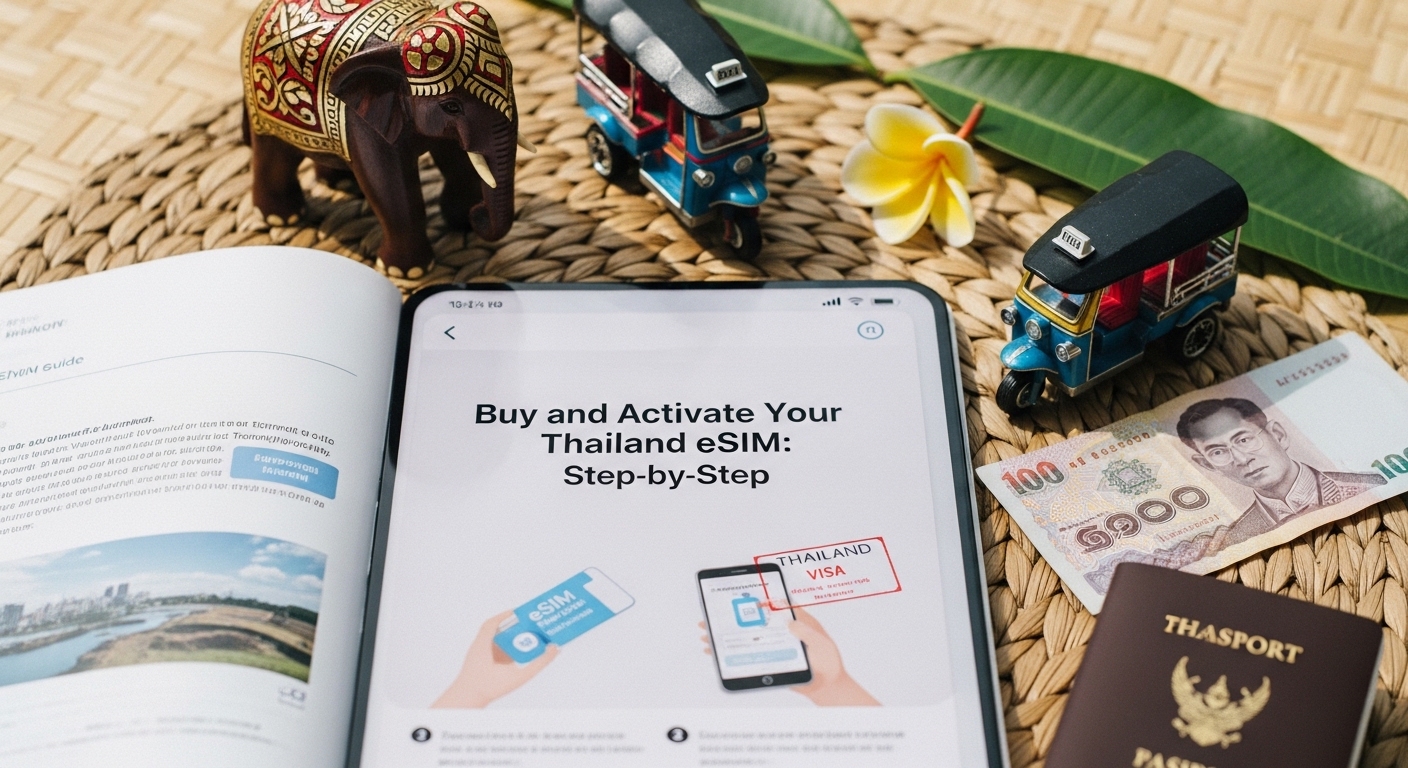
The full process takes about 5 minutes from purchase to connected.
Before you leave home:
- Confirm eSIM compatibility: Settings > General > About (iPhone) or Settings > Connections > SIM Manager (Samsung). Look for “Add eSIM” or “Available SIM.”
- Verify your phone is carrier-unlocked. Most phones purchased outright are already unlocked; if you bought on contract, request an unlock from your carrier before departure.
- Purchase your plan on Airalo and save the QR code to your camera roll as a backup.
Installing the eSIM:
- iPhone: Settings > Cellular > Add eSIM > Use QR Code
- Android (Samsung): Settings > Connections > SIM Manager > Add Mobile Plan
- Scan the QR code from your email or the Airalo app. Do not tap “Activate” yet—doing so in your home country starts the data validity timer.
On arrival in Thailand:
Enable the Thailand eSIM as your default data line in SIM settings. You will connect to AIS or True Move H within 60 seconds.
We have activated Airalo eSIMs on iPhone 13, iPhone 15 Pro, and Samsung Galaxy S24 devices without any compatibility problems. The single most common mistake is forgetting to switch the default data line from your home SIM to the Thailand eSIM—your phone will burn through home-carrier roaming data while the eSIM sits idle. Check your SIM settings as soon as the plane lands.
AIS vs. True Move H: Which Network Should You Choose?
Most Thailand eSIM plans run on either AIS or True Move H, and the difference matters depending on your itinerary.
AIS is Thailand’s largest carrier, with the broadest coverage in rural areas, mountains (Chiang Rai, Mae Hong Son, Pai), and smaller islands including Koh Tao, Koh Lanta, and Koh Kood. Speed is consistent across Bangkok and major cities, and 5G has rolled out in Bangkok, Chiang Mai, and Phuket as of 2026. Airalo and Saily both default to AIS.
True Move H was formed by the DTAC-True merger in 2023 and performs marginally faster in central Bangkok and the eastern seaboard (Pattaya, Hua Hin, Rayong). Holafly and Nomad use this network.
For island-heavy itineraries, choose AIS. For Bangkok-focused or eastern Thailand travel, either network performs well. According to NPERF Thailand Network Coverage, 2026, AIS holds a clear advantage in population-sparse provinces, making it the safer default for this thailand esim guide.
How Much Data Do You Actually Need in Thailand?
We tracked daily data consumption across different travel styles during two months in Thailand:
- Light use (Google Maps, WhatsApp, email): 200–350 MB per day
- Moderate use (navigation, Grab, Instagram, Google searches, hotel check-ins): 600 MB–1 GB per day
- Heavy use (video calls, Reels uploads, Netflix, remote work): 1.5–3 GB per day
For a 14-day trip with moderate use, budget 8–12 GB. The Airalo 10 GB plan covers this comfortably. Digital nomads and content creators should look at Holafly’s unlimited plan, which throttles to 1 Mbps after a daily fair-use threshold rather than cutting off entirely.
Bangkok, Chiang Mai, and most tourist-facing hotels and cafes offer solid Wi-Fi, which meaningfully reduces daily eSIM consumption. First-time visitors to Thailand often over-buy data—a key point this thailand esim guide would flag before you commit to an expensive unlimited plan.
Thailand eSIM vs. Physical SIM Card: Which Wins?
The airport SIM counters at Suvarnabhumi remain a functional option. Staff handle tourist purchases quickly, and a DTAC Tourist SIM with 15 GB and 15 days of validity runs around ฿299 (~$8)—solid value if you are already queuing at immigration.
| Factor | eSIM | Physical SIM |
|---|---|---|
| Setup time | 5 min (before landing) | 15–20 min (at airport) |
| Local Thai number | No | Yes |
| Home SIM swap required | No | Yes |
| Buy before departure | Yes | No |
| Approx. comparable price | ฿540–720 (~$15–20) | ฿299–399 (~$8–11) |
Choose eSIM if you value time, want to avoid the SIM-swap risk, or are combining Thailand with other eSIM-compatible countries on the same trip. Check our Thailand SIM card guide if you want a full breakdown of every physical SIM option available at each major airport.
Coverage Across Thailand’s Islands and Mountain Regions
Urban Thailand—Bangkok, Phuket, Chiang Mai, Chiang Rai, Koh Samui—has consistent 4G/LTE on both major networks. 5G coverage is expanding in Bangkok and Phuket through 2026, per GSMA Mobile Economy Southeast Asia, 2026.
Areas where any eSIM may struggle:
- Jungle trails deep inside Khao Yai, Doi Inthanon, and Erawan National Park
- Remote western islands: Koh Kood, Koh Mak, and Koh Chang’s west coast beyond Klong Kloi beach
- Highland villages in Mae Hong Son province and the Golden Triangle border zone
For these destinations, download offline maps via Google Maps or Maps.me before leaving town. Our Thailand travel tips article covers connectivity strategies for remote zones and national parks in more detail.
What to Do in Thailand: Booking Activities With Your eSIM
A working data connection earns its cost back fast in Thailand. Grab—the dominant ride-hailing app across Southeast Asia—requires a live internet connection. So does every ferry booking confirmation, hotel check-in QR code, and last-minute tour reservation.
We book almost all Thailand activities through Klook for verified operators, upfront pricing, and clear cancellation policies:
- Phi Phi Islands speedboat day trip from Phuket — one of Thailand’s most-visited experiences, with hotel pickup included and a stop at Maya Bay
- Bangkok Grand Palace, Wat Pho & Wat Arun guided tour — covers the three main temple sites in central Bangkok in a single half day, with skip-the-line access
- Chiang Mai Thai cooking class with morning market tour — consistently the top-rated half-day activity in northern Thailand, with all ingredients and a recipe card included
Booking through Klook typically saves 10–15% compared to on-site prices, and refunds are processed predictably. See our Bangkok itinerary and Chiang Mai travel guide for how we structure full-day plans around these experiences.
Where to Stay in Thailand
We use Booking.com to compare accommodation across Bangkok, Koh Samui, Phuket, and Chiang Mai. Free cancellation rates are widely available for Thai properties, which matters when island-hopping plans shift around ferry schedules or weather.
See our Phuket travel guide for beach zone accommodation picks and our Thailand budget guide for cost expectations by destination category—from ฿400 (~$11) guesthouses to mid-range hotels at ฿1,800–3,500 (~$50–97) per night.
Thailand eSIM Guide: Five Things to Do Before You Fly
Based on our experience using this thailand esim guide process across multiple trips, these five steps make arrival significantly smoother:
- Buy your eSIM at least 24 hours before departure. Airalo issues QR codes within minutes, but some providers take longer, and you do not want to troubleshoot at the departure gate.
- Screenshot the QR code. If email access fails in an airport transit area, a saved screenshot works as a reliable backup.
- Download offline maps for every destination. Google Maps offline mode covers entire provinces; download Bangkok, Chiang Mai, and any island destinations before leaving Wi-Fi.
- Install Grab at home. Registration requires phone verification, which is easier over home Wi-Fi than airport data.
- Set the eSIM as default data line before disabling Wi-Fi. Confirm this in SIM settings before you step off the plane.
For the latest Airalo plan pricing and availability, visit Airalo Thailand eSIM plans directly—pricing updates in real time and promotional rates appear regularly.
Frequently Asked Questions
Do I need an unlocked phone for a Thailand eSIM?
Yes. Your device must be carrier-unlocked to install a third-party eSIM. Most phones purchased outright are already unlocked. If you bought on a carrier contract, contact your carrier to request an unlock before your travel date.
Which Thailand eSIM provider is most reliable in 2026?
Based on our testing across this thailand esim guide, Airalo offers the widest plan selection and most consistent performance on the AIS network. Holafly is the top pick for unlimited data. Both providers have responsive customer support and clear refund policies.
Can I use a Thailand eSIM on my iPhone?
Any iPhone XS or later (2018+) supports eSIM. iPhones 14 and later sold in the United States are eSIM-only, meaning they have no physical SIM slot at all and work seamlessly with any Thailand eSIM plan.
How much does a Thailand eSIM cost in 2026?
Plans range from ฿180 (~$5) for 1 GB over 7 days to approximately ฿1,200 (~$33) for 30 days of unlimited data. The best value for a 1–2 week trip sits between ฿540–720 (~$15–20) for a 5–10 GB plan. Check our Thailand budget guide for how connectivity costs fit into total trip budgeting.
Does a Thailand eSIM work inside national parks?
Coverage near main visitor areas—Khao Yai entrance gate, Doi Suthep road to Chiang Mai—is generally adequate. Remote trails and jungle interiors have no reliable signal on any network or provider.
Can I buy a Thailand eSIM after I arrive?
Yes. Purchase over airport Wi-Fi and activate immediately through the provider’s app. Airalo’s app makes this the most straightforward option if you did not buy before departing. The Thailand visa guide covers device-related entry questions alongside documentation requirements.
Conclusion
Staying connected in Thailand is straightforward and affordable in 2026. The core takeaway from this thailand esim guide is simple: buy an Airalo plan before you leave home, install it during the flight, and activate on landing. The AIS network behind Airalo’s Thailand plans covers every major destination and most remote ones, with speeds high enough for navigation, streaming, and video calls.
Use the connection you are paying for. The time you would have spent at an airport SIM counter is better spent getting to your first destination.
Source: Airalo Thailand eSIM Plans, 2026 | Source: NPERF Thailand Network Coverage, 2026 | Source: GSMA Mobile Economy Southeast Asia, 2026