Complete Langkawi Travel Guide: Best Beaches, Tours & Tips
By TravelguidestipUpdated 13 min readHow we earn
Hotel buttons open Stay22 (Booking.com, Agoda and others) and tour buttons open GetYourGuide. We may earn a commission at no extra cost to you.
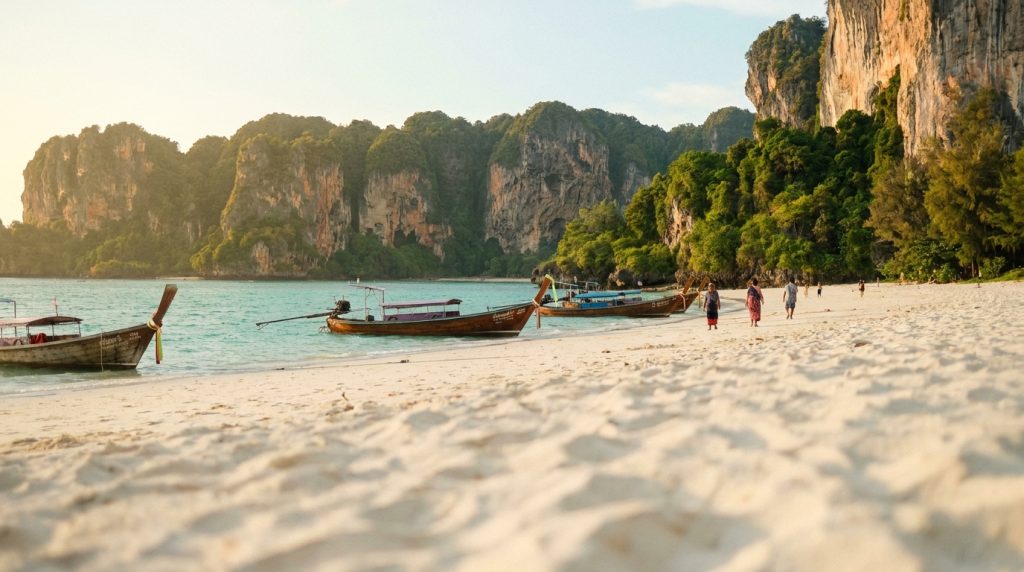
- Best months
- November–April dry season
- Daily budget
- 150-250 MYR $32-53 per day
- Entry
- Visa-free 90 days US, UK, EU, Australia
- From airport
- 15-20 MYR · 15 min Grab from LGK to Pantai Cenang
Quick answer: Langkawi is a duty-free 99-island archipelago off northwestern Malaysia, reached by a roughly 1-hour flight from Kuala Lumpur or by ferry from Kuala Kedah, Kuala Perlis, or Penang. Base yourself near Pantai Cenang, rent a car to cover the large main island, and plan 4-5 days around the SkyCab cable car and Sky Bridge, mangrove tours, and island hopping. Visit November to April for dry weather and avoid the August-October monsoon.
Key Takeaways: Langkawi is Malaysia’s premier beach destination — a 99-island duty-free archipelago off the northwestern coast with white-sand beaches, jungle-clad limestone islands, and Southeast Asia’s most spectacular cable car. The main island (Pulau Langkawi) hosts most accommodation around Pantai Cenang. Budget: 150-250 MYR/day (AUD 44–74 · USD 32–53).
Best time: November to April. No visa required for most Western passports. This guide covers everything you need to plan a 4-5 day Langkawi visit including the Sky Bridge, mangrove tours, island hopping, and duty-free shopping.
Langkawi consists of 99 islands (104 at low tide) covering 478 sq km. The archipelago was designated a UNESCO Global Geopark in 2007 — the first in Southeast Asia — recognizing its 550-million-year-old geological formations. The Langkawi Sky Bridge sits 660m above sea level on Mount Mat Cincang, accessed by Asia’s steepest cable car (a 42-degree gradient).
Approximately 3.5 million visitors arrive annually, with peak season December-March seeing daily ferry capacity utilization above 85%.
Langkawi works as both a standalone beach holiday and a complement to Penang’s heritage and food scene 2h45 away by ferry. This guide gives you the full picture for planning. For activities specifically, see Best Things to Do in Langkawi and Where to Stay in Langkawi.
Stay connected: grab a travel eSIM from Airalo before you go so you have data the moment you land.
Why Visit Langkawi? — Langkawi Travel Guide
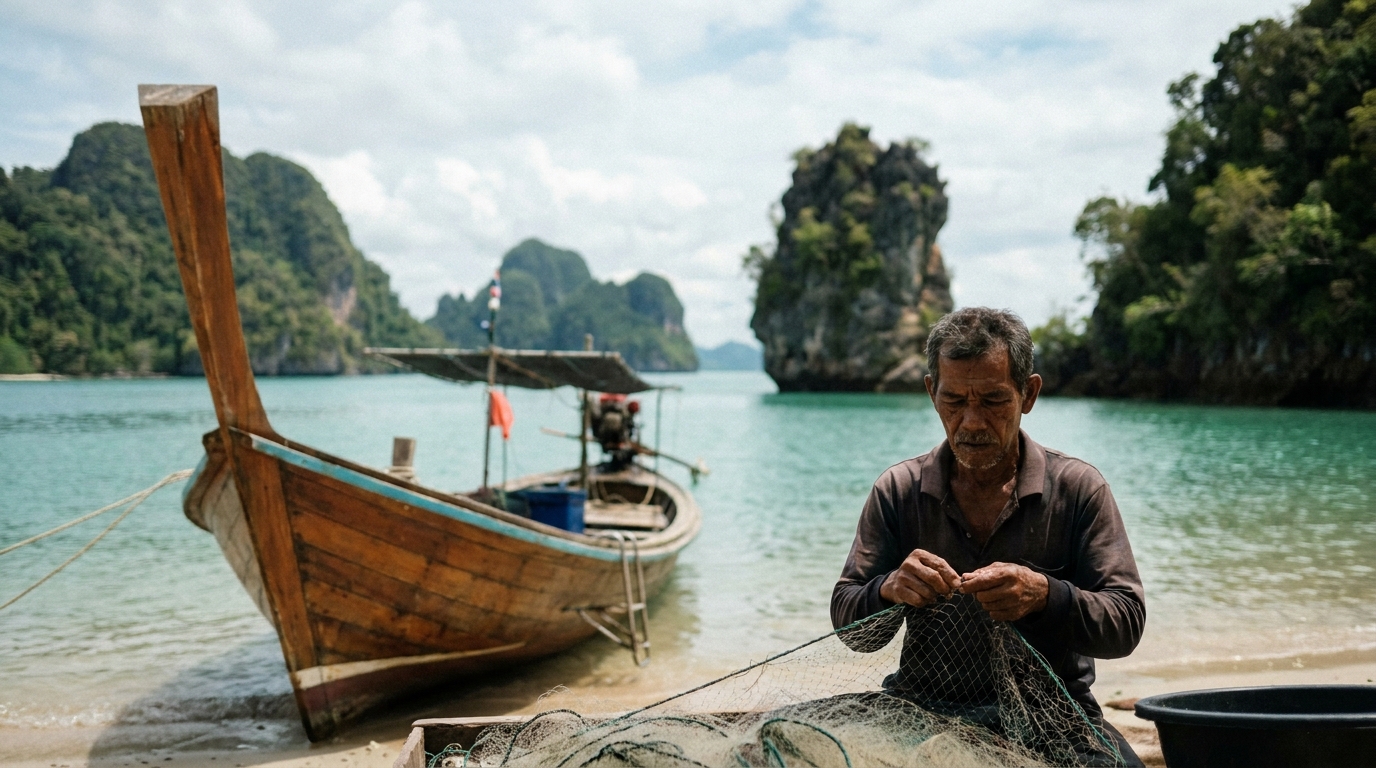
- Duty-free shopping — Langkawi has been duty-free since 1987. Alcohol, chocolate, cigarettes, and select luxury goods are 30-50% cheaper than mainland Malaysia
- UNESCO Geopark — 550-million-year-old limestone formations, mangrove systems, and pristine rainforest
- Sky Cab + Sky Bridge — One of Southeast Asia’s most spectacular attractions
- Beaches — Pantai Cenang, Tanjung Rhu, and Pantai Kok offer different beach atmospheres
- Island hopping — Day tours visit 3-5 surrounding islands including Pulau Dayang Bunting (Lake of the Pregnant Maiden)
Essential Facts
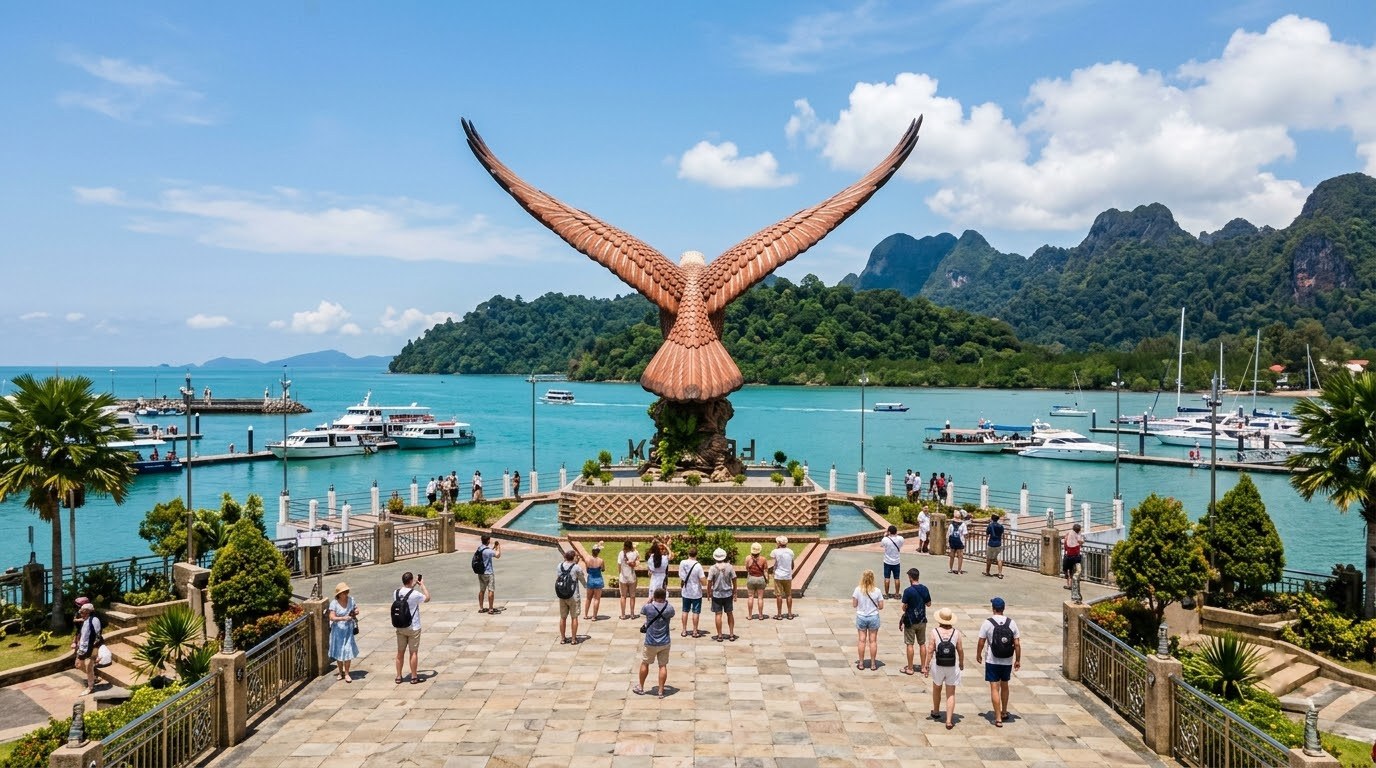
| Capital | Kuah (administrative town and ferry port) |
| Currency | Malaysian Ringgit (MYR); 1 USD ≈ 4.70 MYR |
| Language | Malay (official), English widely spoken in tourist areas |
| Best time | November-April (dry season) |
| Avoid | August-October (monsoon) |
| Visa | Visa-free 90 days for US, UK, EU, Australia |
| Airport | Langkawi International (LGK) |
| Time zone | GMT+8 |
When to Go
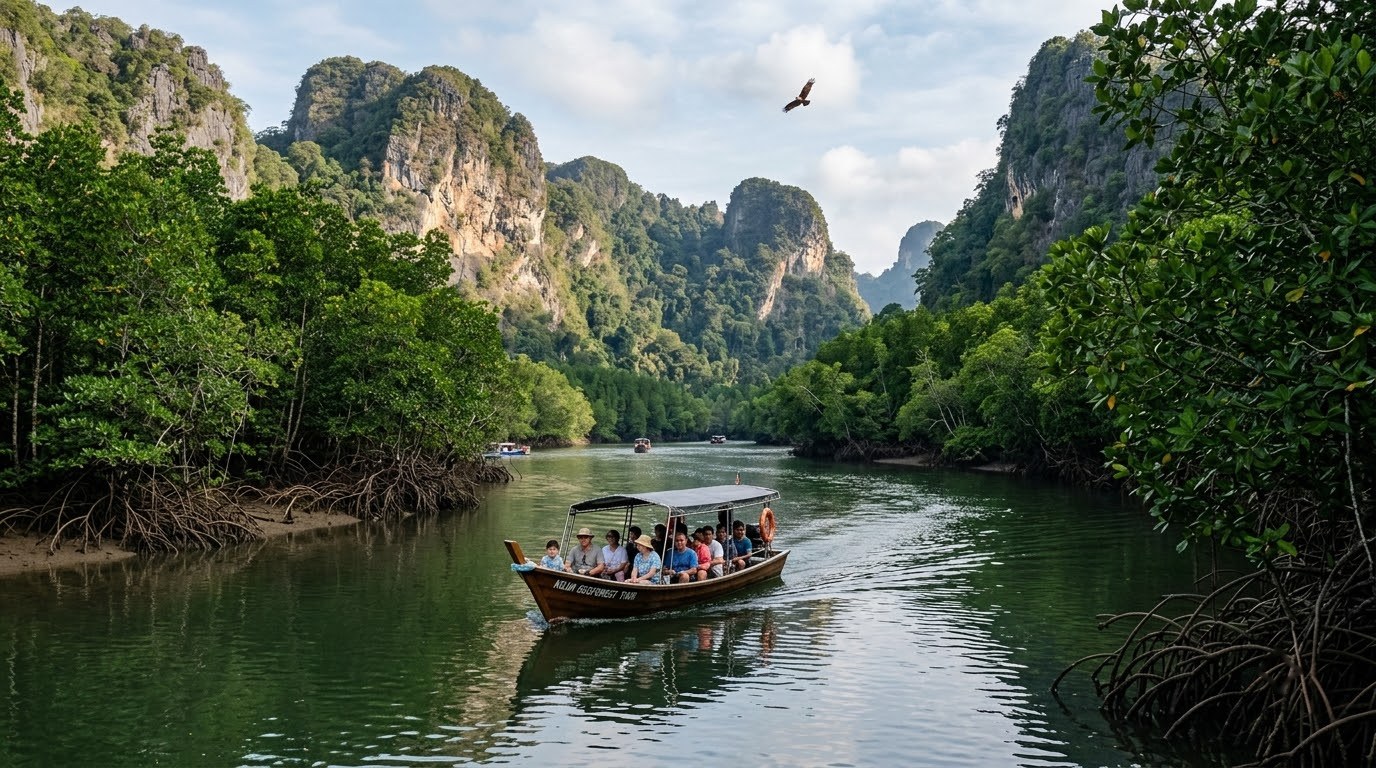
November to April is the dry season — calm seas, clear skies, and minimal rain. December-March is peak season with the highest prices and busiest beaches. April-May offers the best balance: dry weather, fewer crowds, and lower prices.
- November-March: Peak season. Calmest seas, best for island hopping. Prices 20-40% above low season.
- April-May: Shoulder season. Dry, warm, less crowded. Best value window.
- June-July: Rain begins. Manageable but increasing afternoon storms.
- August-October: Wet monsoon. Some island hopping tours cancel due to rough seas. Lowest prices.
For seasonal detail, see Best Time to Visit Langkawi.
Langkawi weather by month
Rainfall figures from the Malaysian Meteorological Department’s Langkawi station show how sharply the island’s weather swings. Temperatures barely move, with the mean maximum staying between about 31 and 33 degrees Celsius all year, but rainfall does.
| Month | Rainfall (mm) | Mean max (°C) |
|---|---|---|
| January | 23.9 | 32.9 |
| February | 32.7 | 33.2 |
| March | 104.8 | 33.0 |
| April | 196.6 | 32.3 |
| May | 206.9 | 31.7 |
| June | 249.9 | 31.5 |
| July | 265.5 | 31.1 |
| August | 319.2 | 30.9 |
| September | 340.6 | 30.6 |
| October | 372.5 | 30.7 |
| November | 193.0 | 31.3 |
| December | 57.5 | 31.6 |
January and February are by far the driest, and December is still light. Rain builds from March, and the three heaviest months are August, September and October, each above 300 mm.
April and May still see a couple of hundred millimetres, usually as short heavy showers rather than all-day rain, so they suit travellers who accept the odd storm in return for fewer crowds. If your dates fall in the wet months, plan outdoor tours for the morning and keep the afternoon free.
Getting to Langkawi
By Air
Langkawi International Airport (LGK) is served by:
– AirAsia: Direct from Kuala Lumpur (~1h, fares from 70 MYR), Singapore, Penang
– Malaysia Airlines: From KL and Singapore
– Firefly: From KL Subang and Penang
Penang to Langkawi is one of Southeast Asia’s most popular short flights — 30 minutes door-to-door versus 2h45 by ferry. AirAsia fares from Penang to Langkawi can drop to 50 MYR if booked 2-3 weeks ahead, often cheaper than the ferry plus airport transfer combined.
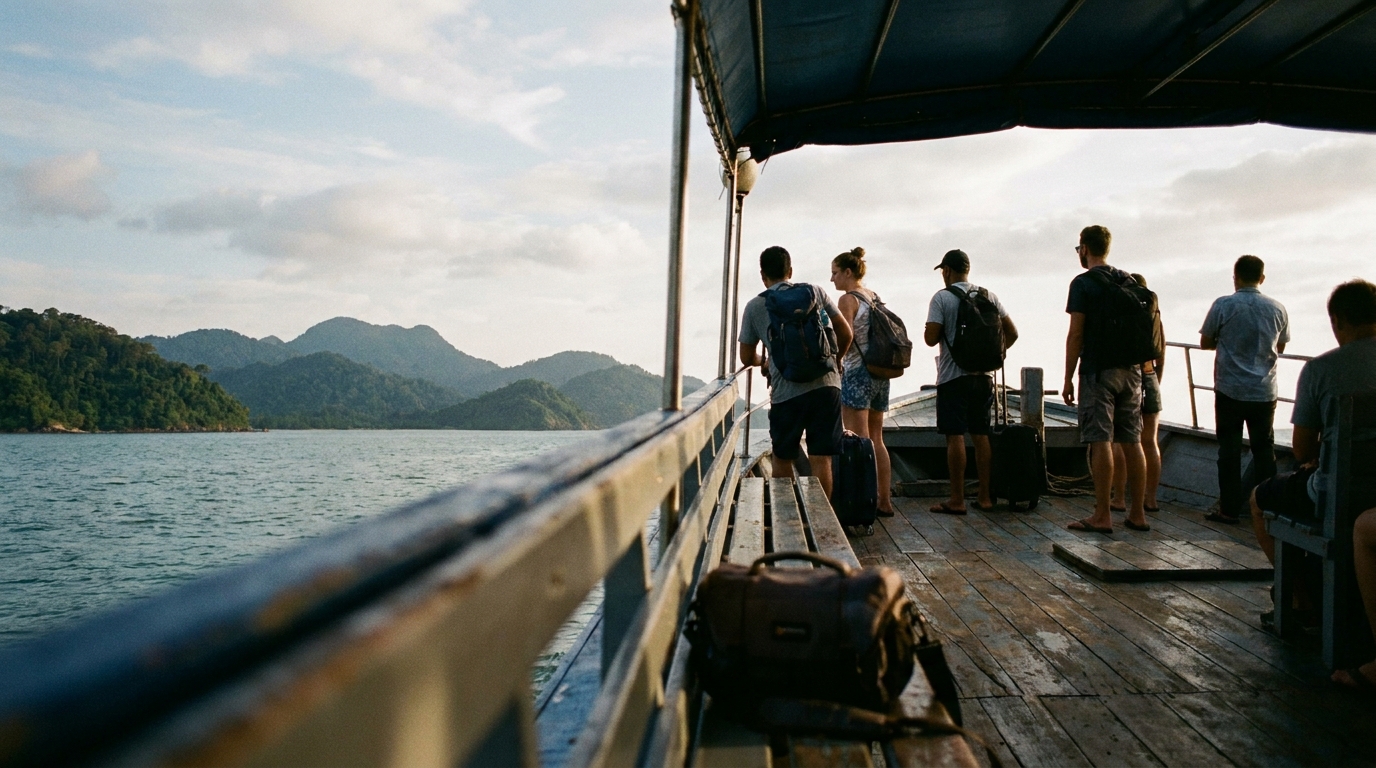
By Ferry
- Penang to Langkawi: Daily ferry, 2h45, ~70-75 MYR one-way
- Kuala Perlis to Langkawi: Most frequent service, 1h15, ~18-22 MYR (mainland Malaysian ferry port)
- Kuala Kedah to Langkawi: Alternative mainland port, 1h30, ~23-25 MYR
- Satun (Thailand) to Langkawi: International route from southern Thailand, 1h15, with immigration
Airport Transfer
- Grab: From LGK to Pantai Cenang ~15-20 MYR (15 min)
- Taxi: Fixed-rate coupons available at the airport, ~25 MYR to Pantai Cenang
- Shuttle: Some hotels include free transfers — check at booking
Ferry fares for foreign visitors in 2026
Ferry prices rose in 2026, so older fare lists understate the cost. Langkawi Ferry Line Ventures announced a RM10 increase for non-MyKad passengers (that is, foreign visitors) from 15 April 2026, while Malaysian MyKad holders were not affected.
| Route (one way, non-MyKad) | Adult | Child |
|---|---|---|
| Kuala Perlis to Langkawi | RM45 (AUD 13.30 · USD 9.60) | RM35 (AUD 10.30 · USD 7.40) |
| Kuala Kedah to Langkawi | RM55 (AUD 16.20 · USD 11.70) | RM42 (AUD 12.40 · USD 8.90) |
Kuala Perlis remains the easier mainland port to reach, with buses running from Butterworth. Kuala Kedah is harder without a car, because most visitors take a train to Alor Setar and then a Grab car.
Departure times shift with demand and the tides, and booking sites show different timetables for the same day. Check the operator’s live schedule when you book, and allow a buffer before any onward flight.
From Thailand, boats from Satun (Tammalang) take about an hour and from Koh Lipe about 90 minutes, usually with one daily departure. Immigration formalities apply at both ends.
Getting Around Langkawi
- Car rental: Strongly recommended. Langkawi is best explored by car. From 50-80 MYR/day for a basic compact, plus fuel.
- Scooter rental: From 30-50 MYR/day. Good for Pantai Cenang area; less ideal for the Sky Cab and northern beaches.
- Grab: Available but limited; no surge pricing in Langkawi. Useful for evenings.
- Taxi: Fixed-rate coupon system at the airport and ferry. Negotiate elsewhere.
- Walking: Pantai Cenang’s main strip is walkable; venturing beyond requires transport.
Top Experiences in Langkawi
Langkawi Sky Cab + Sky Bridge
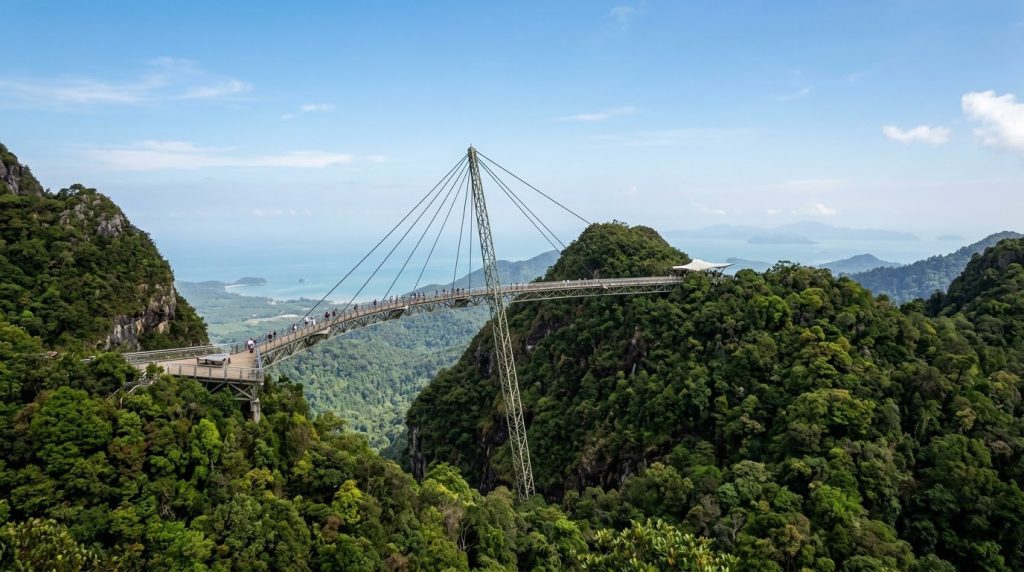
The Panorama Langkawi Cable Car ascends 700m to Mount Mat Cincang’s summit, where the Sky Bridge — a curved 125m suspended walkway — offers panoramic views over the archipelago. Open daily from 9:30am. Entry: ~85 MYR (Sky Cab + Sky Bridge combo).
Island Hopping Tour
The classic Langkawi day tour: 3-5 hours visiting Pulau Dayang Bunting (Lake of the Pregnant Maiden — swimming in a freshwater lake), Pulau Singa Besar (eagle feeding), and Pulau Beras Basah (white-sand beach). Boats depart Pantai Cenang and Telaga Harbor. Cost: 50-80 MYR per person.
Mangrove Tour (Kilim Geoforest Park)
The Kilim Geopark mangroves on Langkawi’s east coast — a UNESCO geopark area with limestone caves, eagle feeding, fish farms, and bat caves. 3-4 hour boat tour from Tanjung Rhu jetty. Cost: 60-100 MYR per person.
Pantai Cenang Beach
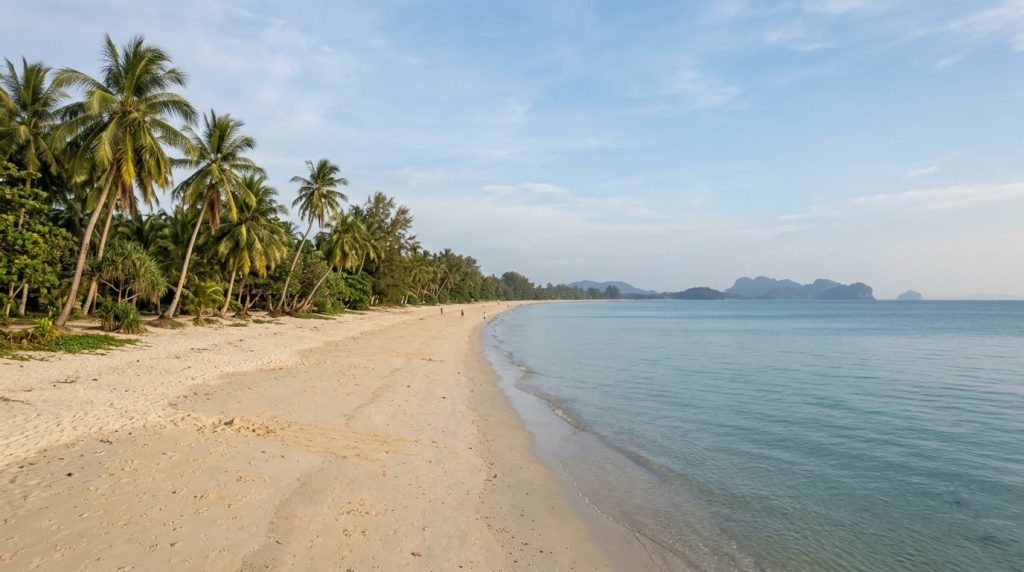
Langkawi’s main beach — 2km of white sand with hotels, beach bars, water sports, and the Underwater World aquarium. Best for sunset.
Tanjung Rhu Beach
A quieter, more upscale northern beach. White sand, calmer water, fewer crowds. Day-pass access to the Tanjung Rhu Resort beach club is available.
The Geopark: three parks, one island
UNESCO gave Langkawi World Geopark status on 1 June 2007. The listing is built around three conservation parks, and knowing which is which makes it easier to pick tours that actually deliver the geology.
- Machincang Cambrian Geoforest Park: Cambrian-era rock on the Gunung Mat Cincang range. The cable car climbs this mountain, and the Seven Wells waterfall sits about 1.5 km north of Oriental Village.
- Kilim Karst Geoforest Park: A mangrove park of limestone caves and three connected river estuaries, stretching about 10 km from Kisap village to Tanjung Rhu. Boat tours here run 2-4 hours.
- Dayang Bunting Marble Geoforest Park: Marble outcrops on Dayang Bunting, the island with the freshwater lake on most island-hopping routes.
Choose operators carefully on the Kilim tours. Some still feed sea eagles with chicken skin to draw them close, a practice conservationists oppose because it makes wild birds dependent on people. Ask the operator how they handle wildlife before you pay.
A simple way to see all three: ride the cable car one morning, take a Kilim boat tour on another, and join an island-hopping tour that includes Dayang Bunting.
4-Day Langkawi Itinerary (Summary)
| Day | Theme | Highlights |
|---|---|---|
| 1 | Pantai Cenang | Beach day, Underwater World, sunset |
| 2 | Sky Cab + West Coast | Sky Bridge, Telaga Harbor, Pantai Kok |
| 3 | Island Hopping | Lake of the Pregnant Maiden, eagle feeding, beach island |
| 4 | Kilim Mangroves + Duty-Free | Mangrove tour, Kuah town shopping |
For the full day-by-day plan, see Langkawi Itinerary.
Langkawi Travel Budget
| Category | Budget | Mid-Range |
|---|---|---|
| Accommodation (per night) | 80-180 MYR | 250-500 MYR |
| Food (per day) | 40-80 MYR | 100-200 MYR |
| Transport (per day) | 30-60 MYR | 60-120 MYR |
| Activities | 50-150 MYR | 100-300 MYR |
| Daily total | ~200-470 MYR | ~510-1,120 MYR |
| USD equiv. | ~AUD 60–139 · USD 43–100 | ~AUD 150–330 · USD 108–238 |
Langkawi is more expensive than Penang but cheaper than Bali for equivalent quality. The duty-free advantage means a beachfront beer at a Pantai Cenang bar costs 6-8 MYR (AUD 1.8–2.36 · USD 1.30–1.70) — roughly half the price of a comparable beer in Phuket or Bali. Imported chocolates are 30-50% cheaper than mainland Malaysia.
Find your Langkawi hotel on the map
Live prices from Booking & Airbnb — tap a pin to compare stays around Pantai Cenang and beyond.
Food and night markets in Langkawi
Langkawi’s food scene runs on a rotating weekly night market rather than one fixed strip, and following it is one of the cheapest ways to eat well on the island. Each village hosts its own market on a different night: Ulu Melaka on Monday, Kedawang on Tuesday, Kuah Town on Wednesday and Saturday, Temonyong on Thursday, Ayer Hangat on Friday and Padang Matsirat on Sunday, generally running from late afternoon into the evening.
These markets mix locals doing their weekly shop with visitors grazing on skewers, noodles and fried snacks, and prices sit well below anything on the Pantai Cenang restaurant strip.
Come hungry and graze rather than committing to one stall, since the appeal of a pasar malam is working through several small plates from different vendors. Expect grilled chicken wings, fried banana fritters, rojak (a fruit and vegetable salad in a spiced sauce) and a rotating mix of regional specialties depending on which village you visit.
If your hotel sits in Pantai Cenang and the night market that day is elsewhere, a Grab ride out and back is usually the easiest way to get there and still make it home before the stalls pack up.
Beyond the markets, a small cafe scene has grown up around Pantai Cenang and Pantai Tengah. Golden Bamboo Cafe serves casual, affordable Malaysian noodle and rice dishes, while Smiling Buffalo Cafe is a garden-set spot for breakfast and brunch with good coffee.
For something different, Yasmin Syrian Restaurant brings Middle Eastern grills, mezze and fresh bread to the island, and for fresh seafood on the cheap, a pick-your-own casual spot like Pai Kin C Food lets you choose the catch and have it cooked to order.
If you’re only in Langkawi for a short stay, timing a visit around one of the markets rather than hunting for it by chance is worth doing, since the locations rotate through villages spread across the island rather than sitting in one easy-to-find spot.
Breakfast options cluster more tightly around Pantai Cenang than anywhere else, so if your hotel sits elsewhere, factor in a short drive or expect simpler options at a local kedai kopi (coffee shop) instead.
Most restaurants and night-market stalls accept cash only, so keep small ringgit notes on hand rather than relying on cards once you step away from the bigger hotels and restaurants.
Where to Stay in Langkawi
Pantai Cenang is the main tourist strip — best for first-time visitors. Tanjung Rhu in the north is for upscale resort holidays. Kuah is the administrative town with duty-free shops, less suited for beach holidays.
- Budget: Pantai Cenang guesthouses from 80-150 MYR/night
- Mid-range: Beach resorts 250-450 MYR/night
- Luxury: The Datai, The Andaman, Four Seasons — 800-2,500+ MYR/night
See Where to Stay in Langkawi for area-by-area recommendations.
Browse Langkawi hotels on Booking.com
Waterfalls and wet-weather plans
Rain changes the island’s best activities rather than cancelling them. Waterfalls look strongest in the wet months, and the pools are at their best after the heaviest rain in September and October. Some falls shrink or dry up between February and April, so the dry-season peak that suits beaches is the wrong time for waterfall hikes.
The Seven Wells (Telaga Tujuh) waterfall, about 1.5 km north of Oriental Village, drops roughly 90 metres and includes natural rock pools. Entry fees are reported differently across listings, so bring small notes for the registration desk and wear shoes with grip, since the steps and rocks are slick after rain.
Forest reserve trails are often closed during the monsoon for safety. Check with your guesthouse or tour operator before driving to a trailhead.
- Sky Bridge: Go early, when the summit is less likely to be misty. A live camera at the ticket counter shows current visibility.
- Stay length: In the wet season, stay at least four nights so one bad day does not wipe out the trip.
- Driving: Roads are in good condition, but wet bends and sudden downpours call for slower speeds. Bring your International Driving Permit, film any scratches on a hired scooter before you leave and check the brakes and lights.
Nightlife in Langkawi
Langkawi’s nightlife is low-key compared with Phuket or Bali, and it centres almost entirely on Pantai Cenang’s beach bars rather than any club scene. Fire shows are a regular evening draw along the beach, and bars string lights and seating out onto the sand as the sun goes down.
Kalut Beach Bar on Pantai Cenang is a good example of the format: beanbag seating, drinks and an open view for sunset, with the crowd thinning out as the night goes on rather than building into a late scene.
Duty-free pricing keeps a beachfront drink cheaper here than on most other Malaysian or regional islands, which suits the relaxed, early-finishing pace most visitors settle into.
Live music shows up occasionally at a handful of the bigger beach bars on weekends, but it’s an exception rather than the norm, and most nights settle into background music and conversation over a sunset drink rather than anything louder.
If you want evening activity beyond a beach bar, the Wednesday and Saturday night markets in Kuah town double as an after-dark outing, combining food with browsing rather than drinking.
Most of the island is quiet after dinner outside Pantai Cenang, so base yourself there specifically if evening atmosphere matters to your trip.
Resort bars inside the bigger hotels are the other evening option, generally quieter and pricier than the beach-bar strip, and a reasonable fallback if you’d rather not walk the sand after dark, and worth asking your hotel about on booking if evening atmosphere matters to you.
None of this compares to the all-night scene found on islands like Koh Phangan or Bali’s southern strip, and that’s largely the point: Langkawi’s nightlife works as a wind-down after an active day rather than a reason to visit on its own, so plan late nights elsewhere and treat the evenings here as recovery time between activity-packed days.
Practical Tips
- Mobile data: Celcom, Maxis tourist SIM at airport (~25 MYR for 7-15 days)
- Cash: ATMs in Kuah town and Pantai Cenang. Small vendors may not accept cards.
- Duty-free limits: Foreign visitors can take alcohol, tobacco, and chocolate purchases home subject to your home country’s customs limits — check before bulk buying
- Sun protection: UV is intense, especially on island hopping tours. Reef-safe sunscreen is sold in Pantai Cenang shops
- Beach footwear: Many beaches have rocks and sea urchins; water shoes are useful for island hopping
Frequently Asked Questions
Is Langkawi worth visiting?
Yes — Langkawi offers Southeast Asia’s most spectacular cable car, UNESCO geopark mangroves, white-sand beaches, and duty-free shopping in one compact archipelago. 4-5 days is ideal for a first visit.
How many days do you need in Langkawi?
4-5 days for a thorough first visit. 3 days works if you focus on the Sky Cab, island hopping, and a beach day. 7+ days for slow travelers or those combining with diving trips.
Is Langkawi expensive?
Mid-range. More expensive than Penang or Phuket for equivalent stays but cheaper than Bali or Singapore. Duty-free shopping creates value on alcohol and chocolate.
Do I need a visa for Langkawi?
US, UK, EU, and Australian passport holders get 90 days visa-free in Malaysia, including Langkawi.
Sources:
1. UNESCO — Langkawi Global Geopark designation and management plan, 2024
2. Tourism Malaysia — Langkawi visitor statistics and destination guide, 2025
3. Langkawi Development Authority (LADA) — Sky Cab, Sky Bridge, and tourism infrastructure data, 2025
More Langkawi Guides
- Best Day Trips from Langkawi 2026: 8 Top Excursions Worth Taking
- Best Langkawi Hotels 2026: Top Picks for Every Budget
- Best Ways How to Get to Langkawi 2026: Flights, Ferry & Tips
- Langkawi on a Budget 2026: Best Cheap Travel Tips & Daily Costs
- Best Food in Langkawi 2026: 12 Must-Try Dishes & Top Restaurants