Is Bangkok Worth Visiting? An Honest Verdict for Australians (2026)
By TravelguidestipUpdated 10 min readHow we earn
Hotel buttons open Stay22 (Booking.com, Agoda and others) and tour buttons open GetYourGuide. We may earn a commission at no extra cost to you.
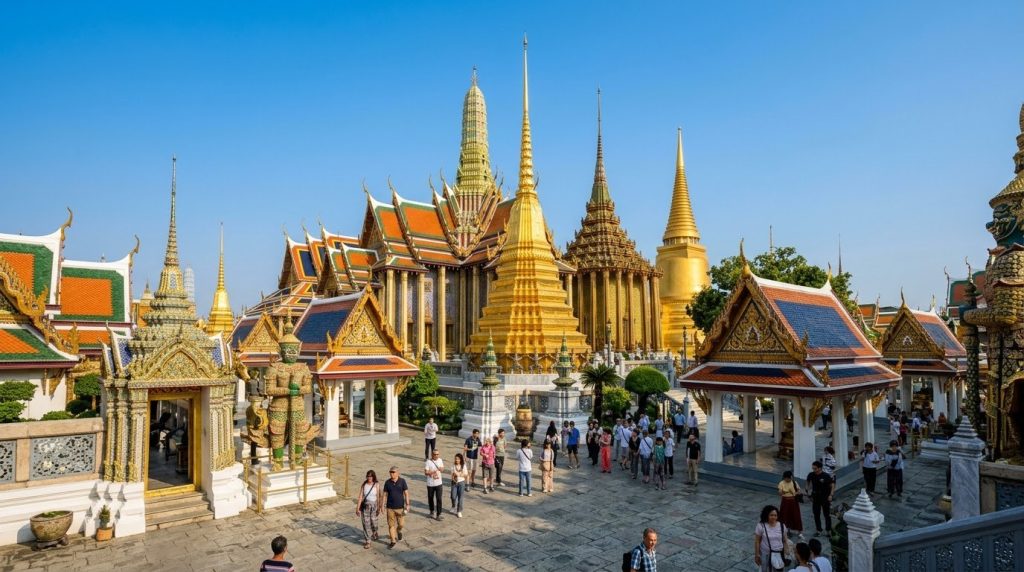
Yes, Bangkok is worth 2 to 3 nights for most Australians, even if the real goal is a beach, because the 9.5-hour direct flight from Sydney lands you there anyway and the island hop to Phuket is only about 1 hour 20 minutes.
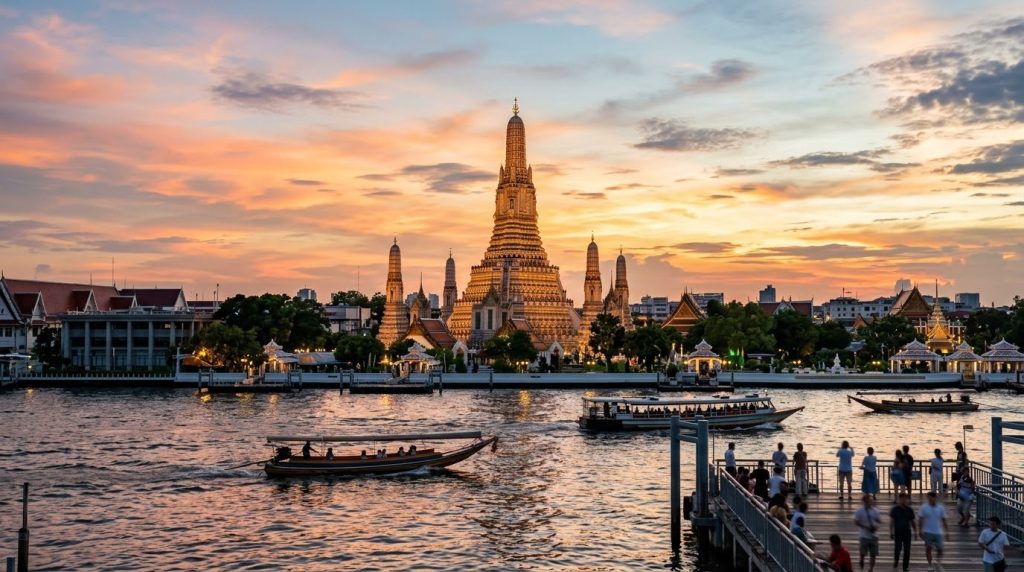
Those nights buy you the Grand Palace, Wat Pho and Wat Arun, some of Asia’s best cheap food and a rooftop sunset. Go between November and February, plan around the heat and traffic, and skip it only if you hate big cities.
| Question | Reality | What to do |
|---|---|---|
| How many nights? | 2 covers the big temples, 3 adds a market and a slower food night | Book 2–3 nights, then fly on |
| Temple entry | Grand Palace AUD 21 · USD 15 (THB 500), Wat Pho AUD 12 · USD 9 (THB 300), Wat Arun AUD 8 · USD 6 (THB 200) | Carry cash for Wat Pho and Wat Arun |
| Heat | April averages a 35.8C maximum; even December hits 32.3C | Temples at opening, pool or mall at midday |
| Traffic | Taxis crawl at peak hour | Use the BTS, MRT and river boats |
| Scams | “The Grand Palace is closed today” is the classic opener | Walk past and go to the gate yourself |
Why 2 to 3 nights is the sweet spot
Most Australians land in Bangkok anyway. Thai Airways and Qantas fly direct from Sydney to Suvarnabhumi, with scheduled times of about 9 hours 20 minutes to 9 hours 50 minutes, and the onward legs are short: Phuket is a 1 hour 20 minute hop at its fastest, Chiang Mai about 1 hour 15 to 1 hour 25 minutes. So the real question is whether to leave the airport.
Two nights is enough for the Old City temples on one day and a market or modern Bangkok on the other. Three nights is better: the first evening is usually lost to the flight, and the extra night gives you one unhurried food crawl.
If you want the full temple-market-day-trip version, our 3-day Bangkok itinerary lays it out hour by hour, and travellers with more leave can stretch it into the 5-day Bangkok itinerary with Ayutthaya and the canals.
What actually makes Bangkok worth the stop
The temples. The Grand Palace and the Temple of the Emerald Buddha are genuinely world-class, and one AUD 21 · USD 15 (THB 500) ticket covers both plus the Queen Sirikit Museum of Textiles. Wat Pho next door has the reclining Buddha and stays open into the evening, and Wat Arun is a short ferry ride across the Chao Phraya. All three together cost AUD 41 · USD 30 (THB 1,000) in entry.
The food. This is the strongest argument for staying. A plate of street pad thai or noodles runs AUD 1.70–3.30 · USD 1.20–2.40 (THB 40–80), and Bangkok’s Michelin Bib Gourmand list includes plain street-side places such as Pad Thai Fai Ta Lu, where a good meal usually comes in under AUD 17 · USD 12 (THB 400) a head.
Chinatown’s Yaowarat Road after dark is the one food experience you cannot replicate in Phuket.
Markets and rooftops. Chatuchak Weekend Market has more than 15,000 stalls and opens 9am to 6pm on Saturdays and Sundays; go before 11am, before the heat and crowds peak.
For the skyline, cocktails at the famous Sky Bar cost AUD 33–62 · USD 24–45 (THB 800–1,500), while Octave in Thong Lo is AUD 16–24 · USD 11–17 (THB 380–580) with a happy hour before 7pm. For a longer list of what to fit in, see our things to do in Bangkok roundup.
The honest downsides: heat, traffic and scams
Heat. Bangkok never really cools down. The coolest months still average 32–33C maximums, and April averages 35.8C with heavy humidity. Plan sightseeing for 8am to 11am, retreat to a pool or air-conditioned mall in the afternoon, and head out again after 5pm.
Traffic. Road traffic is notoriously slow, and a taxi across town at peak hour can take far longer than the distance suggests. Sleep near a BTS Skytrain or MRT station, and use the Chao Phraya river boats for the Old City temples.
Scams. The best-known one starts with a friendly stranger near the Grand Palace saying it is closed today for a ceremony, then steering you to a tuk-tuk that ends up at a gem shop selling overpriced stones. The palace is open daily from 8:30am to 3:30pm, so walk past and check the gate yourself.
Our guide on whether Bangkok is safe to visit covers the rest, from taxi meters to Smartraveller advice.
When to go: the November to February window
The cool, dry season runs from November to February, when the northeast monsoon brings drier air. December averages just 6mm of rain with a 23.1C minimum, and January 13mm, according to Climates to Travel’s Bangkok data. Compare that with September’s 335mm in the wet season.
Cool season lines up nicely with the Australian summer holidays, but it is also peak season, so book hotels and the island flight early if you are travelling over Christmas or January school holidays.
Who should skip Bangkok and fly straight to Phuket or Chiang Mai
– Short beach holidays. With 7 nights or fewer and a beach as the point, spend them all on the sand and fly through to Phuket. – Families with toddlers. Heat, crowded footpaths and traffic make Bangkok hard work with a pram; Phuket or Khao Lak are easier. – People who dislike big cities. If crowds, noise and humidity drain you, go to Chiang Mai instead.
It has the temples, night markets and cooking classes at a calmer pace. – Hot-season travellers who hate heat. In March to May, cut Bangkok to 1 night or skip it.
If money is the deciding factor, our Bangkok budget guide shows what each travel style really costs per day.
Getting around Bangkok: BTS, MRT, boats and taxis
On a short stop, how you move matters almost as much as what you book. Bangkok’s traffic is the city’s biggest time cost, so plan around the rail network rather than against it.
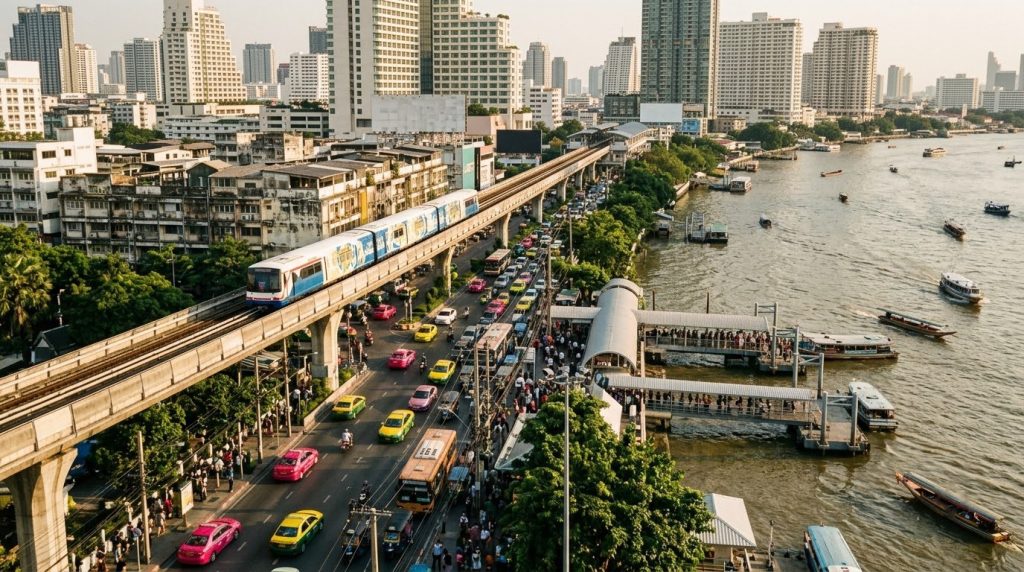
The BTS Skytrain and MRT subway cover most of the areas visitors care about, from Siam and Sukhumvit to the river piers for the Old City temples.
Single fares run about AUD 0.70–2.60 · USD 0.50–1.90 (THB 17–62) depending on distance, and a one-day BTS pass costs AUD 6.25 · USD 4.50 (THB 150) if you expect to make several trips. Buy a Rabbit Card on your first ride to skip the ticket machine queue on later ones.
For the river side of the city, the Chao Phraya Express Boat runs local commuter lines for as little as AUD 0.65–0.85 · USD 0.45–0.60 (THB 15–20) a trip, while the slower, tourist-oriented blue-flag boat charges a flat AUD 2.80 · USD 2 (THB 60) with an all-day unlimited pass around AUD 7–9 · USD 5–6.50 (THB 150–200).
Either way, river piers connect neatly to Wat Pho and Wat Arun without a single road crossing.
Taxis and Grab rides are cheap by Australian standards but slow at peak hours, so save them for late evenings or short hops when the heat makes walking unappealing. Always ask a metered taxi driver to use the meter before you get in; refusing to do so is one of the more common minor scams aimed at tourists leaving the airport or a hotel.
Bangkok with children: what works and what doesn’t
Bangkok is not a natural family destination the way Phuket or Chiang Mai can be, but a 2-night stop works for families with school-age kids if you lean on air-conditioned, indoor options during the hottest hours.
SEA LIFE Bangkok Ocean World, inside the Siam Paragon shopping centre, is the easiest fit: a large indoor aquarium with tunnel walkways, reachable by BTS, with ticket prices from around AUD 50–67 · USD 36–48 depending on where you book, often sold as a combo with the Madame Tussauds wax museum in the same building.
Both sit inside the same mall as food courts and air conditioning, which makes the combination useful on a hot afternoon between temple visits.
The Grand Palace and Wat Pho work for kids who can handle a couple of hours of walking in the heat, but go early, before 10am, and skip the afternoon slot entirely with younger children. Markets such as Chatuchak are overwhelming for toddlers on a weekend, when stall counts and crowds peak; a weekday visit is calmer if your schedule allows it.
With babies or toddlers, the heat, uneven footpaths and lack of shade do most of the damage to a Bangkok stop. Families in that stage of travel are usually better served flying straight through to a beach base and treating Bangkok as a one-night airport stop rather than a destination in its own right.
A day trip to Ayutthaya: is it worth the detour?
Ayutthaya, the ruined former capital of Siam, is the most common day trip added to a Bangkok stop, and it is worth considering if you have a third day and want one dose of history outside the modern city.
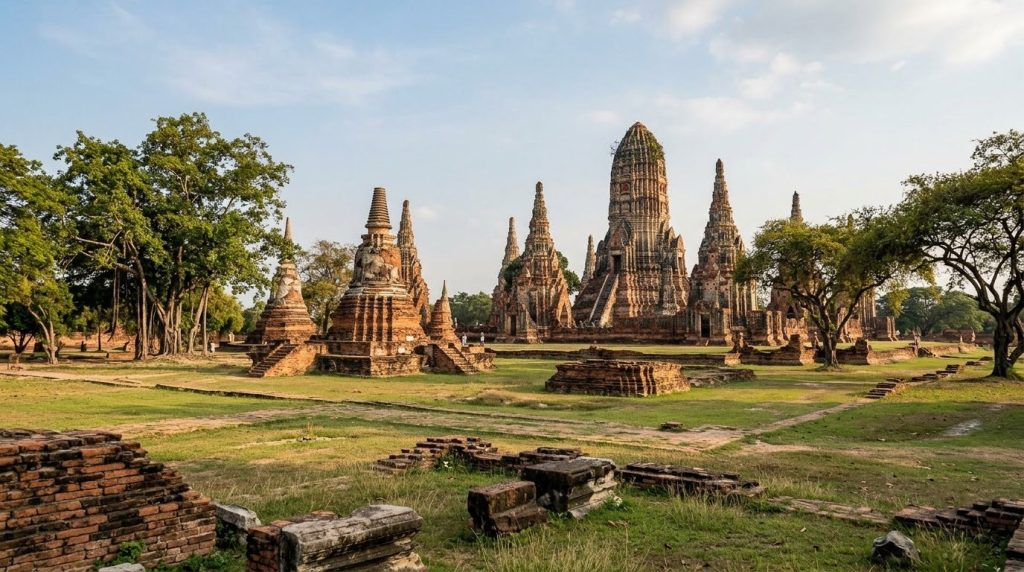
Trains from Bangkok run more than a dozen times a day and take roughly 1 to 1.5 hours depending on the service, with fares spanning AUD 0.60–7.50 · USD 0.45–5.40 (THB 15–180) across fan-cooled third class and air-conditioned options.
The wide range reflects genuinely different experiences, not just ticketing quirks: the cheapest fan-cooled seats are basic but fine for a short ride, while the air-conditioned fare buys a more comfortable trip at peak times.
Once there, the main temple ruins, including Wat Mahathat’s famous Buddha head wrapped in tree roots, are spread across a walkable but spacious historic park, best covered by bicycle or tuk-tuk rental rather than on foot in the heat. A full day, door to door, is realistic once you include the train and getting between temple sites.
Ayutthaya earns its place on a Bangkok itinerary if ancient temples and history interest you more than another day of markets and food. If you would rather spend a third day on modern Bangkok instead, the detour is skippable; nothing about Ayutthaya is essential the way the Grand Palace or Wat Pho are inside the city itself.
Floating market and canal tours worth booking
If temples and skyline bars are not quite the whole picture you want, a half-day floating market tour is the easiest way to see a different, slower side of the region without giving up a full day.
Damnoen Saduak, the best-known floating market, sits about 1.5 to 2 hours outside Bangkok, well beyond a BTS or MRT trip, so it is almost always done as a half-day guided tour rather than independently.
Group tours that include hotel pickup, transport, a guide and a boat ride typically run AUD 33–104 · USD 24–75 (THB 800–2,500), with many operators bundling in a stop at the nearby Maeklong Railway Market, where a working train line runs within arm’s reach of market stalls several times a day.
Private tours for small groups cost more per person but move at your own pace rather than a group’s.
Treat Damnoen Saduak as a cultural and photo stop rather than a cheap-shopping trip: prices on the water are aimed at tour groups, and the market is at its liveliest, and most crowded, in the early morning before most land-based attractions open.
If a half-day out of the city does not fit your schedule, Bangkok’s own canals, the khlongs that run off the Chao Phraya through older residential neighbourhoods, offer a shorter version of the same slower-paced scenery without leaving the city.
Longtail boat trips along these canals are commonly combined with a river boat ride to Wat Arun, giving you a taste of canal life in under an hour rather than a half day.
Where to stay in Bangkok
In Bangkok, the wrong base adds traffic time to every outing. Our full Bangkok travel guide compares neighbourhoods in more detail.
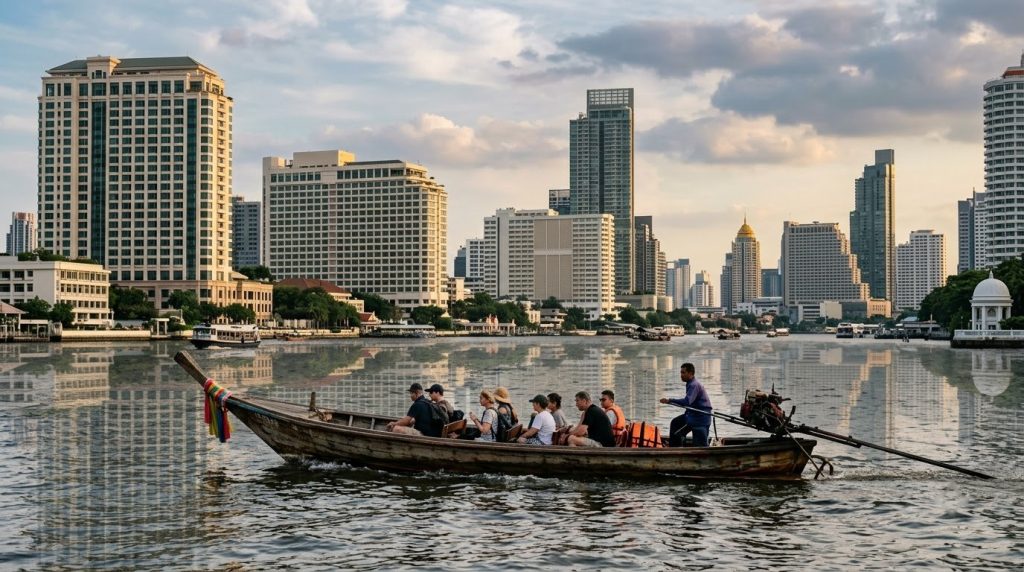
– Riverside and the Old City: best for a 2-night temple-focused stop. You can walk or take the boat to the Grand Palace and Wat Pho. – Sukhumvit (Asok to Thong Lo): best for first-timers who want food, rooftops and the BTS on the doorstep. – Silom and Sathorn: a good middle ground near the BTS, the MRT and the river, close to Lumphini Park and night food streets.
Find your Bangkok hotel on the map
Live prices from Booking, Airbnb and more — move the map or change dates to compare stays across Bangkok.
Frequently Asked Questions
Is Bangkok worth visiting for just 1 night?
One night is only worth it as a stopover. Arrive, eat in Chinatown or near your hotel, then visit Wat Pho or Wat Arun the next morning before an afternoon flight south. You will not fit in the Grand Palace, a market and a rooftop properly, so if Bangkok genuinely interests you, add a second night.
Is Bangkok better than Phuket?
They do different jobs. Bangkok is for temples, food, shopping and city energy; Phuket is for beaches, pools and island day trips. Most Australians get the best trip by doing 2 to 3 nights in Bangkok first, then flying the short 1 hour 20 minute leg to Phuket for the rest of the holiday.
What is the best month to visit Bangkok?
December and January are the most comfortable months. Rainfall averages only 6mm and 13mm respectively, and nights drop to about 23C. November and February are close behind. April is the hottest month, with average maximums near 36C, and September is the wettest, so pack an umbrella and keep afternoons flexible.
Is Bangkok too hot for a first trip?
Bangkok is hot all year, with average maximums above 32C even in the cool season, but it is manageable if you plan around it. Do temples early, rest through the middle of the day, and wear light clothes that still cover shoulders and knees for the Grand Palace dress code.
Is Bangkok worth it for families?
Yes, with older kids who enjoy food, boats and markets, but cap it at 2 nights. Choose a hotel with a pool near a BTS station so the afternoon heat break is easy. With toddlers or babies, the heat and crowded footpaths often outweigh the sights, and many families go straight to Phuket instead.