Disclosure: Some links in this guide are affiliate links. If you book or buy through them, we may earn a small commission at no extra cost to you — it helps keep our guides free.
Angkor Wat Sunrise Guide 2026: Best Time & Photo Spot
The Angkor Wat sunrise is worth the 4 a.m. alarm if you plan it right: arrive by 4:45 a.m., walk to the left reflection pond, and be ready for the light between 5:30 and 6:00 a.m. Gates open at 5:00 a.m. year-round, and the sun clears the horizon anywhere from 5:30 a.m. in December to 6:00 a.m. in June (Angkor Enterprise operating hours). The famous shot, the five towers mirrored in still water, comes from one specific spot, and hundreds of people are trying to stand there with you.
This guide covers exactly what time to leave your hotel, the best photo spot and why the left pond beats the right, how bad the crowds actually get, whether sunrise beats sunset, and how to time your tuk-tuk so you are not the last one through the gate. Peak-season crowds top out around 5,000 to 7,000 ticket sales a day, so timing is the whole game.
Key Takeaways
– Arrive by 4:45 a.m. to claim a front-row spot at the left reflection pond; gates open 5:00 a.m. and sunrise falls between 5:30 a.m. (December) and 6:00 a.m. (June).
– The 1-day Angkor Pass costs $37 in 2026 ($62 for 3 days, $72 for 7 days); children under 12 enter free with a passport.
– Buy your pass between 3:00 and 5:00 p.m. the day before so you skip the ticket-office queue at dawn and get the following day covered.
– A private tuk-tuk runs $20-25 for the whole vehicle on the Small Circuit; a shared tuk-tuk is $5-8 per person.
– Go in November or early February for clear skies and thinner crowds; December and January hit 5,000-7,000 visitors a day.**** We ran this exact dawn three times on our last trip to Siem Reap, once in a January peak-crowd crush and twice in shoulder-season November. The morning we reached the left pond at 4:40 a.m. we had the front rail; the morning we rolled up at 5:20 a.m. we were six rows back and shooting over other people’s phones. Ten minutes of sleep is the difference between the postcard and the scrum.
What time should you arrive at Angkor Wat for sunrise?
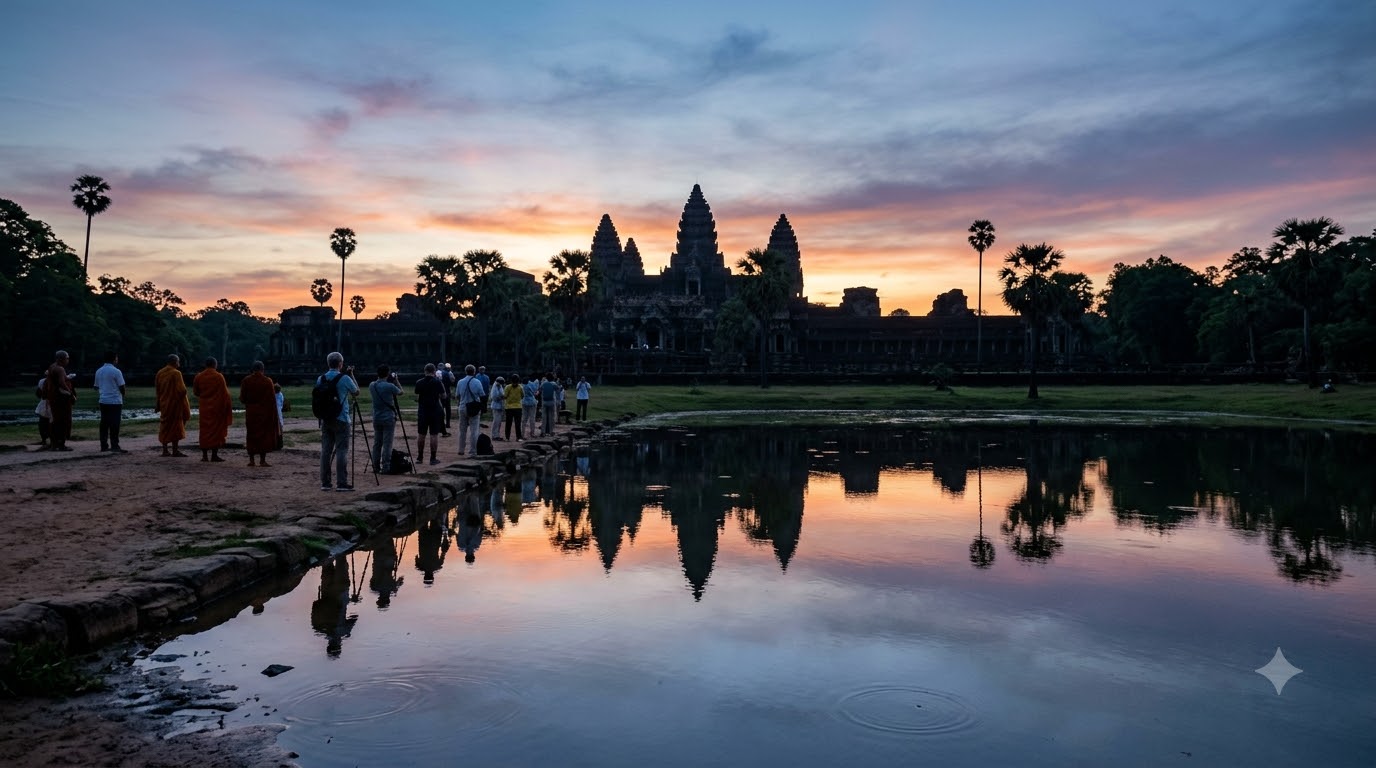
Leave your hotel by 4:15 a.m. and aim to be at the temple causeway by 4:45 a.m. Gates open at 5:00 a.m. every day of the year, but the good pond-side positions fill in the first fifteen minutes. Central Siem Reap sits about 6 km (roughly 15-20 minutes by tuk-tuk) from the Angkor Wat west gate, so a 4:15 a.m. departure gives you a buffer for the ticket check and the walk across the moat.
The sun itself is not punctual. Sunrise shifts through the year, so your “be ready” time moves with it:
- December-January: sunrise around 5:30-5:45 a.m.; be in position no later than 4:45 a.m.
- March (spring equinox): the sun rises directly behind the central tower, the single best alignment of the year for photographers.
- April-June: sunrise closer to 6:00 a.m.; you can arrive by 5:10 a.m. and still get a spot.
- September-November: sunrise around 5:40-5:50 a.m.; crowds are lighter, so 5:00 a.m. is usually fine.
We timed the walk from the parking area to the left pond at about eight minutes at a normal pace, longer if you are fumbling with a headlamp, so factor that in rather than counting from the gate.
The 3-Day Angkor Itinerary
The plan we use ourselves — sent straight to your inbox.
- Day-by-day route
- Where to stay
- Real 2026 costs
Free · No spam · Unsubscribe anytime
Find your Siem Reap hotel on the map
Live prices from Booking & Airbnb — tap a pin to compare stays around Pub Street and the Old Market and beyond.
Where is the best photo spot? (Left reflection pond)
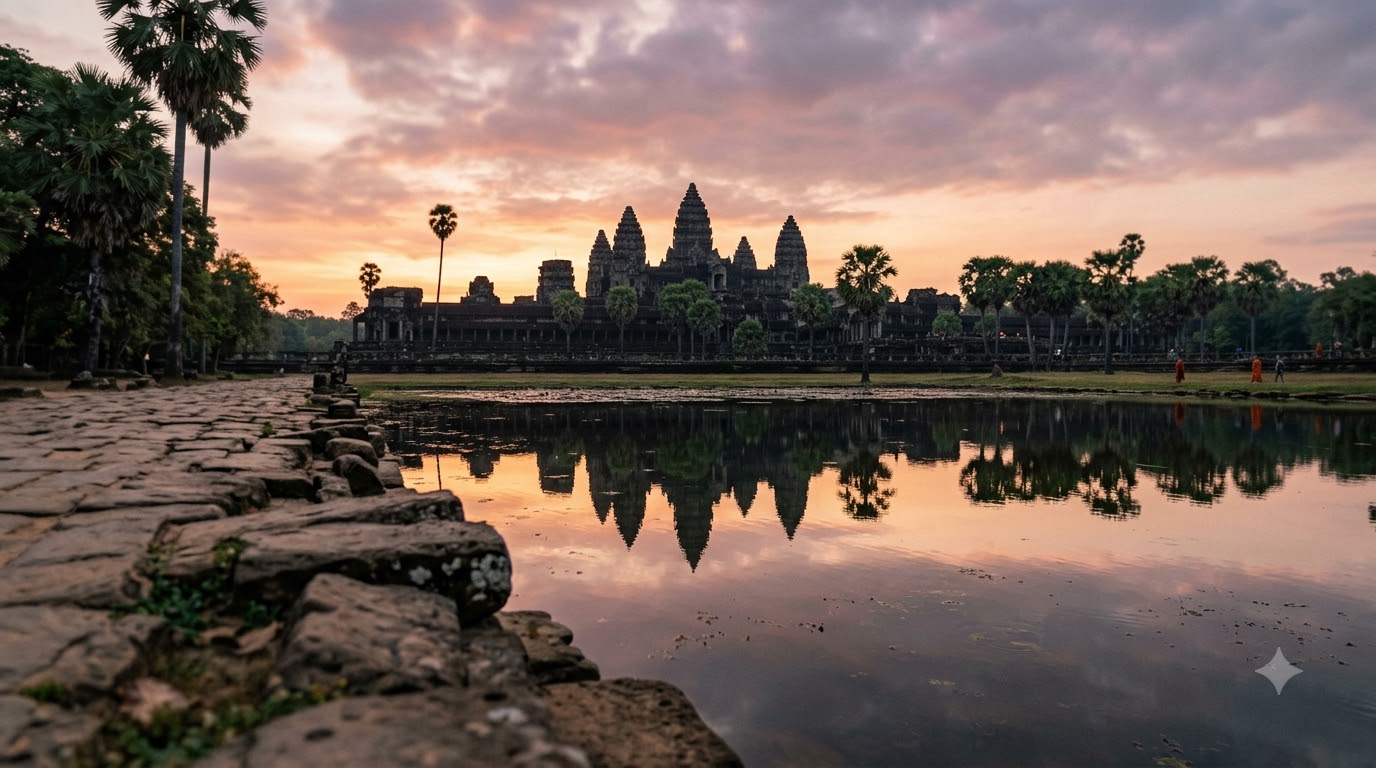
The best spot is the left reflection pond, the rectangular pool on the north side of the main causeway as you face the temple. This is the pool that produces the classic mirror image of all five towers, and it is the reason people set alarms for 4 a.m. Stand at the far edge of the pond, line the towers up over the water, and wait for the sky to color behind them.
A few specifics that save the shot:
- Left pond (north side): the iconic mirror view, most crowded; front rail fills by about 5:00 a.m. in dry season.
- Right pond (south side): the same towers, a slightly different reflection, and noticeably fewer people; a strong backup if the left is packed.
- Turn right, not straight ahead: most of the crowd walks directly to the left pond, so heading toward the right pond first often means open space.
- Bring a small torch: the causeway is dark before 5:00 a.m. and the stones are uneven.
- A phone works fine: you do not need a tripod for the silhouette; the towers-and-color shot is easy handheld once the sky lightens.
On our November morning we shot the left pond, then crossed to the right pond by 6:15 a.m. and had almost the whole rail to ourselves for the warmer post-sunrise light.
How bad are the crowds at sunrise?
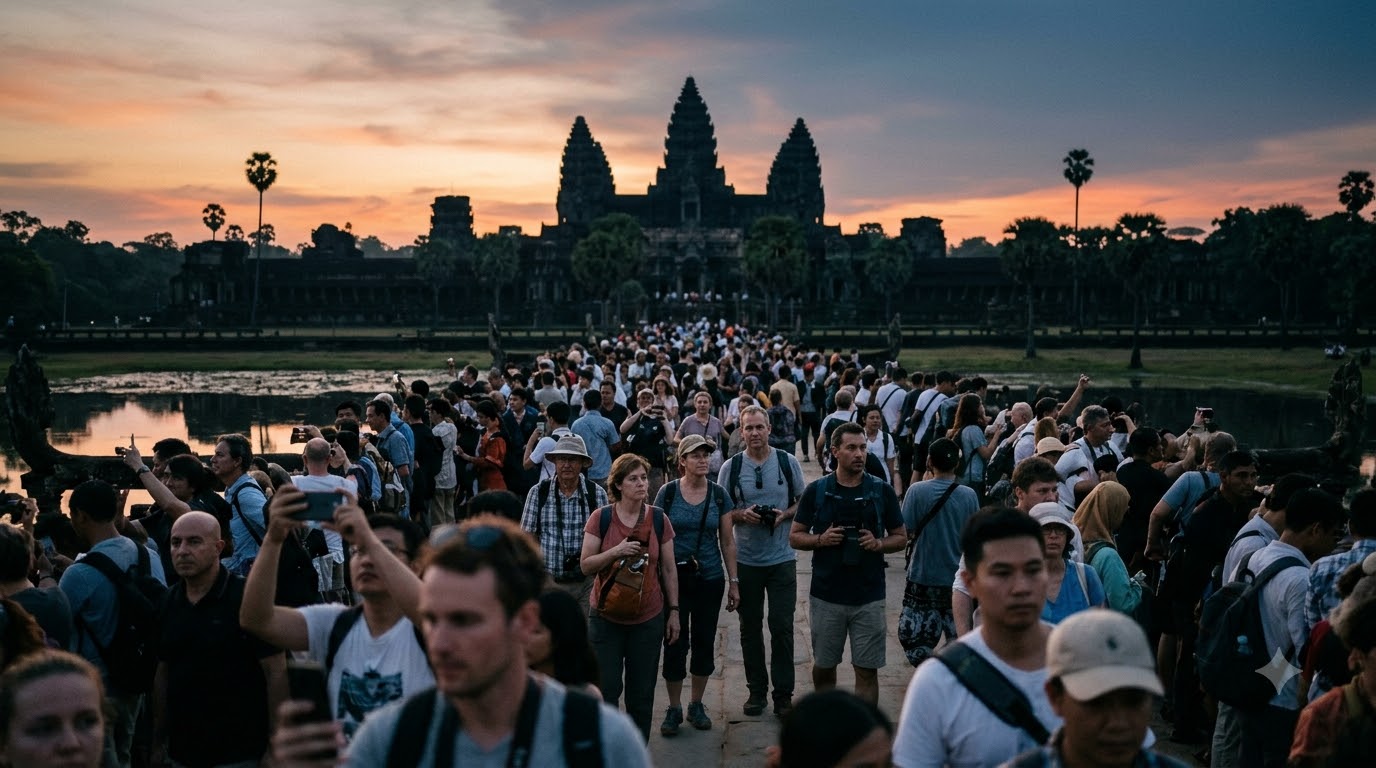
Crowds are heavy in peak season and light in the wet season, and the gap is enormous. In December and January, several hundred people can be standing at the reflection pond by 5:30 a.m., and total daily ticket sales run 5,000 to 7,000 across the whole park. In July and August, daily sales average roughly 1,000 to 1,500, and the pond feels calm by comparison.
| Period | Daily park visitors (approx.) | Sunrise crowd feel | Weather |
|---|---|---|---|
| December-January (peak) | 5,000-7,000 | Packed; arrive 4:45 a.m. or earlier | Cool, dry, 20-30°C |
| November & February (shoulder) | 3,000-4,500 | Busy but manageable | Clear skies, low humidity |
| March-April | 3,000-5,000 | Moderate; equinox draws photographers | Hot, dry, up to 35°C+ |
| May-October (wet) | 1,000-1,500 | Quiet; often room at the rail | Humid, afternoon rain |
Here is the honest part: not everyone loves it. A meaningful share of visitors find the dawn crush underwhelming precisely because the reflection pond is shoulder-to-shoulder. The trick is either going in the shoulder months (November, early February) or accepting the crowd and arriving early enough to be in front of it. The other reward is that once the sunrise crowd disperses around 7:00-7:30 a.m., most people leave for Bayon and Ta Prohm, and Angkor Wat itself becomes far quieter for exploring the inner galleries.
The 3-Day Angkor Itinerary
Hour-by-hour plan, where to stay and what it really costs — free PDF.
Free · No spam · Unsubscribe anytime
Is the Angkor Wat sunrise worth it?
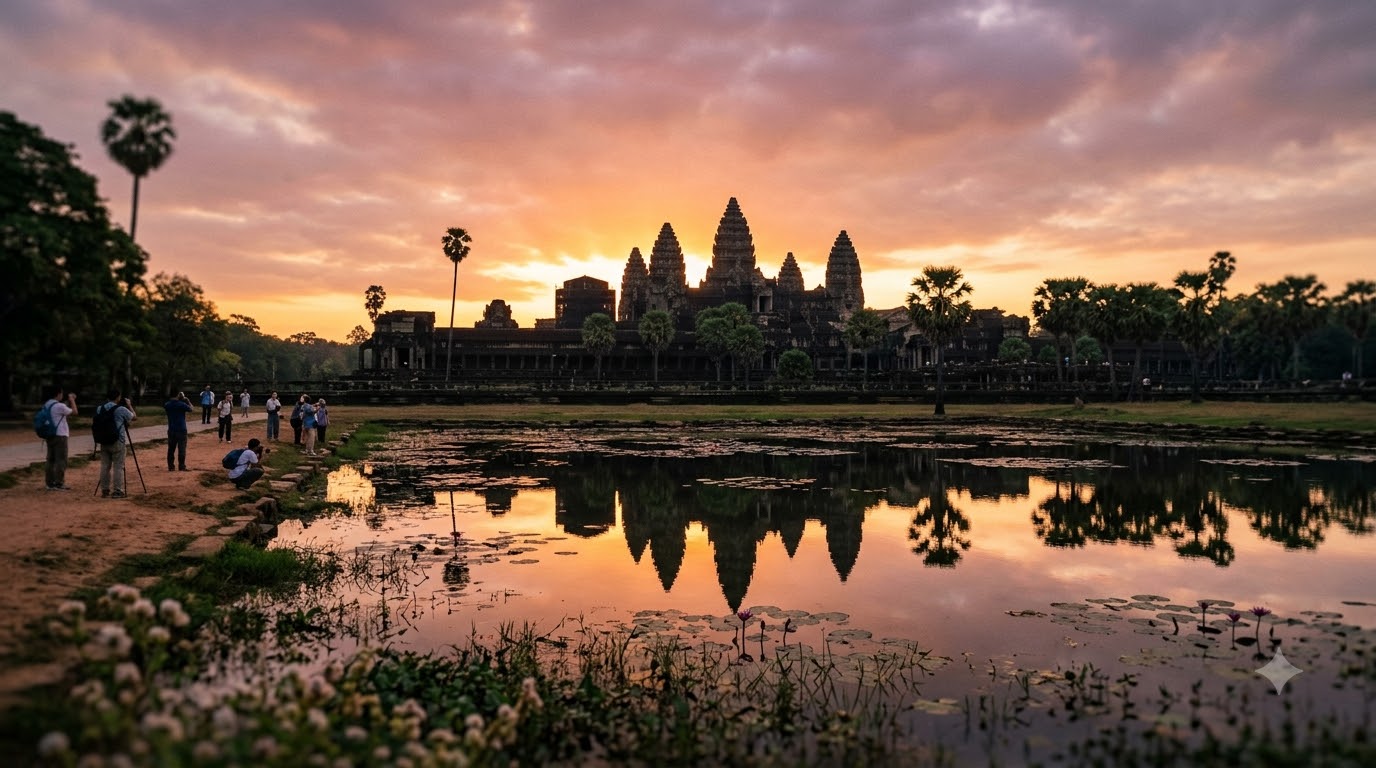
Yes, for most travelers it is worth it, with one condition: manage your expectations about the crowd and go in the right season. The silhouette of the towers against a coloring sky, doubled in the water, is genuinely one of Southeast Asia’s great sights. What disappoints people is not the temple, it is the phones-in-your-face reality of a peak-season dawn.
Reasons it is worth setting the alarm:
- The light is best at dawn: the towers face west, so the rising sun lights the sky behind them for that clean silhouette-and-reflection frame.
- The temple empties after 7 a.m.: you get the sunrise, then a quieter interior when the crowd moves on.
- It costs nothing extra: sunrise is included in your standard Angkor Pass; there is no separate dawn fee.
- March equinox alignment: the sun rises squarely behind the central tower, a photographer’s bucket-list shot.
If you strongly dislike crowds, read the sunrise-vs-sunset section below before committing. For a fuller sense of what else fills a day here, our complete Angkor Wat temple guide walks through the main structures and how the sunrise fits a wider circuit.
Sunrise vs sunset at Angkor Wat: which is better?
Sunrise wins for the classic reflection shot; sunset wins for peace and warm light on the stone. They are genuinely different experiences, not better-or-worse. Sunrise puts the sun behind the temple for silhouettes and pond reflections. At sunset the low sun lights the western face of Angkor Wat directly, and the moat throws long reflections, but far fewer people bother.
| Factor | Sunrise | Sunset |
|---|---|---|
| Best for | Silhouette + reflection pond shot | Warm light on temple stone, calm mood |
| Crowds | Heavy (hundreds at the pond in peak) | Light at Angkor Wat itself |
| Time in 2026 | 5:30-6:00 a.m. (season dependent) | Roughly 5:45-6:15 p.m. |
| Wake-up cost | 4 a.m. alarm required | None; easy afternoon add-on |
| Best alternative spot | Right reflection pond | Pre Rup temple (Grand Circuit) |
Our take after doing both: shoot sunrise once for the trophy shot, then use a late afternoon for a relaxed sunset, either at Angkor Wat’s western face or from the elevated brick terraces of Pre Rup, which stays uncrowded. If you can only pick one dawn and hate crowds, a wet-season sunrise gives you the reflection with room to breathe. To choose your travel dates around all of this, see our best time to visit Siem Reap breakdown.
Tickets, cost, and tuk-tuk timing
You need a valid Angkor Pass before you reach the gate, and you cannot buy it at the temple itself. The 1-day pass is $37 in 2026, the 3-day pass is $62, and the 7-day pass is $72; children under 12 enter free with a passport for age proof (Angkor Enterprise). Buy online at ticket.angkorenterprise.gov.kh, at the main ticket office on Apsara Road (open 4:30 a.m.-5:30 p.m.), or at self-service kiosks in town.
The single smartest move for a sunrise visit is the afternoon-before purchase:
- Buy between 3:00 and 5:00 p.m. the day before: a pass bought after 5:00 p.m. is valid that evening and the full next day, so you skip the dawn queue entirely.
- Private tuk-tuk, Small Circuit: $20-25 for the whole vehicle, and most drivers will do the pre-dawn pickup and wait for you.
- Shared tuk-tuk: $5-8 per person if you split with other travelers from your guesthouse.
- Agree on a dawn start the night before: tell your driver 4:15 a.m. pickup so there is no negotiating in the dark.
- Keep the pass and passport handy: rangers check the pass at the gate and again inside; a phone screenshot of an e-ticket is accepted.
We paid $22 for a private tuk-tuk on the Small Circuit, and the driver waited through sunrise, then ran us to Bayon and Ta Prohm before the mid-morning heat. For the full pass rules, refund policy, and photo requirements, our Angkor Wat ticket guide has the details, and if you want a ready-made route for the rest of the day, the one-day Angkor Wat itinerary picks up right after the sunrise crowd thins.
What to bring and how to dress
Dress for a working temple and a cool dawn, then a hot mid-morning. Angkor Wat enforces a modest dress code in the upper levels: shoulders and knees covered for everyone, no exceptions at the Bakan (top tier). Mornings in the dry season can start around 20-22°C before climbing past 30°C by 9 a.m., so layers matter.
Pack this the night before:
- Light layer or scarf: dawn is cool and covers shoulders for temple entry.
- Trousers or a below-knee skirt: required for the upper level; shorts are turned away there.
- Headlamp or phone torch: the causeway is dark until about 5:15 a.m.
- Water and a snack: you will be out 3-4 hours before a real breakfast.
- Small cash in USD: for the tuk-tuk, water vendors, and coffee stalls that open at dawn near the pond.
Mosquito repellent is worth it at the ponds before the sun is up. Coffee and noodle stalls set up along the causeway edge by around 6 a.m., so a hot drink after the shot is easy to find.
Frequently Asked Questions
What time does Angkor Wat open for sunrise?
Gates open at 5:00 a.m. every day of the year. Sunrise itself falls between about 5:30 a.m. in December and 6:00 a.m. in June, so arrive by 4:45 a.m. in peak season to secure a spot at the left reflection pond before the crowd builds.
Which reflection pond is best for photos, left or right?
The left (north) pond is the famous one, producing the classic mirror image of all five towers, but it is also the most crowded. The right (south) pond gives a very similar reflection with far fewer people, so it is the better choice if the left pond is packed or you prefer space over the exact postcard angle.
How much is the ticket for the Angkor Wat sunrise in 2026?
Sunrise is included in the standard Angkor Pass; there is no separate dawn fee. A 1-day pass is $37, a 3-day pass is $62, and a 7-day pass is $72. Buy it after 5:00 p.m. the day before and it covers that evening plus the next full day, letting you skip the dawn ticket queue.
Is Angkor Wat sunrise better than sunset?
Sunrise is better for the reflection-pond silhouette shot, while sunset is better for warm light on the temple’s western face and much smaller crowds. Many travelers do sunrise once for the iconic photo, then enjoy a calmer sunset at Angkor Wat or from Pre Rup temple on the Grand Circuit.
How do I get to Angkor Wat for sunrise from Siem Reap?
Most visitors take a tuk-tuk, about 15-20 minutes from central Siem Reap. Arrange a private tuk-tuk for $20-25 (whole vehicle, Small Circuit) or a shared one for $5-8 per person, and agree on a 4:15 a.m. pickup the night before so the driver waits through sunrise and continues to the other temples afterward.
Final thoughts
The Angkor Wat sunrise rewards planning more than luck. Buy the pass the afternoon before, agree a 4:15 a.m. tuk-tuk, reach the left pond by 4:45 a.m., and shoot the equinox week in March if your dates allow. Go in November or early February and you trade almost nothing in weather for a much thinner crowd. Then, when the dawn rush drifts off toward Bayon around 7:30 a.m., stay a little longer and have the galleries almost to yourself before rejoining the rest of your one-day Angkor Wat itinerary.