Disclosure: Some links in this guide are affiliate links. If you book or buy through them, we may earn a small commission at no extra cost to you — it helps keep our guides free.
Tokyo Travel Guide 2026: First-Timer Tips, Transport & Budget
This Tokyo travel guide is built for people landing in the city for the first time, and the short version is simple: base yourself near a Yamanote Line station, load a Suica card at the airport, and plan around the season you visit. Tokyo is enormous but the useful parts are stitched together by one of the most reliable train networks on earth, so once you understand the rail map and a rough daily budget, the intimidation drops away fast.
You are arriving at a busy moment. Japan welcomed a record 42.68 million foreign visitors in 2025, up 15.8 percent on the year before and the first time the annual figure passed 40 million (Japan National Tourism Organization, 2026). A yen sitting near 150 to the US dollar, versus roughly 110 back in 2019, is a big reason Tokyo still feels affordable to overseas travelers. This guide is the hub for our whole Tokyo cluster: below we cover when to go, airport transfers, the transport card system, which neighborhoods to sleep in, and what a realistic day costs, then point you to deeper guides on food, things to do, where to stay, and a full five-day plan.
Key Takeaways
– Record crowds: 42.68 million foreign visitors reached Japan in 2025, up 15.8 percent year on year (JNTO, 2026), so book hotels and popular restaurants early.
– Transport card: A Suica smart card with 1,500 yen of credit costs about 2,050 yen at the airport and works on nearly every train, subway, and convenience store.
– Airport transfer: The Narita Express reaches central Tokyo in 55 to 90 minutes for roughly 3,070 to 4,020 yen one way; Haneda is far closer to downtown.
– Daily budget: Mid-range travelers spend about 15,000 to 22,000 yen (roughly 100 to 140 USD) per day, including a mid-range hotel near 25,000 yen a night.
– Best weather: Late March and April bring cherry blossoms with daytime highs near 15 C, and Tokyo’s 2026 full bloom was forecast around March 26 to 27.**** On our first Tokyo trip we wasted an afternoon buying single paper tickets from a machine we did not understand, then finally tapped through with a Suica and never looked back. We now tell every first-timer the same thing: get the card before you leave the airport, because it removes the one friction point that makes Tokyo feel harder than it actually is.
Why Tokyo Works So Well for First-Timers
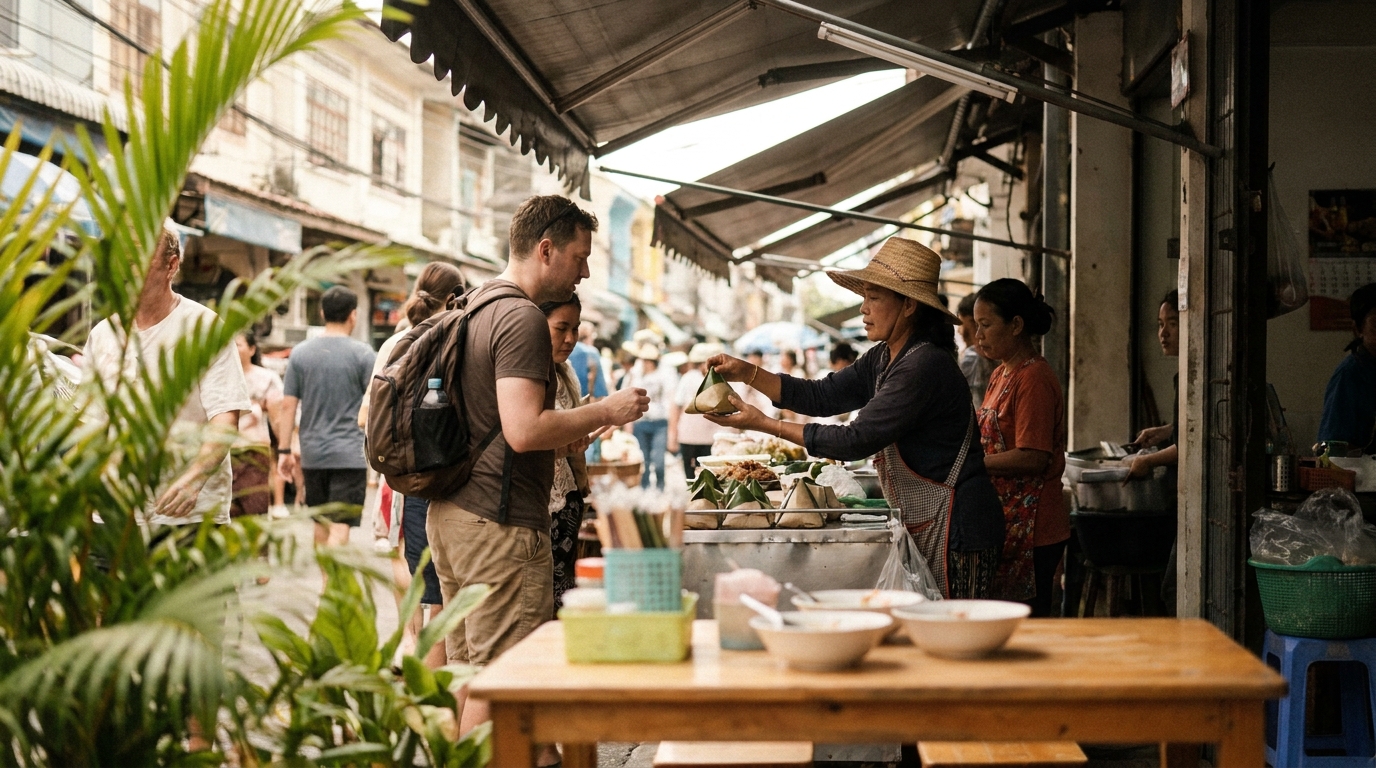
Tokyo rewards first-time visitors because its scale is offset by structure. The city is organized around the JR Yamanote Line, a loop that connects the major hubs, so most of what you plan to see sits within a short ride of that circle. English signage is widespread in stations, restaurants often have picture menus or plastic food models in the window, and the streets feel safe at almost any hour.
The 2025 surge in arrivals tells you two things. First, demand is real and sustained, driven partly by the weak yen and events like World Expo 2025 in Osaka (Nippon.com, 2026). Second, you need to plan ahead more than travelers did a few years back, especially for well-known dining spots and central hotels in spring and autumn. If you want the full menu of sights, museums, and day trips, our companion guide to the best things to do in Tokyo breaks the city down by district and interest.
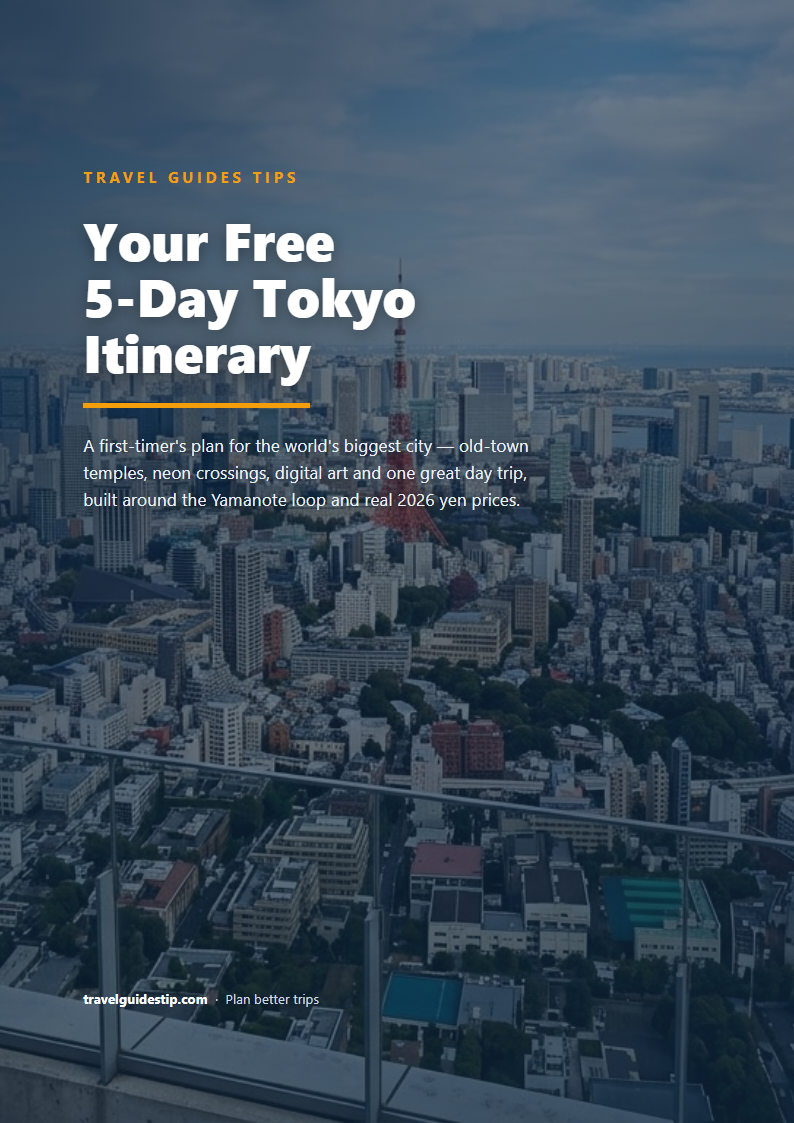
The 5-Day Tokyo Itinerary
The plan we use ourselves — sent straight to your inbox.
- Day-by-day route
- Where to stay
- Real 2026 costs
Free · No spam · Unsubscribe anytime
Best Time to Visit Tokyo
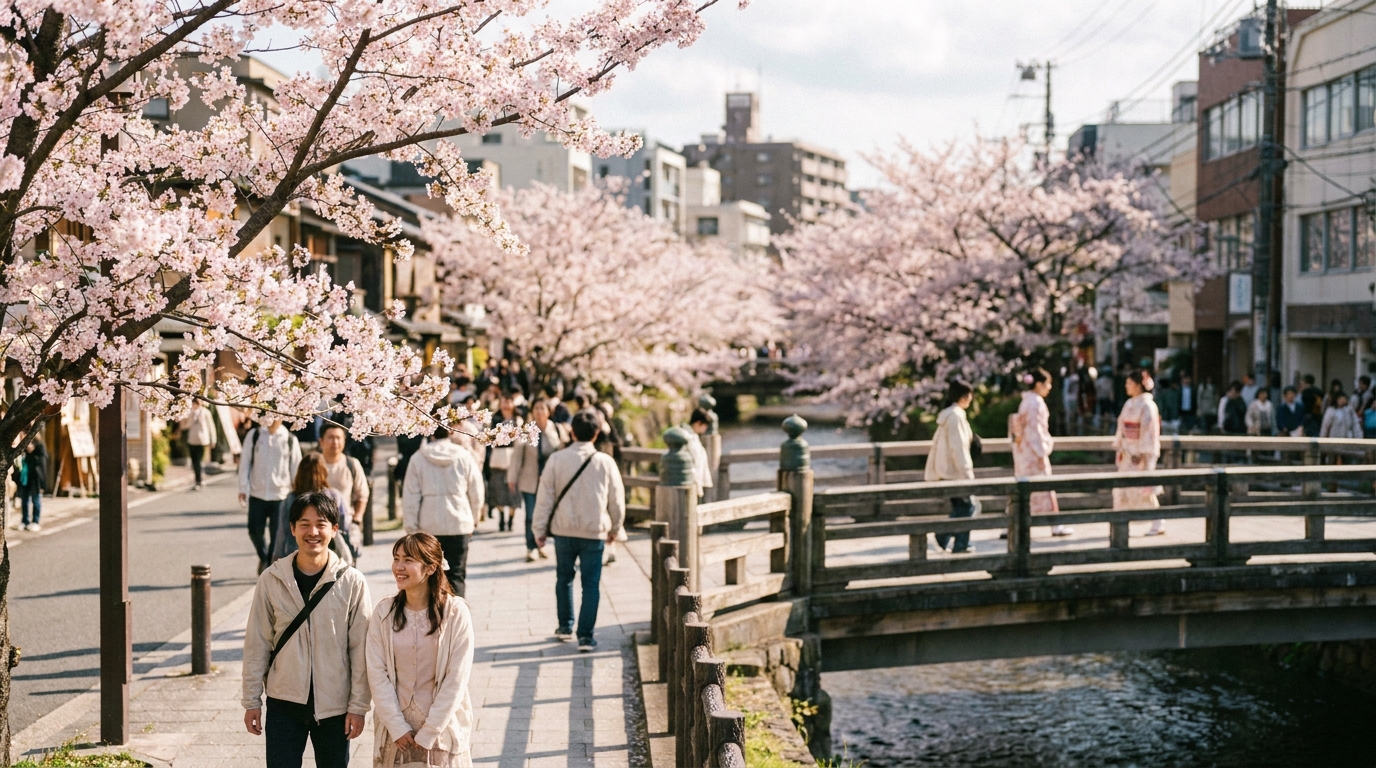
The most comfortable windows are spring, from late March to April, and autumn, from October to November. Spring brings the cherry blossoms; Tokyo’s 2026 bloom was forecast to open around March 20 with full bloom near March 26 to 27, and late-March daytime highs sit around 15 C (59 F) (Nippon.com, 2026). Autumn delivers similar mild temperatures with colorful foliage and thinner crowds than peak sakura week.
Summer, from June through August, is hot and humid with a rainy stretch in June, while winter is cold but dry, quiet, and cheaper. Each season changes what you pack and how you pace your days, so it is worth reading our detailed breakdown of the best time to visit Tokyo before you lock in flights. A rough month-by-month snapshot:
| Season | Months | Typical daytime feel | What to expect |
|---|---|---|---|
| Spring | Late Mar to May | Around 15 to 22 C, mild | Cherry blossoms, biggest crowds, book early |
| Summer | Jun to Aug | Hot, humid, 30 C plus | Rainy June, festivals, cheaper mid-summer |
| Autumn | Oct to Nov | Around 15 to 22 C, mild | Fall foliage, clear skies, great value |
| Winter | Dec to Feb | Cold, dry, 5 to 12 C | Quiet, illuminations, lowest hotel rates |
Getting From the Airport Into Tokyo
Which airport you land at changes your first hour in Japan. Narita sits about 60 kilometers east of the city, so the Narita Express (N’EX) is the standard choice, reaching Tokyo, Shibuya, and Shinjuku stations in 55 to 90 minutes for roughly 3,070 to 4,020 yen one way depending on destination (Get Around Japan, 2026). There is also an N’EX round-trip ticket at about 5,000 yen valid for 14 days, which is good value if you return to Narita. Note that JR East revised many fares upward, roughly 7.8 percent, from March 2026, so confirm the current price when you buy.
Haneda is far closer, sitting inside the metropolitan area, and connects to the city in under 30 minutes via the Tokyo Monorail or Keikyu Line for a few hundred yen. If you have a choice of arrival airport, Haneda usually saves time and money. Whichever you use, buy or top up a transport card before you leave the terminal, which leads to the next section.
Airport transfer options at a glance:
- Narita Express (N’EX): 55 to 90 minutes to Tokyo, Shibuya, or Shinjuku for roughly 3,070 to 4,020 yen one way.
- N’EX round-trip ticket: about 5,000 yen, valid 14 days, worth it if you fly back out of Narita.
- Haneda via Tokyo Monorail or Keikyu Line: under 30 minutes to central Tokyo for a few hundred yen.
- Distance: Narita sits about 60 km east of the city; Haneda sits inside the metropolitan area.
The 5-Day Tokyo Itinerary
Hour-by-hour plan, where to stay and what it really costs — free PDF.
Free · No spam · Unsubscribe anytime
Getting Around Tokyo: Suica, Subway, and JR
The single most useful thing you can do is get a rechargeable IC card, and Suica is the default. A Suica loaded with 1,500 yen of credit runs about 2,050 yen at purchase, and you simply tap in and out at any train or subway gate, then top up at machines as you go (Saily, 2026). The same card pays for convenience stores, vending machines, and lockers, so it doubles as pocket change. On our last trip we loaded a single Suica at the Narita arrivals hall and used it for nine days of trains, convenience-store coffees, and coin lockers without queuing at a ticket machine again.
Understanding the layers matters. The JR network, including the Yamanote loop, is run by Japan Railways, while the separate Tokyo Metro and Toei subway lines fill in everything the loop does not reach. Suica works across all of them, so most visitors never need to think about which company operates a line.
Do You Need a JR Pass or a Subway Pass?
For a Tokyo-only trip, the nationwide Japan Rail Pass is usually not worth it. The 7-day Ordinary pass costs about 50,000 yen through the official site, rising to 53,000 yen through overseas agents for purchases from October 1, 2026 (BluePlanet, 2026), and it only pays off if you take long-distance bullet trains between cities. If you plan to hop out to Kyoto or Osaka, that math changes.
For subway-heavy sightseeing, the tourist-only Tokyo Subway Ticket is cheap: 1,000 yen for 24 hours, 1,500 yen for 48 hours, and 2,000 yen for 72 hours (One Day Away, 2026). It covers unlimited Tokyo Metro and Toei rides but not JR lines like the Yamanote, so pair it with a Suica for the gaps. Which pass makes sense depends on your trip:
- Tokyo-only trip: skip the JR Pass; a Suica plus a Tokyo Subway Ticket is far cheaper.
- Subway-heavy sightseeing: Tokyo Subway Ticket at 1,000 yen for 24 hours, 1,500 yen for 48 hours, or 2,000 yen for 72 hours.
- Adding Kyoto or Osaka: the nationwide 7-day JR Pass (about 50,000 yen) starts to pay off.
- Everyone: keep a Suica for the JR Yamanote line, which the Subway Ticket does not cover.
Here is how the main options compare:
| Option | Price (adult) | Best for | Covers JR? |
|---|---|---|---|
| Suica IC card | ~2,050 yen (incl. 1,500 credit) | Everyone, pay-as-you-go | Yes |
| Tokyo Subway Ticket 72h | 2,000 yen | Subway-heavy sightseeing | No |
| JR Pass 7-day Ordinary | ~50,000 yen | Multi-city bullet-train trips | Yes |
Find your Tokyo hotel on the map
Live prices from Booking & Airbnb — tap a pin to compare stays around Shinjuku and Shibuya and beyond.
Where to Stay: Picking a Base Neighborhood
Base yourself near a Yamanote Line station and most of Tokyo opens up within 20 minutes. Shinjuku and Shibuya put you in the middle of the nightlife, shopping, and transit action, but they are loud and busy. Tokyo Station and Ginza are polished and central, closer to the palace and upscale dining. Asakusa and Ueno lean traditional and tend to be cheaper, with easy access to temples and museums.
How the main base neighborhoods compare:
- Shinjuku and Shibuya: loud and busy, but unbeatable for nightlife, shopping, and train access.
- Tokyo Station and Ginza: polished and central, closest to the Imperial Palace and upscale dining.
- Asakusa and Ueno: traditional and cheaper, with easy access to temples and museums.
- Any Yamanote Line base opens up most of central Tokyo within about 20 minutes.
Across our own stays we have based near Shinjuku, Ueno, and Asakusa, and the same lesson held every time: a room within a five-minute walk of a Yamanote station saved us more time than any single sightseeing choice. For a first visit, we usually steer people toward Shinjuku or Shibuya for convenience, or Ueno and Asakusa for value and a calmer feel. Each area has a very different personality and price point, which we lay out district by district in our guide to where to stay in Tokyo. Whichever you choose, prioritize being within a five-minute walk of a station over saving a little on the room rate.
How Much Does Tokyo Cost in 2026?
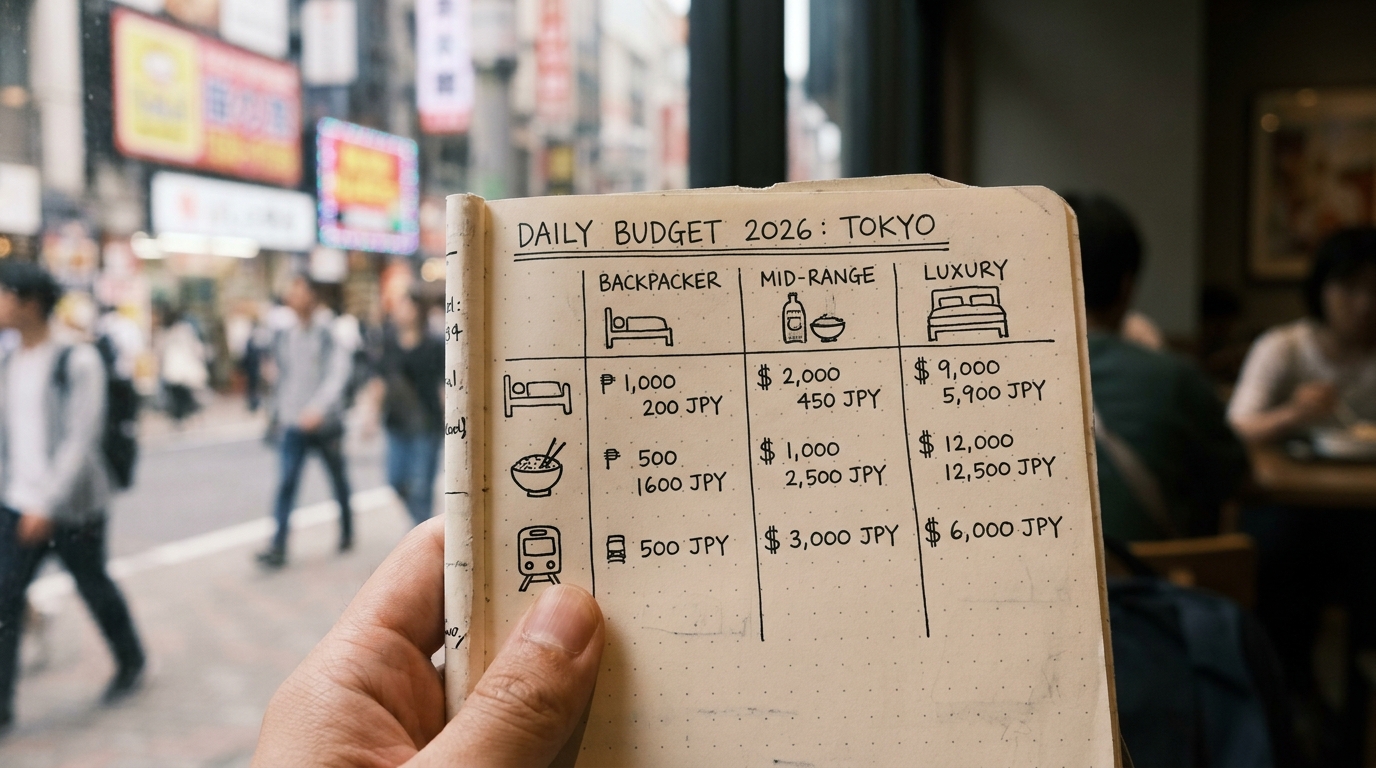
A mid-range traveler should budget roughly 15,000 to 22,000 yen per day, or about 100 to 140 USD, once you add a hotel, meals, transport, and entry fees (Radical Storage, 2026). The single biggest line is lodging: a mid-range Tokyo hotel averages around 25,000 yen (about 158 USD) a night, up a modest 5 to 10 percent on 2025 as utility and labor costs rose.
Food, on the other hand, stays a bargain. A bowl of ramen runs 800 to 1,200 yen, a set lunch at a mid-range restaurant sits around 2,500 to 5,000 yen, and convenience-store meals cost a few hundred yen. Transport is cheap too, with most city hops under 300 yen. A sample daily breakdown for one mid-range traveler:
| Expense | Typical cost per day |
|---|---|
| Mid-range hotel (per person, twin) | 8,000 to 12,500 yen |
| Meals (3, casual to mid-range) | 3,000 to 6,000 yen |
| Local transport (Suica) | 800 to 1,500 yen |
| Sights and entry fees | 1,500 to 3,000 yen |
| Rough daily total | ~15,000 to 22,000 yen |
What to Eat and Do
Tokyo’s food scene is a reason to visit on its own, and you do not need a big budget to eat well. Ramen shops, standing sushi bars, tempura counters, and department-store food halls all deliver excellent meals for modest prices, and the ticket-machine ordering at many ramen spots means you rarely need much Japanese. We map out the specific shops, dishes, and neighborhoods worth planning around in our guide to the best food in Tokyo.
For sightseeing, first-timers usually anchor around Senso-ji temple in Asakusa, the Meiji Shrine and Harajuku, the Shibuya crossing and Shibuya Sky observation deck, teamLab digital art, and a day feeling small under the towers of Shinjuku. Beyond the headline stops, the city is full of small museums, gardens, and neighborhood strolls, all of which we cover in the best things to do in Tokyo.
The headline first-timer sights:
- Senso-ji temple in Asakusa: Tokyo’s oldest temple, free to enter.
- Meiji Shrine and Harajuku: a free shrine forest beside a busy youth district.
- Shibuya Scramble Crossing and the Shibuya Sky observation deck at sunset.
- teamLab digital art: timed-entry tickets that sell out, so book ahead.
- Shinjuku after dark: neon canyons and tiny bars under the skyscrapers.
Putting It Together: How Many Days and What Order
Give Tokyo at least four full days, and five is better if you want a day trip to Nikko, Kamakura, or Hakone. A workable rhythm is to group sights by area so you are not crossing the city repeatedly: one day for the west side around Shinjuku, Shibuya, and Harajuku, another for the traditional east around Asakusa and Ueno, then central Tokyo, the waterfront, and a day trip.
A five-day area grouping that avoids backtracking:
- West side: Shinjuku, Shibuya, and Harajuku in one day.
- Traditional east: Asakusa and Ueno in another.
- Central Tokyo and the Odaiba waterfront on a third.
- One full day trip to Nikko, Kamakura, or Hakone.
If you would rather follow a ready-made plan with timings and station-by-station routing, our 5-day Tokyo itinerary sequences everything above into a day-by-day schedule you can copy or adjust. Pair it with the seasonal advice from this hub, and you have a full trip mapped before you board the plane.
Related guide: Ao Nang Travel Guide 2026: Beaches, Hotels & Tips
Frequently Asked Questions
Is Tokyo expensive for first-time visitors in 2026?
Tokyo is mid-priced by global-city standards, helped by a weak yen near 150 to the US dollar. Expect roughly 15,000 to 22,000 yen (about 100 to 140 USD) a day for a mid-range trip, with lodging as the biggest cost and food notably cheap, from 800-yen ramen to a few-hundred-yen convenience-store meal.
Do I need a Japan Rail Pass for a Tokyo-only trip?
No. The 7-day JR Pass costs about 50,000 yen and only pays off if you take long-distance bullet trains between cities. For Tokyo alone, a Suica IC card for pay-as-you-go rides, optionally paired with a Tokyo Subway Ticket, is far cheaper.
How do I get from Narita Airport to central Tokyo?
The Narita Express reaches Tokyo, Shibuya, and Shinjuku stations in 55 to 90 minutes for roughly 3,070 to 4,020 yen one way, with a 5,000-yen round-trip option valid 14 days. Cheaper limousine buses and the Keisei Skyliner are also available. Haneda Airport is much closer and reaches downtown in under 30 minutes.
What is the best time of year to visit Tokyo?
Late March to April for cherry blossoms, when full bloom fell around March 26 to 27 in 2026 and daytime highs sit near 15 C, or October to November for mild autumn weather and thinner crowds. Summer is hot and humid, and winter is cold, quiet, and cheapest.
How many days do I need in Tokyo?
Plan at least four full days to see the main neighborhoods without rushing, and five if you want a day trip to Nikko, Kamakura, or Hakone. Grouping sights by area, rather than crossing the city repeatedly, is the key to a comfortable pace.
Final Word
Tokyo looks overwhelming from the outside and turns out to be one of the easiest big cities to travel once you have a Suica in your pocket, a base near the Yamanote Line, and a sense of what a day costs. Use this guide as your starting point, then dig into the linked pieces on when to go, where to stay, what to eat, what to do, and how to sequence it all across five days. The city has never been more popular, so plan early and the rest falls into place.