How Many Days in Bali? (2026)
By TravelguidestipUpdated 11 min readHow we earn
Hotel buttons open Stay22 (Booking.com, Agoda and others) and tour buttons open GetYourGuide. We may earn a commission at no extra cost to you.

The direct answer to how many days in Bali you need is 7 days for most first-time visitors, or 10 days if you want to add Nusa Penida and the east coast without rushing. Trips of 3 to 4 days suit a stopover on a wider Southeast Asia route, while 10 days or more suits travellers who prefer fewer transfers and a slower pace.
| Trip length | Areas you fit in | Who it suits | Approx cost/person (AUD · USD) |
|---|---|---|---|
| 3-4 days | One base plus one day trip (e.g. Seminyak/Canggu + Uluwatu) | Stopover travellers, short breaks | AUD 555-833 · USD 400-600 |
| 5 days | Two areas (south coast + Ubud) | First-timers with limited leave | AUD 694-1,041 · USD 500-750 |
| 7 days | Three to four areas (south coast, Ubud, Mount Batur, Nusa Penida) | Most first-time visitors | AUD 971-1,457 · USD 700-1,050 |
| 10+ days | Five or more areas, plus a Nusa Penida or east coast overnight | Slow travellers, repeat visitors | AUD 1,388-2,082 · USD 1,000-1,500 |
Mid-range daily rate AUD 139-208 · USD 100-150 per person, excluding international flights. Figures are shoulder-season averages; expect 40-60% higher in July-August and 20-30% lower in the wet season (see below).
Bali visa and entry requirements
Most visitors, including Australians, enter Bali on a Visa on Arrival or its online equivalent, the e-VOA, both priced at AUD 50 · USD 36 (IDR 500,000) and valid for a 30-day stay.
The e-VOA, applied for online before departure, is generally the smoother option, since it avoids the arrivals-hall queue that the paper visa on arrival still requires; both grant the same length of stay and can be extended once, through a local agent or Indonesia’s immigration office, before the initial 30 days runs out.
Separately from the visa, Bali charges every foreign arrival a tourist levy of AUD 15 · USD 11 (IDR 150,000), paid online before or on arrival.
This levy funds environmental and cultural programs on the island and applies regardless of trip length, from the shortest 3-day stopover covered on this page to a 10-day-or-longer stay, so it is worth budgeting as a fixed cost rather than a variable one tied to how long the trip runs.
A passport valid for at least six months beyond the arrival date is required, and immigration can ask for proof of onward travel, though this is not checked for every arrival. Travellers planning to stay longer than 30 days should apply for an extension or a different visa category before booking non-refundable accommodation past that date, since overstaying attracts a daily fine that compounds the longer it continues.
Flying to Bali from Australia
How many days are worth spending in Bali depends partly on how far the flight is, and Australia has an unusually dense set of direct routes into Denpasar for a destination this far from most Australian capitals.
Jetstar flies direct from the widest spread of cities, including Adelaide, Avalon, Brisbane, Cairns, Darwin, Gold Coast, Melbourne, Newcastle, Perth and Sydney. Virgin Australia covers Brisbane, Gold Coast, Melbourne and Sydney, with a seasonal Canberra service, while Qantas flies from Melbourne and Sydney, and is due to add a Brisbane route from August 2027.
Garuda Indonesia and Batik Air Malaysia add further direct options from Sydney, and from Brisbane, Melbourne, Perth and Sydney respectively, which means most Australian travellers can reach Bali without a transit stop through a third country.
A short direct hop from Perth or Darwin makes even the 3-to-4-day trip covered earlier worth the airfare. Travellers flying from cities with a longer direct route, or connecting through another city first, generally get better value out of the 7-day-or-longer options described above.
The extra nights of a longer stay also spread the cost of the flight itself across more days on the ground, which is worth weighing against a short, direct hop from a closer city.
Bali in 3 to 4 days
Four days is enough for one base and one nearby day trip, not for combining Bali’s south coast with Ubud. Staying in a single area removes the need for a mid-trip transfer.
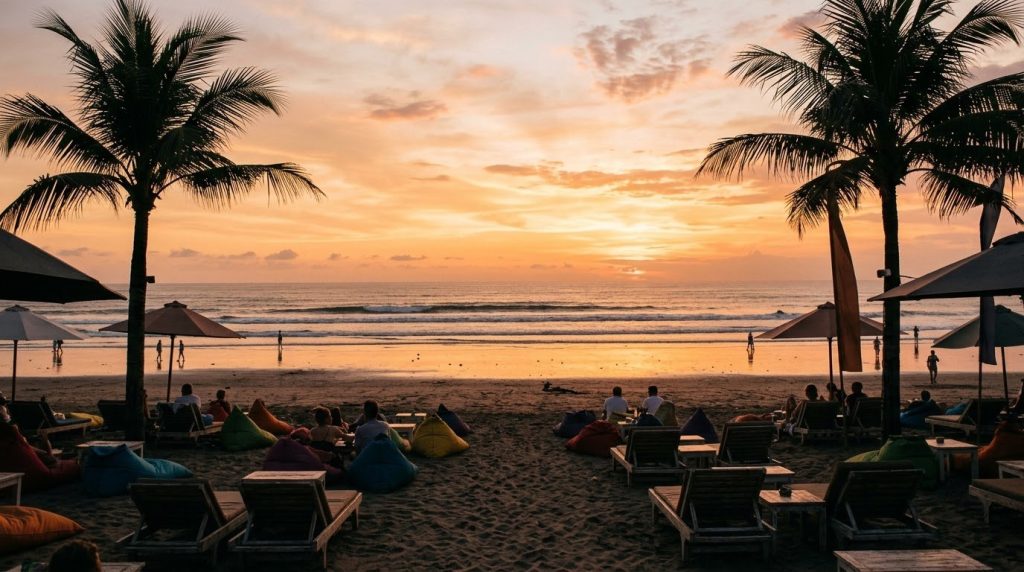
Basing in Seminyak or Canggu keeps you 15 to 30 minutes from the airport and puts Uluwatu’s cliffs within a 25- to 35-minute drive for a day trip; Kuta and Legian (10 minutes from the airport) or Jimbaran (15 minutes) work just as well if you land late or fly out early.
A mid-range 4-day budget runs roughly AUD 555-833 · USD 400-600 per person, based on Bali’s mid-range daily rate (see the full Bali travel budget breakdown).
What you drop at 4 days: Ubud’s rice terraces and temples, the Mount Batur hike, Nusa Penida and the east coast all sit 60 minutes or more away and don’t fit without cutting your coastal time short.

Bali in 5 days
Five days is the minimum for pairing the south coast with Ubud without feeling rushed. Split your time between one coastal base, such as Seminyak, Canggu, Sanur (about 30 to 45 minutes from the airport) or Uluwatu, and 1 to 2 nights in Ubud for rice terraces and temples. Before trading that night, whether Nusa Penida is worth it sets the views at Kelingking and Crystal Bay against crowds and rough roads.
Treat the 60- to 90-minute transfer between the coast and Ubud as its own half-day rather than a quick hop. A mid-range 5-day trip costs roughly AUD 694-1,041 · USD 500-750 per person, excluding international flights.
What you drop at 5 days: a full Nusa Penida day trip and the pre-dawn Mount Batur hike each need a spare day, so fitting either one usually means giving up a night at the coast.
Bali in 7 days – the length most visitors should pick
Seven days is the length most first-time visitors should pick, because it fits four areas without back-to-back travel days.
A typical 7-day trip opens with arrival and a night in Canggu or Seminyak, moves to Ubud for 2 nights of rice terraces and temples, adds a pre-dawn Mount Batur hike, spends a full day on Nusa Penida (a 45-minute fast boat from Sanur), then closes with Uluwatu’s cliffs before departure.
A mid-range 7-day trip costs AUD 971-1,457 · USD 700-1,050 per person. See the full day-by-day plan in our 7-day Bali itinerary.
Bali in 10 days or more
Ten days or more lets you add a slower island or a coastal extension without cutting anything else short. Extend the 7-day route above with an overnight on Nusa Penida instead of a day trip, or add time on Bali’s east or north coast. A mid-range 10-day budget runs roughly AUD 1,388-2,082 · USD 1,000-1,500 per person. Before booking that island night, our Penida or Lembongan breakdown explains why Penida suits 2 nights of big cliffs and Lembongan an easy 3.
Longer trips also absorb Bali’s traffic better, since you are not racing between areas on a tight timeline.
Nyepi: Bali’s Day of Silence
Nyepi, the Balinese Day of Silence, falls annually on the Balinese calendar date of 1 Kedasa, which lands in March; in 2026 it falls on 19 March. It is worth checking against any trip dates before locking in flights, whichever of the lengths covered above you choose.
On the day itself, Ngurah Rai International Airport closes entirely, streets empty out, and residents and visitors alike are required to stay indoors across the whole island; only traditional pecalang security patrols are visible outside.
Road closures for the evening parade beforehand, early restaurant closures, and ATMs switched off with cash removed until the next day add to the disruption on both sides of the day itself.
The restrictions apply to tourists as much as to locals: leaving a hotel, visiting a beach, or even posting dismissively about the holiday on social media has led to deportation or prosecution, including a one-year prison sentence handed to a Swiss tourist in 2026 for doing exactly that.
Build Nyepi into the itinerary rather than around it: a trip landing the day before or departing the day after needs an extra night accounted for, since no flights or transport run on the day itself, whether the stay is the 3-day or the 10-day-plus version covered earlier on this page.
Travellers who land mid-trip, with Nyepi falling in the middle of a longer stay, should expect one full day with no restaurants, no beach access and no organised tours anywhere on the island.
Weather and best time to visit, by month
Bali runs on two broad seasons: a dry season from roughly May to October and a wetter season from November to April, a pattern that shapes which trip length, covered throughout this page, makes the most sense for a given set of travel dates.
The dry season, especially June through September, is Bali’s most reliable stretch for the kind of itinerary this guide covers, including the Nusa Penida boat crossing and the pre-dawn Mount Batur hike, both of which depend on calm seas and clear trails that wet-season storms can disrupt.
July and August sit inside the dry season but carry a cost beyond weather: accommodation rates run well above baseline during these peak months, as noted earlier in this guide’s cost breakdown, so travellers prioritising value over guaranteed dry weather often do better in the shoulder months of May, June or September.
The wet season, November through April, brings shorter but heavier downpours rather than all-day rain in most months, and travel is still very possible, just less predictable for the outdoor-heavy parts of a 7-day-or-longer itinerary.
December and January sit at the wetter end of this range and overlap with the busiest and most expensive holiday travel dates, a combination that affects both comfort and cost at once.
A trip built around 3 to 4 days in a single coastal base, covered earlier on this page, is less exposed to wet-season disruption than a longer itinerary chasing Mount Batur or Nusa Penida.
Why Bali needs more days than its size suggests
Bali needs more days than the map suggests, because traffic between its regions is far slower than the distances imply.
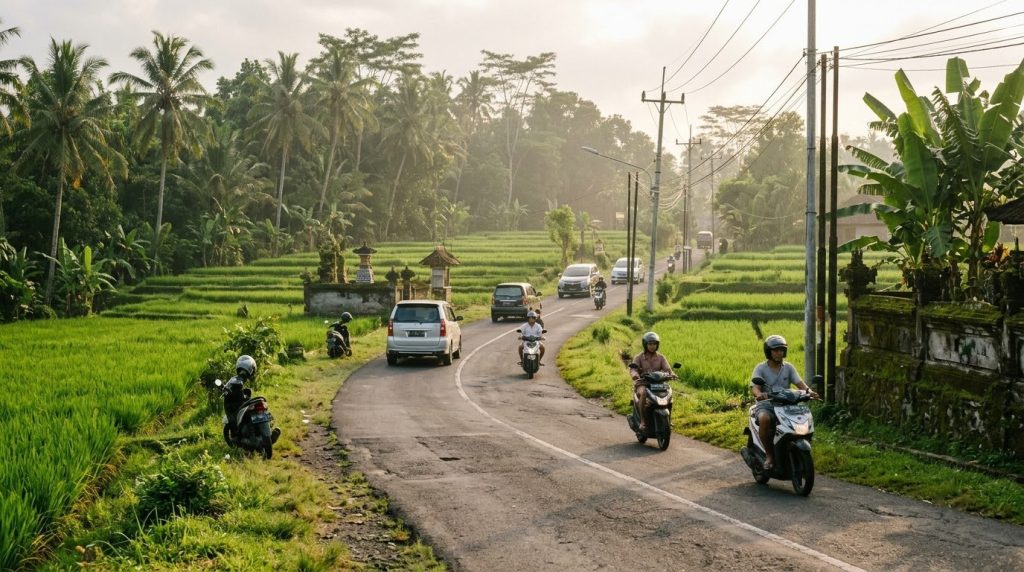
Ubud sits inland while most of Bali’s beach areas sit on the coast, and the drive between them covers only 35 to 40 kilometres yet takes 60 to 90 minutes, the same 60- to 90-minute range you’ll spend getting from Ngurah Rai Airport to Ubud on arrival. Ubud to Uluwatu is worse, at 2 to 3.5 hours in peak traffic.
Even two coastal areas aren’t always a quick hop: Canggu to Uluwatu covers just 26 to 30 kilometres but takes 1 to 1.5 hours in normal traffic and up to 2.5 hours at peak times. Push further east and the gap widens again, since Ubud to Amed on Bali’s east coast runs 2.5 to 3 hours each way.
That single transfer alone can consume half a travel day, which is one reason a 7-day trip only comfortably covers 3 to 4 areas rather than the 5 or 6 a similar distance would allow on a faster road network.
When fewer days is the right answer
Fewer days is the right answer if you are stacking Bali onto a wider Southeast Asia trip or you have already covered the main sights on an earlier visit. It also suits a tight budget, since each extra day adds roughly AUD 139-208 · USD 100-150 at mid-range rates.
And it suits trips timed for July and August, when accommodation runs 40-60% above base rates according to our best time to visit Bali guide; a shorter trip in that window keeps total spend down even at higher nightly rates.
How to decide – quick cheat sheet
– Pick 4 days if you are stopping over between other Southeast Asia destinations. – Pick 5 days if you want the south coast and Ubud without rushing. – Pick 7 days if this is your first trip and you want Mount Batur and Nusa Penida included. – Pick 10 days or more if you want to add Bali’s east coast or a Nusa Penida overnight. – Pick fewer days if you are visiting during July or August and want to control costs. – Pick 7 days minimum if you want Nusa Penida included, since the trip needs a 45-minute boat each way from Sanur plus a full day on the island.
Daily costs beyond accommodation
Beyond the per-trip accommodation estimates covered earlier on this page, day-to-day spending in Bali splits roughly into food, local transport and activities, and each varies more by choice than by trip length.
A warung meal typically costs a fraction of a Western-style restaurant meal in Seminyak or Canggu, so travellers mixing local warungs with the occasional beach-club lunch keep daily food costs well below a trip built entirely around resort dining.
Local transport usually means a private driver or a ride-hailing app rather than public buses, which are limited outside of a few routes; a driver booked for a half or full day is common for day trips to Ubud or Uluwatu, covered elsewhere on this page, and is typically cheaper per person when split across a group than hiring individual rides for the same stops.
Activities add up differently depending on the itinerary length chosen above: the Mount Batur sunrise hike and the Nusa Penida boat trip, both part of the 7-day itinerary recommended on this page, are priced as half-day or full-day packages that usually include transport, a guide and sometimes breakfast, rather than a simple entry fee.
Temple entry fees in Ubud and around the island are generally modest and charged individually, so a multi-temple day adds up gradually rather than in one large cost. Travellers on the shorter 3-to-4-day trip length, covered earlier, naturally spend less here simply because fewer paid activities fit into the itinerary.
Where to stay for your Bali trip
Where you stay decides how much of your trip goes to transfers rather than time on the ground. Coastal bases such as Seminyak (15 to 20 minutes from the airport) and Canggu (20 to 30 minutes) suit shorter trips, since they keep you close to arrival and departure. If you are leaning that way, our Nusa Dua safety check explains why crime is rarely the problem there and what actually is.
Nusa Dua, 25 to 30 minutes from the airport, suits families who want a resort base with calmer water and fewer transfers. Ubud sits 60 to 90 minutes from the airport, which is why it works best as a stop within a 5-day-or-longer trip rather than a standalone base. If Nusa Dua and Sanur are both on your shortlist, our head-to-head of the two calm-water bases shows that Sanur adds a 30-minute fast boat to Nusa Lembongan.
Compare areas in full in our where to stay in Bali guide, then use the map below to check live prices for your dates.
Find your Bali hotel on the map
Live prices from Booking, Airbnb and more — move the map or change dates to compare stays around Bali.