Sanur or Nusa Dua? An Honest Bali Comparison for Families and Couples (2026)
By TravelguidestipUpdated 10 min readHow we earn
Hotel buttons open Stay22 (Booking.com, Agoda and others) and tour buttons open GetYourGuide. We may earn a commission at no extra cost to you.
Pick this if
Sanur
You want a walkable village, cheaper food and a fast boat to the islands.
See hotels in Sanur →Pick this if
Nusa Dua
You want a gated resort enclave, wide white-sand beaches and a quick airport run.
See hotels in Nusa Dua →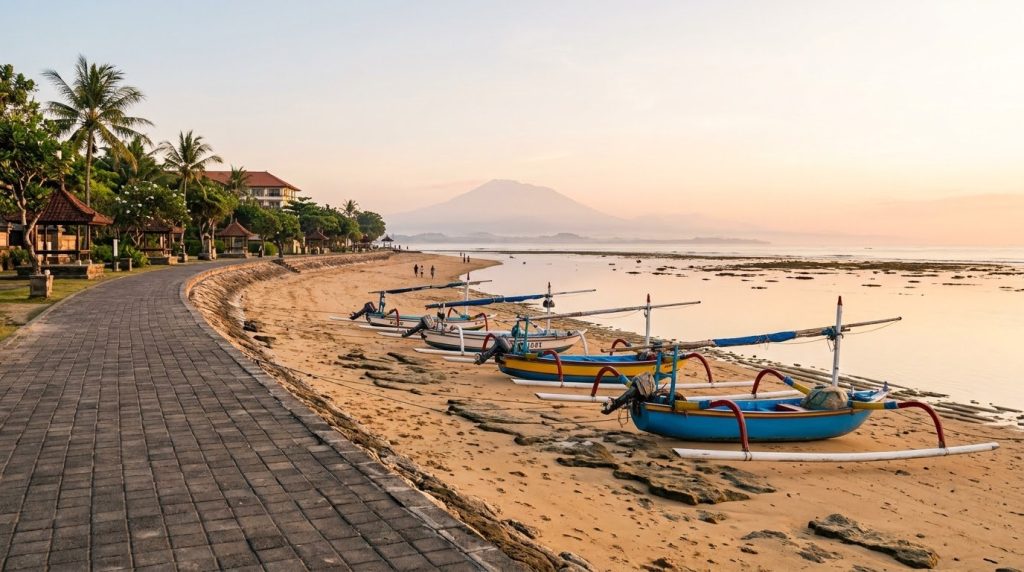
Pick Sanur if you want a walkable village, cheaper food and a 30-minute fast boat to Nusa Lembongan; pick Nusa Dua if you want a gated resort enclave, wide white-sand beaches and a shorter 15–45 minute airport run.
For most Australian families with school-age kids and for older couples who like to stroll out for dinner, Sanur is the better base. Nusa Dua wins when the plan is to stay inside a big resort with a kids’ club and barely leave.
| Factor | Sanur | Nusa Dua |
|---|---|---|
| Vibe | Laid-back beach village, 7–8 km promenade | Gated ITDC resort enclave |
| Swimming | Reef-protected and calm, but very shallow at low tide | Calm, clear water off white-sand beaches |
| Airport transfer | 30–60 min | 15–45 min |
| Local meal | AUD 3–6 · USD 2–4 | AUD 6–10 · USD 4–7 |
| Mid-range hotel per night | AUD 69–153 · USD 50–110 | AUD 125–250 · USD 90–180 |
| Island day trips | Harbour on the doorstep | 45+ min drive to Sanur harbour |
| Best for | Families on a budget, walkers, island-hoppers | Resort-stayers, multi-gen groups, honeymooners |
The real difference: village versus enclave
Sanur is a functioning Balinese town that happens to have a beach. Warungs, massage shops, cafes and mid-size hotels line Jalan Danau Tamblingan, and the paved beachfront path runs 7–8 km so you can walk or ride a hired bike from one end to the other. It faces east, so you get sunrise over the water rather than the sunset crowds of the west coast.
Nusa Dua is a purpose-built resort zone run by the state developer ITDC, entered through guarded gates. Inside, the roads are wide and clean and almost everything you need is in your resort. The flip side: little “Bali” outside the resort wall, and most trips beyond it need a Grab, taxi or driver.
For a deeper read, see our take on whether Sanur is worth visiting and the honest case for whether Nusa Dua is worth visiting go further.
Beaches and tides: Sanur’s low-tide catch
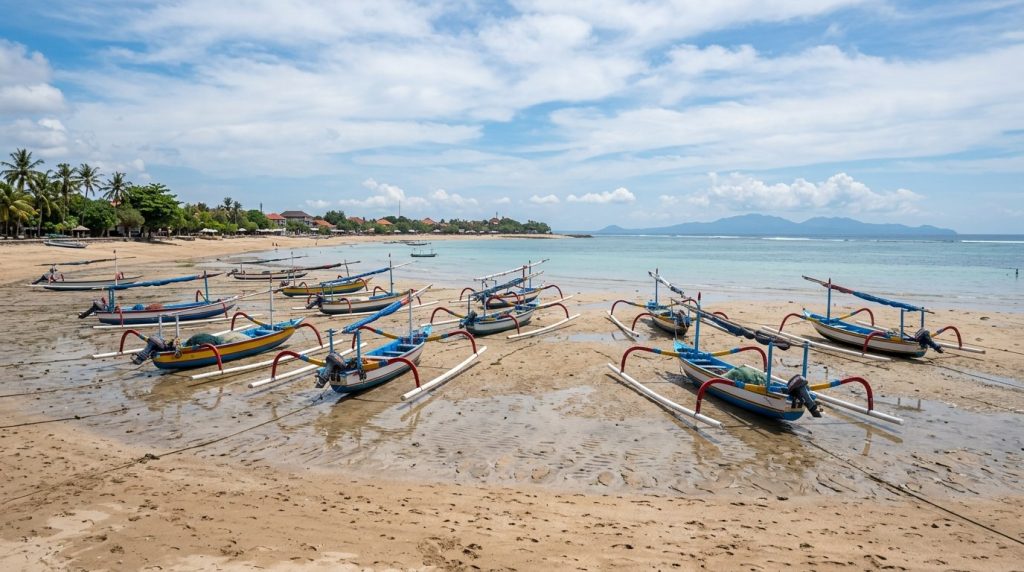
Most first-timers miss this. Sanur’s reef sits roughly a kilometre offshore and breaks the swell, which is why the lagoon is so calm for small kids. But at low tide the water drains a long way out, leaving shallow pools and exposed reef. You can wade out for starfish, but proper swimming waits for the tide. Plan beach time around high tide and pack reef shoes for the sea urchins.
Nusa Dua’s beaches are wider, whiter and more manicured, and the water is usually calm and clear in front of the resorts. The headline attraction is Waterblow, a limestone point where Indian Ocean swells smash into the rocks and fire spray metres into the air.
Entry is AUD 2.20 · USD 1.60 (IDR 25,000) for adults, it is open 9am to 6pm, and it is most dramatic at mid to high tide with a decent swell. Keep children well back from the edge.
Airport transfers and getting around
Both are on the Bali Mandara toll road side of the airport, which saves you from the Kuta crawl. Nusa Dua is closer: sources put it at 15–45 minutes depending on traffic and which resort you are in. Sanur is 30–60 minutes.
After a 3 hour 45 minute flight from Perth or around 6.5 hours from Sydney, that difference matters most with tired toddlers on a late Jetstar or Virgin arrival.
Getting between the two takes 30–35 minutes early morning and 50–60 minutes in the late-afternoon peak. A GrabCar runs AUD 14–19 · USD 10–14 (IDR 160,000–210,000), and the car toll is about AUD 1.20 · USD 0.90 (IDR 14,000). One quirk in Nusa Dua: ride-share pickups often need you to walk to the main gate because of ITDC zone rules.
Inside Nusa Dua, the free Bali Collection shuttle loops hourly between the big resorts and the shopping centre until 10pm. In Sanur, your legs do the work.
Nusa Lembongan and the islands: Sanur’s trump card
Sanur Harbour is the launch point for fast boats to Nusa Lembongan, Nusa Penida and further afield. The Lembongan crossing takes about 30 minutes, 30–45 in choppy seas. One-way fares span AUD 15–39 · USD 11–28 (IDR 175,000–450,000) across operators; Rocky Fast Boat, for example, charges AUD 24 · USD 17 (IDR 275,000) boat-only.
Several operators run three or more departures a day, so a day trip to snorkel and see the Yellow Bridge is easy from Sanur.
From Nusa Dua you face a 45-minute-plus drive to the same harbour first, often with a dawn pickup. If islands are on your list, that alone tips it to Sanur.
Best time to visit: weather and crowds in Sanur and Nusa Dua
Both towns sit on the same stretch of coast, so the seasonal pattern is identical even though the experience of it differs. The dry season runs roughly April to October, with the most reliable stretch from May to September, and this is when Sanur’s low-tide lagoon is easiest to work around and Nusa Dua’s pool-and-beach days run without interruption.
The wet season runs roughly November to March, with the heaviest rain typically falling around January and February rather than spread evenly across the whole window.
In Sanur, wet-season downpours are usually short, late-afternoon affairs that pass through quickly, leaving the promenade wet rather than impassable; plan beach time for the morning and keep an indoor backup, such as a massage or a cafe along Jalan Danau Tamblingan, for when a shower rolls in.
Nusa Dua’s resort grounds absorb a downpour more easily, since most of a stay happens under cover or around a pool anyway, which is one reason multi-generational groups tend to feel the wet season less.
Crowds track the weather. July and August are the busiest, driest weeks in both towns, when Nusa Dua’s resort pools fill up and Sanur’s beachfront cafes queue at breakfast. The shoulder months, April and September specifically, usually land dry-season conditions without the peak crush, and are worth prioritising if the dates are flexible.
Whichever base and whichever month, build the day around the tide chart in Sanur and around the sun rather than the clock in Nusa Dua; the practical weather risk in both places is a short downpour, not a washed-out week.
Food and prices
Sanur has the broader, cheaper food scene: warung meals start around AUD 1.30 · USD 0.90 (IDR 15,000) and a typical local meal is AUD 3–6 · USD 2–4. Beachfront cafes, brunch spots and Western restaurants sit side by side, all walkable from most hotels. Dinner for two at a good restaurant runs about AUD 62–125 · USD 45–90.
Nusa Dua is pricier because most dining happens in resorts. Expect AUD 6–10 · USD 4–7 for a local-style meal and AUD 111–250 · USD 80–180 for a fine-dining dinner for two. Whichever you choose, every foreign visitor pays the Bali tourism levy of AUD 13 · USD 9.40 (IDR 150,000) per person, once per trip, through the official Love Bali portal or at the airport counter.
A sample 3-day itinerary for whichever base you choose
Day 1 in Sanur starts with a high-tide swim before the heat builds, then a bike ride along the beachfront path towards Sindhu Beach for lunch. The afternoon is free for a massage or a wander through Jalan Danau Tamblingan’s shops, and the evening means dinner within walking distance, the main advantage of basing here.
Day 1 in Nusa Dua starts at the resort pool or beach, with a late-morning visit to Waterblow timed around mid to high tide, then lunch back at the resort and an afternoon with nothing scheduled.
Day 2 from either base is the day to cross to the islands or explore further afield. From Sanur, a fast boat from the harbour reaches Nusa Lembongan for a full day of snorkelling and beach-hopping before the return crossing in the afternoon.
From Nusa Dua, the equivalent day means the longer drive to Sanur Harbour first, so building in the extra travel time at both ends keeps the day from feeling rushed.
Day 3 is the easy, local day. In Sanur, that is a slow morning swim, a wander through the market stalls near the temple, and an early dinner before an onward trip. In Nusa Dua, Day 3 suits the free shuttle into the Bali Collection shopping centre for a change of scenery, followed by a last resort evening.
Travellers splitting a trip between the two can swap the order: start in Nusa Dua to ease into the heat and jet lag behind a resort wall, then move to Sanur for the more local, walkable half of the stay.
Verdict by traveller type
– Families with young kids: Sanur, if you plan swims around high tide. Calm lagoon, cheap meals, easy walks and a Lembongan day trip.
Choose Nusa Dua only if a resort kids’ club is the whole point. – Older couples: Sanur if you like strolling to dinner; Nusa Dua if you want a polished resort, a short transfer and minimal decisions. – Multi-generational groups: Nusa Dua. One big resort, the hourly shuttle and the closer airport keep everyone together. – Budget travellers: Sanur, clearly.
Mid-range hotels and local meals cost about half to two-thirds of Nusa Dua prices. – First-timers: Sanur gives you more of real Bali without the Kuta chaos; Nusa Dua is the safer pick if you mostly want a pool and a cocktail. – Honeymooners: Nusa Dua for the five-star resort experience; split the trip with Ubud for culture.
Travelling with young kids: prams, swimming safety and facilities
Sanur’s paved beachfront path is the better of the two for a pram. It runs flat and continuous for several kilometres, past cafes and shaded sections, which makes it realistic to push a sleeping toddler rather than carry one.
Nusa Dua’s internal roads are also wide and well maintained, but most of a family’s day there happens inside the resort grounds rather than out on a public path, so a pram matters less once you are through the gate.
For swimming, Sanur’s reef-protected lagoon is calm enough for small children at higher tide, but worth timing around the tide chart as already covered above; at low tide the exposed reef is wade-only, not swim-safe. Nusa Dua’s beaches are calmer and more consistently swimmable regardless of tide, which is part of why multi-generational groups and families with very young children often default there.
Resorts in the Nusa Dua enclave typically run a kids’ club and supervised pool areas, which suits parents wanting a few hours off rather than full-time supervision on the sand. Sanur’s smaller, locally run hotels rarely offer the same structured childcare, so a family there is more likely to be managing kids directly rather than handing them to a club for a session.
Pram access off the main path is patchier in both towns: Sanur’s side streets towards the warungs are mostly flat but unpaved in places, while Nusa Dua’s resort driveways are smooth but long, so factor a few extra minutes into any walk between a room and the beach.
A baby carrier is a useful backup to a pram in either base, especially for the sand itself, where wheels struggle regardless of how good the path leading to it is.
Whichever base, Waterblow is not a place for children to get close to the rocks; keep a firm hold on little hands near the viewing area, since the spray that makes it dramatic comes from swells hitting the rock shelf directly below the lookout.
Where to stay in Sanur or Nusa Dua
Central Sanur (Jalan Danau Tamblingan and the Sindhu beach stretch): the most walkable part, close to cafes and warungs, and a short ride to the harbour. Suits families and couples who want to eat out every night. Our shortlist of the best hotels in Sanur covers each price band.
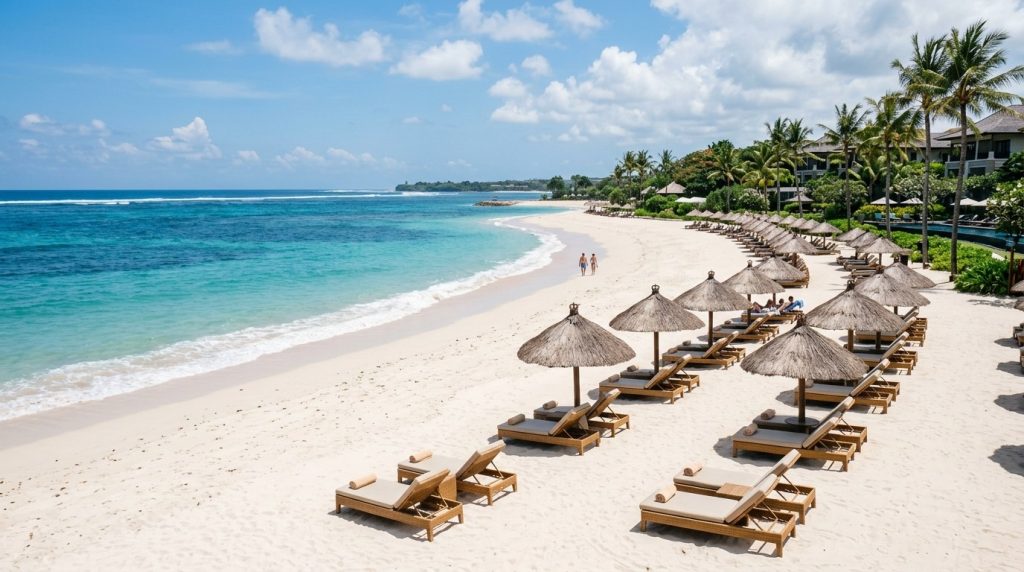
Nusa Dua ITDC enclave and Tanjung Benoa: the gated enclave suits resort-stayers and multi-gen groups; Tanjung Benoa to the north is the water-sports strip. Compare options in our guide to the best hotels in Nusa Dua.
Find your Sanur hotel on the map
Live prices from Booking, Airbnb and more — move the map or change dates to compare stays across Sanur.
Frequently Asked Questions
Is Sanur or Nusa Dua better for families?
Sanur suits most families better because the reef-protected lagoon is calm, meals are cheap and the beach path makes it easy to stroll with a pram. The catch is low tide, when the water drains far out, so plan swims around high tide. Nusa Dua is better if your family wants to stay inside one resort with a kids’ club.
Can you swim at Sanur at low tide?
Not properly. At low tide the water recedes a long way towards the reef, leaving shallow pools and exposed coral where you can only wade. It is good for spotting starfish, but wear reef shoes because of sea urchins. Check a tide chart and plan swims for high tide.
How far is Nusa Dua from Sanur?
The drive is roughly 18–22 km via the Bali Mandara toll road. Allow 30–35 minutes early in the morning and 50–60 minutes in the late-afternoon peak. A GrabCar costs around AUD 14–19 · USD 10–14, plus a small toll.
Is Nusa Dua more expensive than Sanur?
Yes. Mid-range hotels in Nusa Dua run about AUD 125–250 · USD 90–180 a night versus AUD 69–153 · USD 50–110 in Sanur, and local meals cost roughly double. Most Nusa Dua dining happens in resorts, while Sanur has warungs from about IDR 15,000 a plate within walking distance of most hotels.