Is Nusa Dua Safe? An Honest Guide for Australian Travellers (2026)
By TravelguidestipUpdated 11 min readHow we earn
Hotel buttons open Stay22 (Booking.com, Agoda and others) and tour buttons open GetYourGuide. We may earn a commission at no extra cost to you.
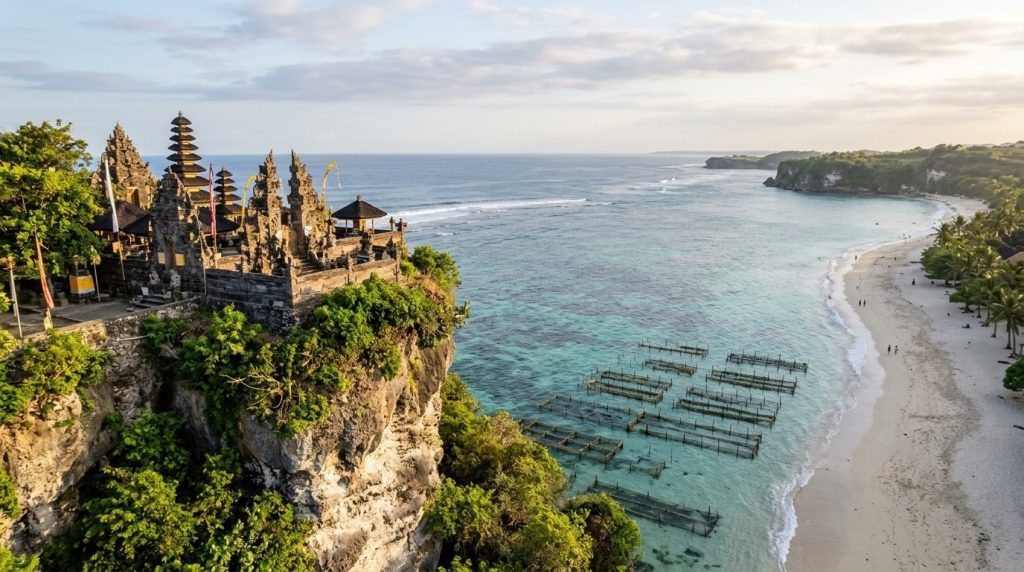
Yes, Nusa Dua is one of the safest places to stay in Bali: its 350-hectare resort enclave sits behind 3 guarded gates, a reef keeps the water calm, and a 24-hour hospital is inside the complex. Smartraveller still rates all of Indonesia “exercise a high degree of caution”. In practice, the problems here are rarely crime.
They are sea urchins at low tide, sunburn, badly run water-sports rides and dodgy drinks outside the resorts.
| Risk | Reality in Nusa Dua | What to do |
|---|---|---|
| Street crime | Low inside the gated enclave; normal Bali petty theft outside | Use the room safe; keep phones off café tables in Bualu |
| Swimming | Calm, but very shallow at low tide | Swim at high tide, inside the buoys, in reef shoes |
| Water sports | Busy at Tanjung Benoa; quality varies | Book a named operator; check the life jacket fits |
| Drinks | Methanol and spiking cases reported in Bali | Avoid cheap spirits and arak outside resorts |
| Sun | UV often extreme | SPF 50+, rashies, shade 11am–3pm |
What Smartraveller says right now
The Smartraveller Indonesia page sets the overall level at “Exercise a high degree of caution”. It was last updated on 11 September 2026 and was still current when I checked on 1 October 2026. Bali has no separate level. Only Highland Papua and Central Papua sit higher, at “Reconsider your need to travel”.
The latest update covers the e-Visa on Arrival, a reminder that you cannot work or volunteer on a tourist visa, and a warning that “some drinks may be spiked or contain dangerous substances like methanol”. The page also notes that authorities continue to disrupt terrorist groups, including in Bali. That risk applies island-wide, not specifically to Nusa Dua.
For the wider picture, from Kuta nightlife to scooter crashes, see our guide on whether Bali is safe right now.
Why the gated enclave feels so secure
Nusa Dua was built as a planned resort zone. The core area, run by the state developer ITDC (formerly BTDC), holds more than 20 resorts. You can only reach it through 3 main gates, each with 24/7 security. Guards stop cars and ask where you are going, and naming your resort or “the beach” gets you through. Entry to the beach is free.
Inside, the footpaths are wide, lit and free of scooters, so walking to dinner after dark is normal. That is rare in Bali. Grab and Gojek drivers often cannot reach your lobby, so meet them at your hotel’s pickup point.
The airport is 25–35 minutes away by toll road. Step outside the gates into Bualu or Benoa and you are in ordinary Bali, with no footpaths, heavier traffic and the usual phone-snatching risk.
The sea: calm, but watch the tide
The offshore reef breaks most of the swell, so Nusa Dua avoids the rips that drown swimmers elsewhere in Bali. The catch comes at low tide. The water drains so far out that swimming stops, sharp coral is exposed and sea urchins sit in the shallows. Lifeguards only cover the busier stretches.
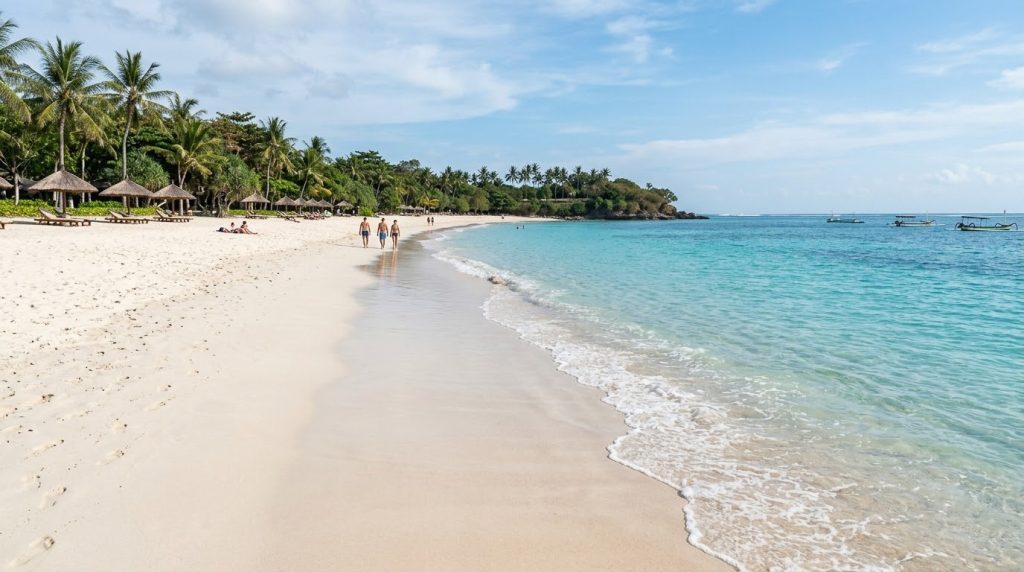
– Check the tide each morning. Swim at high tide and use the pool when it is out. – Pack reef shoes for everyone. Coral cuts kids’ feet. – If you tread on an urchin, see the hotel clinic, because spines left in can get infected. – At Geger Beach, keep clear of the seaweed-farm lines that farmers work at low tide.
Tanjung Benoa water sports: the real risk zone
Tanjung Benoa, the spit just north of the enclave, is Bali’s water-sports hub. Smartraveller warns that Australians have been seriously hurt or killed doing adventure activities, and says you should check that working safety equipment is available. One local guide says beginners must ride jet skis with an instructor because the water is so crowded.
Booking ahead is also cheaper. One operator’s online prices, last checked July 2026:
– Parasailing: AUD 24 · USD 18 (IDR 315,000). Walk-in counters charge about AUD 93 · USD 67. – Jet ski: AUD 18 · USD 13 (IDR 235,000). Walk-in: about AUD 58 · USD 42. – Banana boat: AUD 8.50 · USD 6 (IDR 110,000). Walk-in: about AUD 39 · USD 28.
A named operator should list a life jacket and safety briefing as inclusions. Avoid beach touts who cannot say who runs the boat. If the crew cancel parasailing because of the wind, take that as a good sign.
Best time to visit Nusa Dua for calmer seas and fewer health risks
Bali runs on two seasons: a dry season from April to October and a wet season from November to March. The far south of the island, including Nusa Dua and Benoa, gets noticeably less rain than the north. Denpasar-area totals run to roughly 1,700 mm a year, with December to February the wettest stretch at around 280–350 mm a month and August typically the driest, at about 15 mm.
The sea barely changes with the season. Water temperature ranges from about 27°C between July and September to around 29°C between November and May, so swimming is comfortable whenever you visit. More importantly for safety, the offshore reef that calms Nusa Dua’s lagoon works the same way in every month, which is not true of Bali’s west-coast beaches, where swell and rip risk shift with the monsoon.
What does change with the season is everything on land. Wet-season downpours make the enclave’s footpaths slick for an hour or two after a storm, and drains in Bualu and Benoa can back up. Mosquito activity also rises with the rain, and both dengue and Zika circulate in Bali, so repellent at dawn and dusk matters more from November to March than in the dry months.
If you want the lowest combined risk from weather, mosquitoes and crowds, the shoulder months of April and October give you dry-season conditions without the busiest school-holiday weeks. If the wet season is your only window, build slack into airport transfers, since a downpour can flood toll-road on-ramps for a short while, and pack a stronger repellent than you would for a dry-season trip.
Flight delays into Denpasar also cluster in the wet season, when storms over Java or the Lombok Strait can hold up incoming or outgoing aircraft for an hour or more. Travellers with a tight onward connection should treat a November-to-March arrival or departure with a little more buffer than a dry-season trip needs, and keep travel insurance details handy in case a delay turns into a missed connection.
July and August are Nusa Dua’s busiest and driest weeks, when the enclave’s resorts fill with Australian school-holiday families and prices for everything from a hotel room to a Tanjung Benoa boat trip climb with demand.
Booking water-sports activities a day or two ahead matters more in this window, simply because the good operators sell out, not because the sea itself is any less calm than in the quieter shoulder months.
Mistakes to avoid outside the resort gates
– Cheap spirits and arak. Smartraveller says Australians have died from methanol poisoning in Indonesia, and that drink spiking has been reported in Bali. At small bars, stick to beer or sealed bottles. – Riding a scooter. Smartraveller notes that Australians have been killed in moped crashes, particularly in Bali.
Book a driver instead. – Patting dogs or monkeys. Rabies is present throughout Indonesia. If you are bitten or scratched, go to a clinic the same day. – Tap water. Drink bottled water.
Vaccinations, travel insurance and other health precautions
The CDC’s Indonesia guidance recommends hepatitis A for travellers who are not already immune, hepatitis B for anyone unvaccinated, and typhoid for most visitors. It also advises travellers to be up to date on routine vaccines such as MMR, given current global measles activity.
None of this is Nusa Dua-specific; it is the same baseline the CDC gives for Bali generally, and it is worth a chat with a GP or travel clinic a few weeks before you fly.
Mosquito-borne disease is the main ongoing risk. The CDC notes that dengue circulates in Indonesia and that Zika cases have been reported in travellers returning from Bali, so the repellent-and-cover-up habit described above for the wet season is really a year-round one, just more important when rain is heavier.
On rabies, CDC data shows increased human cases in parts of Indonesia, which backs up the advice elsewhere on this page to avoid patting dogs or monkeys; ask your clinic about pre-exposure rabies vaccination if you plan on being around animals outside the resort.
One piece of good news: the CDC lists Bali’s resort areas, including the south coast, and Ubud as carrying no malaria risk, unlike eastern Indonesia, rural Kalimantan or Sulawesi. You do not need antimalarial tablets for a Nusa Dua stay.
For travel insurance, check the policy explicitly covers the water-sports activities you plan to do at Tanjung Benoa, not just “swimming,” and that it includes medical evacuation.
BIMC Siloam inside the enclave handles most everyday injuries and infections, but a serious case, such as a coral cut that turns septic or a diving injury, can mean transfer to a larger hospital in Bali or evacuation to Singapore or Australia, which is expensive without cover.
Heat is an underrated health risk at an equatorial resort. Humidity in Nusa Dua stays high year-round, and a full day moving between the beach, Tanjung Benoa and a temple visit can bring on dehydration or heat exhaustion faster than travellers expect, especially for kids and older visitors.
Carry water rather than relying on buying it, and treat headaches, dizziness or nausea in the heat as a sign to find shade and fluids immediately rather than pushing on.
Pack a basic travel first-aid kit with rehydration sachets, any regular prescription medication in its original packaging with a copy of the prescription, and a broad-spectrum antiseptic for the coral cuts and scrapes that come with reef shoes and rocky shallows.
Pharmacies (apotek) are easy to find in the enclave and sell most common over-the-counter items without a prescription, but it is worth bringing a two-week supply of anything you cannot easily describe in Indonesian.
Who should think twice about Nusa Dua
Skip Nusa Dua if you want walkable nightlife, cheap street food or surf. The gated calm that makes it safe also makes it quiet and pricey. Couples wanting atmosphere often prefer Sanur, and we compare the two in Sanur vs Nusa Dua. If you are unsure whether the enclave suits you at all, read whether Nusa Dua is worth visiting.
Families: this is Bali’s easiest base for young kids. The main hazards are coral and sun. Fair skin can burn in 15–25 minutes at midday, so use long-sleeved rashies and reapply sunscreen every 2 hours. For the bigger picture, whether Nusa Dua suits your kids explains why toddlers thrive here while teenagers usually need day trips or a second base.
Dengue is present in Bali, so use repellent at dusk. For medical help, BIMC Siloam Nusa Dua is inside the enclave, with a 24-hour emergency centre (+62 361 3000911). Make sure your insurance covers water sports.
Money and card safety while you’re here
Nusa Dua’s gated setting cuts down on street crime, but money scams still reach the enclave through ATMs, money changers and taxi apps. Use ATMs attached to a bank branch or inside your hotel rather than free-standing machines on back streets, since skimming devices are harder to fit to a supervised machine.
Money changers advertising “no commission” on signs outside the main tourist strips are the classic trap: they make their margin on a poor exchange rate instead, or short-change you during the count.
Stick to changers displaying an official authorised licence, or simply use your hotel’s front desk or a bank, and count the rupiah in front of the till before you walk away. Rupiah notes also look alike across denominations to visitors unused to the currency, so separate large and small notes in your wallet rather than relying on a quick glance.
Card skimming is less common inside resort restaurants and shops than at standalone roadside stalls. Where you can, tap or insert your card yourself rather than handing it over, and keep an eye on it if a vendor needs to swipe it out of sight.
Tell your bank you are travelling to Indonesia before you leave, and carry a second card or some emergency cash separately from your main wallet in case one gets lost, blocked or skimmed.
Public Wi-Fi in resort lobbies and beach bars is convenient but not the place to log into online banking or check your super fund; use your phone’s mobile data or a travel eSIM for anything sensitive instead.
Keep a photo of your passport, travel insurance policy and any hotel booking confirmations saved offline on your phone, in case the originals are lost, and leave a spare copy of your passport details with someone at home before you fly.
Finally, treat an unsolicited “special deal” from someone approaching you on the beach or outside the gates the same way you would at home: a request to move to a quieter spot to look at jewellery, a watch or a tour package is a sign to politely decline and keep walking toward a staffed area.
Where to stay in Nusa Dua
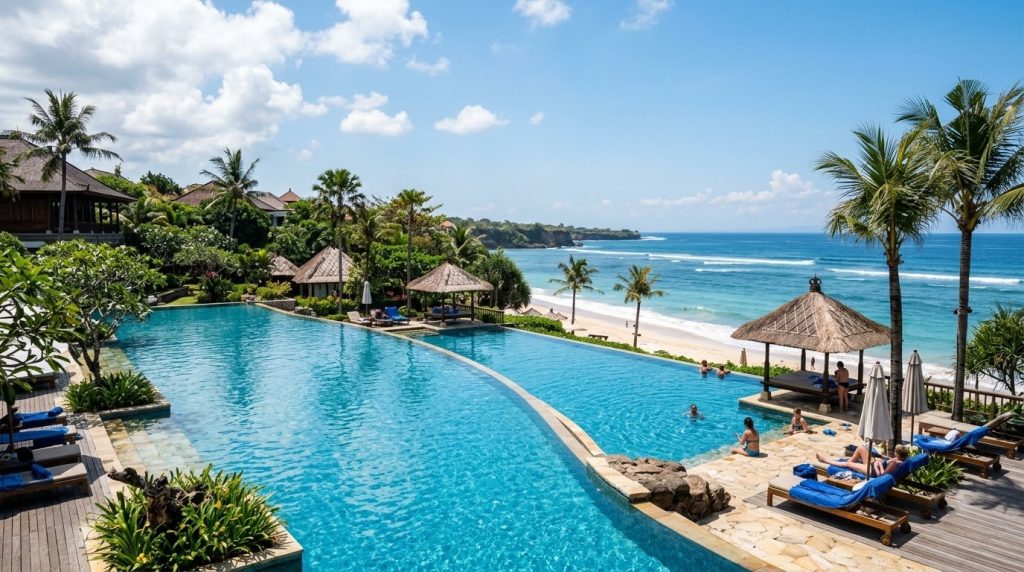
– Inside the ITDC enclave: the safest choice for families and first-timers. See the best hotels in Nusa Dua. – Geger Beach (south end): the quietest stretch, under a clifftop temple. It suits couples, but the shops are a longer walk. – Tanjung Benoa: cheaper and close to the water sports, but outside the gates, with more traffic.
Find your Nusa Dua hotel on the map
Live prices from Booking, Airbnb and more — move the map or change dates to compare stays across Nusa Dua.
Frequently Asked Questions
Is Nusa Dua safe at night?
Inside the ITDC enclave, yes. The paths are lit and the 3 gates are staffed 24/7, so walking between resorts and restaurants after dark is normal. Outside the gates, in Bualu and Benoa, treat it like any Bali town. Use a booked driver late at night, carry your bag on the side away from traffic and avoid unlicensed bars.
Is the water in Nusa Dua safe for kids?
Usually, yes. The offshore reef keeps the waves small, so the water is far calmer than at Kuta or Uluwatu. Swim at mid-to-high tide, stay inside the hotel buoys and put kids in reef shoes. At low tide the water becomes too shallow, with exposed coral and sea urchins. Lifeguards only cover busier sections.
Is Nusa Dua safer than Kuta or Seminyak?
For most travellers, yes. Nusa Dua has a gated perimeter, lighter traffic and no nightclub strip, which removes the settings where most theft, drink spiking and scooter crashes happen. Smartraveller’s “high degree of caution” covers all of Indonesia and does not rate the areas separately. The difference is the environment, not the official level.
Are Tanjung Benoa water sports safe?
They can be, if you choose carefully. Book a named operator ahead, confirm that a life jacket and safety briefing are included, and ride jet skis with an instructor because the water is crowded. Smartraveller warns that Australians have been seriously hurt or killed in adventure activities, so check your insurance covers them.
Do I need to worry about methanol in Nusa Dua?
Less than in party areas, but the risk is not zero. Smartraveller reports methanol deaths in Indonesia, including among Australians, as well as drink spiking in Bali. Resort bars and licensed restaurants are low risk. The danger is cheap spirits, arak and bucket cocktails at small bars outside the enclave, so stick to beer or sealed bottles there.