Disclosure: Some links in this guide are affiliate links. If you book or buy through them, we may earn a small commission at no extra cost to you — it helps keep our guides free.
Bali wins for a 7 to 10 day beach and villa break, because it is a 6.5-hour direct flight from Sydney and you can unpack once. Vietnam wins for trips of 2 weeks or more, when you want food, cities and variety rather than a pool.
Daily costs are closer than most people expect, so the real decision is trip length and travel style. Families and honeymooners should book Bali. Backpackers and food-led couples with time should book Vietnam.
| Factor | Bali | Vietnam |
|---|---|---|
| Direct flight from Sydney | About 6.5 hours to Denpasar | About 8.75 hours to Ho Chi Minh City |
| Direct flight from Perth | About 3.75 hours, many daily | About 6.5 hours, 4 a week (VietJet) |
| Entry for Australians | Visa on arrival plus levy, IDR 650,000 total | E-visa up to 90 days, AUD 35 · USD 25 single entry |
| Backpacker day | AUD 35–56 · USD 25–40 | AUD 28–69 · USD 20–50 |
| Best months | April to October (dry season) | February to April (all regions fairly dry) |
| Trip shape | One or two bases, drivers and day trips | Multi-city, internal flights or trains |
| Clear winner for | Families, honeymoons, short breaks | Backpackers, foodies, trips of 14+ days |
Getting there from Sydney, Melbourne and Perth
Bali is simply closer. Sydney to Denpasar takes about 6 hours 30 minutes direct, Melbourne about 6 hours 15 minutes and Perth under 4 hours, with Jetstar, Qantas, Virgin Australia and Indonesia AirAsia on the routes.
Vietnam takes longer but is no longer awkward. Sydney to Ho Chi Minh City is about 8 hours 45 minutes direct on Vietnam Airlines (daily), Jetstar (three a week) or VietJet, and Vietnam Airlines also flies Sydney to Hanoi.
Melbourne has daily Vietnam Airlines and VietJet services in 8 hours 20 minutes to 8 hours 50 minutes, and Perth has a VietJet direct in about 6 hours 35 minutes, four days a week. The catch: fly into Hanoi, out of Ho Chi Minh City, and add at least one domestic flight.
Visas and entry costs compared
Australians do not get a free pass to either country. For Bali you pay a visa on arrival of IDR 500,000 (AUD 39 · USD 28), good for 30 days and extendable once, plus the Bali tourist levy of IDR 150,000 (AUD 12 · USD 8.40), which you can pay ahead on the official Love Bali portal. Budget AUD 50 · USD 36 per person all up.
Vietnam is an e-visa you sort before you fly. Australians qualify for the 90-day e-visa, single entry costs AUD 35 · USD 25 and multiple entry AUD 69 · USD 50, and processing takes 3 to 7 business days. Apply through the government site at evisa.gov.vn rather than an agency, and do it a fortnight out.
Daily costs: closer than the hype suggests
The “Vietnam is half the price of Bali” line is out of date. Recent 2026 budget guides put a Bali backpacker day at AUD 35–56 · USD 25–40 and a Vietnam backpacker day at AUD 28–69 · USD 20–50, with prices in Vietnam’s tourist cities up roughly 20 to 30 percent on pre-COVID levels. Mid-range travel lands at roughly AUD 69–208 · USD 50–150 a day in both.
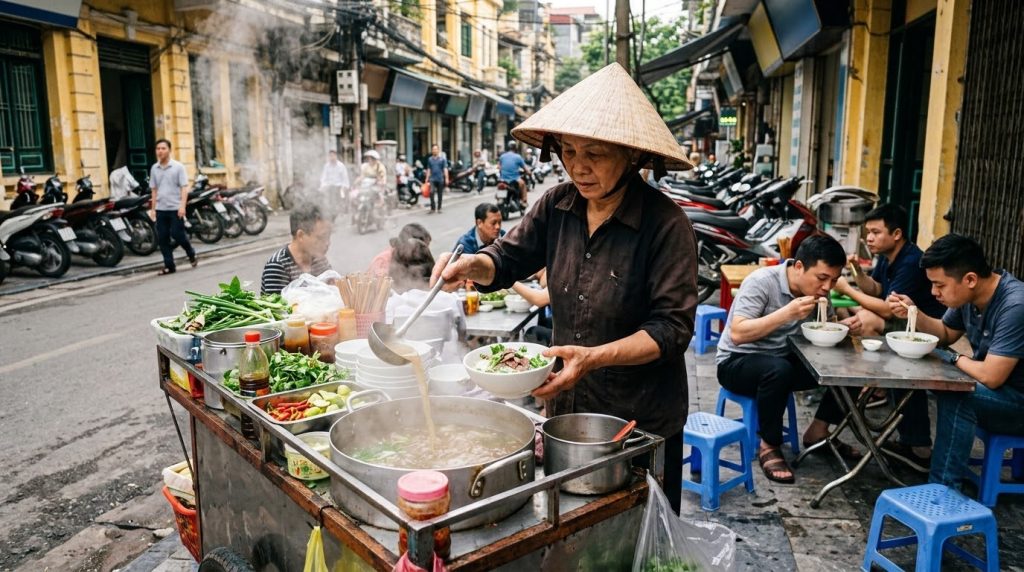
Street food is near identical. A bowl of pho in Hanoi runs VND 50,000–90,000 (AUD 2.60–4.70 · USD 1.90–3.40) and a banh mi VND 20,000–40,000 (AUD 1.05–2.10 · USD 0.76–1.52). A warung nasi campur in Bali costs IDR 20,000–50,000 (AUD 1.55–3.90 · USD 1.10–2.80).
The gap is in trip shape. In Bali your big costs are the villa and a driver. In Vietnam it is transport: Hanoi to Da Nang starts around AUD 36 · USD 26 one way, and two-week routes need two or three legs. Weighing a third option? Our Thailand vs Vietnam comparison runs the same numbers.
Food, culture and what you actually do all day
Vietnam is the stronger food trip, full stop. Hanoi’s street stalls, Hoi An’s cao lau and Saigon’s late-night seafood make eating the main event, and the cities themselves (French-era streets, motorbike chaos, the Old Quarter at 6am) are half the experience.
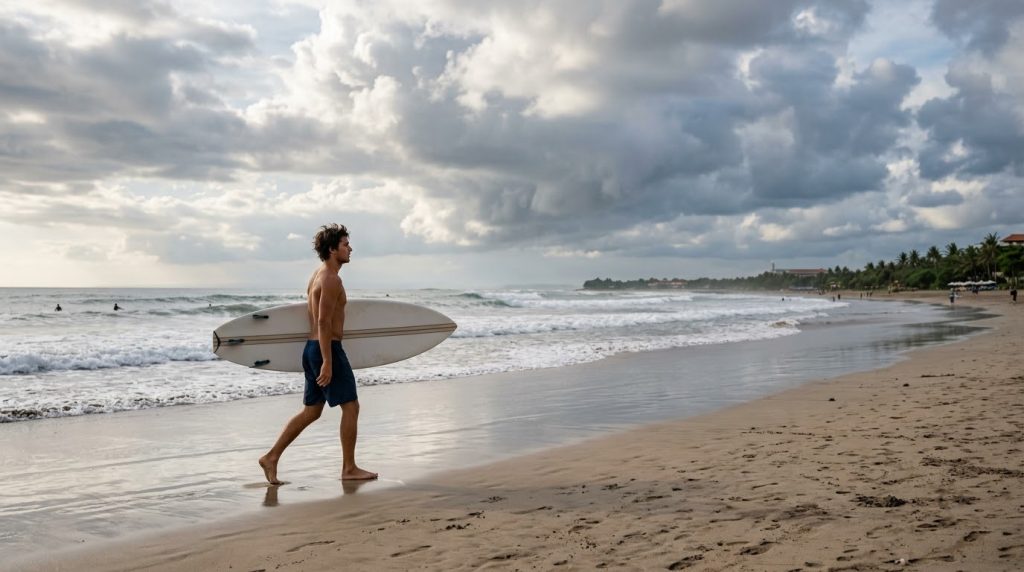
Bali is a slower trip: temple ceremonies in Ubud, rice terraces, surf at Uluwatu and long lunches in Seminyak. The food is good, but most Australians end up in cafes that look like Bondi. If Bali’s southern strip feels too busy, our Bali vs Lombok guide covers the quieter island next door, and the Bali vs Phuket breakdown is the better read if beaches are the whole point.
Weather by month: when each one works
Bali is easy to time. The dry season runs April to October, with August typically the driest month, which suits the mid-year school holidays. November to March is wet and humid, with January the rainiest. If school holidays lock you into the summer break, our guide to Bali in December covers the wet-season reality and why 20 December to 5 January costs most.
Vietnam is three climates in one country. The north is dry from October to April but cool in winter, the central coast around Hoi An and Da Nang is wet from September to December with typhoon and flood risk, and the south is wet from May to November.
February to April is when all three are reasonably dry, so that is the window for a top-to-bottom trip. Our best time to visit Vietnam guide breaks it down month by month.
The practical rule: June to August, pick Bali. February to April, pick Vietnam. October to November, pick Bali for the shoulder season and skip central Vietnam.
The verdict for each type of traveller
– Families with young kids: Bali. Short direct flight, one villa with a pool and no internal flights.
Vietnam’s multi-city pace wears little legs out fast. – Honeymooners and couples on a 7 to 10 day break: Bali. Private pool villas at prices you would not get in Australia, and zero logistics. – Couples with 2 weeks or more who love food: Vietnam. Hanoi, Hoi An and Saigon in one trip beats a second week by the same pool. – Backpackers and solo travellers: Vietnam. The north-south route has a well-worn hostel and bus circuit, more variety per dollar and a 90-day visa. – First trip to Asia: Bali. It is the gentlest landing for Australians. – Perth travellers on a long weekend: Bali. Under 4 hours direct makes it a 4-night trip. Vietnam needs a week at minimum.
Where to stay in Bali
If Bali is your pick, base yourself by trip type. Sanur and Nusa Dua suit families, with calm reef-protected water and resort pools. Seminyak suits couples who want restaurants and sunset bars within walking distance. Ubud suits anyone after culture and a quieter villa, and works as a second base for 2 to 3 nights.
Find your Bali hotel on the map
Live prices from Booking, Airbnb and more — move the map or change dates to compare stays across Bali.
See hotels in Bali →See hotels in Vietnam →
Frequently Asked Questions
Is Vietnam cheaper than Bali for Australians?
Only slightly, and not always. Recent 2026 guides put a Vietnam backpacker day at AUD 28–69 · USD 20–50 against AUD 35–56 · USD 25–40 in Bali, and mid-range spending overlaps almost completely. Street food costs about the same. Vietnam’s extra flights and transfers often cancel out cheaper beds, so choose on trip style, not price.
Do Australians need a visa for Vietnam?
Yes. Australians apply online for Vietnam’s e-visa, which allows stays of up to 90 days. Single entry costs AUD 35 · USD 25 and multiple entry AUD 69 · USD 50, with processing taking 3 to 7 business days. Use only the official evisa.gov.vn site and apply around two weeks before departure.
Is Bali or Vietnam better for a family holiday?
Bali, for most Australian families. The flight is shorter, you can stay in one villa or resort for the whole trip, and areas like Sanur and Nusa Dua have calm water and kids’ clubs. Vietnam works for families with older children who enjoy cities and food, but its multi-city pace suits teenagers better than toddlers.
Can you do Bali and Vietnam in one trip?
You can, but it rarely makes sense under three weeks. Linking them adds a separate international flight, another open-jaw ticket and a lost travel day, which eats into the slow villa time that makes Bali worth it. Better to give each its own trip, or pair Vietnam with Cambodia or Thailand instead.