Disclosure: Some links in this guide are affiliate links. If you book or buy through them, we may earn a small commission at no extra cost to you — it helps keep our guides free.
Thailand vs Vietnam comes down to two similar flights from Sydney — about 9 hours 15 minutes nonstop to Bangkok versus roughly 8 hours 50 minutes nonstop to Ho Chi Minh City — and two different daily budgets, from around USD 35 a day in Thailand to about USD 25 a day in Vietnam.
The honest split is this: choose Thailand for polished beaches, easy logistics and a bigger nightlife scene, and choose Vietnam for cheaper food, more dramatic scenery and a steeper, more rewarding learning curve.
Quick answer: Comparing Thailand and Vietnam? Open live hotel prices in each to weigh cost against location:
| Criterion | Thailand | Vietnam |
|---|---|---|
| Best for | First-timers in Asia | Second or third Asia trip |
| Beaches and islands | World-class, resort-ready | Good but fewer showpiece islands |
| Food scene | Excellent, tourist-friendly | Cheaper, more intense, globally renowned |
| Nightlife | Bigger, louder, built for tourists | Quieter, more local |
| Scenery and adventure | Strong, but less varied | Halong Bay, Sapa, Hoi An |
| Ease of travel | Easier roads, more English spoken | Tougher logistics, steeper learning curve |
| Mid-range daily budget | AUD 125 · USD 90 (THB 2,960) | AUD 90 · USD 65 (VND 1,687,000) |
| Nonstop flight from Sydney | About 9h 15m to Bangkok | About 8h 50m to Ho Chi Minh City |
Beaches and islands — Thailand wins
Thailand wins on beaches because its islands have decades more tourism investment behind them than anywhere on Vietnam’s coast.
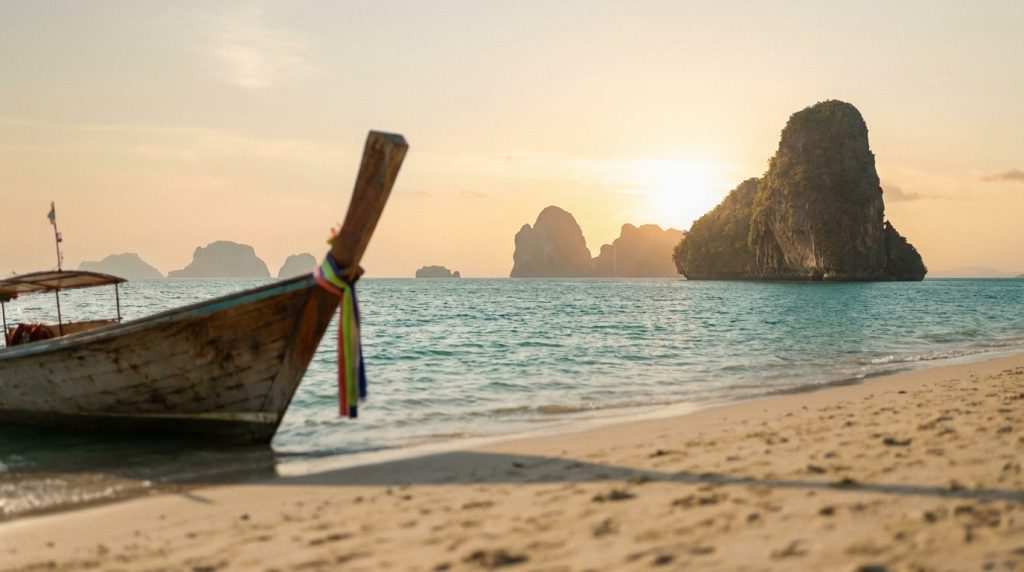
Phuket, Krabi, Koh Samui and Koh Phi Phi each offer a full ecosystem of dive shops, beach clubs, ferries and resorts built specifically around foreign visitors, so a first-time traveller can turn up with almost no planning and still have island-hopping, snorkelling and sunset boat trips sorted within a day.
Multi-island speedboat tours, liveaboard diving trips and beach-hut-to-five-star accommodation ladders all exist at a scale Vietnam hasn’t built out yet, which is why repeat visitors keep coming back to the same few Thai islands rather than exploring new ones.
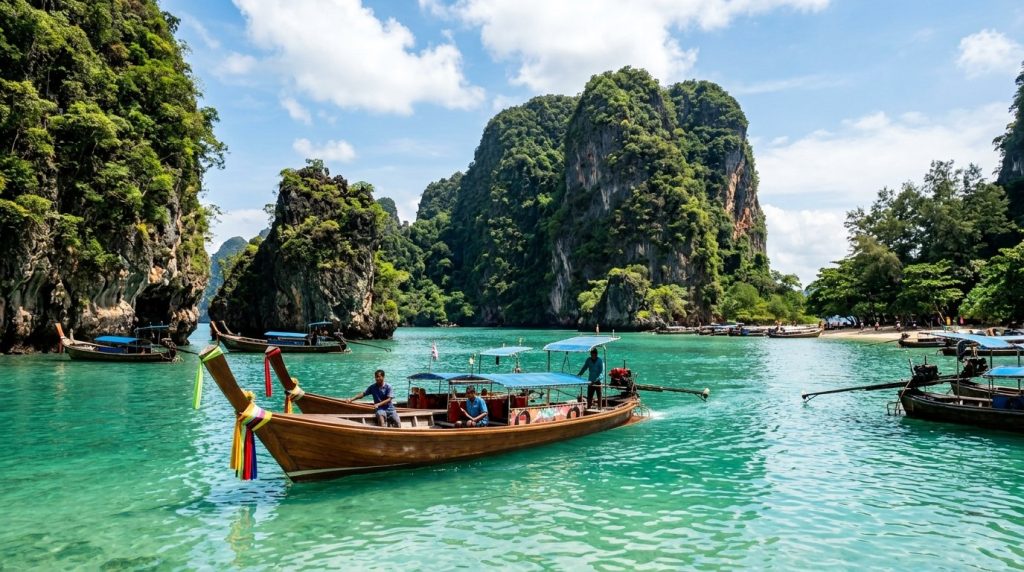
Vietnam’s coastline has genuine highlights too, particularly Phu Quoc and Nha Trang, and Halong Bay’s limestone islands are spectacular to look at, but that bay is better suited to a scenic overnight cruise than a lounge-on-the-sand holiday. Neither Phu Quoc nor Nha Trang has the density of dive operators, beach bars or resort options that Krabi or Koh Samui do.
If beach time is the main goal of the trip, Thailand is the more reliable pick.
Food and value — Vietnam wins
Vietnam wins on food and value because a bowl of pho, a banh mi and a proper Vietnamese coffee often cost less combined than a single beer at a Thai beach bar.
Street food in both countries is excellent, but Vietnam’s is built around fresher herbs, broths and a French-influenced coffee culture that has its own devoted following worldwide, and it comes at a lower price point across the board.
The regional variety adds to the appeal: Hanoi’s bun cha, Hue’s imperial-style dishes and Hoi An’s cao lau noodles are distinct enough that food alone can justify moving between cities, whereas Thai regional cuisine, while excellent, tends to be more consistent from north to south.
That value extends beyond meals too — a Vietnamese guesthouse, a short taxi ride or a local beer typically runs noticeably cheaper than the Thai equivalent, which is part of why backpackers who do both countries back to back usually report Vietnam stretching their money further.
Ease and infrastructure — Thailand for a first trip
Thailand is the easier country for a first Asia trip because Bangkok’s tourist infrastructure has had decades longer to mature than Vietnam’s.
English signage is more consistent, the BTS and MRT rail network makes the capital simple to navigate without a guide, and Sydney’s nonstop capacity to Bangkok — Qantas and Thai Airways combined run around 19 direct flights a week — gives travellers more schedule flexibility than the Vietnam routes offer.
Ride-hailing apps, card payments and English-speaking tour desks are also more consistently available outside the major cities in Thailand, so a traveller who ventures beyond Bangkok to Chiang Mai or the islands hits fewer friction points than the equivalent detour in Vietnam.
Vietnam is catching up fast and Ho Chi Minh City now has its own nonstop Sydney service, but road crossings, overnight buses and the general pace of getting around still ask more of a first-timer, and travelling the full length of the country from Hanoi to Ho Chi Minh City involves more internal flights or long train legs than a comparable Thailand loop.
For deeper planning once a country is picked, see the best time to visit Thailand and a ready-made Bangkok 3-day itinerary.
Scenery and adventure — Vietnam’s edge
Vietnam’s edge in scenery comes from its geography, which stretches far further north to south than Thailand’s and packs in more contrast as a result.
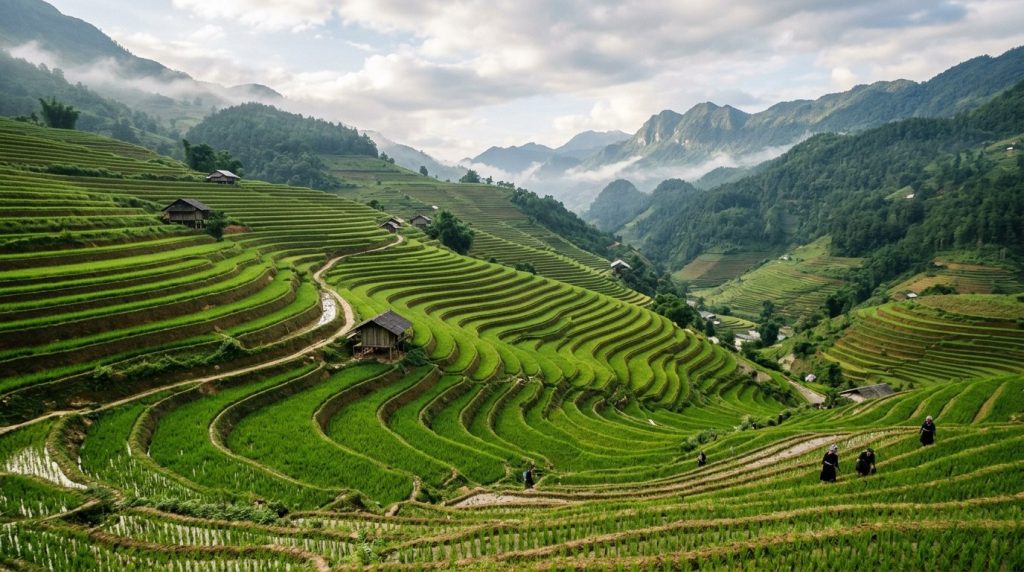
Halong Bay’s limestone karsts, the terraced rice paddies around Sapa and the lantern-lit old town of Hoi An sit within the same country, connected by train and overnight bus routes that turn the trip itself into part of the adventure.
Adventure travellers also gravitate toward routes like the Ha Giang Loop’s mountain switchbacks and the cave systems around Phong Nha, both of which ask more of a traveller logistically than anything comparable in Thailand but pay off with scenery few other Southeast Asian countries can match.
Thailand’s national parks and northern hills around Chiang Mai and Chiang Rai are genuinely worth visiting, but the range is narrower, and Vietnam rewards travellers willing to trade some comfort for scenery that’s harder to match anywhere else in the region.
Plan around the wetter months with the best time to visit Vietnam and start in the capital with a Hanoi 3-day itinerary.
Cost, honestly
Vietnam is cheaper at almost every tier, though the gap narrows the higher up the comfort scale a traveller goes.
A budget trip in Thailand — dorms, street food, local transport — runs around AUD 49 · USD 35 (THB 1,150) a day, while the same style of trip in Vietnam costs closer to AUD 35 · USD 25 (VND 649,000) a day.
Move up to mid-range travel, meaning private rooms, restaurant meals and a couple of paid activities, and Thailand sits around AUD 125 · USD 90 (THB 2,960) a day against Vietnam’s AUD 90 · USD 65 (VND 1,687,000).
Stretched across a two-week trip, that gap at the budget and mid-range tiers adds up to several hundred Australian dollars, which is real money once flights and travel insurance are already accounted for.
At the luxury end the two countries land closer together, since five-star hotels and private drivers cost roughly the same wherever they’re booked, so the savings from choosing Vietnam matter most to travellers staying in the budget or mid-range brackets rather than those planning a resort-style holiday either way.
See hotels in Thailand →See hotels in Vietnam →
Visa requirements for Australians
Thailand’s visa-exemption stay for Australian passport holders was cut from 60 days to 30 days effective 15 September 2026, so anyone still planning around the longer allowance from before that date needs to recheck it. Within the 30-day window, Australians need no visa at all for ordinary tourism; a one-time 30-day extension is available at a Thai immigration office if more time is needed once already in the country.
Vietnam works differently: Australians need an e-visa before arrival rather than relying on a visa-exemption stamp. The e-visa costs AUD 35 · USD 25, can be issued for single or multiple entry, and now covers stays of up to 90 days, a longer runway than Thailand’s exemption even after accounting for the application step.
Processing typically takes a few business days, so applying at least a week ahead of departure is the safer approach rather than leaving it to the airport.
Net effect for a trip covering both countries: Vietnam asks for more paperwork upfront but buys three times the stay length, while Thailand’s entry is simpler but now caps out at 30 days before an extension is needed.
Either way, both now require more attention to validity dates than they did a couple of years ago, so checking the current rule close to departure matters more than relying on an older guide.
Best time to visit: weather compared
November through February is the one window that works well in both countries at once, since Thailand sits dry and settled island-to-island while northern Vietnam turns cool and comfortable rather than its summer swelter.
Outside that overlap, the two countries pull apart: Thailand’s climate is fairly uniform country-wide, hot and dry from March to May, then wet season roughly June through October across most of the country, including the west-coast beaches covered elsewhere on this site.
Vietnam is the trickier of the two to time well because it runs far enough north to south that no single month suits the whole country. Hanoi and the north turn properly cold and grey in December and January, while Ho Chi Minh City and the south stay warm year-round with a wet season from roughly May to November.
Central Vietnam, including Hoi An and Hue, adds its own typhoon season on top, typically running from around August into November, which is the one stretch worth actively planning around rather than just packing a rain jacket for.
The practical read: a Thailand trip is easier to time well no matter the month chosen, while a Vietnam trip rewards checking the specific region on the itinerary before locking in dates, especially for anyone routing the full length of the country as described earlier in this guide.
Choose Thailand if / choose Vietnam if
Choose Thailand if this is a first trip to Asia, the priority is beach and island time with minimal planning, or a bigger nightlife scene matters more than saving money.
Choose Vietnam if the budget needs to stretch further, food and coffee are the main draw, or the goal is dramatic scenery and a more immersive trip worth the extra logistics. Neither country is the wrong call — they suit different trips, not different tiers of quality.
Compare Thailand and Vietnam hotels on the map
Live prices from Booking, Airbnb and more — move the map or change dates to compare stays across both countries.