Malaysia Itinerary 10 Days: KL, the Highlands, Penang and Langkawi
By TravelguidestipUpdated 11 min readHow we earn
Hotel buttons open Stay22 (Booking.com, Agoda and others) and tour buttons open GetYourGuide. We may earn a commission at no extra cost to you.
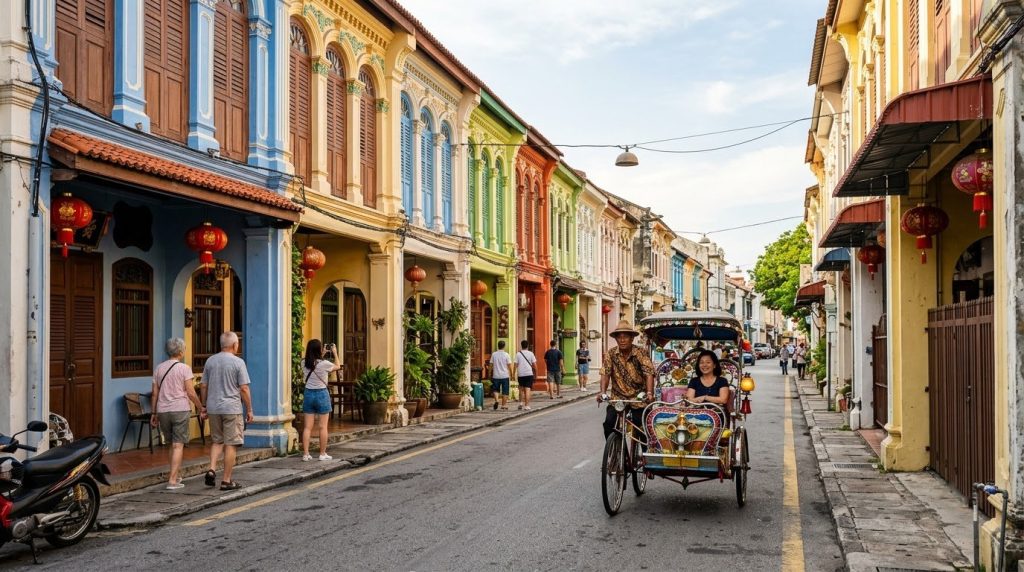
Yes, 10 days covers Malaysia’s classic peninsular loop: 2 nights in Kuala Lumpur, 2 in the Cameron Highlands (or Malacca), 3 in Penang and 2 on Langkawi, linked by two 4–5 hour buses and two short flights. It works because every leg is under five hours and cheap.
Perth travellers land after roughly 5.5 hours in the air and Sydneysiders after about 9, so day one is a short one. Skip Langkawi and you have a relaxed eight-day trip.
| Day | Sleep in | Highlights | Getting there |
|---|---|---|---|
| 1–2 | Kuala Lumpur | Batu Caves, Chinatown, Petronas Towers at night | Fly in |
| 3–4 | Tanah Rata (Cameron Highlands) | Tea estates, cool forest walks | Bus from TBS, 4–5 hrs |
| 5–7 | George Town, Penang | Street food, heritage lanes, Penang Hill | Bus from Tanah Rata, 4.5–5 hrs |
| 8–9 | Langkawi | Beaches, mangroves, cable car | Flight from Penang, 20–40 min |
| 10 | Fly home | Connect through KL | Flight to KL, 1 hr 5 min |
Days 1–2Kuala Lumpur without wasting the jet-lag day
Sleep: Kuala Lumpur, 2 nights.
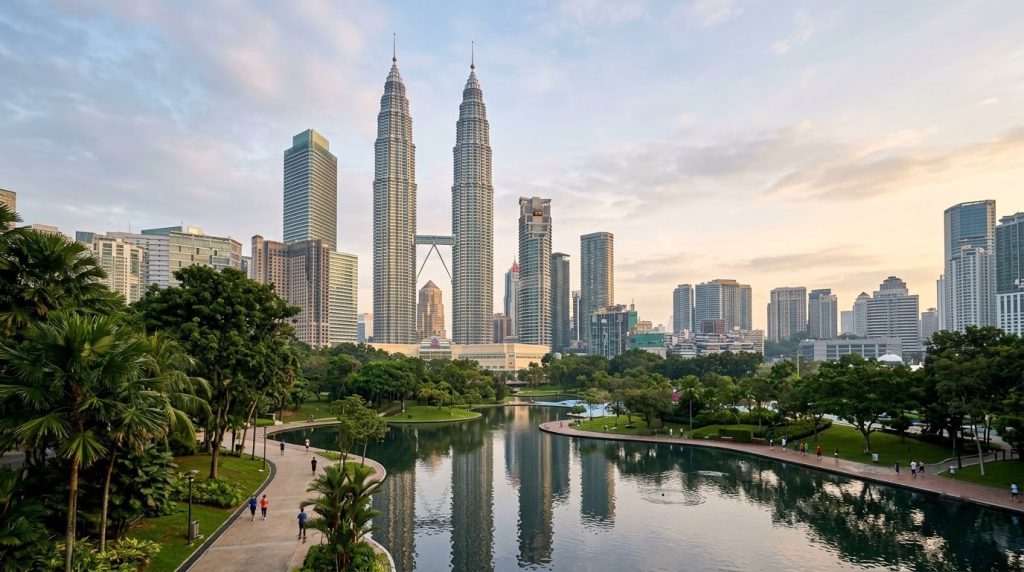
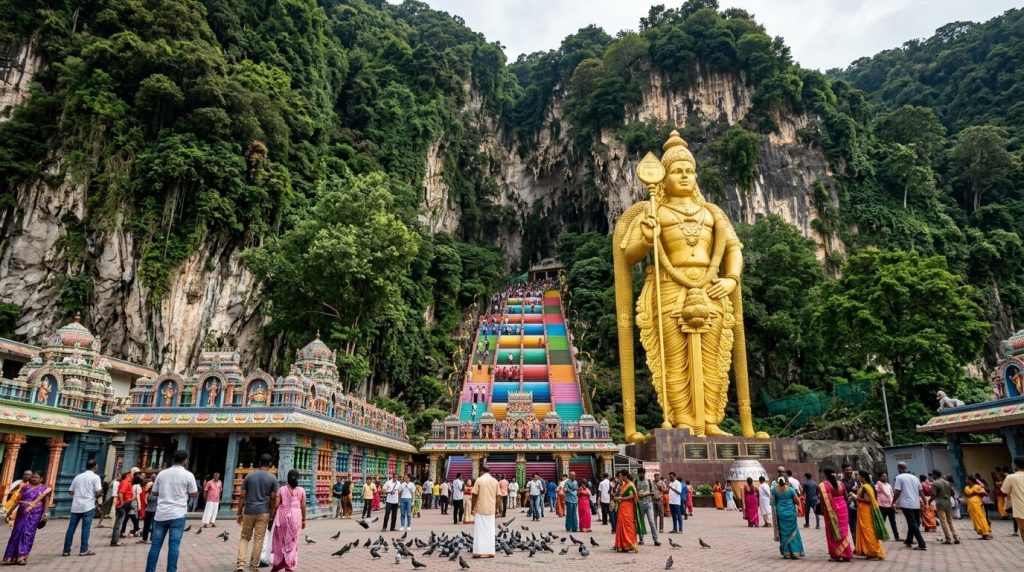
Use the arrival afternoon for Chinatown and Merdeka Square, then the Petronas Towers after dark. Day two is Batu Caves first thing, before the tour buses and midday sun, then Jalan Alor’s food stalls in the evening.
Two nights is enough. KL is a big, humid hub, and most of what makes Malaysia memorable sits further north. Check the best time to visit Malaysia first, because the west and east coasts get their wet seasons at different times, and that decides whether Langkawi earns its two nights.
Kuala Lumpur after dark: rooftops, food streets and clubs
Jalan Alor covers the food side of a KL night, so this is about everything around it. KLCC Park’s Petronas Towers light show runs for a few minutes most evenings after dark, and it is free to watch from the park lawn, no booking required. From there, the city’s rooftop scene gives you several ways to see the towers from above rather than from the ground.
Marini’s on 57, inside one of the Petronas towers themselves, is the closest eye-level rooftop view of the twin spires and the pricier end of the scale, with a dress code and table minimums in the evening.
Atmosphere 360, a revolving restaurant and bar sitting above Menara Kuala Lumpur’s observation deck, is higher than the Petronas sky bridge and turns a full circle roughly every hour, giving a 360-degree view without moving from your seat.
Helipad KL, a working helicopter pad by day, converts into an open-air rooftop bar after dark with some of the least obstructed skyline views in the city, since there is no glass between you and the towers.
For a livelier, less scenic night, Changkat Bukit Bintang and the TREC entertainment complex nearby are the city’s main nightlife strip. Changkat’s bars and small clubs generally wind down by 2 to 3am, while several TREC venues, including Zouk Kuala Lumpur, run later, some to around 5am on weekends.
Both areas sit within walking distance of Bukit Bintang’s monorail and MRT stations, so you do not need a taxi back if your hotel is nearby.
Dress codes matter more at the rooftop venues than almost anywhere else on this route: smart casual is the baseline at Marini’s on 57 and Atmosphere 360, and shorts, singlets and sandals can get turned away after dark even if they were fine for a daytime visit.
Cover charges and minimum spends are common at TREC’s clubs on weekends, typically waived earlier in the night or for groups that eat at one of the complex’s restaurants first. None of this applies to Jalan Alor or the smaller hawker lanes around Bukit Bintang, which stay casual and cash-friendly all night.
Days 3–4Cameron Highlands, or Malacca instead
Sleep: Tanah Rata, 2 nights.
Buses leave Terminal Bersepadu Selatan (TBS) for Tanah Rata several times a day. Budget 4–5 hours and AUD 15–17 · USD 11–12 (RM 45–48). The last hour climbs a winding mountain road, so take something for motion sickness if you need it.
Up top it is noticeably cooler than KL. Spend day four at the BOH Sungei Palas tea garden near Brinchang. Entry is free, but BOH lists it as open Tuesday to Sunday, 8:30am–4:30pm, so do not plan it for a Monday. Add a forest trail and scones, and two nights is plenty.
The Malacca swap. Prefer history to cool weather? Go to Malacca. The TBS to Melaka Sentral bus takes about 2 hours 15 minutes to 2 hours 30 minutes and costs AUD 4–5 · USD 3–3.5 (RM 12–14). Time it so you are in town on a Friday or Saturday, because the Jonker Street night market runs Friday to Sunday from 6pm and Sunday is the quietest night.
Take the bus, not the train: track upgrades between Mid Valley and Seremban/Tampin halt Komuter trains from 10am to 4pm until as late as the end of December 2026. From Malacca, direct buses to Penang’s Sungai Nibong take around 7 hours.
Days 5–7Penang, the real reason to come
Sleep: George Town, 3 nights.
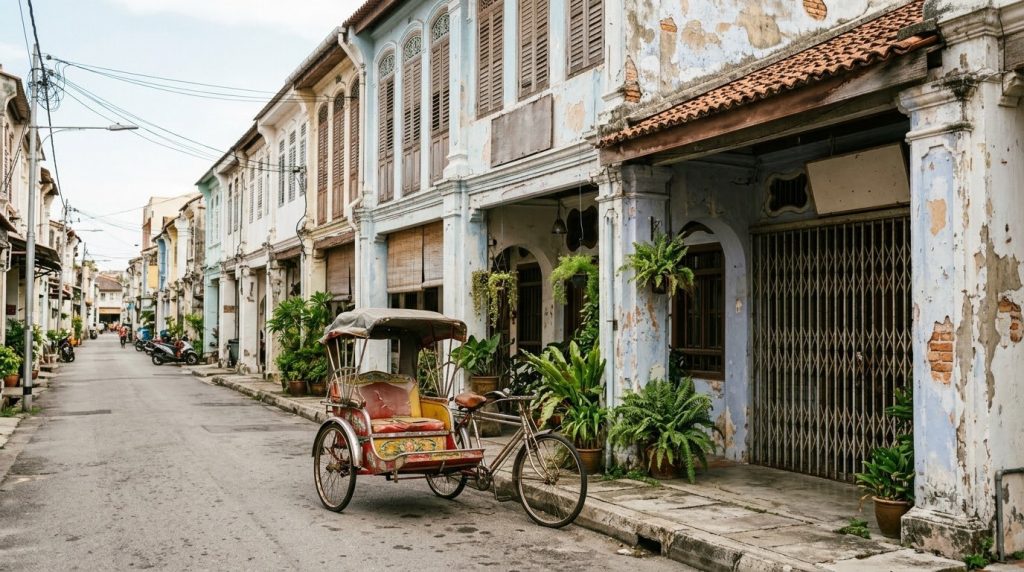
The Tanah Rata to Penang bus runs mainly in the morning and early afternoon. It takes 4.5–5 hours and costs from AUD 12 · USD 9 (RM 35). Some services stop at Butterworth on the mainland. If yours does, the ferry to George Town is AUD 0.70 · USD 0.50 (RM 2) and runs every 30 minutes from 6:30am.
If you skip the highlands, the ETS from KL Sentral to Butterworth takes 3 hours 35 minutes on the Express and up to 4 hours 20 minutes on Gold, for AUD 20–38 · USD 14–27 (RM 59–112) depending on class and how early you book. Book through KTMB, because the cheapest fares go first. With only a week, our shorter Malaysia plan by train uses that same Express service and leaves out Langkawi and the highlands on purpose.
Give Penang three nights. George Town’s food is the best value in the country, the heritage core is walkable, and Penang Hill opens at 6:15am, so beat the queues early. Our Penang itinerary breaks these days into hawker centres, temples and street-art walks, so you are not just wandering on day two. That hawker food is why our guide to whether Malaysia is expensive puts a mid-range day at about AUD 153, almost level with Thailand.
Days 8–10Langkawi and the flight home
Sleep: Langkawi, 2 nights.
The direct Penang to Langkawi ferry stopped in 2020 and has not returned. Fly instead: AirAsia runs the most services, with Firefly and Malaysia Airlines also on the route. It takes 20–40 minutes and costs from about AUD 21 · USD 15 (RM 60).
The land alternative is a ferry from Kuala Kedah, which takes about 1 hour 45 minutes and costs AUD 15 · USD 11 (RM 45), and you still have to get from Penang to the jetty first.
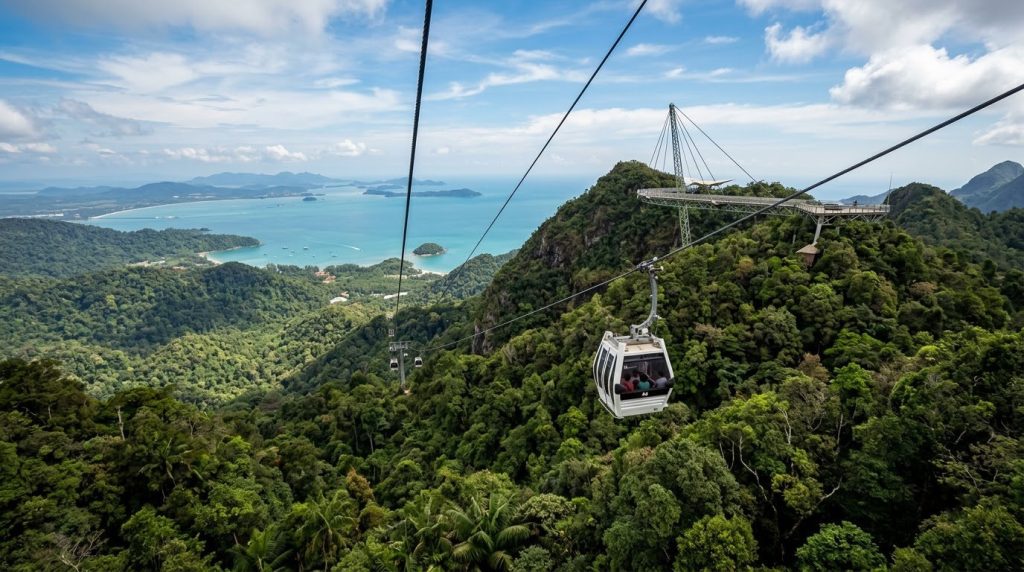
Spend one day on the beaches around Pantai Cenang and one on a mangrove boat trip or the cable car. On day ten, fly Langkawi to KL (1 hour 5 minutes on AirAsia or Batik Air) and connect home, leaving at least 3 hours between flights if they are on separate tickets.
What to cut if you only have 7 days
– Drop Langkawi first. It is the leg that costs the most for the least that is unique, and you can fly home from Penang. – Cut the highlands to zero, not to one night. One night means 9–10 hours on buses for a single afternoon of tea fields.
Take the ETS straight from KL to Penang instead. – Do not cut Penang below 2 nights. It is the food and heritage highlight of the trip. – Leave out Malacca on a Monday to Thursday visit. It is good, but without the weekend night market a day trip loses half its appeal.
A tight 7-day version is KL (2 nights) and Penang (4 nights), flying home from Penang.
What this trip costs in 2026
Daily costs change a lot between Kuala Lumpur’s malls and Penang’s hawker stalls, and between a backpacker bed and a mid-range hotel.
A 2026 cost guide for Kuala Lumpur puts a budget day, hostel bed, street food and public transport, at around AUD 40 · USD 29 (RM 118), and a mid-range day, a 3-star hotel, a couple of sit-down meals and some paid activities, at around AUD 113 · USD 81 (RM 331).
Penang runs a little higher: the same guide puts a budget day at about AUD 74 · USD 53 (RM 217) and a mid-range day at about AUD 196 · USD 141 (RM 576), reflecting George Town’s pricier heritage-zone accommodation.
Based on those two stops, a 10-day version of this route, excluding flights, lands at roughly AUD 550-900 · USD 400-650 for a careful budget traveller and roughly AUD 1,500-2,400 · USD 1,100-1,700 mid-range, covering beds, food, local transport and entry tickets.
The Cameron Highlands and Langkawi legs tend to sit in a similar range: homestays and basic hotels are cheaper in the highlands, while Langkawi’s beach resorts can push a mid-range budget higher if you add water-sports or a boat trip.
The exchange rate used in this guide is approximately USD 1 = RM 4.08, current as of October 2026; check a live rate before you change money, since the ringgit moves against the US dollar over the course of a year.
A few small costs are easy to forget when adding up a trip like this. A local prepaid SIM with data and some call minutes from a Digi or Maxis Hotlink counter at KL International Airport typically runs around AUD 14-20 · USD 10-14 (RM 25-55), depending on the data allowance you pick.
Tipping is not expected anywhere on this route; restaurant bills already include a service charge in most sit-down places, and street stalls are cash only with no tip line.
Entry tickets add up faster than food does: Batu Caves is free to the main temple, but the Cameron Highlands tea gardens, Penang Hill’s funicular and Langkawi’s cable car or boat trips each run from a few dollars to around AUD 30 · USD 22 per person, so budget an extra AUD 10-15 · USD 7-11 a day for activities on top of the daily cost ranges above.
Is the route safe and easy for Australians?
Smartraveller rates Malaysia overall at “Exercise normal safety precautions” (last updated 4 August 2026), and you must complete the Malaysia Digital Arrival Card (MDAC) before arriving. The higher-risk zone is eastern Sabah, nowhere near this route. On the peninsula the real risks are bag snatching, traffic and heat on Batu Caves’ stairs at noon. Our guide on whether Malaysia is safe covers scams and taxis.
What to pack for the highlands, Penang and Langkawi
This route crosses three different climates in ten days, so layering matters more than any single item. Kuala Lumpur, Penang and Langkawi sit at sea level and stay hot and humid year-round, with daytime temperatures commonly in the high-20s to low-30s Celsius; light, breathable, quick-dry clothing works best, and a hat and reef-friendly sunscreen cover the beach days on Langkawi.
The Cameron Highlands are the outlier. Daytime temperatures there generally sit around 18-25°C and nights can drop to 13-15°C, cool enough that a light jacket or a long-sleeve layer earns its spot in the bag, something many first-time visitors to tropical Malaysia leave at home.
A rain jacket or a compact umbrella is worth packing everywhere on this route, since short, heavy downpours are common in all four stops, highlands included, and they rarely last long enough to justify waiting them out indoors.
- A light scarf or sarong, useful for covering shoulders and knees at mosques and some temple visits
- Comfortable closed shoes for Batu Caves’ stairs and Penang Hill’s trails, plus sandals for the beach legs
- A universal or UK-style Type G adapter; Malaysia runs on 230V with the same three-pin plug as the UK, which differs from Australia’s plugs
- A dry bag or zip-lock bags for Langkawi’s mangrove boat trip and any rain on the Cameron Highlands bus ride
Pharmacies are easy to find in KL, George Town and Langkawi’s main tourist strips, so basics like sunscreen, insect repellent and motion-sickness tablets are simple to buy locally if you forget them; they are harder to find in Tanah Rata, so buy them before you head up to the highlands.
Luggage matters too, given the mix of buses, a short-haul flight and a ferry transfer on this route. A single rolling bag plus a daypack is easier to manage than a large suitcase on the Tanah Rata bus, where overhead storage is limited and the final climb up the mountain road can be slow and winding.
Budget airlines on the Penang to Langkawi hop usually cap cabin bags around 7kg, so weigh your bag before the airport if you are travelling carry-on only, and keep a printed or downloaded copy of the Malaysia Digital Arrival Card confirmation, since wi-fi at smaller bus terminals is not always reliable.
Where to stay in Kuala Lumpur, Penang and Langkawi
– Kuala Lumpur, Bukit Bintang: first-timers who want food streets, malls and a monorail stop at the door. Chinatown is cheaper and better for character. – Tanah Rata: the bus terminal, cafes and trailheads are all within walking distance, so you do not need a car. – George Town heritage core: couples and food lovers.
Pick Batu Ferringhi only if you want a beach pool over street food. Our where to stay in Penang guide compares the neighbourhoods street by street.
Find your Kuala Lumpur hotel on the map
Live prices from Booking, Airbnb and more — move the map or change dates to compare stays across Kuala Lumpur.
Frequently Asked Questions
Is 10 days enough for Malaysia?
Ten days is enough for the west coast of the peninsula: Kuala Lumpur, the Cameron Highlands or Malacca, Penang and Langkawi. It is not enough to add Borneo as well. Sabah or Sarawak needs its own week, because flights from KL take time and the wildlife trips need early starts and full days.
Should I pick the Cameron Highlands or Malacca?
Pick the Cameron Highlands if you want cool air, tea estates and walking. Pick Malacca if you prefer colonial history, museums and a weekend night market. Malacca is only about 2 hours 15 minutes by bus from KL, while the highlands take 4–5 hours on a winding road. That makes Malacca the better choice for anyone who gets carsick.
Is there still a ferry from Penang to Langkawi?
No. The direct Penang to Langkawi passenger ferry stopped in 2020 and has not resumed. Most travellers now fly, which takes 20–40 minutes and often costs from about RM 60. The alternative is getting to Kuala Kedah on the mainland and catching a ferry of about 1 hour 45 minutes from there.
Is the ETS train from KL to Penang worth it?
Yes, if you are skipping the highlands. The ETS from KL Sentral reaches Butterworth in 3 hours 35 minutes to 4 hours 20 minutes, with fares from RM 59 to RM 112 depending on class. A RM 2 ferry then crosses to George Town every 30 minutes. It beats the bus for comfort, and early bookings get the lowest fares.