Disclosure: Some links in this guide are affiliate links. If you book or buy through them, we may earn a small commission at no extra cost to you — it helps keep our guides free.
Koh Samui wins for families, couples and anyone who wants resort comfort, because it has its own airport 1h35 from Bangkok, while Koh Tao wins for divers and backpackers, because a PADI Open Water course there costs THB 9,900–12,950 and the reefs start minutes from the beach.
The two islands sit about 1h30 apart on the Lomprayah catamaran, so the smartest answer for most Australians is not either/or: base yourself on Samui, then give Tao three or four nights.
| Factor | Koh Samui | Koh Tao |
|---|---|---|
| Best for | Families, couples, first-timers | Divers, backpackers, solo travellers |
| Getting there | Own airport (Bangkok Airways, Scoot) | Ferry only, no airport |
| Accommodation | Big resorts, pool villas, beach hotels | Dive-shop bungalows, hostels, small resorts |
| Signature activity | Beach clubs, spas, Ang Thong day trips | PADI Open Water from THB 9,900 |
| Wettest months | October to mid-December | October to December |
| Ferry between them | AUD 26–28 · USD 18–20 (THB 650–700), about 1h30 | Same route in reverse |
Who each island is really built for
Samui is the big, developed Gulf island: ring road, international hospitals, supermarkets, beach clubs and resorts with kids’ clubs and airport pick-ups. With one week of leave and a holiday that should start the moment you land, Samui makes that easy. Our Koh Samui travel guide breaks down the beaches one by one.
Koh Tao is small, hilly and organised around diving. Most of the island’s economy is dive schools, and the social life runs on boat schedules: early dives, sunset beers on Sairee Beach, early night. It is cheaper and more casual, but the roads are steep, the beaches are smaller and every arrival and departure depends on a boat. That matters if you are travelling with toddlers or anyone who gets seasick.
Diving: the reason most people choose Koh Tao
Koh Tao is one of the cheapest places in the world to get certified. Current published prices for the PADI Open Water course run from THB 9,900 at Isla Tortuga Divers to THB 12,950 at Black Turtle Dive, which works out at AUD 390–505 · USD 280–365.
Siam Scuba’s 2026 price guide lists its course at THB 12,000 for 2.5 days, all gear, boat trips and certification included, and compares it with AUD 700+ · USD 505+ for the same course in Australia.
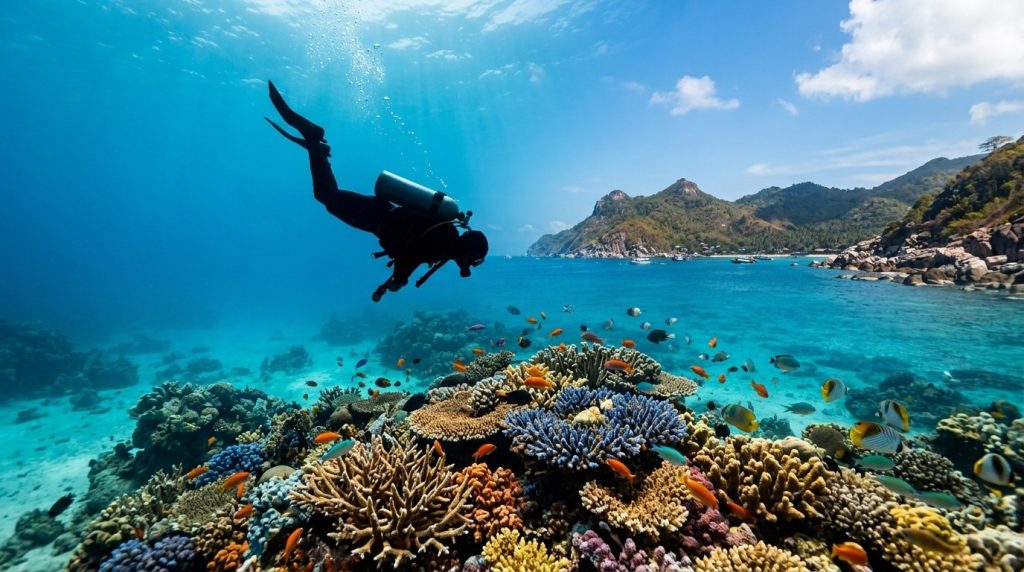
Want a taste first? A Discover Scuba dive is about AUD 102 · USD 74 (THB 2,600). Water sits at 28–30°C year-round, and most sites are 20–40 minutes by boat. If diving is the point of the trip, sleep on Tao.
Getting there from Australia
There are direct Thai Airways and Qantas flights from Sydney to Bangkok, scheduled at 9h20 to 9h50. From there:
– Koh Samui: Bangkok Airways flies Bangkok to Samui in roughly 1h25–1h35, with one-way fares from about AUD 94 · USD 68. Scoot and Bangkok Airways also fly Singapore to Samui nonstop in about 1h55, which suits Australians connecting through Changi. – Koh Tao: there is no airport.
You either fly to Samui (or Chumphon) and take a boat, or ride the Lomprayah joint bus-and-ferry from Bangkok. That takes about nine hours and costs AUD 49–61 · USD 35–44 (THB 1,250–1,550).
That airport gap is the biggest practical difference. With kids or a short break, Samui’s airport is worth paying for.
Lomprayah ferry times and prices between the islands
Lomprayah runs the only direct high-speed catamaran between the two islands. Main departures leave Samui around 8am and 1pm, with services from Nathon, Maenam and Bangrak piers, and arrive at Mae Haad Pier on Koh Tao’s west coast. The catamaran takes about 1h30, up to 2h in rough water.
– Adults: AUD 26–28 · USD 18–20 (THB 650–700) – Children 3–11: AUD 13–14 · USD 9–10 (THB 325–350) – Slower Laemsor ferry: about AUD 22 · USD 16 (THB 550)
Check in 30 minutes early, and note the 20 kg baggage limit. If you want a night on Koh Phangan, Seatran and Lomprayah both let you break the trip there. Book times on the operator’s official Lomprayah site, because schedules shift by season.
Monsoon timing: the Gulf runs on a different calendar
This catches Australians out. The Andaman coast (Phuket, Krabi) is wet from roughly May to October, but the Gulf islands get the north-east monsoon from October to December. On Samui, November is on long-term averages the wettest month, with around 445 mm of rain, and the first half of December stays unsettled before things clear in the second half.
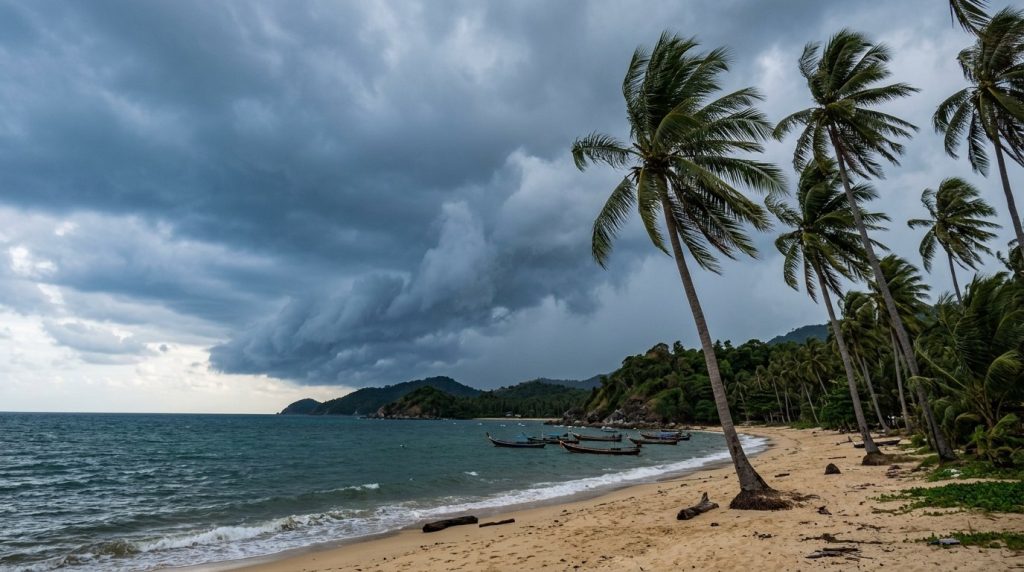
Koh Tao follows the same pattern. Dive schools report visibility dropping to 5–15 m from November to January. They still dive daily by switching to sheltered sites, but crossings get rough. The calmest seas and best visibility (20–30 m+) come in March to May and again in September to early October, which is also whale shark season.
For Christmas and January school holidays, aim for the second half of December onwards. If you are heading over in our spring, compare the Phuket vs Koh Samui seasons first, since Phuket is the better pick in November.
Food and nightlife on each island
Samui has the wider food scene by a large margin: beach-club restaurants, Western chains, high-end Thai and seafood grills sit alongside the local noodle shops, especially around Chaweng and Fisherman’s Village in Bophut. Nightlife runs from relaxed beachfront bars to the Chaweng strip’s clubs and late-night venues, so you can pick a quiet dinner or a loud night depending on the evening.
Koh Tao’s food and nightlife both run on dive-school hours: cheap Thai food carts and simple Western cafes cluster around Sairee Beach and Mae Haad, aimed at people doing an early dive the next morning rather than a late one. Bars along Sairee do fire shows most nights, but the overall scene is smaller and quieter than Samui’s.
If a big night out matters to the trip, Koh Phangan’s monthly Full Moon Party at Haad Rin Beach sits on the same Lomprayah route already covered above, with an entry fee of around THB 200; it is one reason some travellers break the Samui-to-Tao ferry trip there for a night.
Verdict by traveller type
– Families: Koh Samui, clearly. Airport, resorts with pools and kids’ clubs, flatter beaches like Bophut and Choeng Mon, and proper hospitals. – Couples: Samui for a comfort-first honeymoon; Tao if you both dive or want a quieter, rougher-edged island. – Budget travellers and backpackers: Koh Tao.
Dive-school accommodation deals and cheaper food stretch a tight budget. – First-timers to Thailand: Samui, then add Tao as a side trip. If you are still choosing countries, our Bali vs Thailand and Thailand vs Cambodia comparisons cover the bigger picture. – Divers: Koh Tao, no contest.
How to combine both in 7 to 10 days
Fly into Samui and stay four or five nights. Take the morning Lomprayah to Tao, spend three to four nights there (enough to finish an Open Water course), then either ferry back to Samui for your flight or take the joint ticket to Bangkok. Do it in that order and you finish the trip on the cheaper island, with the airport only 1h30 away.
Getting around once you’re there
On Samui, a ring road and plenty of Grab and taxi coverage mean you rarely need to rent anything; shared songthaews run along the main beach roads for short hops if you want the cheapest option.
Koh Tao has no ring road and far less Grab coverage, so most visitors either walk within Sairee and Mae Haad or rent a scooter for about THB 200–300 a day (about AUD 7.80–11.70 · USD 5.60–8.45); the same caution about licences and wet, steep roads that applies on Koh Samui applies here too, since Tao’s hills are, if anything, steeper.
Unmetered taxi trucks charge roughly THB 300–400 (about AUD 11.70–15.65 · USD 8.45–11.25) even for a short 2 to 3 km trip, and a full day of private transport around the island runs about THB 3,000–4,000 (about AUD 117–156 · USD 84.50–112.50). Agree the fare before you get in either way, since nothing here is metered.
Where to stay in Koh Samui or Koh Tao
– Chaweng, Koh Samui: the busiest beach, with the most restaurants and nightlife. Best for first-timers and groups. – Bophut and Fisherman’s Village, Koh Samui: calmer water, a walkable village and close to the airport. Best for families and couples. – Sairee Beach, Koh Tao: the main strip of dive schools and bars. Best for divers and backpackers. Chalok Baan Kao in the south is quieter.
Find your Koh Samui hotel on the map
Live prices from Booking, Airbnb and more — move the map or change dates to compare stays across Koh Samui.
See hotels in Koh Samui →See hotels in Koh Tao →
Frequently Asked Questions
Is Koh Tao or Koh Samui better for a first trip to Thailand?
Koh Samui is the easier first trip. It has its own airport with Bangkok Airways flights from Bangkok in about 1h35, plenty of resorts and solid medical care. Koh Tao is better as a second stop once you are comfortable, especially if you want to dive, because it needs a ferry and the island is smaller and more basic.
How long is the ferry from Koh Samui to Koh Tao?
The Lomprayah high-speed catamaran takes about 1h30, stretching to 2h in rough seas. Main departures leave around 8am and 1pm, and adult tickets cost AUD 26–28 · USD 18–20 (THB 650–700). Routes via Koh Phangan take 2h30–3h. Expect a bumpier crossing from October to December.
How much is the PADI Open Water course on Koh Tao?
Published 2026 prices run from THB 9,900 to THB 12,950, or AUD 390–505 · USD 280–365, depending on the dive school. That usually includes instructor, e-learning, gear rental, boat dives and certification. The course takes about 2.5 to 3 days, so plan at least three nights on the island.
When should you avoid the Gulf islands?
Think twice about late October through mid-December. The north-east monsoon brings heavy rain to both islands, with November the wettest month on Samui, and seas can be rough enough to make crossings uncomfortable. Dive visibility on Tao drops to 5–15 m. From late December the weather usually settles.