Disclosure: Some links in this guide are affiliate links. If you book or buy through them, we may earn a small commission at no extra cost to you — it helps keep our guides free.
Phuket vs Koh Samui comes down to two numbers: Phuket’s international airport moved 17.4 million passengers in 2025, while a one-way Bangkok Airways flight to Koh Samui’s monopoly airport commonly starts at AUD 97 · USD 70 (THB 2,308) for a one-hour hop.
Phuket is the easier, cheaper island to reach because it has its own major airport, while Koh Samui depends on a single airline or a multi-hour ferry, and the two islands take their monsoon rains in opposite months.
Quick answer: Comparing Phuket and Koh Samui? Open live hotel prices in each to weigh cost against location:
| Criterion | Phuket | Koh Samui |
|---|---|---|
| Airport | Major international airport, direct flights from Asia, the Middle East and Europe | Small, privately owned by Bangkok Airways, near-monopoly on the Bangkok route |
| Ferry alternative | Not needed | Donsak–Nathon ferry, about 1.5–3 hours, hourly sailings roughly 5am–7pm |
| Wettest months | May–October (Andaman monsoon), peaks around September | October–December (Gulf monsoon), peaks around November |
| Driest, sunniest months | November–April | December–August, outside the October–November peak |
| One-way flight from Bangkok | Competitive market, multiple airlines | AUD 97 · USD 70 (THB 2,308) and up, monopoly pricing |
| Overall vibe | Bigger island, more nightlife, widest budget range | Smaller, quieter, more boutique resorts |
Getting there — Phuket is easier and cheaper
Phuket is the cheaper, faster island to reach because it has its own major international airport, while Koh Samui depends on a single monopoly airline or a multi-hour ferry connection.
Phuket International Airport handled 17.4 million passengers in 2025, and direct flights land there from Singapore, South Korea, China, the United Arab Emirates, Saudi Arabia and France, among other countries, so most international travellers need no domestic connection at all.
Once you land, the best hotels in Phuket are a short taxi ride from the terminal, and a five-day Phuket itinerary can start the same afternoon.
Koh Samui’s airport is privately owned and operated by Bangkok Airways, which built the runway itself and holds a near-monopoly on flights there, so it can price the short route accordingly.
One-way Bangkok–Samui fares commonly start at AUD 97 · USD 70 (THB 2,308) and climb past AUD 201 · USD 145 (THB 4,781) in peak season, well above the AUD 42 · USD 30 (THB 989) a comparable one-hour domestic hop costs on a competitive Thai route.
Budget travellers can fly into Surat Thani on the mainland instead and finish the trip by road and sea, a bus-ferry combination that runs around AUD 62 · USD 45 (THB 1,484) and takes five to seven hours door to door from Bangkok.
The ferry itself, from Donsak pier on the mainland to Nathon pier on Koh Samui, takes roughly 1.5 to 3 hours depending on the operator, with sailings running about once an hour from 5am to 7pm. Plan the island route in advance with a Koh Samui itinerary so connection times line up with ferry or flight schedules.
The opposite monsoons — the season picks the island
The single biggest variable in this decision is timing, because Phuket and Koh Samui sit on opposite coasts and take their monsoon rains in different months. Phuket faces the Andaman Sea on Thailand’s west coast and catches the full southwest monsoon from May to October, peaking around September, when afternoon downpours and rougher seas are common.
Koh Samui faces the Gulf of Thailand on the east coast and is sheltered from that same wind, so it stays comparatively dry through those same months. Instead, Koh Samui takes the northeast monsoon, which picks up moisture crossing the Gulf and dumps its heaviest rain on the island from October to December, peaking around November.
That six-month offset means the “better” island changes with the calendar rather than staying fixed. A trip booked for July or August should lean toward Koh Samui, since Phuket is deep in its wettest stretch while the Gulf coast stays relatively dry.
A trip booked for November should lean toward Phuket instead, since Koh Samui is then in its own wettest month while the Andaman coast has already dried out. Check month-by-month conditions in the best time to visit Koh Samui guide before locking in dates, especially for a shoulder-season trip.
Beaches, nightlife and vibe compared
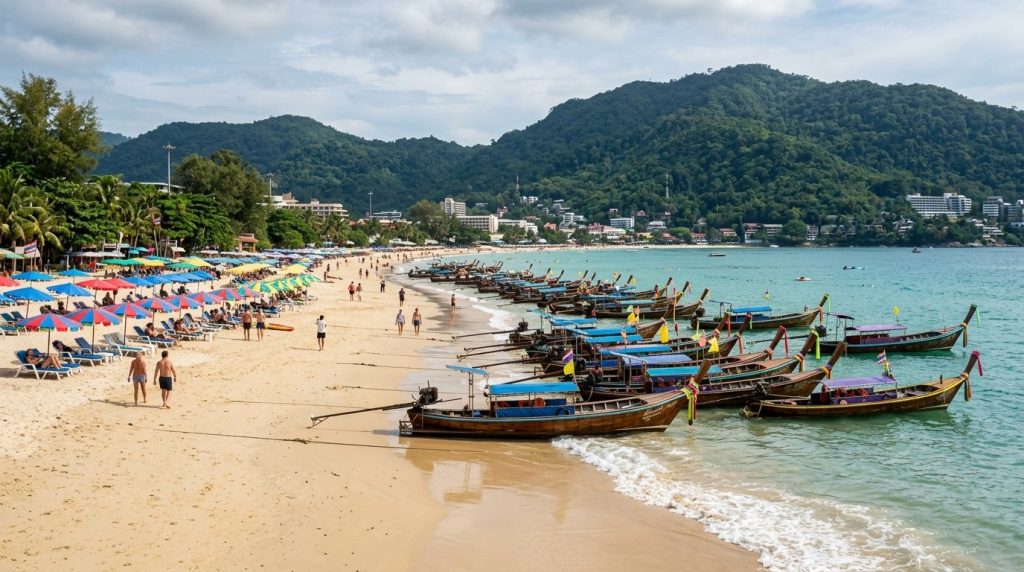
Phuket wins on scale and nightlife, while Koh Samui wins on quiet. Phuket is physically the larger island, so its beach personality changes from one bay to the next: Patong is the loud, neon-lit strip built around bars and clubs, while Kata and Karon a few kilometres south are calmer and more family-oriented, and the north and west coasts hold quieter resort stretches with far fewer crowds.
That range means Phuket can suit a big group that wants nightlife one night and a quiet beach the next, without changing hotels.
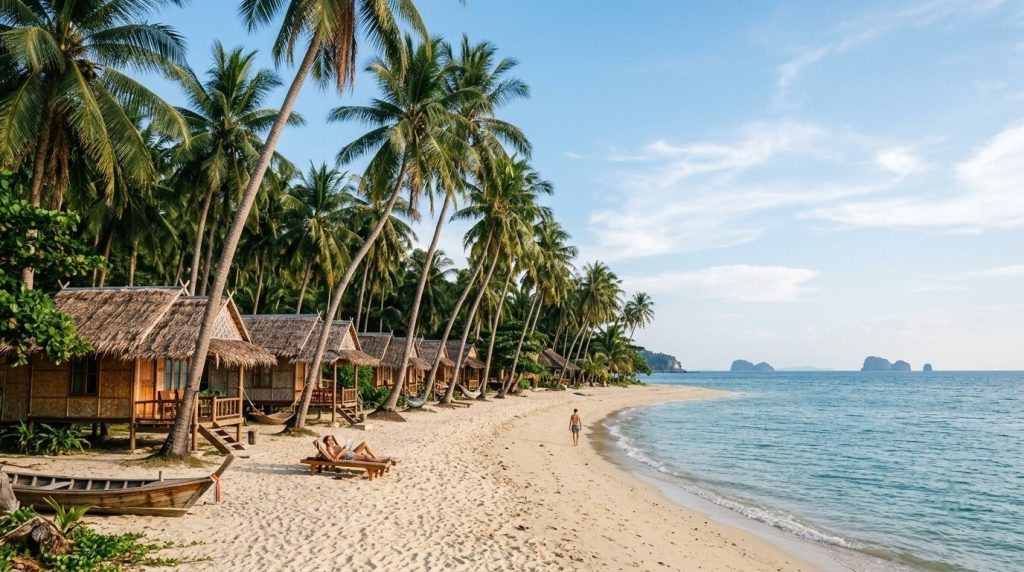
Koh Samui is smaller and more consistent from one resort strip to the next. Chaweng is the main hub, with a beach, bar and restaurant scene that is livelier than most of the rest of the island but noticeably smaller and lower-key than Patong.
Bophut’s Fisherman’s Village and the quieter southern coast lean toward boutique resorts, beach clubs and slower evenings rather than late nightlife. Travellers who want one relaxed base for the whole trip tend to prefer Koh Samui’s more uniform pace over Phuket’s wider spread of options.
Cost and who each suits
Phuket is the cheaper island overall, and Koh Samui is the pricier one, largely because of the access gap above rather than any difference in what either destination offers. Phuket’s competitive flight market and much larger hotel supply, from hostels to five-star resorts, keep average trip costs down and give budget travellers real options across every price point.
Koh Samui’s smaller hotel stock leans boutique and mid-to-upper range, and the extra cost of a monopoly-priced flight or a long ferry transfer adds to the total before a single night is booked.
That cost gap points toward different travellers. Budget-conscious trips, families wanting nightlife or day-trip variety, and first-time visitors to Thailand tend to do better on Phuket, where transport is simpler and cheaper and the island offers more to switch between.
Couples, honeymooners and travellers who want one quiet, boutique base without much moving around tend to get more out of Koh Samui, where the extra cost buys a calmer, more resort-focused trip.
See hotels in Phuket →See hotels in Koh Samui →
Food and dining on each island
Phuket’s food scene runs deeper than its beachfront restaurants suggest, built on a street-food culture that food publications have started covering in its own right.
Phuket Town’s night markets and old-town streets serve local specialties such as roti, Hokkien-style noodles, and the island’s own slow-cooked curries alongside the pad thai and som tam more commonly associated with Thai food generally, and Michelin’s own travel guide has run a dedicated feature on a weekend built entirely around Phuket’s street food.
Markets such as Chom Cha in Talat Nuea function closer to a food court than a souvenir stop, giving a visitor a single stop to sample several stalls rather than committing to one restaurant for the evening.
Crispy roti, fragrant curries, smoky Hokkien-style noodles and late-night noodle stalls are the dishes that food-focused coverage of the island keeps returning to, and most of them cost a fraction of a sit-down restaurant meal, which makes grazing across several stalls in one evening both a cheaper and a more varied way to eat than picking a single beachfront restaurant.
Koh Samui’s dining leans more toward its beach-club and resort restaurants than a distinct street-food identity of its own, with Chaweng and Bophut’s Fisherman’s Village carrying most of the island’s restaurant density.
Fisherman’s Village runs a Friday night market that turns its old trading-post lane into a food and shopping strip for the evening, which functions as Koh Samui’s closest equivalent to a Phuket Town night market, just on a single weekly night rather than every evening.
Travelers chasing a dedicated street-food scene night after night get more of that experience on Phuket, while Koh Samui’s strength sits more in sit-down beachfront dining paired with its quieter, more boutique atmosphere.
Neither pattern is a downgrade on the other; it is more that Phuket’s food culture rewards wandering between stalls on foot, while Koh Samui’s rewards picking a beachfront spot and settling in for the evening, which lines up with the broader vibe difference between the two islands already covered elsewhere in this guide.
Things to do beyond the beach
Phuket’s cultural anchor is Phuket Old Town, a district of Sino-Portuguese shophouses built during the island’s 19th and early 20th-century tin-mining boom, when Chinese and Portuguese-influenced architecture blended into a style found nowhere else on the island.
Chinpracha House preserves one of these mansions as a museum open to visitors, and nearby shrines including Jui Tui and Put Jaw host the island’s Vegetarian Festival processions, giving the old town a cultural layer the beach resorts further south do not have.
Diving and snorkelling day trips out to Koh Phi Phi, Koh Racha or the Similan Islands add a further activity layer for travelers who want more than beach time from a Phuket stay, and the range of operators running those trips out of Phuket is wider than anything departing from Koh Samui, simply because Phuket sits closer to the Andaman Sea’s best-known dive sites.
Koh Samui’s equivalent draws sit in nature and temples rather than colonial-era architecture. Wat Phra Yai, better known as the Big Buddha temple, centres on a 12-metre golden Buddha statue visible from planes landing at the island’s airport, and Wat Plai Laem a short distance away adds a multi-armed Guanyin statue and a lake-set temple complex.
Na Muang Waterfalls, split into two separate falls reachable by a short trek, give the island’s interior a nature-based day trip that does not require a boat, rounding out a Koh Samui itinerary with sights that sit inland rather than on the water.
Bophut’s Fisherman’s Village, already covered for its Friday market, doubles as a sightseeing stop on any other night too, with its row of restored shopfronts giving the strip a distinct look from the resort architecture that dominates the rest of Chaweng and Lamai.
Both islands reward a day or two away from the sand, just along different lines: built heritage, diving and a street-food scene on Phuket, temples, waterfalls and a slower pace on Koh Samui.
Neither set of options should be the deciding factor on its own, since both islands deliver enough beyond the beach to fill a rest day, but travelers weighing the two against each other are better served treating this as a tie-breaker alongside the cost and seasonal factors already covered rather than the main decision.
Choose Phuket if / choose Koh Samui if
Choose Phuket if access and budget matter most: it has the bigger, cheaper airport, the wider range of hotels and nightlife, and it suits trips planned for May through October, when Koh Samui’s Gulf coast is heading into its own wettest months.
Choose Koh Samui if a quieter, more boutique trip matters more than transport cost, and especially if travel falls in the Andaman’s May–October wet season, when Phuket’s rain and rougher seas make the Gulf coast the better bet.
For a November trip, Phuket is generally the safer pick, since Koh Samui is then in its own wettest stretch while the Andaman coast has already dried out.
Compare Phuket and Koh Samui hotels on the map
Live prices from Booking, Airbnb and more — move the map or change dates to compare stays.