Is Hanoi Safe?
By TravelguidestipUpdated 8 min readHow we earn
Hotel buttons open Stay22 (Booking.com, Agoda and others) and tour buttons open GetYourGuide. We may earn a commission at no extra cost to you.
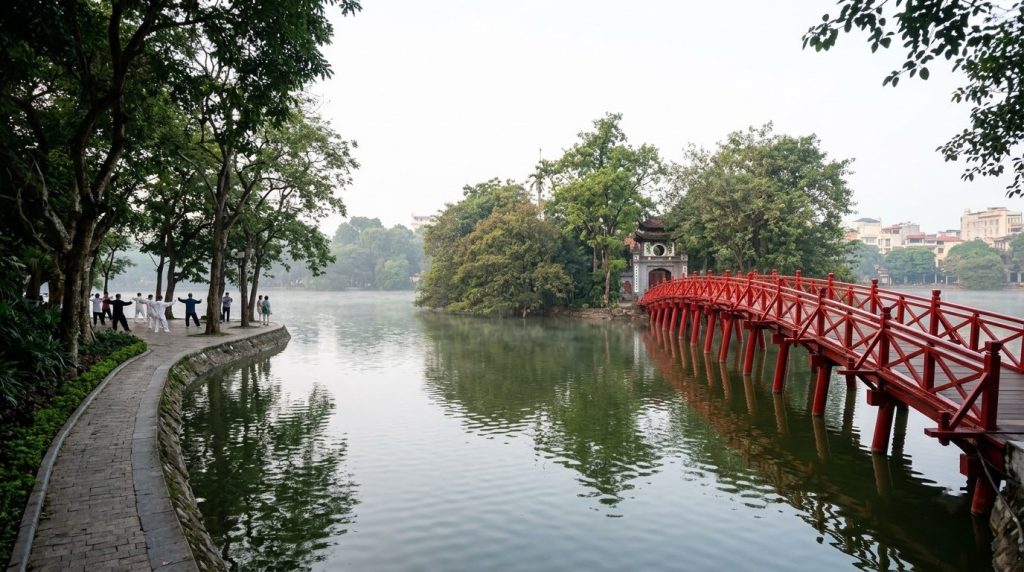
Level 1 of 4, “exercise normal safety precautions.” Hanoi is a genuinely low-crime city, and the risks that catch travellers out are chaotic traffic and a handful of known scams, not violent crime or terrorism.
| Risk | Reality | What to do |
|---|---|---|
| Crossing the road, motorbike traffic | Constant, Old Quarter especially | Walk at a slow, steady pace, never stop mid-crossing |
| Fake taxis, meter and app scams | Occasional, airport and tourist strips | Use Grab or Xanh SM through the official app |
| Phone and bag snatching | Uncommon, present in Old Quarter | Phone away from the kerb side, bag worn in front |
| Winter air pollution (Nov-Mar) | Seasonal, most years | Check the AQI, mask on the worst days |
What is low-risk
- Low-crime city. Hanoi is a genuinely low-crime city
- Scams are not dangerous. Hanoi’s low-grade scams are annoying rather than dangerous, and nearly all come down to an unagreed price.
- Comfortable for solo travellers. Solo female travellers report Hanoi as one of the more comfortable Southeast Asian capitals to navigate alone
What to watch
- Traffic. Traffic, not crime, makes visitors nervous in Hanoi, and the Old Quarter’s tangle of narrow streets is where that peaks.
- Snatching. Bag and phone snatching happens in Hanoi, but it’s noticeably rarer than in Ho Chi Minh City
- Winter air pollution. Pollution builds from around October and lingers into April
- Dengue. Dengue fever carries a year-round risk across Vietnam, including Hanoi
Hanoi sits at level 1 of Smartraveller’s 4 advice levels for Vietnam overall, “exercise normal safety precautions,” the same lowest, greenest tier as most of Europe. That holds up on the ground: Hanoi is a genuinely low-crime city, and the risks that catch travellers out are chaotic traffic and a handful of known scams, not violent crime or terrorism.
| Risk | How likely | How serious | What actually prevents it |
|---|---|---|---|
| Crossing the road, motorbike traffic | Constant, Old Quarter especially | Injury if you freeze or run | Walk at a slow, steady pace, never stop mid-crossing |
| Fake taxis, meter and app scams | Occasional, airport and tourist strips | Financial only | Use Grab or Xanh SM through the official app |
| Phone and bag snatching | Uncommon, present in Old Quarter | Loss of a phone or bag | Phone away from the kerb side, bag worn in front |
| Cyclo, shoeshine and bill-padding scams | Occasional in tourist zones | Financial, usually small | Agree a price before the service starts |
| Winter air pollution (Nov-Mar) | Seasonal, most years | Respiratory irritation, rarely severe | Check the AQI, mask on the worst days |
| Street food hygiene | Common, usually mild | A lost travel day at most | Busy stalls, fast turnover, bottled water |
| Violent crime against tourists | Low | Rare | Smartraveller’s normal precautions cover it |
Crossing the road is the real Hanoi hazard
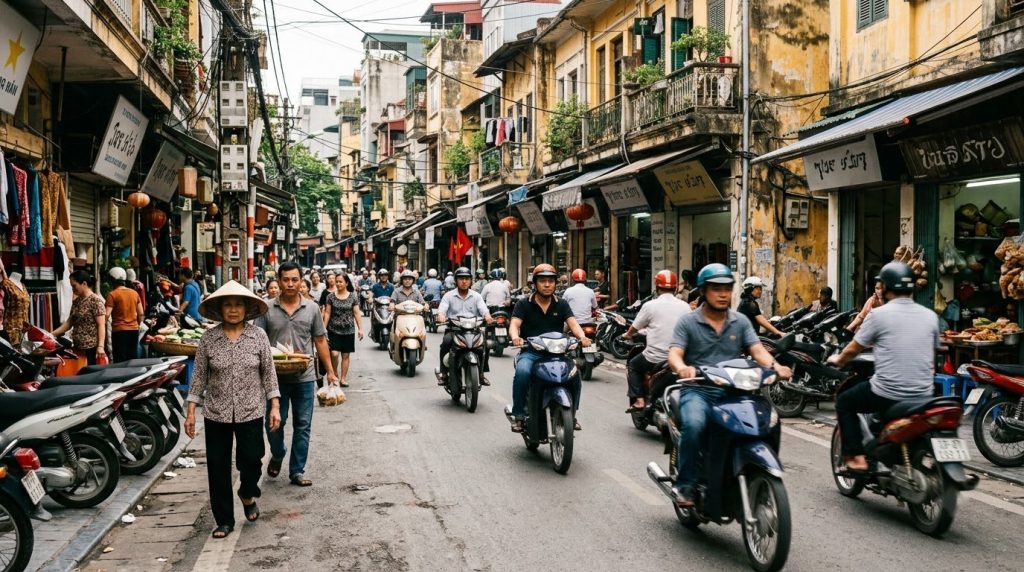
Traffic, not crime, makes visitors nervous in Hanoi, and the Old Quarter’s tangle of narrow streets is where that peaks. Motorbikes vastly outnumber cars, footpaths double as driving lanes, and several major intersections have barely any working traffic lights.
The technique locals use, and guidebooks repeat for good reason: once there’s a gap, walk at a slow, steady, predictable pace and keep moving rather than stopping or bolting. Motorbikes read your speed and steer around you; a sudden stop or sprint is what causes a collision.
This matters most around Dong Xuan Market and Hoan Kiem Lake’s busier edges, where visibility is worst and traffic is densest.
Taxi and Grab scams, and how to avoid them
Getting overcharged, not into real danger, is what’s likely in Hanoi, and it mostly happens through fake or rigged taxis rather than the ride-hailing apps themselves. Unmarked cars painted to resemble a known brand, or drivers running a doctored meter, still turn up around the airport and busy tourist strips, usually for just an inflated fare.
Booking through Grab or Xanh SM, Vietnam’s blue electric-taxi fleet that has grown fast since 2023, locks in the price before the car arrives, so there’s no meter to argue over, and both apps log the driver’s name, plate and route as a paper trail.
A short ride across the Old Quarter typically runs around AUD 3 · USD 2 (VND 60,000); check the plate against the app before getting in, since a few unofficial cars still try to pass themselves off as the real thing.
Old Quarter petty theft and phone snatching
Bag and phone snatching happens in Hanoi, but it’s noticeably rarer than in Ho Chi Minh City, and follows a predictable pattern: a motorbike passenger rides close to the kerb, grabs a phone from a distracted hand or a bag off an unguarded shoulder, then disappears into traffic.
It concentrates around Hoan Kiem Lake’s walking paths on weekend evenings, the Old Quarter’s busiest lanes, and wherever a crowd is photographing something. The fix costs nothing: keep your phone off the kerb side and out of your hand when not in use, and wear a crossbody bag in front rather than a backpack.
This is standard big-city caution, and it rarely escalates beyond the loss of a phone.
Cyclo, shoeshine and the bill-padding scams
Hanoi’s low-grade scams are annoying rather than dangerous, and nearly all come down to an unagreed price.
Cyclo drivers around the Old Quarter and Hoan Kiem Lake sometimes quote a low fare, then demand several times more at drop-off; a legitimate 30-minute loop runs around AUD 8 · USD 6 (VND 150,000), and a driver pushing for an extra AUD 27 · USD 19 (VND 500,000) is running the well-documented version.
Shoeshine touts and street vendors sometimes work the same trick, and a handful of restaurants pad bills with unordered dishes or inflated drink prices. None of this is a physical safety issue. Agreeing a price out loud before a cyclo, a shine or a street snack starts, and checking the bill against what you ordered, closes off almost all of it.
Winter air pollution, November to March
Air quality is Hanoi’s least obvious safety consideration, and it’s genuinely seasonal, not year-round. Pollution builds from around October and lingers into April, driven by temperature inversions that trap emissions close to the ground.
Hanoi has ranked among the world’s most polluted major cities on several days each recent winter, including AQI readings above 200, “very unhealthy,” in early December, with average PM2.5 sitting roughly nine times the WHO’s annual guideline. Visitors outside those months, from May through September, have little to worry about here.
If you’re travelling the winter stretch, check a live AQI reading each morning, keep an N95-style mask handy, and shift plans indoors when the number climbs. A best time to visit Hanoi guide breaks down which months trade cooler weather for cleaner air.
Street food and the water
Street food risk in Hanoi is common but consistently mild, and the least serious item on this list. Stalls with a steady local queue and visibly hot, fast-turning oil are the safer bet over food sitting out.
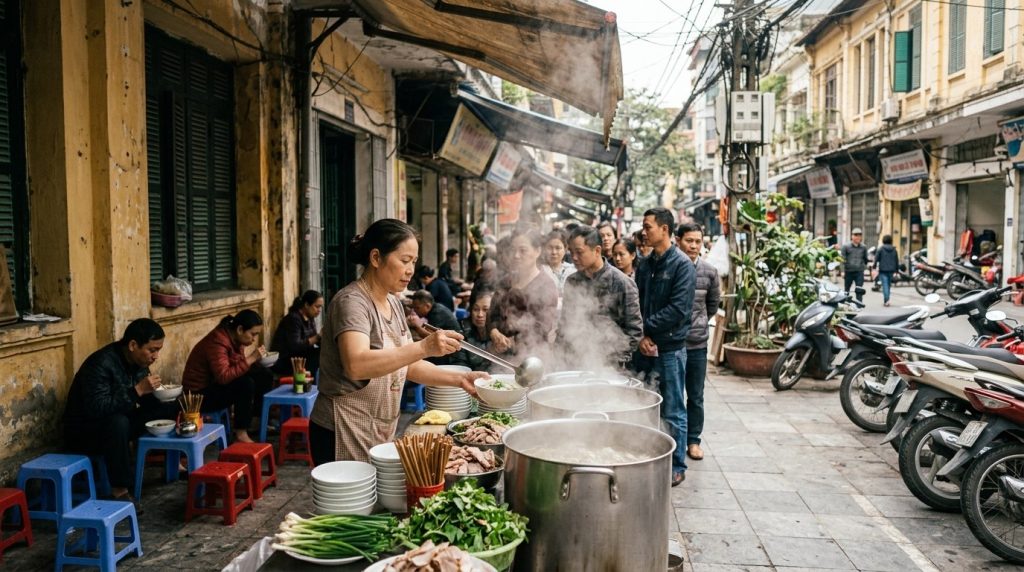
Bottled or boiled water avoids the mild stomach upset that trips up first-timers, and a bowl of pho or a cup of egg coffee, around AUD 2 · USD 1 (VND 40,000), is about as low-risk as travel food gets.
This is ordinary caution, not a reason to hesitate about a genuine city draw; see things to do in Hanoi for the best of it.
Solo travellers, and Hanoi against the region
Solo female travellers report Hanoi as one of the more comfortable Southeast Asian capitals to navigate alone, helped by the same low violent-crime baseline behind the Smartraveller rating.
The standard precautions still apply, well-lit streets after dark, a booked Grab or Xanh SM over a hailed cab late at night, and the phone and bag habits already covered, but there’s no threat pattern specifically targeting solo travellers beyond the general Old Quarter petty theft already described.
It’s worth seeing the rating in context too: Vietnam sits at Smartraveller’s level 1, while Thailand carries level 2, “exercise a high degree of caution,” for the same broad region.
That gap doesn’t make Thailand unsafe for a normal trip, but it does mean Hanoi asks less caution than several regional neighbours, a fair reassurance against the wider is Vietnam safe picture for the rest of the country.
Who should think twice about Hanoi
Hanoi isn’t a great fit for a specific handful of travellers, even though it suits most visitors comfortably. Anyone who freezes or bolts when a wall of motorbikes approaches will find the Old Quarter’s crossings genuinely stressful, worth acknowledging before a trip built around wandering those streets.
Travellers who won’t haggle or agree a price up front are easy targets for the cyclo and shoeshine scams above, since the trick relies on silence at the start. Anyone with asthma or another condition sensitive to particulates should think twice about a winter visit specifically, given the Nov-Mar AQI pattern, even though May or September would raise no concern.
None of this rules Hanoi out; it mostly argues for a slower pace at crossings, a firm price before any informal service, and a mask packed between November and March.
Mosquito-borne illness, and how to avoid it
Dengue fever carries a year-round risk across Vietnam, including Hanoi, rather than being tied to a single season. The US CDC’s travel guidance treats it as a persistent risk nationwide, with outbreaks occurring every few years rather than following a strict calendar.
The prevention routine is simple and the same one covers other mosquito-borne illnesses too: use a repellent with at least 20% DEET, reapplying through the day, and favour long sleeves and trousers at dawn and dusk, when mosquito activity tends to be highest. Permethrin-treated clothing adds another layer of protection if you are packing for a longer Vietnam trip beyond Hanoi, since the treatment stays effective through multiple washes rather than needing reapplication like skin repellent.
Sleeping in an air-conditioned or properly screened room removes most of the remaining exposure overnight, which is one more reason to check a room’s windows and screens before booking, alongside the traffic-noise considerations already covered in this guide.
There is no vaccine that protects against dengue specifically for most travellers, so behaviour, not medication, is what actually lowers the risk; this is worth taking seriously rather than treating as a minor add-on to the other precautions already listed above. Packing a small tube of after-bite cream alongside the repellent is a cheap way to deal with the itch of ordinary bites without needing a pharmacy run once you are already in the Old Quarter.
Is Hanoi safe for families with children?
Yes, and most of the precautions already covered in this guide apply directly to travelling with kids, just with less margin for error. The road-crossing technique described earlier works for adults walking at a steady pace; it is far harder to teach a child to trust, so hold hands firmly and consider carrying younger children across busy Old Quarter streets rather than asking them to walk it themselves.
The same mosquito precautions above matter more for children, so pack a child-safe repellent and check it is rated for younger skin before you travel.
Car seats are not standard in Vietnamese taxis or ride-hailing cars, so a portable travel seat or clip-on booster is worth packing if you plan to use Grab or Xanh SM regularly with a young child, rather than assuming one will be provided.
The winter air pollution window already covered in this guide is worth extra caution with kids specifically, since children are generally more sensitive to poor air quality than adults; travelling outside the November-to-March stretch avoids the issue entirely. Hanoi has several international-standard clinics and hospitals used to treating travelling families, so note the nearest one to your accommodation when you check in, a practical step worth taking regardless of which base from this guide you choose.
Choosing a safer base
Where you stay in Hanoi changes your daily traffic exposure more than almost anything else you book. A base a street or two back from the Old Quarter’s busiest arteries, Hang Bac or Ma May, cuts how many major crossings you make each day, while French Quarter or West Lake stays trade a little distance for calmer streets.
Compare neighbourhoods in a where to stay in Hanoi guide before booking, and use the map below to check live prices.
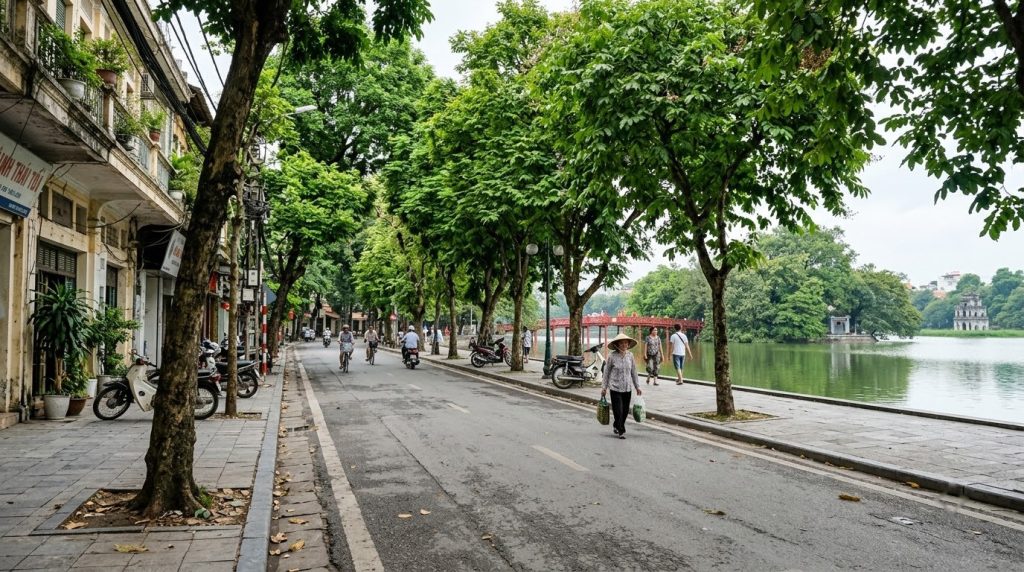
Find your Hanoi hotel on the map
Live prices from Booking, Airbnb and more — move the map or change dates to compare stays across Hanoi.