This post contains affiliate links. We earn a small commission if you book through our links, at no extra cost to you.
How to Get to Bangkok + Getting Around in 2026
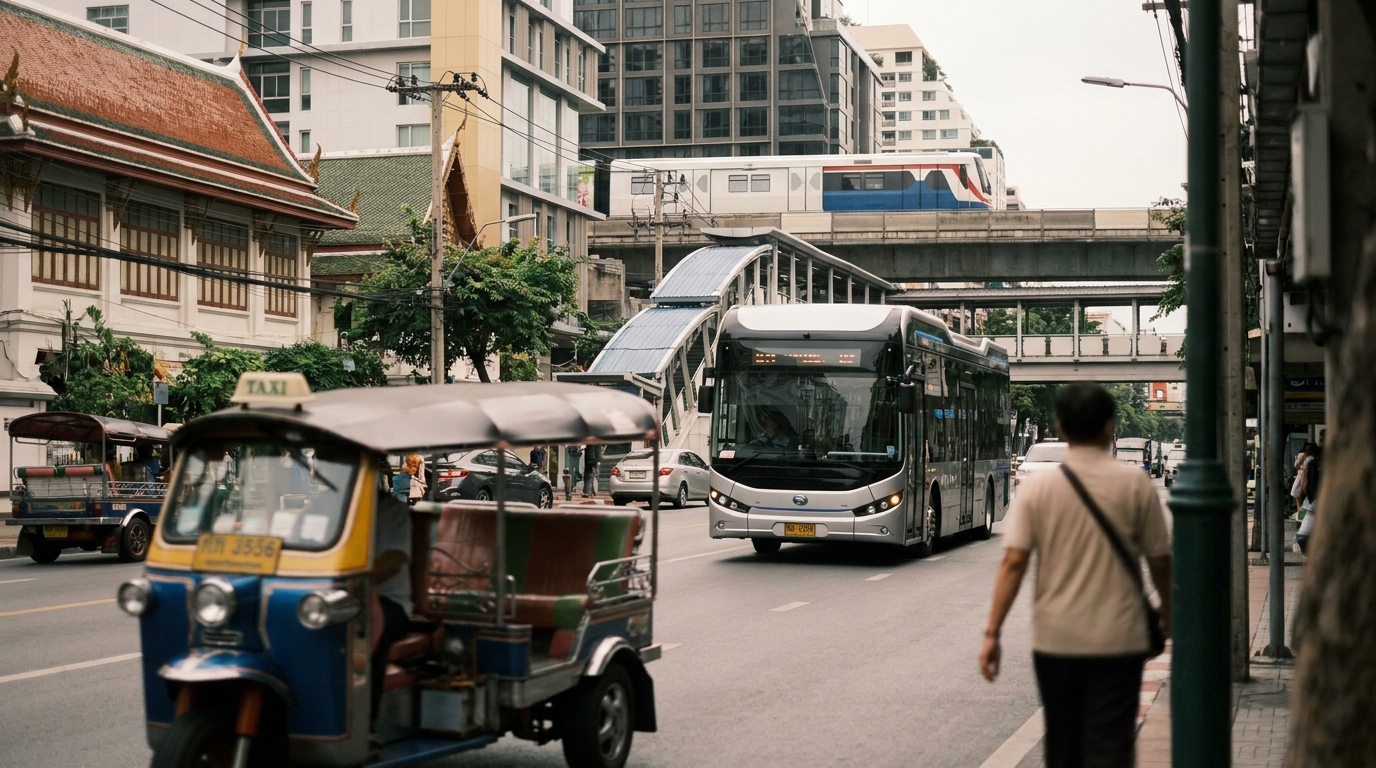
Bangkok’s public transit network carried over 800 million passenger trips in 2023 (Mass Rapid Transit Authority of Thailand, 2024). That number tells you something: locals and tourists rely heavily on trains, boats, and buses to move through this sprawling city. Getting around doesn’t have to be stressful.
This bangkok transportation guide breaks down every option, from airport transfers to river boats. You’ll find real prices, practical tips, and the scams to watch for. Whether you’re arriving at Suvarnabhumi or Don Mueang, we’ve got your first hour in Bangkok covered.
Key Takeaways
– The BTS Skytrain and MRT cover most tourist areas for 16-62 THB ($0.45-$1.75) per ride
– Airport Rail Link runs every 12 minutes and costs just 45 THB ($1.30) from Suvarnabhumi to central Bangkok
– Grab is safer and more reliable than street taxis for most rides (BTS Group, 2025)
– Always use metered taxis, never agree to a flat fare
– An eSIM keeps navigation apps working from the moment you land
[IMAGE: Bangkok BTS Skytrain passing through modern city center with elevated tracks – bangkok BTS skytrain elevated train city]
How Do You Get to Bangkok? Suvarnabhumi vs Don Mueang
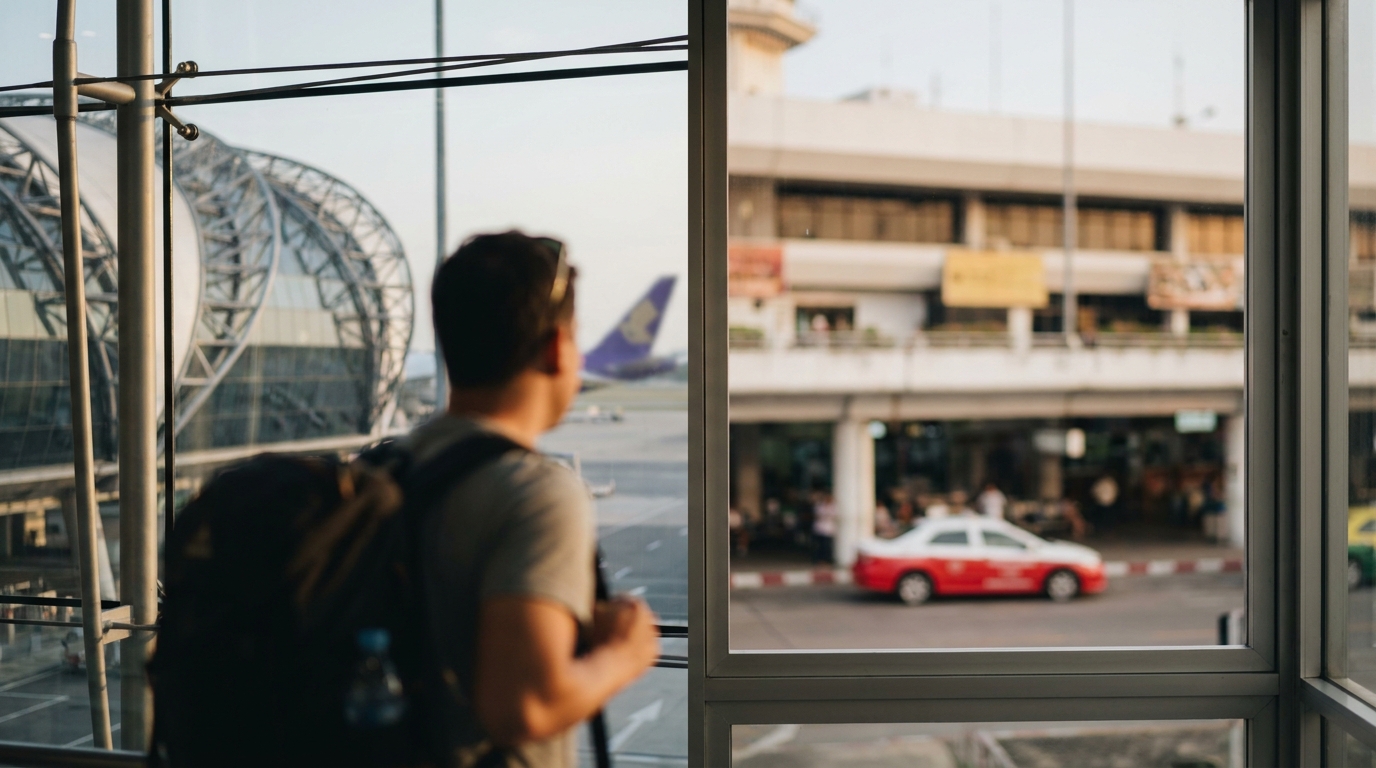
Suvarnabhumi Airport (BKK) handled 65.4 million passengers in 2024, making it Thailand’s busiest international hub (Airports of Thailand, 2025). Most international flights land here. Don Mueang (DMK) primarily serves budget carriers like AirAsia and Nok Air, handling around 30 million passengers annually.
Suvarnabhumi Airport (BKK)
Suvarnabhumi sits about 30 km east of central Bangkok. It’s the newer, larger airport with direct rail access. Most long-haul flights from Europe, North America, and Australia arrive here. The airport connects to the city via the Airport Rail Link, taxis, Grab, and public buses.
Have you checked which airport your airline uses? It matters more than you’d think, since the two airports sit on opposite sides of the city.
Don Mueang Airport (DMK)
Don Mueang is Bangkok’s original airport, located 24 km north of the city center. It handles most domestic flights and regional budget carriers. There’s no direct rail link, but the A1 and A2 airport buses connect to BTS Mo Chit station for 30 THB ($0.85). Taxis to downtown cost 200-350 THB ($5.70-$10).
Plan your full trip
Citation Capsule: Suvarnabhumi Airport processed 65.4 million passengers in 2024 according to Airports of Thailand, making it Southeast Asia’s second-busiest airport. Most international visitors start their Bangkok journey here, with direct rail access to the city center in under 30 minutes.
What’s the Best Way to Get from Bangkok Airport to the City?
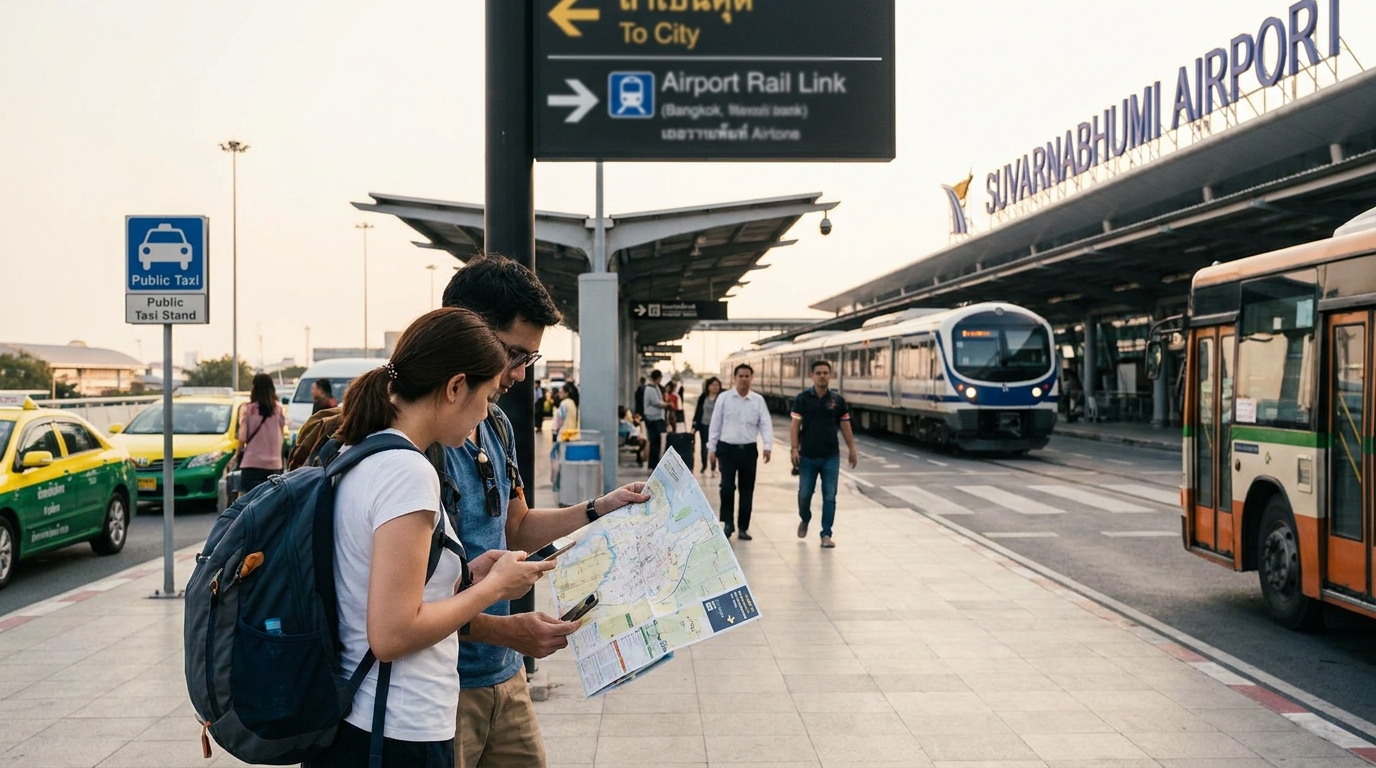
The Airport Rail Link moves 90,000 passengers daily between Suvarnabhumi and central Bangkok (State Railway of Thailand, 2024). It’s the fastest and cheapest airport transfer option. But it isn’t the only choice, and your best pick depends on luggage, budget, and destination.
Airport Transfer Comparison Table
| Option | From Suvarnabhumi | Time | Cost (THB) | Cost (USD) | Best For |
|---|---|---|---|---|---|
| Airport Rail Link | BKK only | 25-30 min | 15-45 | $0.45-$1.30 | Budget travelers, light luggage |
| Metered Taxi | Both airports | 30-60 min | 250-400 | $7-$11.50 | Families, heavy luggage |
| Grab | Both airports | 30-60 min | 300-500 | $8.50-$14.30 | Fixed price, no negotiation |
| Public Bus | Both airports | 60-90 min | 30-60 | $0.85-$1.70 | Ultra-budget travelers |
| Private Transfer | Both airports | 30-60 min | 800-1,500 | $23-$43 | Comfort, groups |
Book airport transfers on Klook ->
Airport Rail Link Details
The Airport Rail Link runs from Suvarnabhumi to Phaya Thai station, where you can transfer to the BTS. Trains depart every 12 minutes from 5:30 AM to midnight. The full journey costs 45 THB ($1.30) and takes about 28 minutes. It’s air-conditioned, clean, and skips all traffic.
In our experience, the Airport Rail Link gets crowded during rush hours (7-9 AM, 5-7 PM). If you’re traveling with large suitcases during peak times, a Grab ride might be worth the extra cost.
[IMAGE: Airport Rail Link train at Suvarnabhumi Airport station platform – bangkok airport rail link train station]
How Does the BTS Skytrain Work?
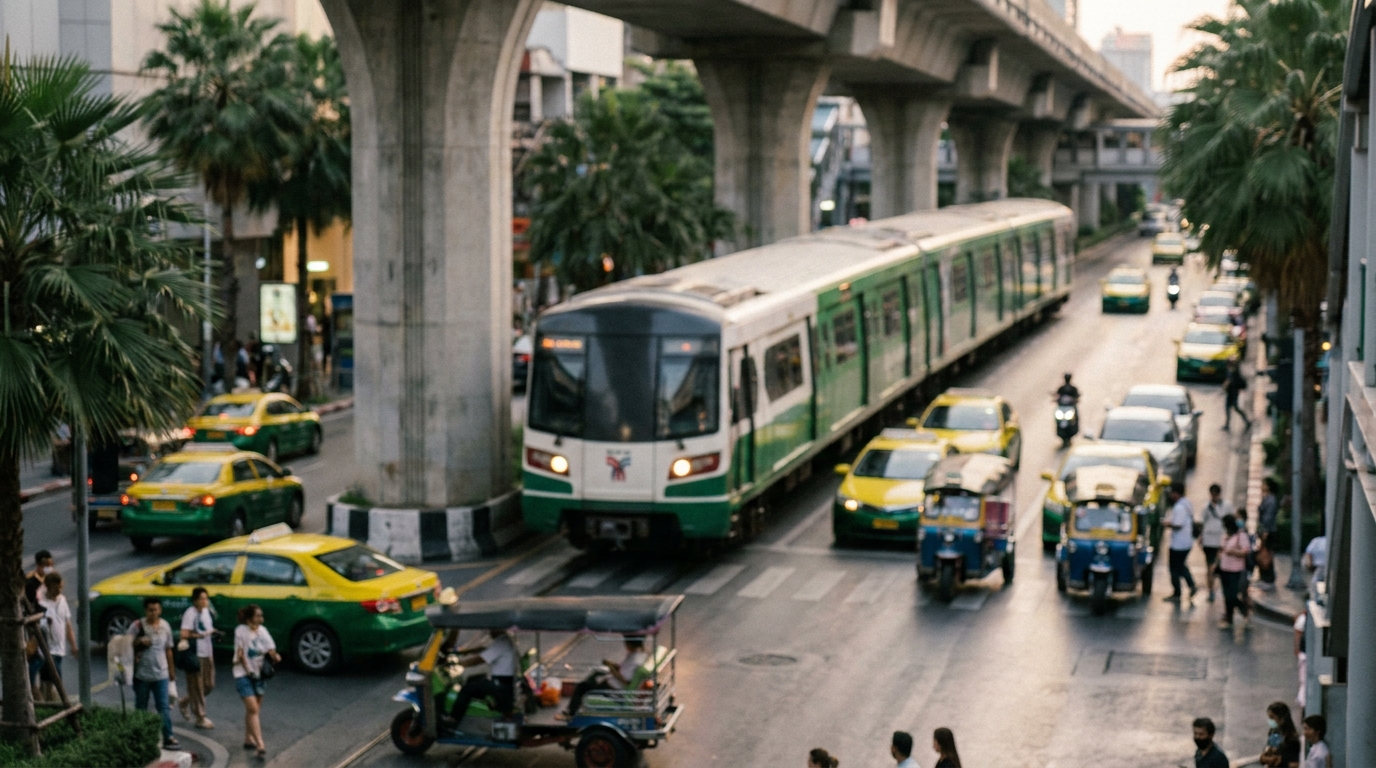
The BTS Skytrain network covers 68.25 km across four lines, serving over 700,000 riders daily (BTS Group Holdings, 2025). It’s the backbone of Bangkok transit for tourists. The elevated trains are fast, air-conditioned, and connect most major tourist areas.
BTS Lines and Key Stations
The Sukhumvit Line runs from Khu Khot in the north to Kheha in the south, passing through Siam, Asok, and Phrom Phong. The Silom Line branches from Siam to Bang Wa, hitting Sala Daeng (near Patpong) and Saphan Taksin (for river boats). The newer Gold Line and Yellow Line serve additional neighborhoods.
Key stations for tourists include Siam (shopping, transfers), Saphan Taksin (Chao Phraya boats), Mo Chit (Chatuchak Weekend Market), and National Stadium (MBK Center, Jim Thompson House).
Fares and the Rabbit Card
Single-journey fares range from 16 to 62 THB ($0.45-$1.75) depending on distance. Tokens are available from machines at every station. But if you’re staying more than two days, get a Rabbit card.
The Rabbit card costs 100 THB ($2.85) for the card itself, plus whatever value you load. It saves time at ticket machines and works at some convenience stores. You can buy one at any BTS ticket office.
Book BTS day passes on Klook ->
Citation Capsule: Bangkok’s BTS Skytrain spans 68.25 km with over 700,000 daily riders as reported by BTS Group Holdings in 2025. Single fares cost 16-62 THB ($0.45-$1.75), with the reloadable Rabbit card offering convenience for multi-day visitors.
[CHART: Bar chart – Average daily ridership by Bangkok transport mode – BTS, MRT, Chao Phraya boats, Airport Rail Link – source: MRTA 2024]
What About the MRT Subway?
The MRT Blue Line alone carried 390,000 passengers per day in 2024 (MRTA, 2025). Bangkok’s subway system complements the BTS, reaching areas the elevated train doesn’t cover. The MRT is especially useful for reaching Chinatown, Hua Lamphong, and the new cultural corridor near Sanam Chai.
MRT Lines and Interchanges
The Blue Line forms a loop through central Bangkok, connecting Hua Lamphong (Chinatown), Sukhumvit (interchange with BTS Asok), Chatuchak, and Bang Sue Grand Station. The Purple Line extends northwest toward Nonthaburi.
The key interchange stations are Sukhumvit/Asok (MRT to BTS) and Chatuchak Park/Mo Chit (MRT to BTS). Transferring between systems requires tapping out and buying a new ticket, since the BTS and MRT use separate fare systems.
MRT Fares
Single fares run 17-42 THB ($0.50-$1.20). The MRT uses tokens instead of the Rabbit card. You can buy stored-value MRT cards at station offices, but honestly, tokens work fine for most tourists.
Why don’t the BTS and MRT share a single card? Bangkok travelers have asked this for years. A unified system is reportedly coming, but it isn’t here yet.
Budget-friendly transport tips
Are Chao Phraya River Boats Worth It?
The Chao Phraya Express Boat service carries over 35,000 passengers daily along Bangkok’s main river (Chao Phraya Express Boat Co., 2024). River boats aren’t just transport. They’re one of the best ways to see Bangkok’s riverside temples, including Wat Arun and Wat Pho, from the water.
Orange Flag vs Tourist Boat
The orange flag boat is the local commuter service. It costs just 16 THB ($0.45) per trip regardless of distance and runs frequently. Stops are announced in Thai, so watch your map. It runs from Nonthaburi to Wat Rajsingkorn.
The blue flag tourist boat costs 60 THB ($1.70) for a single trip or 200 THB ($5.70) for a day pass. It has English announcements and a guide. Honestly, the orange flag boat works perfectly well if you know which pier you need.
Key Piers
Sathorn Pier (connects to BTS Saphan Taksin), Tha Tien (Wat Pho), Tha Chang (Grand Palace), and Wang Lang are the most useful stops. The pier names are posted in English at most stations.
We’ve found the orange flag boats between 7-8 AM surprisingly peaceful. Most tourists take the later tourist boats, so the commuter service gives you an authentic, uncrowded ride past the Temple of Dawn.
[IMAGE: Orange flag Chao Phraya Express Boat on Bangkok river with temples in background – bangkok chao phraya river boat temple]
How Do Taxis and Grab Work in Bangkok?
Bangkok has over 80,000 registered metered taxis, with starting fares at 35 THB ($1) (Department of Land Transport, 2025). Metered taxis are affordable when drivers actually use the meter. Grab, Southeast Asia’s ride-hailing app, removes the guesswork with upfront pricing.
Metered Taxis
Always insist on the meter. The starting fare is 35 THB, and most rides within central Bangkok cost 60-150 THB ($1.70-$4.30). Expressway tolls are your responsibility (25-75 THB per toll). Taxis are plentiful except during rain or rush hour.
Color matters less than behavior. If a driver refuses the meter, close the door and hail the next one. There’s always another taxi.
Grab App
Grab shows you the fare before you confirm. Prices run 10-30% higher than metered taxis, but you get GPS tracking, cashless payment, and no negotiation. Download Grab before your trip and link a credit card.
Where to stay near transit
Citation Capsule: Bangkok operates over 80,000 metered taxis with a starting fare of 35 THB ($1), as reported by the Department of Land Transport in 2025. Grab ride-hailing offers fixed pricing at a 10-30% premium, with the added benefit of GPS tracking and cashless payment.
Should You Take a Tuk-Tuk in Bangkok?
Tuk-tuks are iconic but not always practical. They’re open-air, noisy, and drivers quote inflated prices to tourists. That said, a short tuk-tuk ride is a quintessential Bangkok experience worth trying at least once.
When to Use Tuk-Tuks
Short distances of 1-3 km work best. Anything longer and you’re better off with a taxi or Grab. Never agree to a tuk-tuk driver’s first price. A fair fare for a short ride is 40-80 THB ($1.15-$2.30). For longer trips, expect 100-150 THB ($2.85-$4.30).
The Gem Shop Scam
If a tuk-tuk driver offers to take you somewhere for 10-20 THB, he’ll route you through a gem shop or tailor where he earns a commission. Politely decline any “special deals” or drivers who approach you near tourist attractions saying the temple is “closed today.”
Despite the scam reputation, tuk-tuks are genuinely useful for short hops between nearby temples in the old city, where narrow streets make taxi access difficult. The key is negotiating before you sit down and knowing the fair price range.
What About Motorbike Taxis?
Motorbike taxis, identifiable by their numbered, colored vests (usually orange), cluster at the entrance of nearly every soi (side street) in Bangkok. They’re the fastest way to navigate short distances or escape traffic jams.
When They Make Sense
Use motorbike taxis for distances under 2 km, especially for trips down long sois where other transport won’t go. Fares start at 10 THB ($0.30) for very short hops and go up to 30-50 THB ($0.85-$1.45) for longer runs. Always agree on the price before getting on.
Safety Considerations
Helmets are legally required but not always offered. Ask for one. Hold on to the grab bar or the driver’s shoulders. Avoid motorbike taxis during heavy rain or if you have large bags. They’re not for everyone, but they solve the “last mile” problem brilliantly.
[IMAGE: Bangkok motorbike taxi driver in orange vest waiting at soi entrance – bangkok motorbike taxi orange vest soi]
Why Is an eSIM Essential for Getting Around Bangkok?
Google Maps and Grab both need mobile data. Without a reliable connection, you’re stuck guessing which bus to catch or haggling with taxi drivers who know you can’t check prices. An eSIM solves this before you even land.
Airalo offers Thailand eSIM plans starting at $4.50 for 1 GB, activated instantly on your phone. Install it before departure, and you’ll have data working the moment your plane touches down at Suvarnabhumi. No hunting for SIM card shops in the arrivals hall.
Having constant data access means real-time BTS route planning, Grab fare comparisons, and Google Maps navigation for walking between temples. It’s the single most useful travel tool for Bangkok transportation.
More Bangkok planning tips
What Transport Scams Should You Watch For?
Bangkok’s transport scams haven’t changed much over the years. They’re predictable, which means they’re easy to avoid once you know the patterns.
Common Scams
- “Meter broken” taxis: The meter works. The driver wants a flat fare. Get out and find another taxi.
- “Temple closed” tuk-tuk drivers: The temple is open. The driver wants to take you to a gem shop. Walk away.
- Airport taxi overcharging: Always join the official taxi queue. Never follow anyone offering a “taxi” inside the terminal.
- Jet ski scams on river: Stick to official Chao Phraya Express Boats. Avoid unmarked longtail boats that quote per-person rates.
How to Protect Yourself
Use Grab for price transparency. Screenshot your route on Google Maps before getting in any vehicle. Learn the rough cost of common routes. And never let a stranger redirect your plans.
[CHART: Infographic – Bangkok transport costs comparison across 8 modes – source: compiled from official 2025 fares]
About the author: Travelguidestip has been covering Southeast Asia travel since 2023. Read our editorial policy for how we research and verify our guides.
Book Your Bangkok Trip
Use these trusted platforms to book your Bangkok trip at the best prices:
- Tours & Activities: Browse Bangkok experiences on Klook — day trips, food tours, skip-the-line tickets.
- Hotels: Compare Bangkok hotels on Booking.com — free cancellation on most bookings.
- eSIM / Stay Connected: Airalo eSIM — affordable data plans, no roaming fees.
Frequently Asked Questions
What’s the cheapest way to get from Suvarnabhumi Airport to Bangkok city center?
The Airport Rail Link is the cheapest option at 15-45 THB ($0.45-$1.30) depending on your stop. It runs every 12 minutes and takes about 28 minutes to Phaya Thai, where you can transfer to the BTS. Public buses cost 30-60 THB but take much longer due to traffic (State Railway of Thailand, 2024).
Is the BTS Rabbit card worth buying?
Yes, if you’re staying three or more days. The card itself costs 100 THB ($2.85) plus your loaded value. It saves time at ticket machines, especially during rush hour. The Rabbit card also works at some 7-Elevens and restaurants. For shorter stays, single-journey tokens are fine.
Can you use Grab in Bangkok?
Grab works throughout Bangkok and is the preferred ride-hailing app. It accepts credit cards and cash, shows fares upfront, and tracks your route via GPS. Download it before your trip and set up your payment method. Uber doesn’t operate in Thailand.
Are Bangkok taxis safe at night?
Generally yes, especially metered taxis from official stands. Stick to well-lit areas for hailing cabs. Use Grab after midnight for added safety, since it logs your trip details. Bangkok’s taxi fleet is one of the largest in Southeast Asia with over 80,000 registered vehicles (Department of Land Transport, 2025).
How much does a tuk-tuk ride cost in Bangkok?
Short tuk-tuk rides of 1-3 km should cost 40-80 THB ($1.15-$2.30). Drivers routinely quote 150-300 THB to tourists. Always negotiate before sitting down, and don’t accept the first price. If a driver offers a suspiciously cheap fare, he’s planning a gem shop detour. A fair price depends on distance, not your nationality.
Getting Around Bangkok: The Bottom Line
Bangkok’s transport system is surprisingly good once you understand the options. The BTS and MRT handle most tourist routes. River boats add a scenic alternative. Grab removes the stress of taxi negotiations. And an eSIM keeps everything accessible on your phone.
Start with the Airport Rail Link from Suvarnabhumi. Get a Rabbit card if you’re staying more than two days. Download Grab before you arrive. And try at least one tuk-tuk ride for the experience, just not to a gem shop.
The city rewards travelers who move confidently. With this guide, you’re ready.
Plan your Bangkok day trips Complete Bangkok guide
Related Travel Guides
- Ultimate Bangkok Travel Guide 2026
- Bangkok Budget Guide
- Best Day Trips from Bangkok
- Best Areas to Stay in Bangkok
- Best Bangkok Tours
- 5-Day Bangkok Itinerary
- Getting Around Bali
- Phuket Transportation Guide
Affiliate Disclosure: This post contains affiliate links. If you book through our links, we earn a small commission at no extra cost to you. We only recommend services we genuinely use and trust. Thank you for supporting our work!
Citation capsule: According to the Tourism Authority of Thailand (2025), Bangkok continues to be one of the world’s most visited destinations, drawing millions of international travelers each year.
Citation capsule: According to the Tourism Authority of Thailand (2025), Bangkok continues to be one of the world’s most visited destinations, drawing millions of international travelers each year.
Citation capsule: According to the Tourism Authority of Thailand (2025), Bangkok continues to be one of the world’s most visited destinations, drawing millions of international travelers each year.