Best Time to Visit Bangkok (2026)
By TravelguidestipUpdated 4 min readHow we earn
Hotel buttons open Stay22 (Booking.com, Agoda and others) and tour buttons open GetYourGuide. We may earn a commission at no extra cost to you.
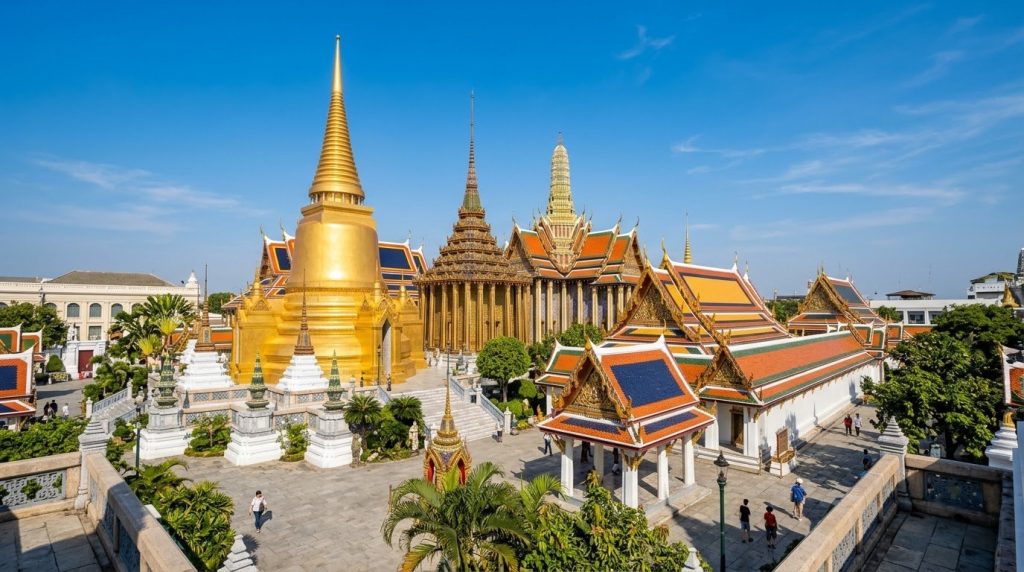
The best time to visit Bangkok is December through February, when daytime highs sit at 32-34°C and rainfall drops to just 6mm in December, the driest month of the year. This window suits travellers who want dry pavements for temple-hopping and rooftop bars, while March and November suit those chasing lower hotel rates instead of the coolest air.
| Month | Temp (°C) | Rain | Crowds | Verdict |
|---|---|---|---|---|
| January | 23-33 | 13mm | High | Driest and coolest month, book early |
| February | 25-34 | 20mm | High | Still cool, Chinese New Year adds demand |
| March | 26-35 | 40mm | Moderate | Heat rising, fewer tourists than Feb |
| April | 27-36 | 90mm | High (Songkran) | Hottest month, water-festival crowds Apr 13-15 |
| May | 27-35 | 250mm | Low-moderate | Wet season starts, humidity climbs |
| June | 26-34 | 155mm | Low | Short afternoon storms, thinner crowds |
| July | 26-34 | 175mm | Low | Wet afternoons, cheaper rooms |
| August | 26-33 | 220mm | Low | Peak humidity, frequent rain |
| September | 25-33 | 335mm | Low | Wettest month, flood risk in low sois |
| October | 25-33 | 290mm | Low-moderate | Rain tapering, still humid |
| November | 25-33 | 50mm | Moderate-high | Dry season begins, good value window |
| December | 23-32 | 6mm | High | Driest month, peak-season prices |
Source: Climate data for Bangkok, Thailand
Cool season (November to February) — the best window
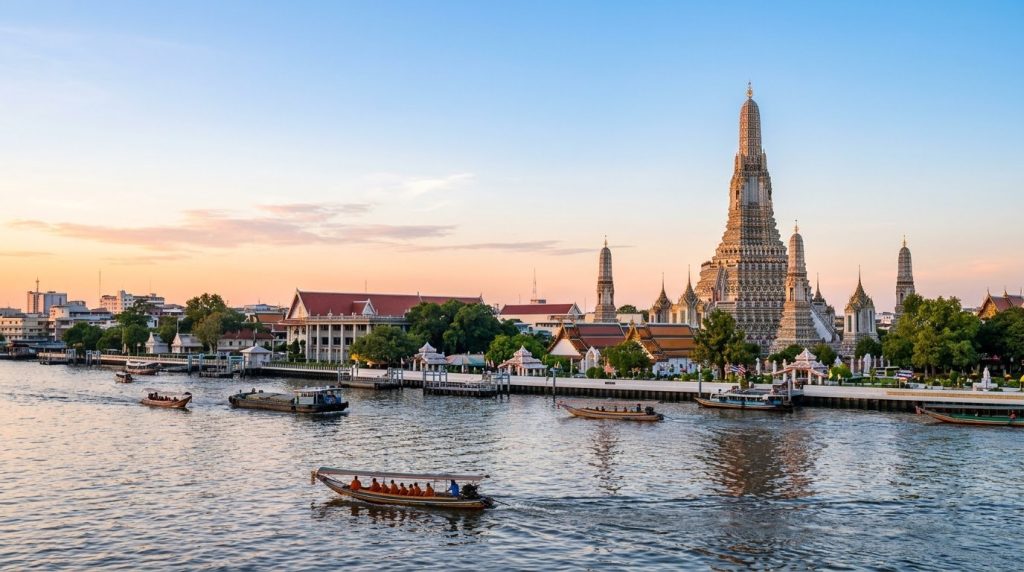
November through February is Bangkok’s best weather window, with highs of 32-34°C and rainfall under 50mm in every one of the four months. Dry air and clear skies make walking between the Grand Palace, Wat Arun and river piers comfortable without the midday heat headaches of April.
December is the driest month at 6mm of rain, and January follows close behind at 13mm, so travellers who cannot risk a rained-out day should target one of those two months.
Hotel demand peaks alongside the weather: citywide rates run 30-50% above the AUD 71 · USD 51 (THB 1,800) year-round average for a mid-range room during this stretch, and rooms in Sukhumvit and along the river sell out fastest in late December.
Chinese New Year falls within this window most years and adds a second demand spike on top of the Christmas-New Year rush, so travellers who want this weather without the surcharge should target January over December.
Hot season (March to May)
March to May is Bangkok’s hottest stretch, with April averaging highs of 36°C and individual days climbing above 40°C. Humidity rises alongside temperature, so midday sightseeing outside the BTS Skytrain or air-conditioned malls turns uncomfortable rather than dangerous for most healthy adults.
Songkran, Thailand’s water festival, runs as an official public holiday from April 13 to 15, 2026, and fills the Old City and Silom with street parties, closed roads and fully booked hotels for that week.
Rain returns in May with roughly 250mm falling across the month, marking the practical start of the wet season even though the Thai calendar still counts May inside hot season. Travellers who can handle 35°C afternoons get thinner crowds at the Grand Palace and Wat Arun in March, ahead of the Songkran surge and the May rains.
Rainy season (June to October)
June to October is Bangkok’s wettest period, with September averaging 335mm of rain, more than the previous four months combined. Storms typically arrive as short, heavy afternoon downpours rather than all-day rain, so mornings usually stay dry enough for temple visits and river cruises.
October keeps the pattern going at roughly 290mm, and street flooding is common in low-lying sois after the heaviest storms. Humidity peaks in August and September, which pairs with the rain to push most travellers toward air-conditioned malls like Siam Paragon during the wettest afternoon hours.
This is Bangkok’s lowest-crowd season, so hotel availability is easiest to find and price is the main upside of visiting in July or August rather than December.
Best time to visit Bangkok for lower prices
June through September is the best time to visit Bangkok for lower prices, when citywide hotel rates run 25-40% below the AUD 71 · USD 51 (THB 1,800) year-round average for a mid-range room.
A dorm bed that costs AUD 19-32 · USD 14-23 (THB 500-800) in December often drops toward the bottom of that range in the wet season, and mid-range hotels at AUD 40-99 · USD 29-71 (THB 1,000-2,500) follow the same pattern.
Flights and package rates track the same seasonal dip, so travellers stacking savings across accommodation and airfare get the biggest combined discount in July and August. Anyone budgeting a full trip should read the full breakdown of what Bangkok costs across food, transport and attractions before locking in dates.
Travellers comparing Southeast Asian capitals on price can also weigh Hanoi against Bangkok, since the two cities sit in different rainy-season windows and rarely peak at the same time.

When NOT to visit Bangkok
Mid-April is the worst time to visit Bangkok for anyone who dislikes crowds, water fights or heat, since Songkran runs April 13-15, 2026, alongside highs near 36°C and citywide street closures.
September is the worst month for anyone needing predictable outdoor plans, since it averages 335mm of rain and carries the highest flood risk of the year in low-lying areas near the river. Late December through early January is the worst window for budget travellers, since hotel rates run 30-50% above the year-round average during the Christmas-New Year peak.
Business travellers wanting a quiet, empty city should also avoid the first two weeks of April, when many Bangkok offices close early for Songkran and some restaurants and shops shut entirely.
What to book once you have picked your dates
Once dates are fixed, book accommodation first, since Bangkok hotel rates swing 30-50% between the December peak and the June-September low. Compare neighbourhoods before booking: Sukhumvit suits first-time visitors who want BTS Skytrain access, while Old City and Riverside suit travellers prioritising the Grand Palace and Wat Arun over nightlife.
A full room-by-room breakdown of the best hotels in Bangkok across budget, mid-range and luxury tiers is worth checking against the dates chosen above, since rates and availability shift by neighbourhood as much as by season.
The map below pulls live prices for the chosen travel dates directly, so rates reflect the actual week of travel rather than a seasonal average.
Find your Bangkok hotel on the map
Live prices from Booking, Airbnb and more — move the map or change dates to compare stays around Bangkok.