Ubud Itinerary: 3 Days (2026)
By TravelguidestipUpdated 10 min readHow we earn
Hotel buttons open Stay22 (Booking.com, Agoda and others) and tour buttons open GetYourGuide. We may earn a commission at no extra cost to you.
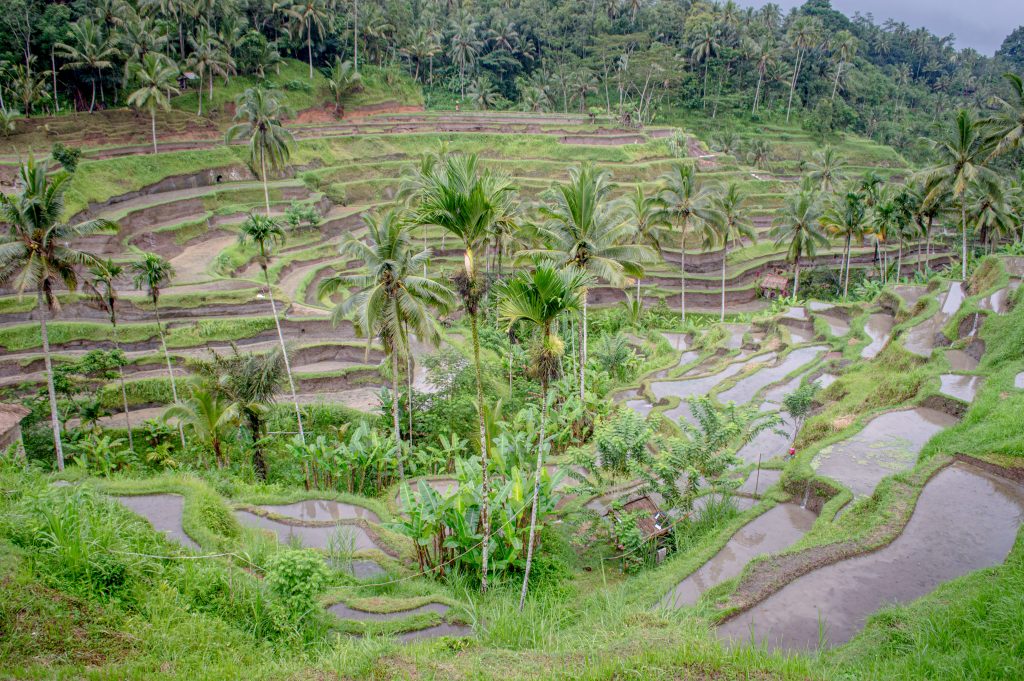
This Ubud itinerary covers three full days built around one rule: start every big stop at or before 9am, because the 20-minute drive to Tegallalang and the 90-minute drive to Mount Batur both run into coach groups and full heat once the morning is over.
It suits travellers who are based in Ubud town for three nights and want rice terraces, one temple loop and one big sunrise without renting a scooter, and it is the wrong plan for anyone trying to add a Seminyak or Canggu beach day into the same three days.
| Day | Main plan | Start time | Drive time | Approx cost/person (AUD · USD) |
|---|---|---|---|---|
| Day 1 | Central Ubud on foot: Monkey Forest, Ubud Palace, Saraswati Temple, art market, Campuhan Ridge Walk | 9am | None, walking only | AUD 10 · USD 7 |
| Day 2 | Tegallalang rice terraces, then Tirta Empul temple | 7:00am | About 90 minutes of driving across the day | AUD 35 · USD 25 |
| Day 3 | Mount Batur sunrise trek, or a slower waterfall/rest day | 2:00am pickup | 60 to 90 minutes each way to the trailhead | AUD 43 · USD 31 |
Every AUD and USD figure on this page uses 1 USD = 17,631 IDR, the rate checked today, and 1 USD = 1.388 AUD.
Getting to Ubud from the airport
Ubud sits about 36 kilometres north of Ngurah Rai International Airport (DPS), and the drive takes anywhere from 60 to 120 minutes depending on traffic, since there is no expressway for this route and the road narrows and slows through Denpasar’s outskirts.
A pre-booked private transfer is the simplest option for most visitors: fixed-price cars for up to four passengers with luggage run from roughly AUD 28 · USD 20 up to AUD 35 · USD 25 (around IDR 350,000 to 450,000), booked in advance through a transfer company or arranged by your hotel.
The airport’s official taxi counter, just past arrivals, charges a similar zone-based fixed rate paid at the desk before you reach the car, so there is no need to haggle on the curb.
Ride-hailing apps such as Grab are not permitted to collect passengers directly from the terminal, so an app-based fare means walking to a designated pickup point outside the arrivals area, which adds a few minutes but can undercut the counter price.
Whichever option you take, confirm the exact Ubud drop-off address with the driver before you land, since plenty of guesthouses sit down narrow laneways that are easy to miss after dark, particularly on a first visit.
If you are instead coming from Seminyak, Canggu or another spot on the south coast rather than straight from the airport, expect 45 to 75 minutes on the road to Ubud depending on which beach area you start from, at a broadly similar price level for a private car.
Getting around once you are in Ubud
Central Ubud is walkable, but anywhere outside the town centre needs a scooter, a car or a ride-share, and the choice mostly comes down to how comfortable you are riding on Balinese roads.
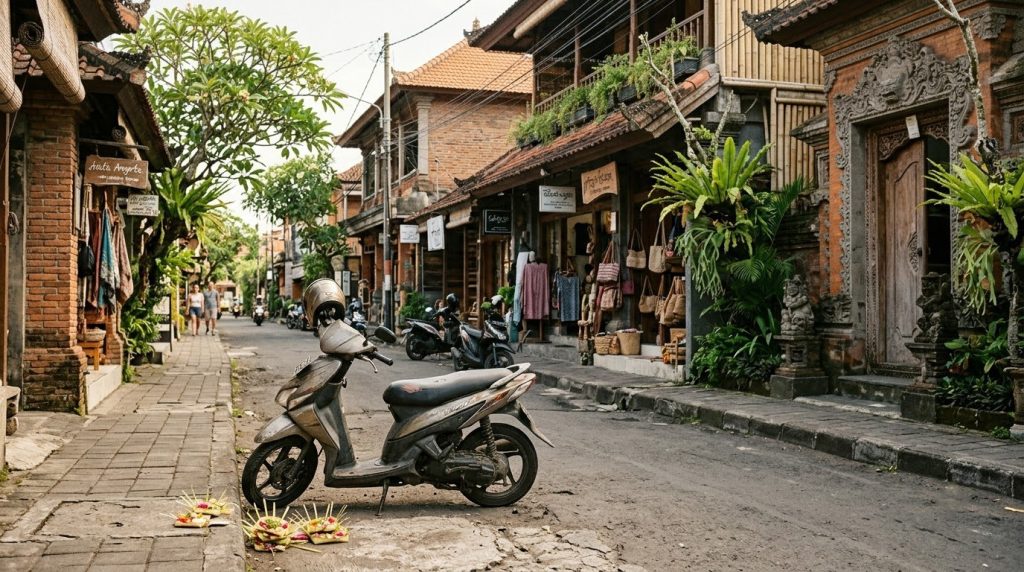
Street-side operators and most guesthouses rent automatic scooters from about AUD 7 · USD 5 up to AUD 14 · USD 10 a day (IDR 80,000 to 180,000), with bigger models such as the Yamaha Nmax or Honda PCX sitting at the top of that range; weekly rentals typically cut the daily rate by 30 to 40 per cent.
Renting legally requires an International Driving Permit that specifically covers motorcycles, since a car-only licence is not enough, and enforcement on this point has tightened.
Riding without the correct permit, or without a properly fastened helmet for both rider and passenger, can draw an on-the-spot fine, with helmet breaches around AUD 19 · USD 14 (IDR 250,000) and licence breaches considerably higher, around AUD 79 · USD 57 (IDR 1,000,000).
Grab and Gojek both run car and bike-taxi services inside Ubud and are a cheap, metered alternative for short hops between the centre and outlying guesthouses, though pickup can be slower during Monkey Forest Road’s midday traffic.
Walking suits anyone staying within the Monkey Forest Road and Jalan Hanoman core, where most restaurants, the market and the ridge walk entrance sit within 10 to 15 minutes on foot, but anywhere further out, including Campuhan Ridge’s far end or guesthouses up the northern lanes, is a stretch to cover twice a day in Bali’s heat without a scooter or a ride-share hop.
Day 1 – central Ubud on foot
Day 1 needs no car, because every stop on it sits within a 15-minute walk of central Ubud. Start at the Sacred Monkey Forest Sanctuary right at its 9am opening, before the tour groups arrive, where the official foreign-adult ticket is AUD 10 · USD 7 (IDR 130,000).
From there it is a short walk north to Ubud Palace and the Saraswati Temple water garden, both free to enter and best photographed before 10am. Spend the middle of the day at the Ubud Art Market for textiles and woodwork, then break for lunch on Jalan Hanoman, away from the market-front cafes charging tourist prices. Still deciding whether to include Ubud at all? Read is Ubud worth visiting.
Save the Campuhan Ridge Walk for late afternoon, roughly 4pm to 5:30pm, when the heat has dropped and the ridge catches better light; the walk itself is free, with only a small optional donation, commonly IDR 10,000 to 20,000, at the Pura Gunung Lebah temple near the start.
Day 2 – rice terraces and the temple loop north
Day 2 needs a private car and driver, because Tegallalang and Tirta Empul sit in opposite corners of Ubud’s north and neither is reachable on foot.
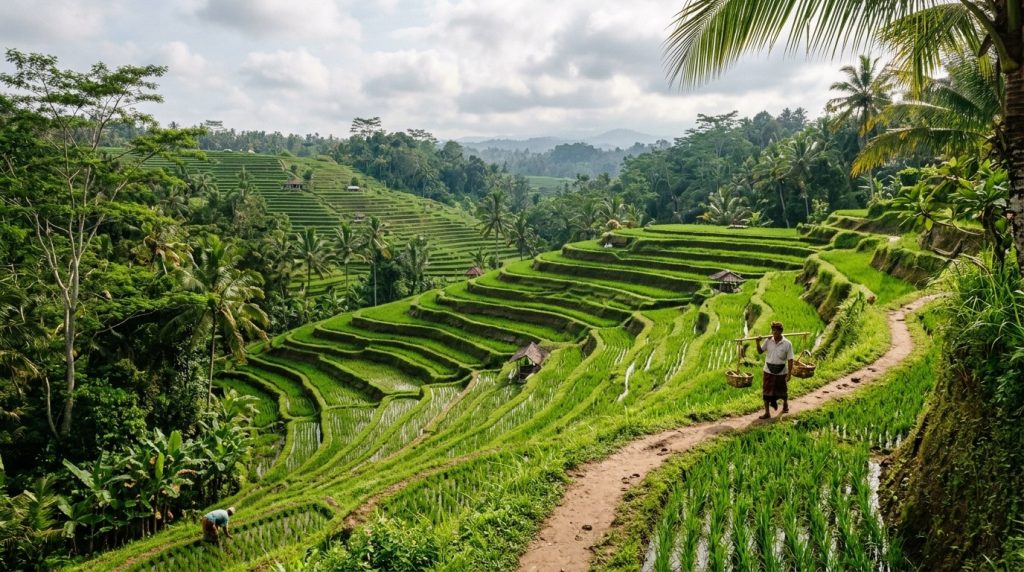
Leave central Ubud by 7am so you reach the Tegallalang rice terraces around 7:25am, ahead of the coach groups that fill the viewpoints by mid-morning; entry is informal and paid per section rather than at one gate, typically about AUD 2 · USD 1.40 (IDR 25,000) in cash at each viewpoint.
Some viewpoints at Tegallalang also charge separately for the Bali swings and the elevated photo platforms, which sit outside the basic entry donation and are worth skipping if you are short on time.
From Tegallalang, continue on to Tirta Empul temple, where the official entrance fee is AUD 6 · USD 4 (IDR 75,000) and includes a basic sarong; joining the purification bathing costs an extra IDR 10,000 for a rinse-ready sarong, about AUD 1 more.
Between the drive out to Tegallalang and the loop back through Tirta Empul, expect close to 90 minutes of driving across the day even though neither leg looks long on a map.
A full-day private car and driver in Ubud runs IDR 600,000 to 850,000, so splitting that two ways with entrance fees works out to roughly AUD 35 · USD 25 per person.
Day 3 – Mount Batur, a waterfall day, or a slow day
Day 3 is the one day this itinerary should not run on autopilot, because the sunrise trek up Mount Batur asks for almost no sleep. If you are still deciding how long to book, see how many nights Ubud really needs, which shows 2 nights only works when you skip the volcano. Before booking the trek, our guide to Ubud’s real risks explains why you should check Batur’s alert level and only climb with a registered guide.
Guides collect hikers from Ubud hotels between 1:30am and 2:30am, then drive 60 to 90 minutes to the trailhead for a roughly 39-kilometre trip, and a local guide is mandatory rather than optional for the climb.
A typical guided package with transport, breakfast and a guide runs IDR 400,000 to 700,000 per person, around AUD 43 · USD 31 at the middle of that range, and it is worth confirming exactly what is included before booking.
Many operators add a stop at a coffee plantation on the drive back into Ubud, which is a reasonable extra as long as you have not booked tight onward transport for later that morning.
If a 2am start does not suit the rest of your trip, treat Day 3 as a slow day instead: skip the pre-dawn pickup, sleep in, and spend the day at a spa or on a short local walk without needing a car at all.
Why the day has to start before the coaches
Every early start on this page solves the same problem, which is that Ubud’s best-known stops get crowded and hot at almost the same hour each day.
The Sacred Monkey Forest Sanctuary opens at 9am with last entry at 5pm, and arriving right at opening is the only way to see it before day-trip groups from the south coast fill the paths. Tegallalang is a 20 to 25-minute drive from central Ubud, short enough that arriving by 7:30am still beats the coach buses that begin arriving mid-morning.
Mount Batur works the same way in reverse: sunrise in Bali lands close to 6am, and a 60 to 90-minute drive from Ubud means a 1:30am to 2:30am pickup is not optional if you want to be on the summit in time.
None of these are long drives on paper, which is exactly why a plan built forwards from a normal breakfast time misses all three.
What does not fit in three days
A Seminyak or Canggu beach day does not fit, because Bali’s south-coast areas sit 60 to 90 minutes from Ubud by road each way, turning a single beach afternoon into three or four hours of driving.
Nusa Penida does not fit either, since it needs a separate boat crossing from Sanur and its best light is around midday, which clashes with every early start already built into this plan.
Doing Tegallalang, Tirta Empul and Mount Batur in a single day does not fit, because the drive time alone across those three stops runs past four hours before accounting for time on foot at each one.
If the goal is to see the rest of Bali rather than only Ubud, the 7-day Bali itinerary covers that ground properly instead of trying to bolt it onto these three days.
Where to eat in Ubud
Ubud’s food scene splits roughly into two everyday price tiers, and knowing which one you are walking into avoids the surprise of a menu priced for Seminyak.
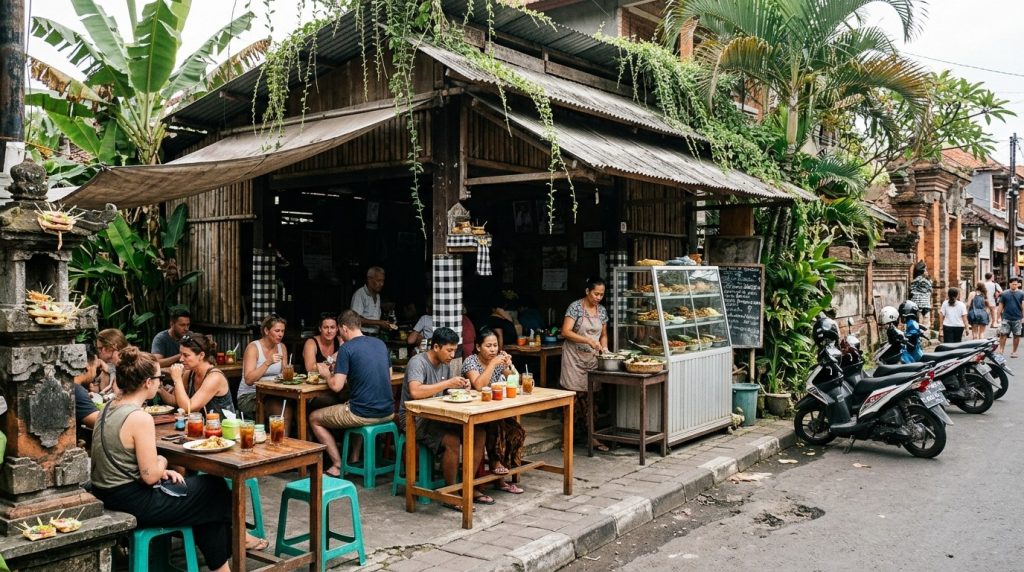
Local warungs, the small family-run eateries serving nasi campur, nasi goreng or mie goreng, charge roughly AUD 1.50 · USD 1.10 to AUD 3.90 · USD 2.80 a plate (IDR 20,000 to 50,000), and the best ones are usually a street or two back from Monkey Forest Road rather than directly on it.
Casual cafes aimed at travellers, including the smoothie-bowl and all-day-breakfast spots clustered around Jalan Hanoman and Penestanan, charge roughly AUD 4.70 · USD 3.40 to AUD 11.80 · USD 8.50 for a main (IDR 60,000 to 150,000), reflecting imported ingredients and air-conditioned seating.
At the top end, Ubud’s fine-dining and tasting-menu restaurants charge significantly more again, reflecting imported ingredients, wine lists and multi-course formats, and are worth booking ahead for rather than walking into.
A rule of thumb that holds across most of Ubud: a restaurant with laminated multilingual menus and photos of the food directly on Monkey Forest Road is pricing for passing tourist traffic, while the same dish a block or two away, where locals are eating, usually costs noticeably less.
Bottled or filtered water is the safer default over tap water everywhere in town, and most warungs and cafes sell it cheaply by the bottle rather than including it in the meal price.
Ubud’s long-standing reputation as Bali’s wellness hub also means vegetarian and vegan menus are the norm rather than the exception, even at warung level, so dietary requirements are easier to manage here than in many other parts of Bali.
Temple etiquette while you are here
Every temple on this itinerary, including Saraswati Temple on Day 1 and Tirta Empul on Day 2, has the same baseline dress rule: knees and shoulders need to be covered, and a sarong tied at the waist is the standard way to meet that rule if you are wearing shorts or a skirt.
Most temples that see regular tourist traffic, including Tirta Empul, provide or rent sarongs at the entrance for a small fee, often bundled into the entrance ticket as it is at Tirta Empul, though packing a light sarong of your own saves time at smaller sites such as Saraswati Temple.
A cloth sash tied around the waist over the sarong is sometimes expected in addition to the sarong itself, particularly at more actively used temples rather than ones kept mainly for sightseeing, so follow the lead of other visitors or ask at the entrance if a sash is available.
Shoes are generally fine to keep on in outer temple courtyards, but you may be asked to remove them before entering an inner shrine area, so watch for signs or follow what locals in front of you are doing.
Menstruating women are traditionally asked not to enter the inner courtyards of Balinese temples, a custom that is enforced inconsistently but worth knowing before you go.
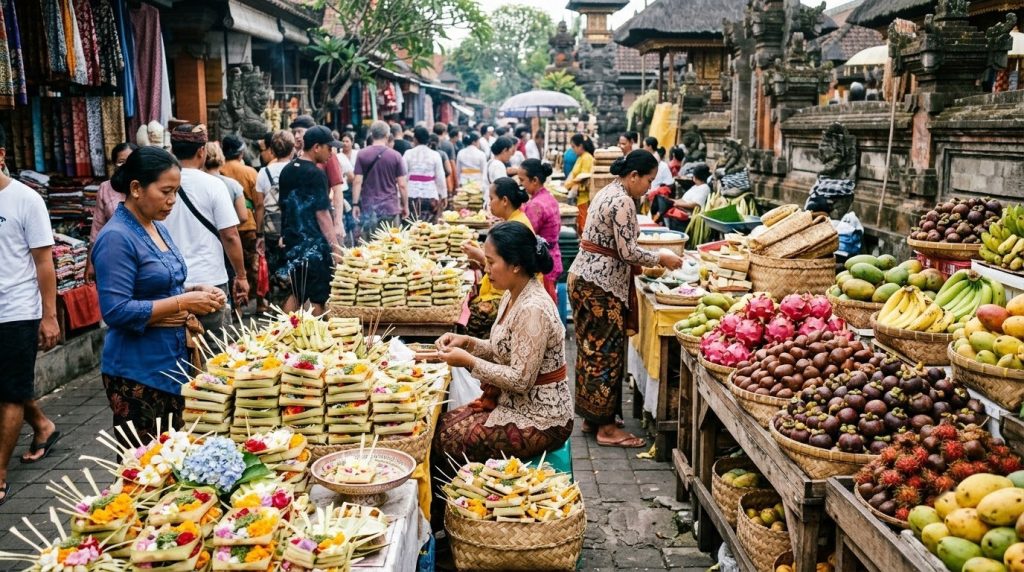
Small woven offering baskets, known as canang sari, are placed on the ground throughout Ubud every morning as part of daily Balinese Hindu practice, and stepping around rather than over or on them is a basic courtesy. Photographing people during active prayer or ceremony without asking first is best avoided even where no sign says so explicitly.
Where to stay on this route
Staying inside central Ubud, within walking distance of Monkey Forest Road, saves the most time on this itinerary, since Day 1 needs no car and Day 2 and Day 3 both start from a hotel pickup.
The best hotels in Ubud breaks down options by budget and walking distance to the centre, and checking the best time to visit Ubud first is worth doing before locking in the start times above, since crowd and weather patterns shift the exact timing by season.
Find your Ubud hotel on the map
Live prices from Booking, Airbnb and more — move the map or change dates to compare stays around Ubud.
Related guides: best Bali swings and swing tours.
Related guides: best villas in Ubud with a private pool.