Is Ubud Worth Visiting? (2026)
By TravelguidestipUpdated 10 min readHow we earn
Hotel buttons open Stay22 (Booking.com, Agoda and others) and tour buttons open GetYourGuide. We may earn a commission at no extra cost to you.

Ubud is worth visiting in 2026, and two numbers make the case: a Sacred Monkey Forest Sanctuary ticket costs AUD 10 · USD 7 (IDR 130,000) for a rainforest sanctuary and troop of macaques no beach town in Bali has, and the drive from Ubud to the nearest south-coast beach runs only 60 to 90 minutes each way.
It stops being worth it if the whole Bali trip runs under 7 nights and none of them can be spared for that inland detour.
| Traveller type | Worth it? | Nights to give it | Why |
|---|---|---|---|
| First Bali trip, 10+ nights total | Yes | 2 to 3 nights | Rice terraces and jungle balance out beach time elsewhere |
| Beach-only holiday, 5 to 7 nights total | No | 0, day trip at most | No nights to spare for a 60- to 90-minute inland detour |
| Digital nomad or long-stay (3+ weeks) | Yes | 5 or more nights | Slower pace and walkable side streets reward a longer base |
| Nightlife or beach-club trip | No | Skip entirely | No beach clubs, and central Ubud is quiet after dark |
| Honeymoon or anniversary trip | Yes | 2 to 3 nights | Jungle villas and spa culture the coast cannot match |
| Family with kids under 8 | Conditional | 1 to 2 nights | Monkey Forest and rice terraces work, but book a resort with a pool |
What Ubud has that the beach areas do not
Ubud earns its reputation on three things no coastal town can copy: terraced rice fields inside walking distance of the centre, a genuinely cooler climate, and a wellness and arts scene built over decades rather than the last five years.
Sitting inland at roughly 200 to 300 metres, Ubud runs cooler, wetter and more humid than Seminyak, Canggu or Kuta on the coast, with nights holding near 20 to 23°C year-round against a 23.5°C floor on the beach strip.
That elevation is also what grows the rice terraces at Tegalalang and feeds the gorge along the Campuhan Ridge Walk, both a short trip from the centre.
The Sacred Monkey Forest Sanctuary anchors the town itself, open 9am to 6pm with last entry at 5pm, and its AUD 10 · USD 7 (IDR 130,000) foreign-adult ticket buys a forest, three temples and a resident troop of long-tailed macaques found nowhere on Bali’s coast.
Ubud Palace and the Saraswati Temple water garden sit free to enter a short walk from the Monkey Forest gate, and the Ubud Art Market a block over still runs on textiles and woodwork rather than the mass-produced beach-strip souvenirs sold near Kuta and Legian. None of that competes with a beach club, and it is not supposed to.

How commercialised the centre actually is
The two or three streets that make up central Ubud are genuinely commercialised, and that is not exaggeration from a bad TripAdvisor thread.
Jalan Raya Ubud backs up badly through the day, choked by cars, scooters and tour buses squeezing over the town’s handful of one-lane bridges, with the worst of it clustering around late morning, when day-trip coaches arrive, and late afternoon, when they leave.
Bali crossed 7 million foreign arrivals by the end of 2025, and the Monkey Forest alone draws more than 10,000 visitors a day at peak season, numbers that show up as souvenir stalls and queueing tour groups the length of the main strip.
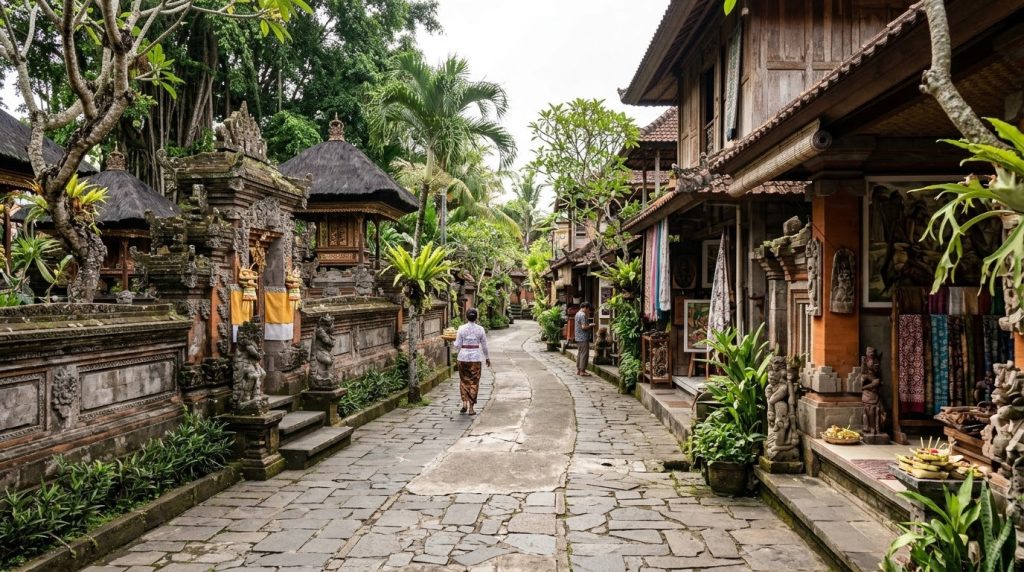
The commercialisation is real, but it is also narrow: walk a few hundred metres off Jalan Raya Ubud toward Penestanan or Nyuh Kuning and the stalls thin fast into rice paddies and quiet lanes, even though the traffic problem itself has spread outward to Sayan, Mas and Tegalalang too.
Side streets like Jalan Hanoman and Jalan Dewi Sita still get busy at dinner time, but they trade the market-front tourist pricing on the main strip for local warungs and smaller cafes within a five-minute walk, which is usually enough distance to feel like a different town.
Getting to and around Ubud
Ngurah Rai International Airport sits on Bali’s south coast, and the drive north to Ubud commonly takes 60 to 90 minutes, longer again if it lands during the afternoon crawl around Denpasar and Sanur.
A private airport transfer or taxi for the full car typically runs IDR 300,000 to IDR 450,000, or about AUD 22 to AUD 34 · USD 16 to USD 24, covering one to three passengers and their bags; a metered taxi from the airport rank can land in the same range but is worth confirming before setting off, since quoted flat rates from pre-booked drivers remove any ambiguity a meter does not.
Ride-hailing apps also operate across southern Bali and into Ubud, though pickup restrictions apply at the airport terminal itself, so a short walk to a designated pickup point is often part of the process.
Once inside Ubud, the centre itself is walkable for anyone staying within a few streets of Monkey Forest Road, but the one-lane bridges and daytime congestion on Jalan Raya Ubud already covered in this guide make a scooter or a hired driver the more realistic choice for reaching Tegalalang, Campuhan or anywhere outside the walkable core.
Renting a scooter is the cheapest independent option, with a standard 110cc automatic running IDR 60,000 to IDR 100,000 a day, or about AUD 5.60 to AUD 9 · USD 4 to USD 6.50, though riding one requires genuine comfort with Bali’s mix of potholes, loose gravel and unpredictable right-of-way, and a helmet with the strap closed is non-negotiable rather than optional.
Indonesian law requires an International Driving Permit covering motorcycles to ride legally, and police checkpoints do check for one; missing the right paperwork at a checkpoint commonly costs IDR 300,000 to IDR 500,000, or about AUD 25 to AUD 42 · USD 18 to USD 30, on top of whatever the scooter itself cost to rent.
Hiring a driver for a half or full day removes both the traffic risk and the paperwork question entirely and is the more common choice for a short two- or three-night stay, since it also solves parking and lets everyone in the group skip the traffic stress that building up a loop through the rice terraces otherwise involves.
The no-beach trade-off, in drive times
The real cost of basing in Ubud is time, not money, and it gets paid in the same stretch of minutes twice.
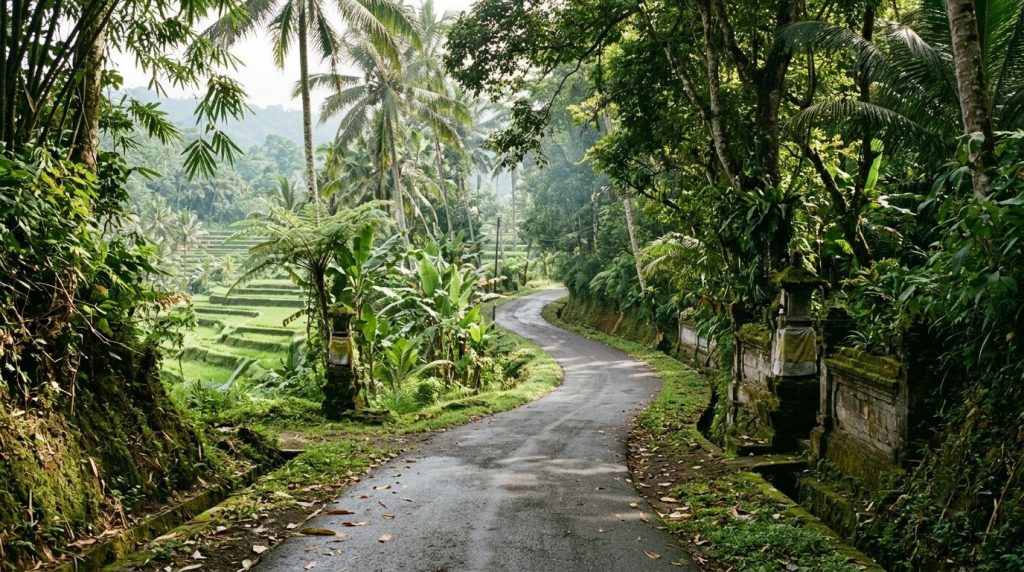
Every south-coast beach, from Seminyak to Canggu, sits 60 to 90 minutes from Ubud by road, and the trailhead for a Mount Batur sunrise trek is another 60 to 90 minutes away in the opposite direction, so either trip alone eats two to three hours of driving before counting any time at the destination.
That math rules out treating Ubud as a base for a single beach afternoon, since half the day disappears in the car both ways, and it makes a rushed one-night add-on a worse plan than either skipping Ubud entirely or committing to the two to three nights it actually rewards.
The trade shows up in the climate too: Ubud’s hills run cooler but more humid than the coast, so travellers splitting a trip between the two often notice the beach half feels hotter and drier on the same dates, a swing worth planning packing around rather than a reason to pick one over the other.
Compare the areas side by side in where to stay in Bali before deciding whether an inland base or a coastal one fits the rest of the trip better.
How many nights Ubud actually earns
Two to three nights is the right dose for most travellers, and pushing past that without a specific reason, a retreat, a workspace, a long-stay booking, tends to run into diminishing returns once the rice terrace, temple and market loop repeats. If you also want the Mount Batur sunrise, our how long to stay in Ubud explains why 3 to 4 nights is the safer booking.
Ubud’s own hotel spread reflects that: rates run from around AUD 40 a night in a Mas village guesthouse to well over AUD 1,000 in a Sayan river-gorge villa, a range built for a short, deliberate stay rather than a two-week base.
The right number of nights also shifts with the season, since wet-season afternoons push more time indoors than the dry months do, a pattern the best time to visit Ubud covers month by month, and for the order to run those two or three days in, see the Ubud itinerary.
Practical safety in Ubud and Bali
The single biggest everyday risk in Ubud is traffic, not crime. Jalan Raya Ubud’s one-lane bridges and the scooters, cars and tour buses squeezing over them already make the centre slow during the day, and that same congestion is where most visitor injuries happen: a scooter accident, not a theft or a scam, is the most common way a Bali holiday actually goes wrong.
Riding defensively, staying well under the speed most locals ride at, and treating every intersection as though no one else will stop are the three pieces of advice that come up across rider guides for Bali, along with the basics of a helmet, closed shoes rather than sandals, and checking a rental scooter’s brakes and tyres before riding off.
Road surfaces in and around Ubud vary street to street rather than staying consistent, with potholes and loose gravel more common on the lanes leading out toward Penestanan and the rice-terrace roads than on the paved centre of town, so a slower pace on unfamiliar stretches matters more than it would on a well-marked city street elsewhere.
None of this is a reason to avoid Ubud, and it does not contradict the Numbeo-style safety reputation Bali holds more broadly; it simply means the real safety conversation here is about how a visitor gets around, not about street crime, and planning around that is straightforward once it is factored in before the first ride rather than discovered on it.
The financial risk behind a scooter accident is bigger than the rental cost suggests. Australia’s Smartraveller advisory warns that a travel insurer will deny a claim if the rider held no licence, or no licence covering that vehicle class, at the time of the accident, and an Adelaide family’s case made headlines in Australia after their son’s scooter accident in Indonesia left them covering more than AUD 370,000 in medical bills once their insurer refused the claim on exactly that basis.
Carrying a current motorcycle licence and an International Driving Permit before renting a scooter in Ubud, and checking a travel insurance policy’s fine print for a licence requirement before relying on it, costs nothing and closes off the single largest financial risk tied to getting around independently.
Who should skip Ubud
Skip Ubud if the trip is a beach-and-nightlife holiday under 7 nights total, because the 60- to 90-minute drive each way to the coast eats a day that itinerary cannot spare, and central Ubud has no beach clubs or late bars to make up for it. Monkey bites are a common reason Australians end up at Ubud clinics, and our Ubud safety breakdown covers what to do the same day if one happens.
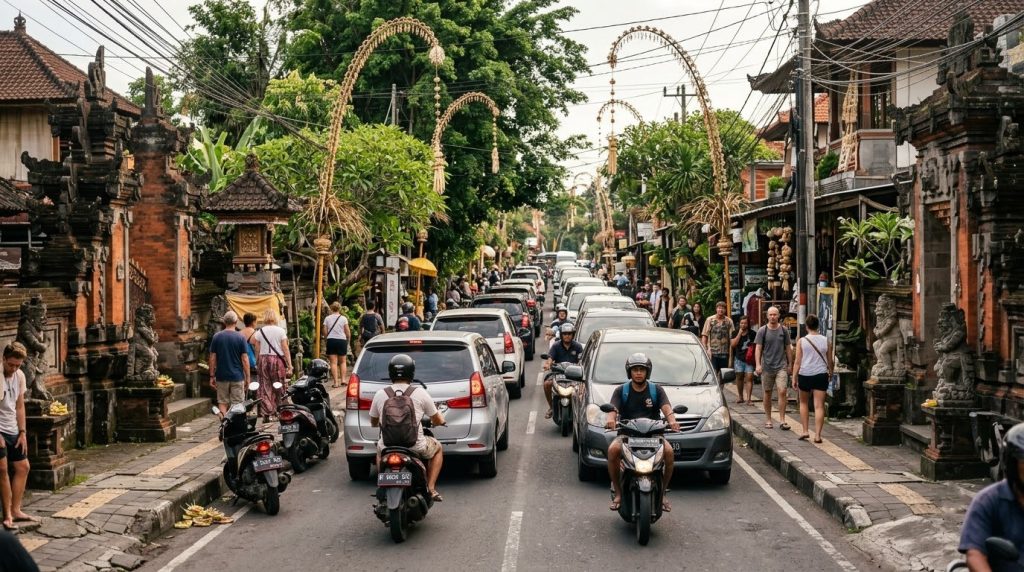
Skip it if traffic genuinely ruins a holiday, since Jalan Raya Ubud crawls through late morning and late afternoon with no way around that timing if the plan runs on normal daytime hours.
Skip it if the goal is the sleepy, undiscovered village from a decade-old memoir, because the central strip today is dense with tour groups and souvenir stalls, and that quiet only starts a few hundred metres off the main road.
Skip it too if mobility is limited, since rice terrace paths, temple steps and narrow, uneven village lanes are not built for wheelchairs or unsteady footing.
And skip the Monkey Forest specifically, even if the rest of the trip stays on the itinerary, if food, sunglasses or loose bag straps cannot be kept out of reach, since the resident macaques are genuinely bold around visitors carrying anything that looks edible or grabbable.
Visiting Ubud with a baby or young child
Indonesia has no law requiring children to ride in a car seat, at any age, which means a hired driver’s car will not automatically come with one and a family needs to plan around that gap rather than assume it is covered.
The practical fix most family travel guides to Bali recommend is bringing a lightweight, compact car seat from home that fits into a private driver’s car or an airport transfer, since rental options for child seats are inconsistent across operators and cannot be relied on to turn up on the day.
A baby carrier works well for the walk around Monkey Forest Road and the rice terrace paths covered elsewhere in this guide, both of which involve uneven ground that a stroller handles poorly.
Riding a scooter with an infant or toddler, whether on a parent’s lap or in an aftermarket seat bolted to the frame, is specifically discouraged by family travel guides to Bali despite being a common sight locally, since the same traffic conditions that make defensive riding necessary for an adult are magnified with a child on board and no seatbelt or crash protection involved.
A hired driver or a taxi is the safer choice for every transfer once a baby is part of the trip, and the extra cost is small relative to the rest of a Bali holiday.
Central Ubud’s flatter streets and the short distances between the Monkey Forest, Ubud Palace and the art market also mean a family based centrally can cover most of a day on foot with a carrier, saving the car entirely for the longer trips out to the rice terraces or back to the coast.
Mosquito protection is worth packing as carefully as the car seat: a fine-mesh net over a travel cot or stroller is the most commonly recommended precaution for a baby sleeping during the day in Ubud’s cooler, wetter climate, where mosquitoes are more present than on the drier coast.
Where to stay if you decide to go
Central Ubud itself, within walking distance of Monkey Forest Road, is the best base for a two- to three-night stay, and the full shortlist by budget sits in the best hotels in Ubud guide. Use the live map below to compare what is available for your dates.
Find your Ubud hotel on the map
Live prices from Booking, Airbnb and more — move the map or change dates to compare stays around Ubud.
Related guides: best villas in Ubud with a private pool.