Is Sanur Worth Visiting? (2026)
By TravelguidestipUpdated 9 min readHow we earn
Hotel buttons open Stay22 (Booking.com, Agoda and others) and tour buttons open GetYourGuide. We may earn a commission at no extra cost to you.

Sanur is worth visiting for anyone who wants a calm, reef-protected beach about 30 to 45 minutes from Ngurah Rai Airport and a direct 30 to 45 minute fast boat to Nusa Penida. It is not worth visiting if you want to walk out of your hotel into nightlife, because the nearest real bar strips in Seminyak and Canggu sit 45 minutes or more away by car.
| Traveller type | Worth it? | Nights to give it | Why |
|---|---|---|---|
| Families with young kids | Yes | 3 to 4 nights | Reef-calmed shallow water, wide traffic-free sidewalks |
| Retirees and slow travellers | Yes | 4 to 5 nights | Quiet pace, 20 to 30% cheaper than Seminyak |
| Divers and Nusa Penida day-trippers | Yes | 2 to 3 nights | Sanur Harbour is the main fast-boat departure point |
| Solo travellers chasing nightlife | No | 0 nights | Nearest bar strip is 45+ minutes away |
| Honeymooners wanting clifftop views | No | Skip | Uluwatu and Seminyak deliver that, Sanur doesn’t |
| Surfers | No | Skip | The reef that calms the water also kills the swell |
Who Sanur is genuinely right for
Sanur genuinely works for families with young children, retirees, divers, and anyone building a trip around Nusa Penida. Families still torn between bases can read our Sanur or Nusa Dua comparison, which explains why Sanur suits most Australian families with school-age kids.
It has been one of Bali’s tourist areas since the 1960s, so the hotels, warungs and clinics feel established rather than trend-chasing, and the wide, tree-lined sidewalks run largely traffic-free along the coast, which matters more than it sounds once you’ve tried pushing a stroller down a Kuta backstreet.
A sizeable expat and retiree community lives here year-round, which keeps the pace slow and the service unhurried rather than performative.
Value is a real part of the case too. A mid-range beachfront room in Sanur runs AUD 69–180 · USD 50–130 (IDR 880,000–2,290,000) a night, calculated at today’s rate of 1 USD to 17,631 IDR, and rates across the board sit 20 to 30 percent below Seminyak or Canggu for comparable quality, a gap covered in more depth in our Bali daily budget breakdown.
Divers and snorkellers also do well here, since Sanur sits close to reef breaks along the east coast and doubles as the main departure point for Nusa Penida trips, which most Seminyak or Canggu-based travellers have to drive 45 minutes or more to reach.
None of this suits someone whose trip is built around a nightclub reel, and that’s the honest limit of the case for Sanur.
The beach, and what the reef actually means
Sanur’s beach rewards planning around the tide far more than it rewards a spontaneous swim. A wide offshore reef breaks the swell before it reaches the shore, which is why Sanur has no surf and no rip currents worth worrying about, unlike the beaches around Uluwatu or Canggu. At high tide, that produces a genuinely calm, shallow lagoon that’s safe for weak swimmers and young kids without heavy supervision.
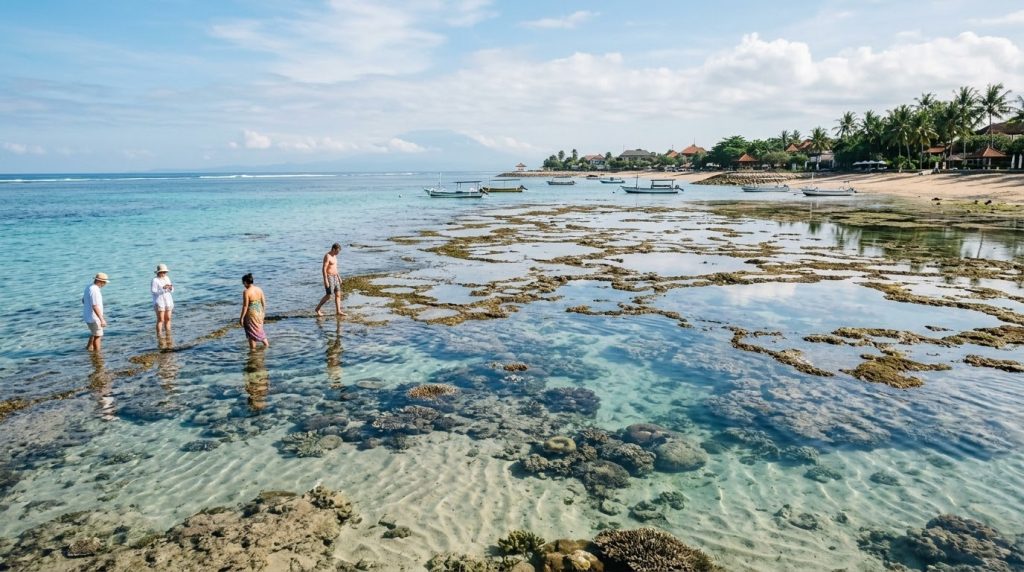
At low tide, the water can recede close to a kilometre out, exposing sand flats, seagrass beds and the reef itself, and what’s left is a few inches of water rather than a swimmable lagoon.
Locals and hotel staff plan around this without much thought, which is why most beachfront hotels in Sanur keep a proper pool rather than relying on the ocean.
The nearly 7-kilometre paved path that runs along the coast from Mertasari in the south past the harbour area is flat, shaded in sections and closed to motor vehicles, so walking or cycling it works at any tide even when swimming doesn’t.
The trade-off is straightforward, no danger and no surf, but check a tide chart before you plan a swim, not after.
The “Snore” reputation, and how fair it is
The “Snore” nickname is accurate about nightlife and misleading about almost everything else. Sanur earned it because it has close to no late-night bar scene, no beach clubs on the Canggu or Uluwatu model, and a visitor age profile that skews toward families and retirees rather than groups in their twenties.
If your idea of a good Bali night includes a DJ set running past 2am, Sanur will disappoint you inside a single evening, and no amount of hotel-hopping will fix that.
What the nickname misses is the daytime and early-evening experience, where Sanur has an established restaurant strip along Jalan Danau Tamblingan, a genuine expat community that keeps the cafes and wine bars busy, and a beachfront that stays usable and low-hassle at almost any hour without the tout pressure you get in Kuta.
The quiet is the actual product here, not a failure of the destination. Travellers who arrive expecting Sanur to secretly have a hidden club scene are checking the wrong box, while travellers who arrive wanting a slower Bali usually leave having gotten exactly what they came for.
Sanur as a base for Nusa Penida and the east
Sanur is the most practical mainland base for reaching Nusa Penida and Nusa Lembongan. Sanur Harbour is the main fast-boat departure point for both islands, with crossings taking roughly 30 to 45 minutes and fares running around IDR 170,000 to 215,000 each way, landing at Toyapakeh or Banjar Nyuh depending on the operator.
Boats tend to run earliest and most frequently from Sanur, which matters if you’re chasing the cliff viewpoints on Nusa Penida before the day-tripper crowds arrive.
Basing yourself in Sanur removes the pre-dawn transfer that travellers staying in Seminyak or Canggu have to make, since Sanur to Ngurah Rai Airport is only about 30 to 45 minutes and the harbour itself sits inside town rather than a taxi ride away.
It also puts you closer to Bali’s east coast generally, with Ubud around 40 minutes north if you want to add a cultural stop without repositioning your whole trip.
For anyone building an itinerary around a Nusa Penida day trip or overnight, or planning to island-hop through the east, that logistics advantage is Sanur’s strongest and least sentimental argument, independent of whether you like the town itself.
Who should skip Sanur
Skip Sanur if nightlife, surf or a young crowd matter more to your trip than convenience. Surfers should skip it outright, since the same reef that makes Sanur safe for swimming also kills any real swell, and there is nowhere in the immediate area to paddle out.
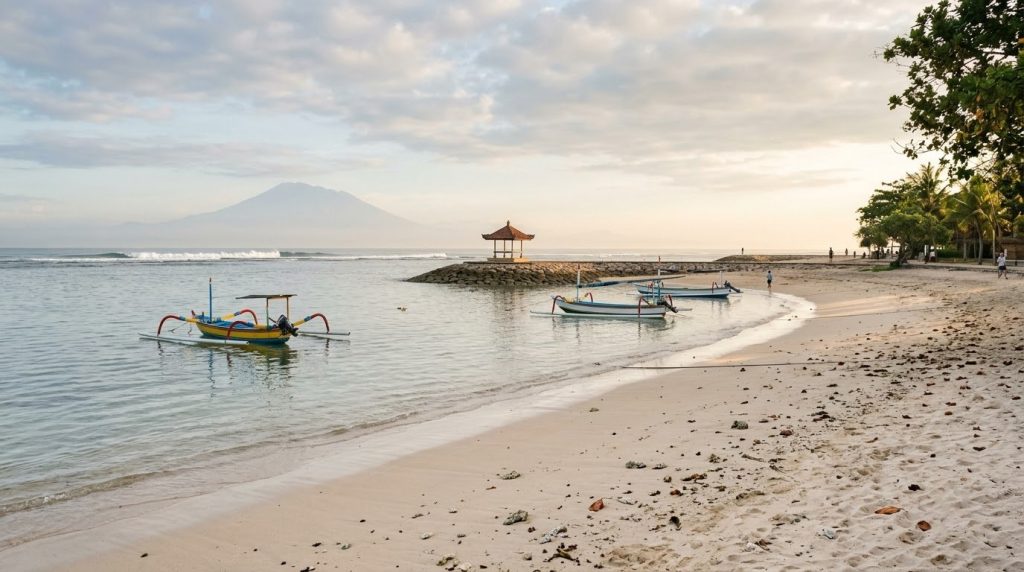
Travellers under 30 looking for a beach club scene, a bar crawl, or a crowd their own age will find Sanur thin within a day or two. The closest real nightlife in Seminyak sits 45 to 50 minutes away by car, and Canggu can run anywhere from 45 minutes to well over an hour depending on the time of day.
Honeymooners chasing clifftop infinity pools and sunset bars are better served in Uluwatu, and travellers who want the beach directly in front of their room at every tide, not just high tide, will be frustrated by Sanur’s reef flat.
If any of that describes your trip, it’s worth comparing Sanur against Bali’s other beach towns before booking, because the area you pick will shape the trip more than any single hotel choice will.
Best time to visit Sanur
Bali runs on two seasons, and Sanur follows the same pattern as the rest of the island. The dry season stretches from April to October, with daytime temperatures sitting in the 26 to 31°C range and rainfall dropping to its lowest in August, typically the sunniest, driest month to book around.
The wet season runs November through March, bringing shorter but heavier afternoon downpours rather than all-day rain, and humidity climbs alongside the cloud cover.
For Sanur specifically, the dry season matters less for swimming, since the reef keeps the lagoon calm regardless of rainfall, and more for the walking and cycling path along the coast, which is far more pleasant without a tropical downpour cutting the afternoon short.
Divers and Nusa Penida day-trippers benefit most from dry-season timing, since choppier wet-season seas can delay or cancel fast-boat crossings more often than they do in July or August.
July through September tends to draw the heaviest demand across Bali generally, including school-holiday periods for Australian and European families, so rooms in Sanur book out earlier and prices firm up compared with the shoulder months of April, May, June and October, which offer a similar dry-season climate without the same competition for beds.
If flexibility matters more to you than guaranteed sunshine, those shoulder months are usually the better trade.
Getting to and around Sanur
Most visitors reach Sanur by road from Ngurah Rai International Airport. Ride-hailing apps such as Grab and Gojek are usually the cheapest option, typically running AUD 13–18 · USD 9–13 (IDR 160,000–230,000) for the trip, picked up from the designated rideshare zone at arrivals.
Prepaid taxi counters inside the terminal cost more, generally AUD 20–28 · USD 14–20 (IDR 250,000–350,000), but involve no app, no surge pricing and a fixed fare agreed upfront. A private pre-booked transfer with a dedicated driver runs from roughly AUD 32–45 · USD 23–32, a useful option for families travelling with young kids and extra luggage.
Once you are in Sanur, you generally do not need a car. The town is small and flat enough to cover on foot or by bicycle, and the paved beachfront path makes cycling between the harbour and Mertasari genuinely practical rather than a novelty.
Scooters are the most common way locals and longer-stay visitors get around, with rental shops along the main streets charging roughly AUD 8–16 · USD 6–11 (IDR 100,000–200,000) a day depending on the bike. Rental shops usually ask for a passport photocopy or a cash deposit rather than your actual passport, and a helmet is non-negotiable.
An International Driving Permit is technically required to ride legally and to keep travel insurance valid, even though enforcement is inconsistent, so it is worth organising one before you fly rather than risking a claim being refused later.
A few safety basics for Bali
Smartraveller, the Australian Government’s official travel advisory, currently asks travellers to exercise a high degree of caution in Indonesia overall. That is a standing baseline level rather than a reason to cancel a trip, but it is worth checking the current advisory for Indonesia before you fly, since specific warnings can change.
Keep a copy of the advice and your travel insurance details accessible on your phone, not just in an email you might not be able to open.
Road traffic is the most common everyday risk in and around Sanur, since Bali’s roads mix scooters, cars, trucks and pedestrians with far less separation than most Australian drivers are used to, and footpaths can disappear without warning once you leave the main beachfront strip.
If you rent a scooter, wear a helmet every time, ride defensively rather than assertively, and avoid riding at night if you are not already confident on Bali’s roads. Confirm your travel insurance explicitly covers scooter use before you ride, not after an accident.
Standard travel hygiene applies too: stick to bottled or filtered water, be cautious with ice and raw produce from street stalls until your stomach adjusts, and keep sun protection and hydration front of mind given how consistently hot the dry season runs.
None of this is specific to Sanur, it is the same baseline caution that applies anywhere in Bali, and it should not change the calculation of whether Sanur itself is worth visiting.
Where to stay if you decide to go
If Sanur fits your trip, stay along the beachfront path between Sanur Harbour and Mertasari, which keeps you within walking distance of the calmest swimming water, the boats to Nusa Penida, and the restaurant strip on Jalan Danau Tamblingan. Rooms nearer the harbour suit an early boat departure, while rooms nearer Mertasari suit families who want quieter mornings and easier access to the widest stretch of sand.
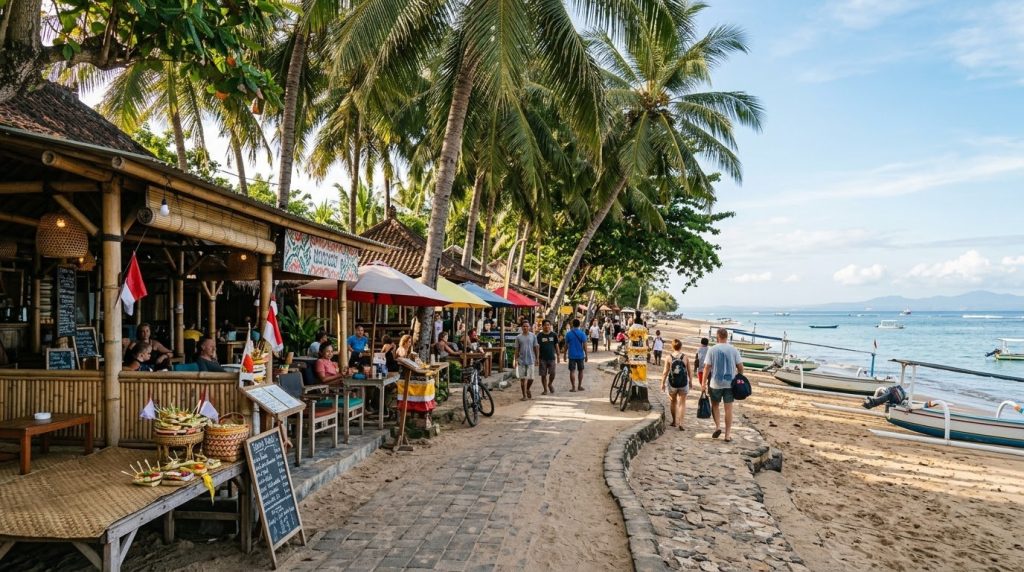
For a full breakdown of areas, price tiers and specific hotels, see our Sanur hotel guide. If you’re still weighing Sanur against the rest of the island, our island-wide hotel guide compares it directly against Seminyak, Canggu, Ubud and Uluwatu so you can check the trade-offs before you commit.
Find your Sanur hotel on the map
Live prices from Booking, Airbnb and more — move the map or change dates to compare stays around Sanur.