Phu Quoc or Nha Trang: Which Vietnam Beach Wins in Each Month (2026)
By TravelguidestipUpdated 10 min readHow we earn
Hotel buttons open Stay22 (Booking.com, Agoda and others) and tour buttons open GetYourGuide. We may earn a commission at no extra cost to you.
Pick this if
Phu Quoc
You want a slower island resort with calm sunsets from november to april.
See hotels in Phu Quoc →Pick this if
Nha Trang
You want a real city beach with better snorkelling and cheaper rooms.
See hotels in Nha Trang →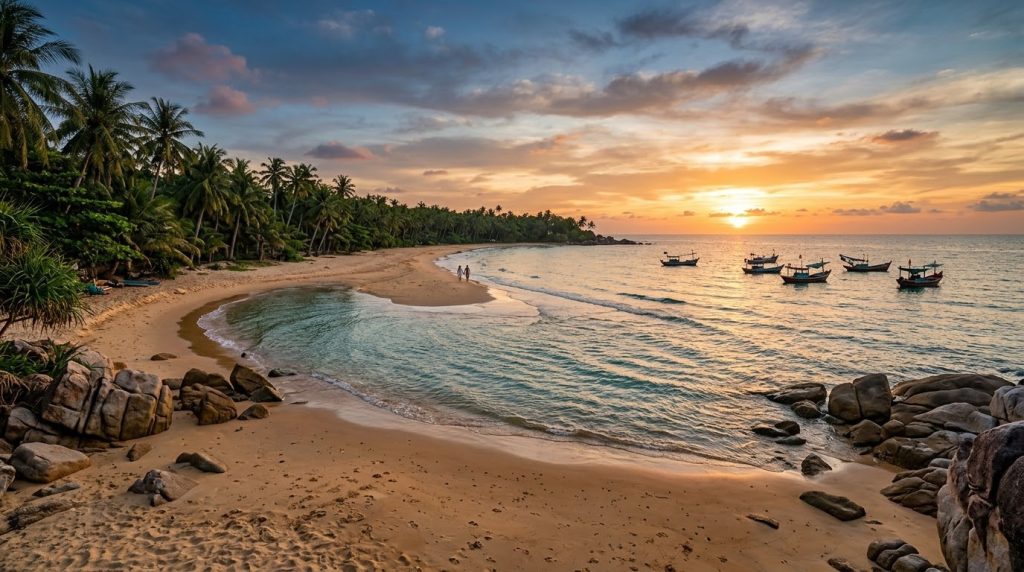
Pick Phu Quoc from November to April and Nha Trang from May to August: these 2 beaches have opposite weather, and their dry seasons overlap for only 4 months, January to April. Phu Quoc is the slower island resort with a 30-day visa exemption and calm sunsets. Nha Trang is a real city beach with better snorkelling, more bars and cheaper rooms.
| Factor | Phu Quoc | Nha Trang |
|---|---|---|
| Dry season | November to April | January to August |
| Wettest months | August and September | October and November |
| Visa for Australians | 30 days visa-free if you stay on the island | e-visa needed (AUD 35 · USD 25) |
| Airport to beach | about 10 km to Duong Dong | 38 km, around 45 minutes |
| Snorkelling | An Thoi islands, a lot of dead reef | Hon Mun marine protected area, recovering reef |
| Nightlife | Night market, Sunset Town shows | Bars and rooftop clubs along Tran Phu |
| Best for | Couples, resort families, December | Mid-year trips, divers, budget travellers |
Month-by-month pick: the opposite weather windows
Phu Quoc’s rain peaks in August and September, with 22 to 24 rainy days a month. Nha Trang flips that: showers from September, and October and November are the wettest months, with storms possible.
| Month | Phu Quoc | Nha Trang | Pick |
|---|---|---|---|
| January | Dry, calm west coast | Dry season starting | Phu Quoc |
| February | Dry | Dry | Either |
| March | Dry | Dry | Either |
| April | Dry, hottest stretch | Dry | Either |
| May | Rain begins | Dry | Nha Trang |
| June | Wet, west coast choppy | Dry | Nha Trang |
| July | Wet | Dry, clearest water | Nha Trang |
| August | Peak rain | Dry, clearest water | Nha Trang |
| September | Peak rain | Showers starting | Nha Trang |
| October | Wet season ending | Wettest, storm risk | Phu Quoc |
| November | Dry season starts | Wettest, storm risk | Phu Quoc |
| December | Dry | Rain easing late month | Phu Quoc |
For Australians the school calendar lines up neatly: the December to January summer break belongs to Phu Quoc, the June to July winter break to Nha Trang. In October, Phu Quoc is the lesser evil, since its rain tends to come in short bursts while Nha Trang can lose whole days to weather.
Visa: the Phu Quoc 30-day exemption has fine print
Phu Quoc is the only place in Vietnam giving every nationality 30 days visa-free. You must fly in directly from overseas, or connect through Ho Chi Minh City or Hanoi while staying airside. Clear immigration in Saigon and it is gone. It also only covers the island: take the ferry to Ha Tien or Rach Gia and you need a proper visa.
Nha Trang is on the mainland, so Australians need an e-visa from the official portal. It costs AUD 35 · USD 25 single entry, valid up to 90 days, processed in 3 to 7 business days. Combining both? Just get the e-visa; the Phu Quoc island visa rules explain the exemption in full.
Flights from Australia and getting to the beach
There is no regular direct service from Australia to Phu Quoc or Cam Ranh (Nha Trang’s airport) in 2026. Most travellers fly into Ho Chi Minh City with Jetstar or Vietjet, then take a domestic hop of roughly 50 minutes to an hour to either.
The difference is on the ground. Phu Quoc’s airport sits about 10 km south of Duong Dong, so you are at your resort quickly. Cam Ranh is 38 km from Nha Trang city, around 45 minutes by taxi or Grab at AUD 16–21 · USD 12–15 (VND 300,000–400,000).
Beaches and snorkelling compared
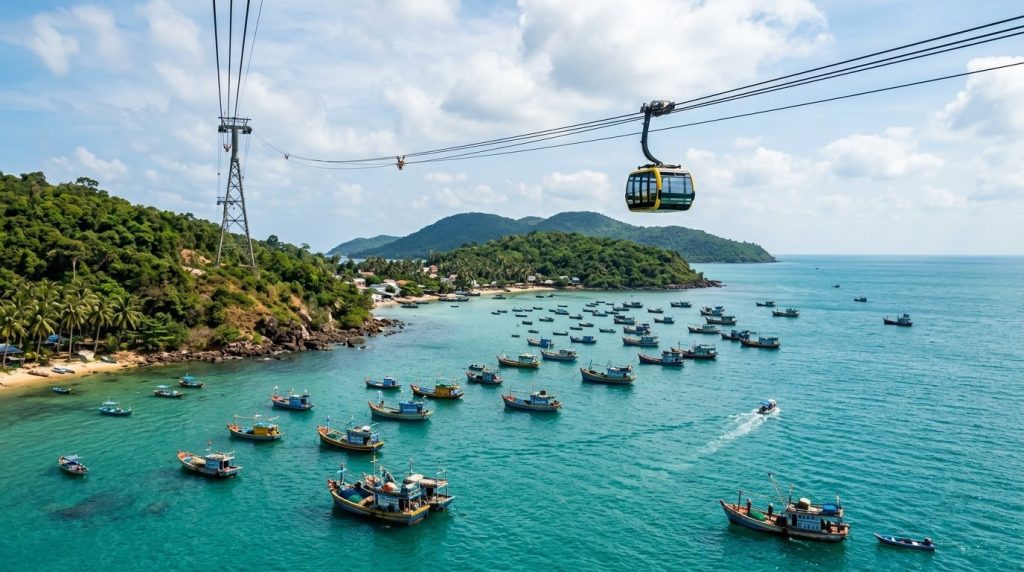
Phu Quoc’s best swimming is on the west coast: Long Beach for restaurants, Ong Lang for quieter coves, Bai Dai for big resorts. From November to April that coast is sheltered and glassy; from June to September it gets windy and the east coast swims better. Our honest Phu Quoc verdict adds a warning on where to sleep, since the south is a building site until the APEC summit in 2027.
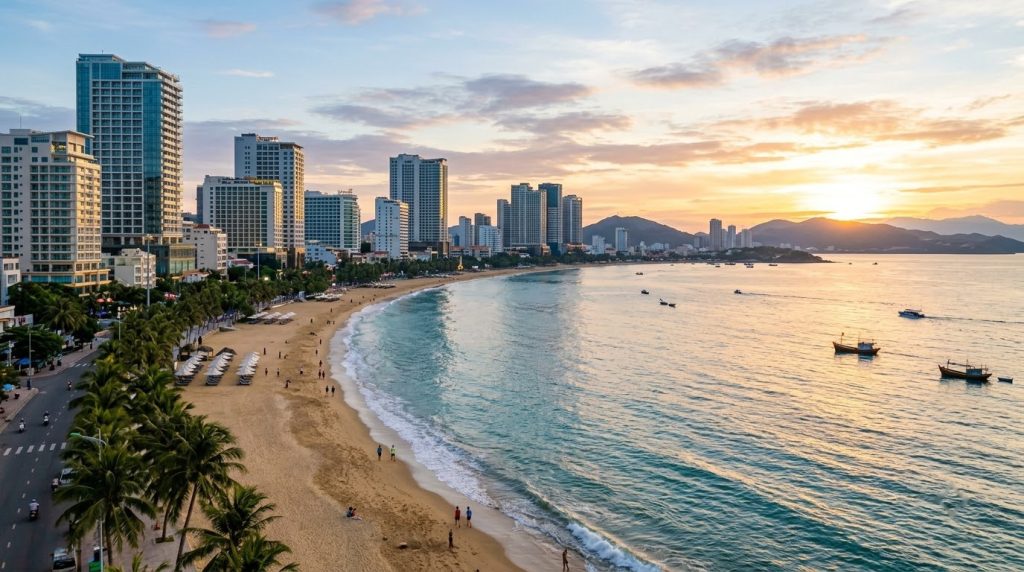
Nha Trang’s main beach is a busy city strand along Tran Phu street: fine for a swim, not an escape. The real reason to choose Nha Trang is underwater. Hon Mun marine protected area was Vietnam’s first, holds about 350 hard coral species, and its shallow reef sits 1 to 2 metres down.
Boat snorkel trips run around AUD 27 · USD 19 (VND 500,000), and July to September brings the clearest water. Phu Quoc’s An Thoi islands look great from the boat, but even local guides admit a lot of that reef is dead. For more on the city itself, read our honest take on whether Nha Trang is worth visiting.
Nightlife and families: who gets what
Nha Trang wins nightlife: bars and rooftop clubs cluster along Tran Phu, all walkable. Phu Quoc’s evenings are more staged, with the Bai Truong night market for seafood (the old Duong Dong market closed in February 2026), then Sunset Town’s Kiss of the Sea show and fireworks.
For families, both destinations have a big Vin theme park. VinWonders Nha Trang costs AUD 56 · USD 40 (VND 1,050,000) for anyone 140 cm and over. Phu Quoc pairs VinWonders (AUD 51 · USD 37) with Vinpearl Safari (AUD 45 · USD 33), or both on a combo for AUD 80 · USD 58 (VND 1,500,000).
Young kids do better on Phu Quoc: calmer water in season and a short airport transfer.
How many nights to allow on each island
Most first-time visitors plan 3 to 4 nights on Phu Quoc. That is enough time to work through the west-coast beaches, fit in one boat or cable-car day around the An Thoi islands, and still have an evening free for the night market, without feeling rushed.
Push past 4 nights only if diving, a full day at Vinpearl Safari, or a genuinely slow pace matters more than covering the island’s main sights.
Nha Trang runs on a similar clock. 3 to 4 nights covers the city beach, a Hon Mun snorkelling trip and a day at VinWonders, with a spare half-day left over for the Po Nagar towers or a mud-bath resort outside town.
Travellers who find the city beach underwhelming after a day or two tend to fill the rest of the stay with day trips rather than extending it, since Nha Trang’s main draw is what sits offshore, not the city strip itself.
Anyone trying to fit both beaches into one Vietnam trip should treat the flight or transfer between them as its own day rather than squeezing it into either island’s nights, since the only practical route in 2026 is a domestic hop that is rarely a same-day in-and-out connection.
Getting around once you’re there
Phu Quoc is built for a rented scooter. A standard automatic runs AUD 7–10 · USD 5–7 a day from shops around Duong Dong and Long Beach, and covers the whole island comfortably, since even the drive from the island’s southern tip to its northern coast takes around 1.5 hours.
Rental shops will hand a scooter to a tourist without checking for a motorbike licence, but Vietnamese law and most travel insurance policies require one for anything over 50cc, so check your policy before relying on a rented bike for anything beyond short, low-speed trips.
Grab also operates on the island and suits short hops or a night out, with fares starting from around AUD 2.80 · USD 2, though coverage thins out after dark away from the main tourist strips.
Nha Trang does not reward a scooter the way Phu Quoc does, because the centre is walkable and the traffic is heavier.
Grab is the default here: GrabBike fares start at about AUD 0.97 · USD 0.70 for the first kilometre, then roughly AUD 0.28 · USD 0.20 for each kilometre after that, with fares rising as much as 30 percent late at night or in the early morning. GrabCar runs at a similar per-kilometre rate for short rides.
A cyclo, more a sightseeing novelty than real transport, costs about AUD 1.40–2.80 · USD 1–2 per kilometre, on top of whatever is negotiated with the driver. A rented motorbike is also available in Nha Trang, at roughly AUD 7–14 · USD 5–10 a day, for anyone wanting to reach Ba Ho waterfall or the outskirts independently.
What a typical day actually costs
Using the same day-by-day method, one night’s room, three meals, local transport and one paid activity, a comfortable mid-range day runs about AUD 146–271 · USD 105–195 on Phu Quoc against roughly AUD 90–160 · USD 65–115 in Nha Trang (2026 figures).
Phu Quoc’s resort cluster pulls its own average higher even at the mid-range tier, while Nha Trang’s cheaper hotel base and package-tour pricing keep the same day noticeably cheaper.
Food follows the same pattern at the cheap end. On Phu Quoc, a basic day of eating, a street breakfast, a local lunch and a market dinner with one beer, lands around AUD 14 · USD 10; stepping up to a cafe breakfast, a mid-range lunch and a seafood dinner with drinks moves that to about AUD 35 · USD 25.
A sit-down seafood meal at a mid-range restaurant runs roughly AUD 14–28 · USD 10–20, and a 1.5-litre bottle of water from a convenience store costs under AUD 1.40 · USD 1 (about VND 12,000–20,000).
Nha Trang eats cheaper at the bottom end, around AUD 4.20 · USD 3 (roughly VND 25,000) for a basic local meal, climbing to about AUD 29 · USD 21 for a mid-range three-course meal for two.
Accommodation is where the two destinations really separate. Phu Quoc’s range runs from AUD 12–22 · USD 9–16 for a backpacker dorm bed up to AUD 416–1,249 · USD 300–900 for a 5-star resort room, since the island’s luxury-resort cluster pulls the top end well above anything Nha Trang offers at the same star rating.
Nha Trang’s hotel base sits lower across every tier, which is the main reason its day-to-day budget comes in under Phu Quoc’s even before flights are counted.
Local food worth planning a meal around
Phu Quoc is known across Vietnam for fish sauce and pepper, and both turn up on nearly every table on the island. For a sit-down meal, look for Ham Ninh crab, grilled scallops and sea urchin, and the banh canh noodle soup locals eat for breakfast rather than dinner.
Goi ca trich, a herring salad rolled in rice paper with herbs and dipped in a peanut and fish-sauce blend, is the one dish worth seeking out specifically, since it is harder to find on the mainland. Seafood at night-market stalls is priced by weight and picked live from tanks, so agree the price before the fish leaves the tank.
Nha Trang’s food leans the same seafood direction but with a mainland city’s range of options alongside it. Nem nuong, grilled pork skewers wrapped in rice paper with herbs and a thick dipping sauce, is the dish locals send visitors to first, and it is sold at dedicated nem nuong restaurants rather than street stalls.
Banh canh and bun ca, both noodle soups built on a fish-based broth, are the everyday lunch order, while lobster and salangane, or bird’s nest, dishes sit at the expensive end of menus aimed at visitors rather than locals.
Because Nha Trang is a full city rather than an island, its food scene also stretches to proper Vietnamese and international restaurants away from the seafood strip, a range Phu Quoc’s smaller dining scene cannot match.
Either destination rewards eating where the locals eat over the resort restaurant, since seafood bought directly from a market stall or family-run kitchen costs a fraction of the same dish on a hotel menu, and is usually fresher.
Verdict by traveller type
– Couples: Phu Quoc, November to April, for sunsets and quieter resorts. Plan the length with our guide to how many days in Phu Quoc. – Families: Phu Quoc in the summer holidays, Nha Trang in the June to July break. – Budget travellers: Nha Trang, for cheap guesthouses, street food and onward buses. – First-timers on a wider Vietnam loop: Nha Trang slots onto the mainland route by train or bus; compare it with the central coast in Da Nang vs Nha Trang. – Snorkellers and divers: Nha Trang, ideally July to September.
Where to stay in Phu Quoc or Nha Trang
On Phu Quoc, stay on Long Beach near Duong Dong for restaurants and the night market; Ong Lang for couples who want quiet coves; or Bai Dai in the north for families wanting an all-in resort near the theme parks. Our Phu Quoc itinerary shows how to split nights between them. In Nha Trang, stay central near Tran Phu, or at Cam Ranh for resorts near the airport.
Find your Phu Quoc hotel on the map
Live prices from Booking, Airbnb and more — move the map or change dates to compare stays across Phu Quoc.
Frequently Asked Questions
Is Phu Quoc or Nha Trang better in December?
Phu Quoc. December sits inside its November to April dry season, with calm seas on the west coast. Nha Trang is still finishing its wet season in December, and although rain eases as the month goes on, early December can be grey and choppy. For Christmas and the Australian summer holidays, Phu Quoc is the safer bet.
Do Australians need a visa for Phu Quoc?
Not if you fly straight to the island and stay there. Phu Quoc gives every nationality 30 days visa-free, including when you connect through Ho Chi Minh City or Hanoi and stay airside. If you clear immigration on the mainland or travel beyond the island, you need a Vietnamese e-visa, which costs AUD 35 · USD 25.
Which has better snorkelling, Phu Quoc or Nha Trang?
Nha Trang. Hon Mun marine protected area was Vietnam’s first, holds about 350 species of hard coral and has shallow reef 1 to 2 metres down, with the clearest water from July to September. Phu Quoc’s An Thoi islands are pretty above water, but much of the reef is dead from algae in nutrient-rich water.
Can you visit Phu Quoc and Nha Trang on one trip?
Yes, but only in January to April, when both are dry. Vietjet sells Phu Quoc to Nha Trang flights, but schedules vary, so many people connect via Ho Chi Minh City, each leg taking roughly an hour. You will also need a full e-visa, because leaving the island cancels the Phu Quoc exemption.