Disclosure: Some links in this guide are affiliate links. If you book or buy through them, we may earn a small commission at no extra cost to you — it helps keep our guides free.
Da Nang and Nha Trang sit 463km apart on Vietnam’s central coast, a 75-minute flight or a slow 9-10 hour drive between them, and choosing between them is really a choice between two different holidays.
Da Nang is a modern coastal city that doubles as the gateway to Hoi An’s Old Town, Ba Na Hills and the Marble Mountains, built for travellers who want culture and scenery layered around the beach.
Nha Trang is a beach-resort town in its own right, built around a long municipal beach, an offshore theme-park island and a large package-tourism scene, with less to see once you step back from the water. Both work, but most first-time Australian visitors get more out of Da Nang.
Quick answer: Comparing Da Nang and Nha Trang? Open live hotel prices in each to weigh cost against location:
| Criterion | Da Nang | Nha Trang |
|---|---|---|
| Type | Modern beach city, gateway to central Vietnam | Beach-resort town, island day trips |
| Airport | Da Nang International (DAD) | Cam Ranh International (CXR) |
| Signature beach | My Khe, long open sand | Tran Phu Beach, city promenade |
| Big draw | Ba Na Hills, Marble Mountains, Son Tra, Hoi An 30 minutes away | VinWonders theme park, diving, mud baths |
| Crowd | Mixed domestic and international, family resorts | Large Russian and domestic package-tour scene |
| Vibe | Culture-and-beach, moderate nightlife | Resort and party feel, less cultural depth |
| Dry season | January to July | January to August, drier and longer |
| Mid-range hotel (night) | AUD 53 · USD 38 (VND 1,000,000) | AUD 48 · USD 35 (VND 900,000) |
Why these two cities get compared, and why they are not a day-trip pair
Da Nang and Nha Trang show up on the same shortlists because they are Vietnam’s two biggest purpose-built beach cities, each with its own international airport, each marketed as a central-coast alternative to Phu Quoc or the north.
Unlike Da Nang and Hoi An, which sit 30 minutes apart and get paired in a Da Nang vs Hoi An comparison as a basing decision, Da Nang and Nha Trang are 463km apart and genuinely separate trips.
A domestic flight covers the distance in 75 minutes on Vietnam Airlines or Vietjet, and travellers building a longer central-coast itinerary sometimes fly between the two rather than choosing only one, but a road transfer runs 9 to 10 hours and is not something most Australians will do on a two or three-week trip.
Treat this as an either/or decision for a single beach stop, not a stopover pairing.
Beaches: My Khe versus Tran Phu and the islands
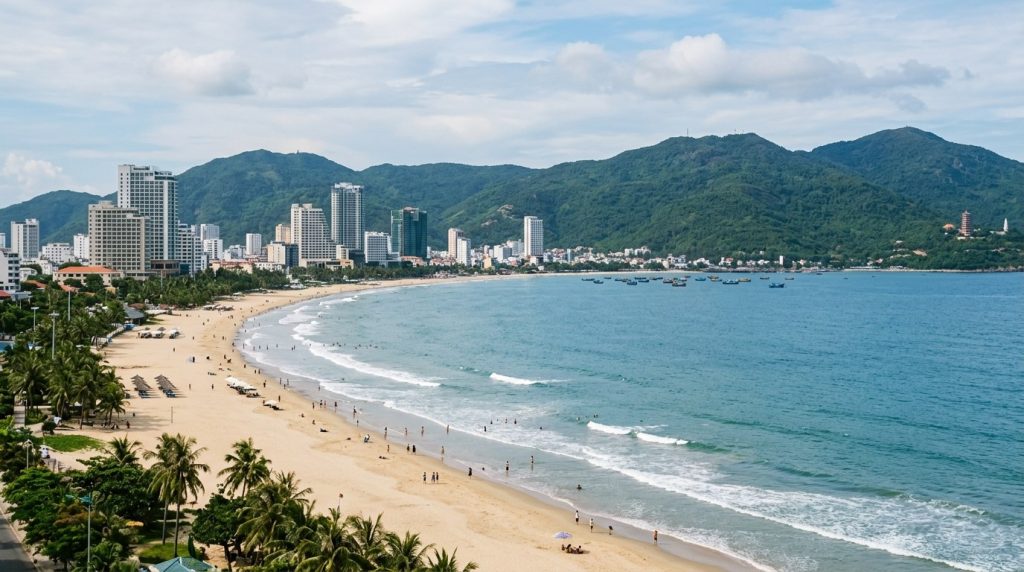
Da Nang’s My Khe Beach is several kilometres of open, gently sloping sand backed by high-rise hotels and resorts, with calmer swimming conditions and enough length that it rarely feels crowded even in peak months.
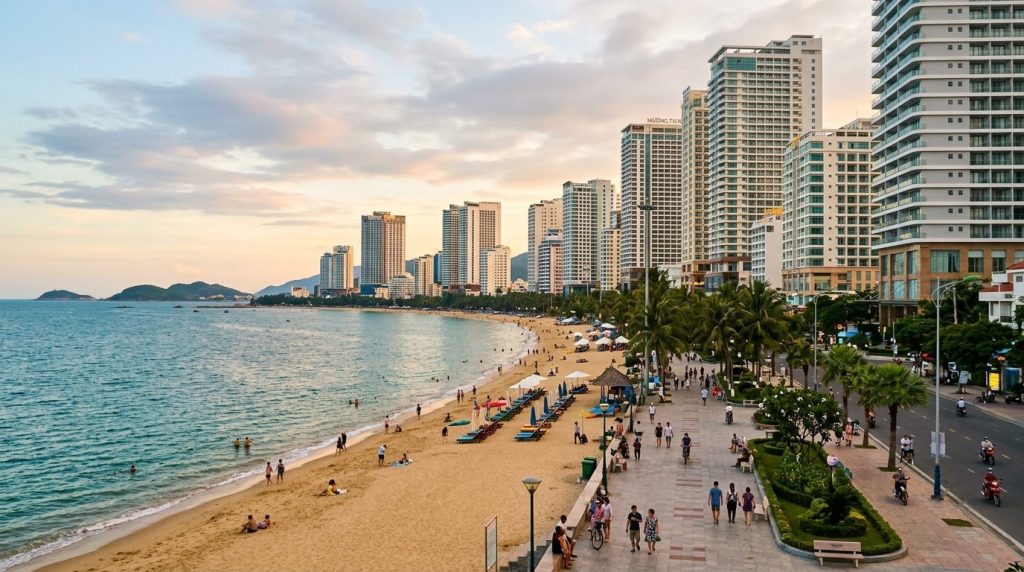
Nha Trang’s Tran Phu Beach runs along the length of the city itself, a busy strip backed by a promenade, hotels and the elevated Vinpearl cable car running out to Hon Tre island, and it draws heavier foot traffic simply because the city wraps around it rather than sitting beside it.
Nha Trang’s real beach advantage is offshore: Hon Mun is a marine protected area good for snorkelling, Hon Tam has a quieter resort beach, and the Vinpearl cable car (one of the longest over-water cable car systems in the world) makes island-hopping unusually easy for a city break.
Da Nang’s beach is the better swim; Nha Trang’s islands are the better day out.
Things to do: Ba Na Hills and Marble Mountains versus VinWonders and diving
Da Nang’s attractions lean toward scenery and culture. Ba Na Hills, with its Golden Bridge held up by giant stone hands, costs AUD 40 · USD 29 (VND 750,000) per adult for entry and the cable car, and the Marble Mountains and Son Tra Peninsula’s Lady Buddha statue add two more half-day stops without leaving the city.
Hoi An’s Old Town, 30 minutes south, is the single biggest reason Da Nang wins for first-timers, and a full route through both is worth checking in this 4-day Da Nang itinerary. Nha Trang’s attractions lean toward activity and theme-park entertainment instead.
VinWonders on Hon Tre island runs AUD 56 · USD 40 (VND 1,050,000) for an adult all-access ticket, and the city is one of Vietnam’s main diving and snorkelling bases thanks to the Hon Mun marine area, with day boats running out most mornings.
Thap Ba’s mineral mud baths, a popular half-day package at AUD 17 · USD 12 (VND 315,000), round out Nha Trang’s more activity-driven, less historic list of things to do.
Food: central Vietnamese staples versus a Russian-influenced tourist strip
Da Nang’s food scene centres on mi quang, a turmeric noodle bowl with pork, shrimp and rice crackers, alongside strong seafood and a broad spread of international restaurants that reflects the city’s larger size and more varied visitor base.
Nha Trang’s specialty is bun cha ca, a fish-cake noodle soup built on the city’s fishing-port history, plus nem nuong Nha Trang, grilled pork skewers wrapped in rice paper.
The bigger difference is context rather than the food itself: Nha Trang’s central tourist strip carries heavy Russian-language signage and menus, a legacy of the city’s long-running Russian charter tourism, which shapes the restaurant mix more than it does in Da Nang.
Crowd and vibe: family resort city versus package-tour beach town
Da Nang draws a mixed crowd of domestic Vietnamese travellers, other Asian visitors and a growing international base, and it reads as a modern, fairly polished resort city with moderate nightlife concentrated around the beach hotels and the Han riverfront.
Nha Trang carries a heavier package-tour identity, built up over two decades of large-scale Russian and domestic group tourism, and the result is a livelier but less culturally layered strip of bars, souvenir shops and all-inclusive resorts close to the centre.
Neither vibe is wrong, but Nha Trang feels more like a dedicated resort town and less like a city you would explore on foot for its own sake.
When to visit: the same coast, a different dry season
Da Nang and Nha Trang share the broad central-Vietnam pattern of a wetter second half of the year, but their microclimates are not identical. Nha Trang’s dry season runs January through August, several weeks longer than Da Nang’s January-to-July window, and its annual rainfall averages around 1,894mm against roughly 2,574mm in Da Nang.
November is the wettest month in both cities, but Da Nang’s November average of about 467mm is noticeably heavier than Nha Trang’s 330mm, and Da Nang is more exposed to the typhoons that track through central Vietnam from September into January.
Travellers pinning a trip to August or early September get more reliable sun in Nha Trang; a full month-by-month breakdown for Da Nang sits in this best time to visit Da Nang guide, and a country-wide view is in this best time to visit Vietnam guide.
See hotels in Da Nang →See hotels in Nha Trang →
Choose Da Nang if / choose Nha Trang if
Choose Da Nang if this is a first Vietnam trip, if Hoi An’s Old Town is on the list, if a calmer, longer swimming beach matters more than island day trips, or if a slightly more international, less package-tour atmosphere is the priority.
Choose Nha Trang if diving or snorkelling is the main goal, if a pure beach-resort week with a theme park and mud spas sounds better than sightseeing, or if the dry season needs to stretch into August.
For most Australians building a first central-Vietnam trip, Da Nang wins on balance, mainly because Hoi An sits 30 minutes away and turns one beach stop into a culture-and-beach combination that Nha Trang cannot match on its own.
Find your Da Nang hotel on the map
Live prices from Booking, Airbnb and more — move the map or change dates to compare stays.