Lombok Travel Guide 2026: Everything You Need to Know
By TravelguidestipUpdated 10 min readHow we earn
Hotel buttons open Stay22 (Booking.com, Agoda and others) and tour buttons open GetYourGuide. We may earn a commission at no extra cost to you.
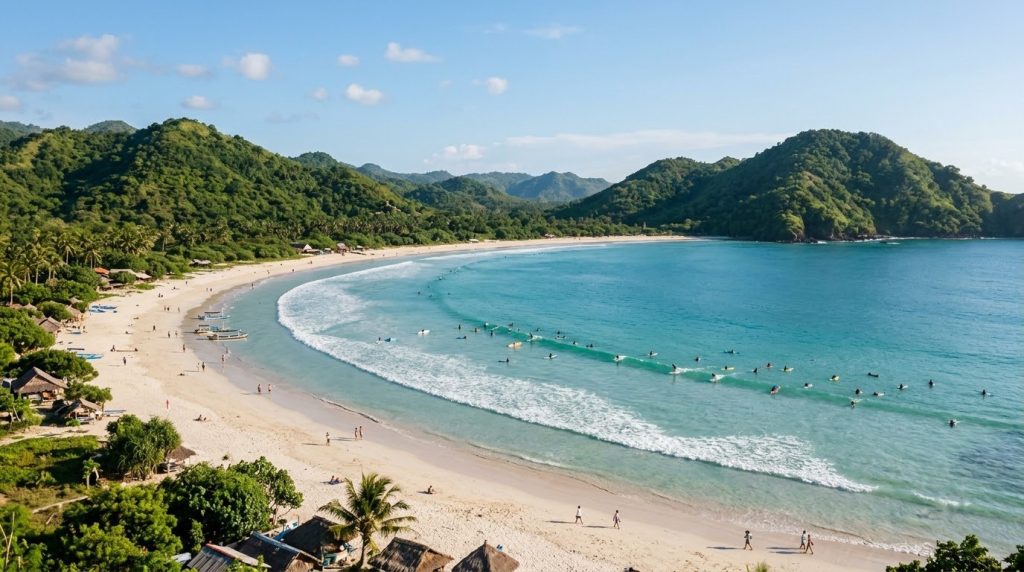
Quick answer: Lombok is Bali’s quieter eastern neighbor, best visited in the dry season (May–September) for Mount Rinjani trekking and Gili Island snorkeling. Plan 4–7 days to combine the Gilis, Kuta Lombok’s surf coast, and a Rinjani or Sasak-village day trip; it sits 30–45 minutes by flight or about 2 hours by fast boat from Bali, so it works as a standalone trip or a Bali add-on.
Key Takeaways: Lombok is Bali’s less-developed eastern neighbor — same volcanic landscape, better surf, cleaner Gili Island waters, and a fraction of Bali’s tourist traffic. Mount Rinjani (3,726m) is one of Southeast Asia’s great volcano treks. The Gili Islands (Trawangan, Air, Meno) have no motorized vehicles and some of Indonesia’s best snorkeling.
Lombok is 30-45 minutes by flight from Bali or 2 hours by fast boat — easy to combine or use as a standalone destination.
Lombok is part of the West Nusa Tenggara province of Indonesia. Population approximately 3.3 million. Main ethnic group: Sasak (indigenous). Religion: predominantly Muslim (unlike Hindu-majority Bali). Lombok International Airport (LOP) opened in 2011, located at Praya, 45km from Senggigi. Mount Rinjani (3,726m) is Indonesia’s second-highest volcano, active — last significant eruption 2016. The three Gili Islands (Trawangan, Air, Meno) have no motorized vehicles by local regulation since the 1980s.
For activity details, see Best Things to Do in Lombok. For where to base yourself, see Where to Stay in Lombok.
Why Lombok Instead of (or After) Bali — Lombok Travel Guide

Lombok is not “Bali without the crowds” — it’s a fundamentally different destination that happens to be nearby. The differences matter:
- Culture: Sasak Muslim culture vs Balinese Hindu culture. Different ceremonies, architecture, food, and village life.
- Surf: Kuta Lombok has some of Indonesia’s best surf breaks (Desert Point, Selong Belanak, Mawi). More advanced than Bali’s Kuta.
- Trekking: Rinjani is a serious multi-day summit. Bali has no equivalent.
- Gili Islands: Quieter, no cars, clearer water than anywhere in Bali.
- Development: Lombok is 10-15 years behind Bali in tourist infrastructure — better if you want space, harder if you need amenities.
Best reason to visit Lombok: the combination of surf + volcano + snorkel islands in one destination, with significantly less tourist density than Bali.
Lombok’s Key Regions

Senggigi (West Coast)
The original tourist center — beach strip with hotels, restaurants, and transport connections. Convenient base but not the most atmospheric. Best for: first night arrival, day trips north to Pura Batu Bolong temple.
Gili Islands (Northwest)
Three small islands 30-45 minutes by fast boat from Bangsal pier:
– Gili Trawangan — largest, bars/nightlife, backpacker-friendly, snorkel on east coast
– Gili Air — quietest with some facilities, best for mid-range travelers
– Gili Meno — smallest, most secluded, honeymoon territory, giant turtle sanctuary
Kuta Lombok (South)
Not the same as Kuta Bali. A small surf town with dramatic bays, empty beaches, and a growing boutique hotel scene. Desert Point (1.5h west) is one of Asia’s legendary left-hand breaks.
Sembalun Valley (East, Rinjani Base)
High plateau at 1,200m elevation — cool temperatures, strawberry farms, and the main eastern approach to Rinjani. Base for multi-day summit treks.
North Lombok (Senaru, Waterfalls)
Sendang Gile and Tiu Kelep waterfalls are among Indonesia’s most accessible waterfall pairs. Senaru village is also the northern Rinjani trailhead.
Find your Lombok hotel on the map
Live prices from Booking & Airbnb — tap a pin to compare stays around Kuta Lombok and Senggigi and beyond.
Lombok Quick Facts

| Category | Details |
|---|---|
| Currency | Indonesian Rupiah (IDR). 1 USD ≈ 15,700 IDR (2026) |
| Language | Bahasa Indonesia, Sasak dialect locally |
| Religion | Predominantly Muslim (call to prayer 5x daily) |
| Power | 220V/50Hz, Type C/F plugs |
| SIM card | Telkomsel/XL best coverage, buy at airport or Mataram |
| Time zone | WITA (UTC+8) |
| Best airport | Lombok International (LOP), Praya |
Getting to Lombok

From Bali:
– Fast boat: Padang Bai → Teluk Nare/Bangsal (2-2.5h, 300,000-450,000 IDR). Perama, Gili Getaway operate daily services.
– Ferry: Padang Bai → Lembar (4-5h, 60,000 IDR). Budget option, slow.
– Flight: DPS → LOP (30-45 min, 200,000-500,000 IDR). Best for time efficiency.
From Jakarta/other Indonesian cities:
– Direct flights to LOP on Lion Air, Citilink, Garuda Indonesia.
From Singapore/Kuala Lumpur:
– Connect via Bali (DPS) or fly direct (limited schedule). Check AirAsia.
Getting Around Lombok
Motorbike: Most practical for independent travelers. Rent from guesthouses 60,000-80,000 IDR/day. International license technically required but rarely checked outside major towns.
Grab: Available in Mataram and Senggigi areas. Doesn’t operate to Gili Islands or Kuta Lombok.
Private driver: 400,000-600,000 IDR/day for custom routes. Best value for 3-4 people visiting multiple areas.
Cidomo (horse cart): Traditional transport on the Gili Islands — the only wheeled vehicle permitted. 50,000-100,000 IDR for short trips.
Gili fast boats: Shuttle boats between islands run regularly, 80,000-150,000 IDR per trip.
Lombok Budget Overview
| Budget tier | Daily cost | What you get |
|---|---|---|
| Budget | 250,000-400,000 IDR | Guesthouse, warung meals, local transport |
| Mid-range | 500,000-1,000,000 IDR | Boutique hotel, restaurants, tours |
| Comfort | 1,000,000-2,500,000 IDR | Resort, guided activities |
Lombok is cheaper than Bali equivalent for accommodation (15-25% less) and eating locally. Gili Islands add a premium — island transport and import costs push restaurant prices up. Typical daily costs for rooms, food and transport are set out in our Lombok travel cost guide.
See Best Things to Do in Lombok for activity costs, Where to Stay in Lombok for accommodation picks.
When to Visit Lombok
Best: May-September (dry season). July-August is peak for Rinjani trekking — clearest skies, driest trails.
Avoid for trekking: December-February (wet season). Rinjani trails become slippery, river crossings dangerous. Rinjani officially closes during peak wet season.
Gili Islands: Year-round. July-August sees the most visitors but the islands are small enough that it rarely feels overcrowded.
Surf: Dry season (May-September) for south swells. Desert Point works best June-September.
Lombok with Kids
Lombok has fewer dedicated kids’ attractions than Bali, but families still do well here by basing in Senggigi or Kuta Lombok rather than the Gili Islands’ party strip.
Selong Belanak, a wide curved bay near Kuta, suits younger children best. The sand is soft, the shallows are calm for paddling, and beach vendors rent loungers and sell food on-site.
Kuta Lombok’s town beaches have fewer sharp coral patches underfoot than the Gili Islands, making them easier for barefoot toddlers. Senggigi’s main beach strip can collect litter between cleanups, so check conditions before settling in for sandcastle time.
Surf schools at Selong Belanak and Kuta Lombok run lessons for children as well as adults, using soft-top boards and gentle beginner waves — a good half-day activity that doesn’t require strong swimming experience.
On the Gili Islands, swap the moped-free streets for cidomo horse carts or a bicycle with a child seat — there’s no motorised traffic to worry about. Gili Meno’s turtle sanctuary is a reliable half-day stop that keeps most kids engaged without heavy walking.
A family-friendly Gili day trip usually means a shared snorkel boat around Gili Air or Gili Meno rather than the livelier Gili Trawangan, since the reef there is calmer and easier to supervise from the water.
Skip Mount Rinjani with young children: the multi-day trek involves steep, exposed trail sections and mandatory overnight camping at altitude that isn’t built for family logistics. Save the volcano for a solo or adults-only side trip.
Many mid-range hotels and resorts around Senggigi and Kuta let children stay free in a parent’s room — confirm the age cutoff and any extra-bed fee when booking.
Pack children’s seasickness tablets for the Bali-Lombok fast boat crossing and any Gili inter-island transfers — the open-water stretch between Padang Bai and the Gilis can get choppy outside the calmest months.
The nearest full-service hospital is in Mataram, roughly 45 minutes from Kuta Lombok by road; confirm your travel insurance covers medical evacuation from the Gili Islands, where facilities are limited to small clinics for minor issues.
Strollers are impractical outside the main hotel grounds — footpaths in Senggigi and Kuta are uneven or non-existent in places, and sand or cobbled lanes dominate the Gili Islands, so a baby carrier works far better for toddlers than a pram.
What to Pack for Lombok
Lombok’s mix of beach, volcano, and traditional villages calls for a slightly wider packing list than a pure beach trip. A few items are hard to find locally or cost noticeably more once you land.
Reef-safe sunscreen is the first priority — it’s sold in Senggigi and Kuta shops but at a premium, so bring enough for the whole trip. A rash guard or light long-sleeve top cuts down on how much sunscreen you need in the water.
Pack a dry bag for any Gili Islands boat crossing. Fast boats beach directly on the sand rather than using a jetty, so bags get splashed or dunked during boarding.
Bring flip-flops for the beach and one pair of closed, sturdy shoes — sandals aren’t enough for the waterfall trails near Senaru or for Rinjani’s volcanic scree if you add the trek.
A sarong earns its space twice over: as sun cover on boat decks and as a quick layer for visiting Sade village, mosques, or any setting where bare shoulders or thighs would stand out.
Carry a basic first-aid kit with rehydration salts and antiseptic — pharmacies are easy to find in Mataram and Senggigi but thin on the Gili Islands and in Sembalun.
A universal travel adapter covers Lombok’s Type C/F sockets, and a small portable battery pack is useful on Rinjani treks or full-day Gili island-hopping where charging points are scarce.
Lightweight, quick-dry clothing works better than heavy fabrics given Lombok’s humidity; pack for 4-5 days and plan to use a guesthouse laundry service, which most offer cheaply.
If the itinerary includes Rinjani, add a warm layer and a headlamp — temperatures near the summit and crater rim drop sharply overnight, a contrast most travelers don’t expect on a tropical island.
Local Etiquette and Dress in Lombok
Lombok is predominantly Muslim, and everyday dress and manners are more conservative than Bali’s. Beachwear is fine on the sand at Kuta, Senggigi, or the Gili Islands, but swap it for covered shoulders and knees once you step into a town, village, or shop.
Visiting Sade village or any other Sasak settlement, modest clothing matters more than at the beach resorts — long trousers or a knee-length skirt and a shirt with sleeves are the safe default for both men and women.
Mosques are active across Lombok, and the call to prayer sounds five times daily. Non-Muslim visitors can usually view mosque exteriors respectfully, but entering the prayer hall typically requires a headscarf for women, modest dress for everyone, and removing shoes.
Remove your shoes before entering a private home, a losmen’s family living area, or any shop where the owner has already removed theirs — it’s a near-universal cue across rural Lombok.
During Ramadan, many warungs outside the main tourist strips close or reduce hours during daylight; eating or drinking visibly in public is worth avoiding out of respect, even though hotels and tourist restaurants keep serving as normal.
Public displays of affection beyond hand-holding are best kept minimal outside of resort grounds, in line with local norms across the Sasak Muslim community.
When photographing people in traditional villages, ask first — a nod or gesture is enough, and most residents are happy to be photographed once asked rather than caught by a passing lens.
A lightweight sarong doubles as both practical modesty cover and a quick layer for temple or village visits, worth keeping in your day bag rather than packed away.
Tipping isn’t deeply embedded in Sasak custom but is increasingly expected in tourist-facing roles — rounding up for drivers, guides, and spa staff is appreciated and doesn’t need to be large.
Frequently Asked Questions
Is Lombok worth visiting?
Yes — especially for travelers who’ve done Bali and want something less developed, or who want to surf/trek in combination with beach time. The Gili Islands are among Southeast Asia’s best snorkeling destinations.
Is Lombok safe for tourists?
Generally yes. Standard precautions apply. The Gili Islands are very safe — no motorized vehicles reduces accident risk. Rinjani treks should use a licensed guide. For road risks, scams and areas to watch, read is Lombok safe.
How many days do you need in Lombok?
Minimum 4 days for Gili Islands only. 7-10 days for Gili Islands + Rinjani trek + Kuta. Most travelers do 5-7 days.
Can you do Lombok as a day trip from Bali?
Not recommended. The crossing takes 2+ hours each way. Even Gili Trawangan deserves 2 nights minimum.
Affiliate Disclosure: This post may contain affiliate links. We earn a small commission at no extra cost to you if you book through these links.
Sources:
1. Lombok Tourism — West Nusa Tenggara official tourism, 2025
2. Indonesia.travel — Lombok destination guide, 2025
3. Mount Rinjani National Park — official trekking information, 2025
More Lombok Guides
- Best Day Trips from Lombok 2026: 8 Excursions Worth Taking
- Best Hotels in Lombok 2026: Top Picks for Every Budget
- How to Get to Lombok 2026: Complete Transport Guide
- Lombok Travel Budget 2026: Complete Cost Breakdown Guide
- Best Time to Visit Lombok 2026: Month-by-Month Weather Guide
- Best Food in Lombok 2026: 12 Must-Try Dishes + Where to Eat
- Lombok Itinerary 2026: Best 5 & 7-Day Plans