Disclosure: Some links in this guide are affiliate links. If you book or buy through them, we may earn a small commission at no extra cost to you — it helps keep our guides free.
Best Jiufen Travel Guide 2026: Taiwan’s Real-Life Spirited Away Mountain Village
Jiufen clings to a mountainside in northern Taiwan like a village that gravity forgot. Narrow stone staircases climb between red lanterns and wooden tea houses. The Pacific Ocean stretches to the horizon from every balcony. Mist rolls in from the East China Sea most afternoons, wrapping the village in the kind of atmospheric fog that makes you understand exactly why Hayao Miyazaki reportedly drew inspiration from this place for the bathhouse in Spirited Away.
Once a gold mining boomtown during the Japanese colonial era, Jiufen now draws over 5 million visitors annually (Taiwan Tourism Bureau, 2026) to its lantern-lit alleyways and teahouse terraces. This Jiufen travel guide covers why this village looks like an anime come to life, the best things to do on Old Street, the tea houses worth climbing stairs for, the most magical photo spots, and how to get here from Taipei.
Key Takeaways
– Jiufen Old Street (Jiufen Laojie) is the main pedestrian alley lined with food stalls, tea shops, and lanterns. Go on a weekday. Saturdays see shoulder-to-shoulder crowds. The street runs roughly 500 meters and takes 30-60 minutes to walk.
– The best tea house is A-Mei Tea House, the dark wooden building with cascading red lanterns that appears in every Jiufen photograph. A pot of oolong tea costs 300-500 TWD (9-15 USD). Reserve a balcony table at least one week ahead.
– Shifen Waterfall and Sky Lantern release pair naturally with Jiufen as a full-day itinerary from Taipei. Shifen is a 40-minute drive away. Release a lantern on the railway tracks in Shifen Old Street (200 TWD/6 USD).
– The night view from Jiufen is the reason to stay until dark. The red lanterns illuminate against the dark sea around 6:00 PM in winter (5:30 PM November-February). The last bus to Taipei departs around 9:00 PM.
– Jiufen is a 1-hour day trip from Taipei. Take the TRA train to Ruifang (40 minutes, 49 TWD/1.50 USD), then bus 788 or 965 up the mountain (15 minutes, 15 TWD). Total one-way cost: less than 3 USD.We only recommend services we genuinely trust. Learn more.
**** We first visited Jiufen on a Saturday in November and could barely move through Old Street. We returned on a Tuesday in March, arriving at 10:00 AM before the Taipei day-trippers, and had the staircase below A-Mei Tea House entirely to ourselves for 15 minutes. The village was the same. The experience was unrecognizable.
Why Jiufen Looks Like Spirited Away
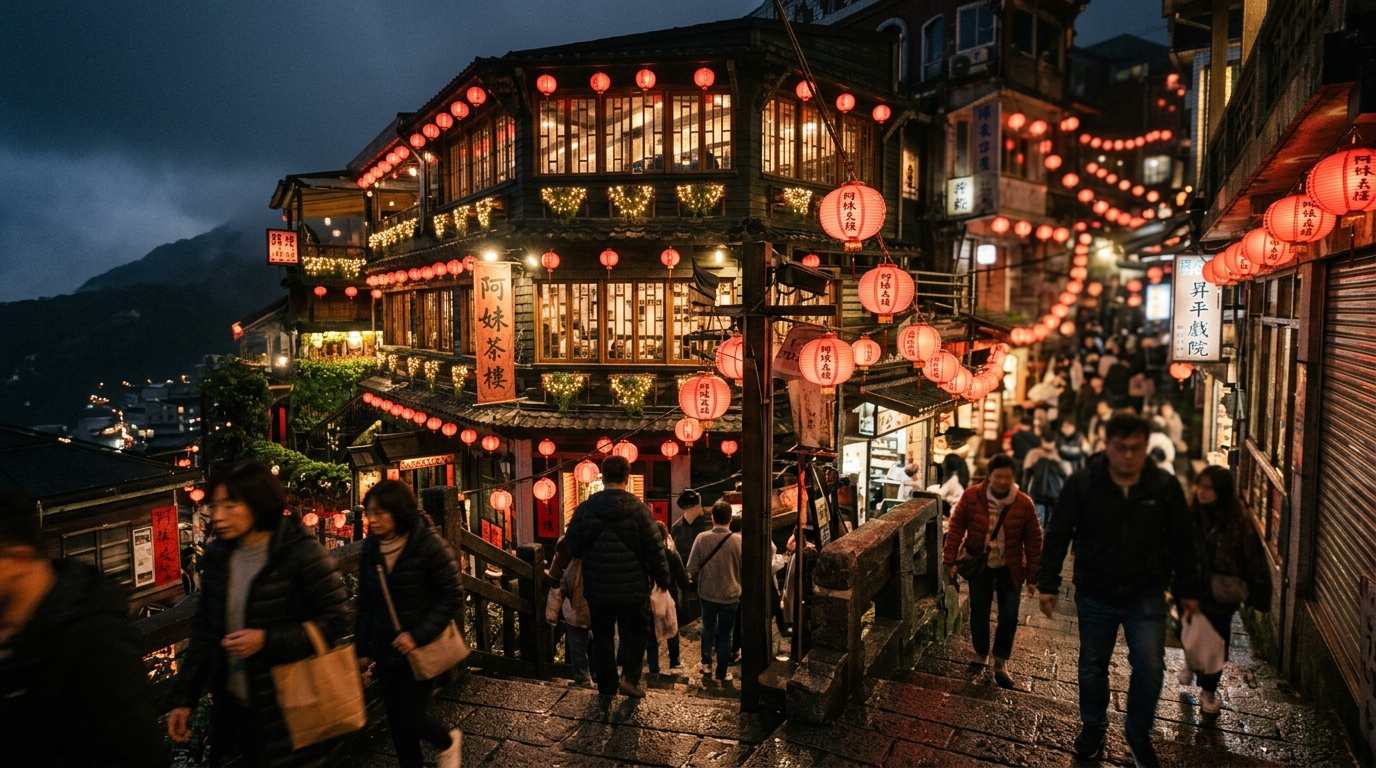
Jiufen was built during the gold rush of the 1890s-1940s, when the hills around the village produced more gold than anywhere else in the Japanese Empire. The mining company built a company town of wooden houses clinging to the steep hillside, connected by staircases rather than roads. The Japanese influence is visible in the architecture: wooden sliding doors, tiled roofs, latticed windows.
When the gold ran out in the 1970s, the village emptied. It was “rediscovered” in 1989 by the Taiwanese film A City of Sadness, which used Jiufen as a location. Tourism followed. Then Spirited Away premiered in 2001, and visitors from Japan and later the world began pointing at the red lanterns, the narrow staircases, and the teahouse balconies and saying two words: “Spirited Away.”
Hayao Miyazaki has neither confirmed nor denied that Jiufen directly inspired the bathhouse. Studio Ghibli has stated that the film’s visual inspiration came from multiple sources. But standing on the staircase below A-Mei Tea House at dusk, with the red lanterns glowing against the darkening sea, the question of whether Miyazaki copied Jiufen or Jiufen later shaped itself to the comparison feels beside the point. The village is gorgeous. The comparison is earned.
The 2-Day Jiufen Itinerary
The plan we use ourselves — sent straight to your inbox.
- Day-by-day route
- Where to stay
- Real 2026 costs
Free · No spam · Unsubscribe anytime
Best Things to Do in Jiufen Old Street
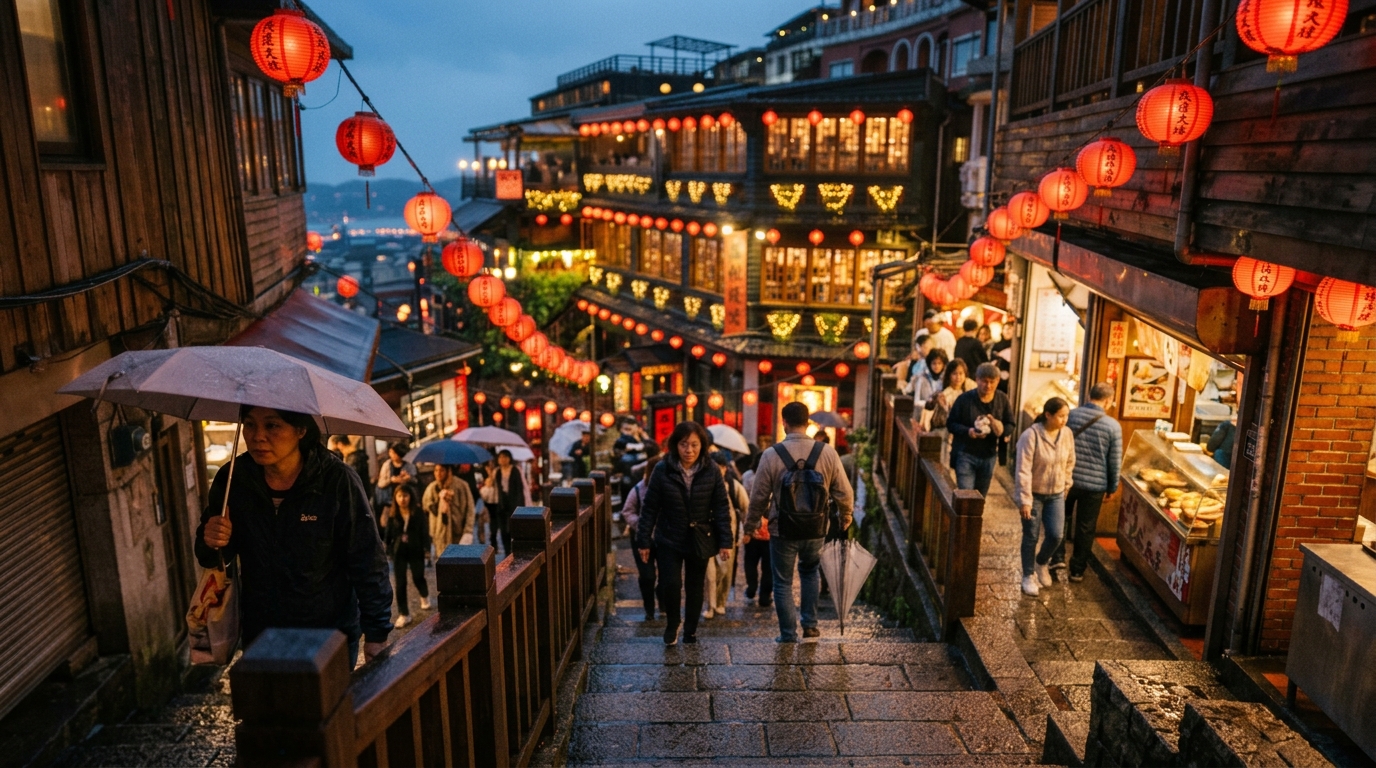
Jiufen Old Street (Jiufen Laojie)
The main pedestrian alley curves through the heart of the village, lined with food stalls, tea shops, and souvenir stores selling hand-painted lanterns and pineapple cakes. The street narrows to barely two meters in places, and the crowd flow moves like a river in a canyon.
The food is the point. Peanut ice cream rolls (40 TWD/1.20 USD): two scoops of taro ice cream wrapped in a thin crepe with shaved peanut brittle and cilantro. The combination sounds wrong. It is not. Taro balls (yu yuan) at Grandma Lai’s (50 TWD/1.50 USD): chewy taro and sweet potato balls in sweet bean soup, served in a bowl you eat standing on the staircase because this is Jiufen and chairs are aspirational. Stinky tofu (50 TWD): fermented tofu deep-fried and served with pickled cabbage. The smell is legendary. The taste is better than the smell.
Walk the full 500 meters of Old Street. Eat everything. Budget 200-300 TWD (6-9 USD) for a complete street food meal.
Shengping Theater
The Shengping Theater, built in 1934 during the Japanese colonial period, was the first movie theater in northern Taiwan. It screened films for miners and their families, and it has been preserved with the original wooden seats, projector, and film posters. The theater is free to enter and takes 15 minutes to explore. The balcony view of Jiufen’s rooftops and the sea is a bonus.
Gold Ecological Park
A 10-minute bus ride from Jiufen in the neighboring village of Jinguashi, the Gold Ecological Park preserves the ruins of the Japanese-era gold mining operation. The highlight is the Crown Prince Chalet, a wooden Japanese-style residence built in 1922 for a visit by the Japanese Crown Prince (the visit never happened, but the chalet is beautiful). Walk up the hill to the Golden Waterfall, where oxidized minerals in the water have turned the rocks a vivid rust-orange. The waterfall is free. The color looks Photoshopped. It is not.
Best Tea Houses with a View
A-Mei Tea House
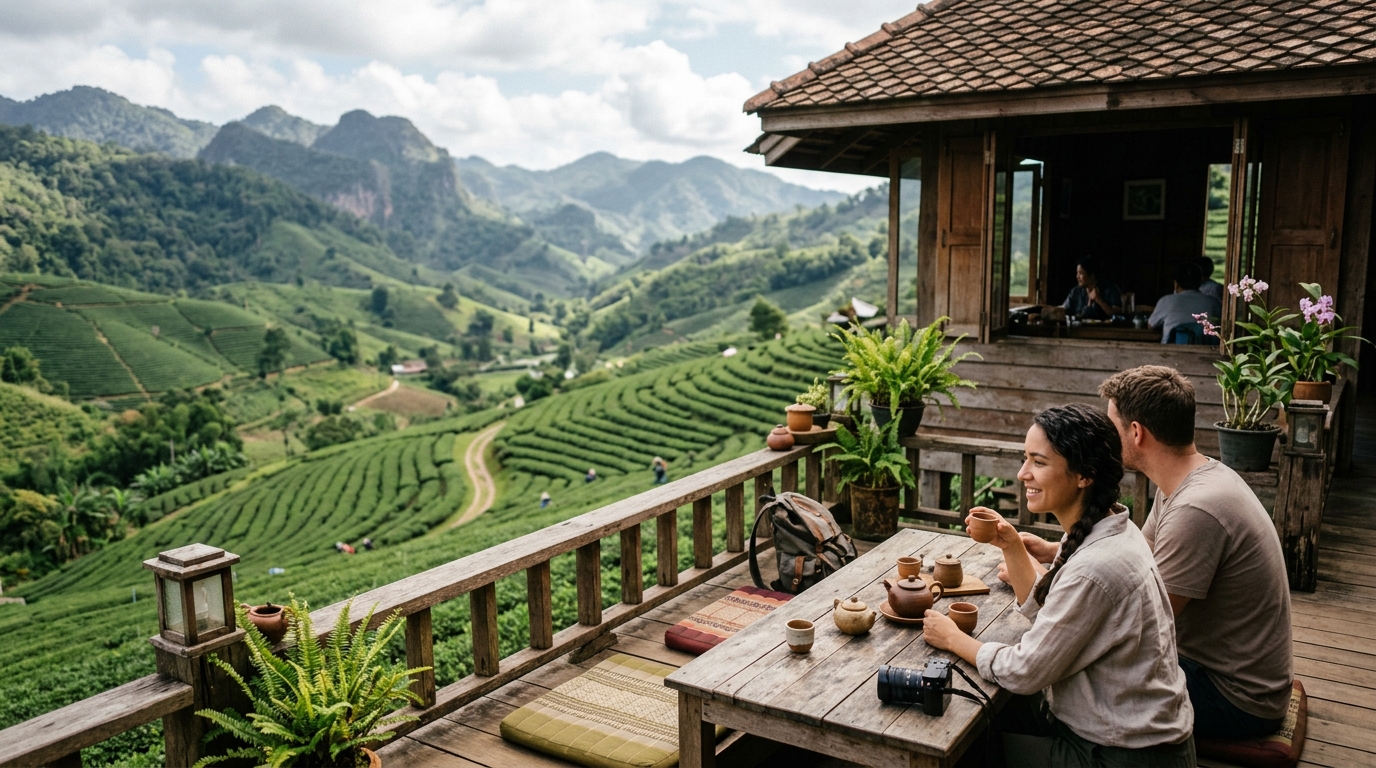
The dark wooden building draped in red lanterns sitting at the junction of Old Street and the staircase to the temple is the single most photographed building in Taiwan. A-Mei Tea House occupies the best real estate in Jiufen, and it knows it. The interior is dark, intimate, and filled with the scent of brewing oolong. The balcony terrace seats 10-12 people and overlooks the Pacific Ocean.
A pot of high-mountain oolong costs 300-500 TWD (9-15 USD). The tea is served in a traditional gongfu ceremony: rinse the leaves, pour the first steep, pour the second, drink the third. The process takes 30-45 minutes and is the point. Reserve a balcony table at least one week ahead by calling the teahouse directly. Walk-ins can wait 30-60 minutes on weekends.
Jiufen Teahouse
Across the staircase from A-Mei, the Jiufen Teahouse is slightly less famous and slightly less crowded. The interior is a maze of wooden rooms at different levels connected by narrow staircases. The balcony seats face the sea directly. A pot of tea costs 250-400 TWD (7.50-12 USD). The sweet potato cake (80 TWD) is made in-house.
Skyline Tea House
A 5-minute walk uphill from the main street, Skyline Tea House has the highest balcony view in Jiufen and the fewest visitors. The climb deters the casual tourist. The view of the lanterns below, the sea, and Keelung Mountain across the valley rewards the climb. A pot of tea costs 200-350 TWD (6-10 USD). Go at dusk for the transition from daylight to lantern light.
The 2-Day Jiufen Itinerary
Hour-by-hour plan, where to stay and what it really costs — free PDF.
Free · No spam · Unsubscribe anytime
Most Magical Photo Spots in Jiufen
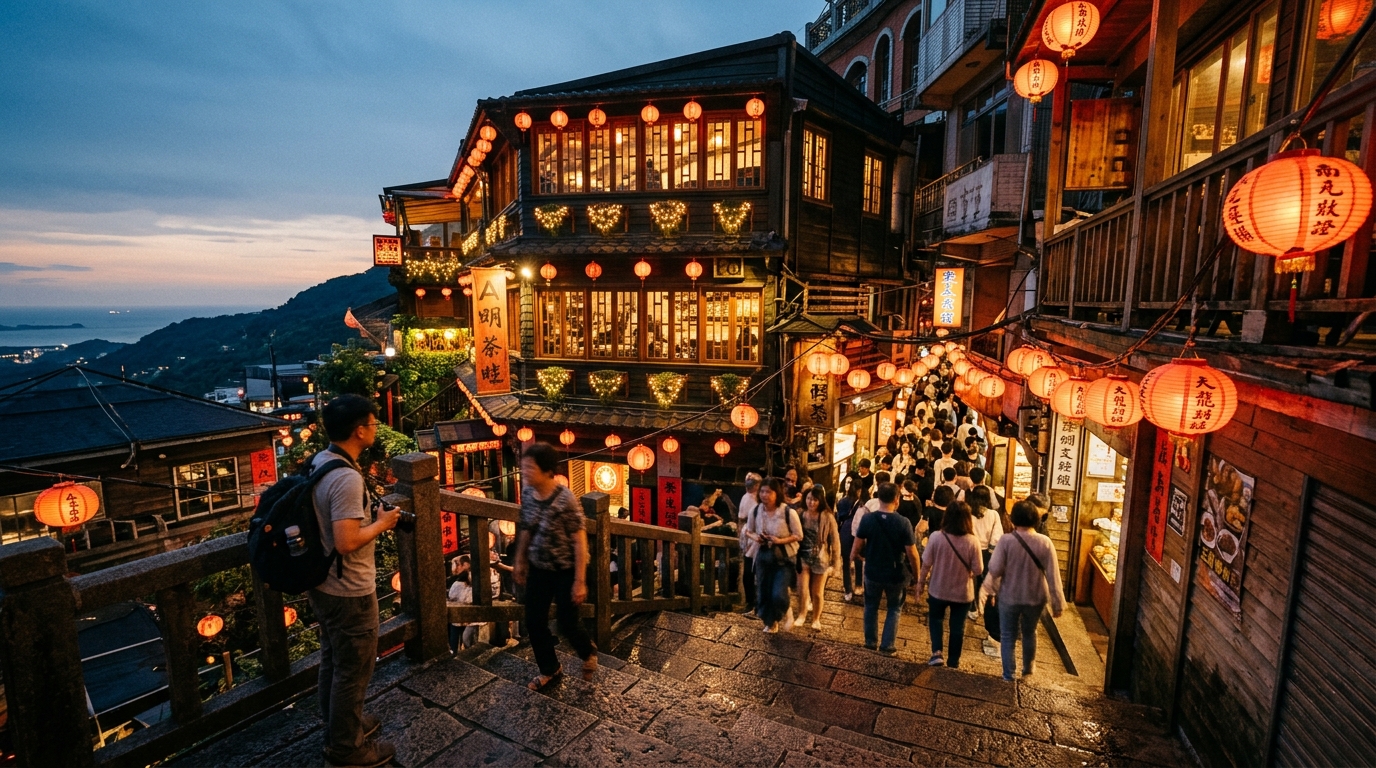
The Classic: Shuqi Road Staircase
The staircase descending from A-Mei Tea House along Shuqi Road is the Spirited Away shot. Red lanterns line both sides. The teahouse rises on the left. The sea fills the background. Photograph from the bottom of the stairs looking up, ideally at dusk when the lanterns are lit and the sky is deep blue rather than black. A 50mm lens compresses the lanterns. Arrive at 5:00 PM in winter, 6:00 PM in summer. By 5:30 PM on weekend evenings, photographers with tripods form a queue.
The Sea View: A-Mei Tea House Balcony
From the balcony of A-Mei Tea House, the view looks down across the rooftops of Jiufen toward the Pacific. On clear days, the horizon line divides the frame into equal thirds: lanterns and rooftops, green hills, blue sea. A 35mm lens captures the full scene. Book the balcony table for the last seating of the afternoon to photograph the transition to dusk.
The Mist Shot: Old Street at Dusk
When the mist rolls in from the sea, Jiufen Old Street transforms into a tunnel of warm lantern light cutting through grey fog. The atmosphere is pure fantasy. Photograph from the midpoint of Old Street, where the curve of the alley creates depth. A 50mm lens at f/1.8 or wider handles the low light. ISO 3200 or higher is necessary.
The Detail: Red Lanterns
Isolate individual lanterns against the dark wood of the teahouses. A 70-200mm lens at 200mm compresses multiple lanterns into a layered pattern of red circles and warm light. Focus on the nearest lantern and let the others blur. The effect looks like a Spirited Away production still. Because, essentially, it is.
**** Most visitors photograph the A-Mei staircase from the bottom. Walk 50 meters uphill past the teahouse to the small temple platform above. From here, the entire staircase, the red lanterns, the teahouse, and the sea compress into a single frame from a bird’s-eye angle that almost no one else captures.
How to Get to Jiufen from Taipei
By Public Transport (Budget)
Take the TRA train from Taipei Main Station to Ruifang (40 minutes, 49 TWD/1.50 USD one-way). Exit Ruifang station and cross to the bus terminal. Take bus 788 or 965 to Jiufen (15 minutes, 15 TWD). The bus climbs the mountain in a series of switchbacks with sea views. Total journey: roughly 1 hour, 64 TWD (2 USD) each way. Trains depart every 20-30 minutes. Buses every 15-20 minutes. The last return bus from Jiufen to Ruifang departs around 9:00 PM. Check the schedule at the bus stop on arrival.
By Guided Tour (Convenience)
If you prefer not to navigate Taiwanese bus timetables, book a guided Jiufen and Shifen day tour through GetYourGuide. Tours depart Taipei at 8:00-9:00 AM and return by 5:00-6:00 PM, covering Jiufen, Shifen Waterfall, and a sky lantern release at Shifen Old Street. Prices range from 1,200-1,800 TWD (37-55 USD) including transport and guide.
Combined Day Trip: Jiufen + Shifen
The ideal day trip from Taipei pairs Jiufen with Shifen, a former coal-mining town 40 minutes away. At Shifen, write your wishes on a paper lantern (200 TWD/6 USD for a four-color lantern), release it from the railway tracks (the train still runs through the town center, creating one of Taiwan’s most photographed juxtapositions of tradition and infrastructure), and walk to the Shifen Waterfall (free), Taiwan’s widest waterfall at 40 meters across.
Route: Taipei → Ruifang → Jiufen (morning) → Ruifang → Shifen (afternoon) → Taipei. The Pingxi Line train from Ruifang to Shifen takes 25 minutes. This itinerary fills a full day from roughly 9:00 AM to 7:00 PM.
Frequently Asked Questions
How many hours do I need in Jiufen?
Two to three hours is adequate for Old Street, the food, and one teahouse. Three to four hours allows a relaxed pace with tea at A-Mei and photography at dusk. Jiufen is small and can be experienced thoroughly in half a day.
Is Jiufen worth visiting?
Yes. Jiufen is one of Taiwan’s most atmospheric destinations and unlike anywhere else on the island. The combination of red lanterns, mountain teahouses, sea views, and street food creates a visual and sensory experience that justifies the day trip. Over 5 million annual visitors (Taiwan Tourism Bureau, 2026) confirms its status.
What is the best time to visit Jiufen?
Weekdays (Tuesday-Thursday) are dramatically quieter than weekends. November through March brings cooler weather and the best atmospheric mist. April through June brings spring flowers and clearer skies. July and August are hot (30-35 degrees C/86-95 F) and humid. Go in the late afternoon regardless of season to experience the lanterns lighting up at dusk.
Is Jiufen good at night?
Jiufen is most beautiful at dusk and the early evening when the lanterns are lit and the sky is still deep blue. After 8:00 PM, most food stalls and shops close. By 9:00 PM, the village is quiet. Stay for the lantern lighting at dusk, then take the 8:00 PM bus back to Taipei.
How do I get from Jiufen to Shifen?
Take bus 788 or 965 from Jiufen back to Ruifang (15 minutes). From Ruifang, take the Pingxi Line train to Shifen (25 minutes). The combined journey takes roughly 1 hour. A taxi between Jiufen and Shifen costs 600-800 TWD (18-25 USD) and takes 30 minutes.
Jiufen at dusk, when the red lanterns flicker on against a darkening Pacific sky and the mist rolls in from the sea, is one of the most atmospheric experiences in Taiwan. The food stalls on Old Street will fill you for 200 TWD. The tea at A-Mei will cost more than the food and be worth it. The staircase below the teahouse will have a queue of photographers, and you will join them. Accept these things. Jiufen is not a secret. It is a shared dream.
For more Taiwan inspiration, explore our guides to Taipei, Sun Moon Lake, and Taroko Gorge. For more Asian travel, read our guides to Bali and Tokyo. For mountain getaways, visit our Grindelwald guide in the Swiss Alps.
Sources: Taiwan Tourism Bureau (2025-2026), TRA train schedules (2026). Book: GetYourGuide for Jiufen tours, Booking.com for Taipei hotels, Airalo for Taiwan eSIM from $6.