Disclosure: Some links in this guide are affiliate links. If you book or buy through them, we may earn a small commission at no extra cost to you — it helps keep our guides free.
Chiang Mai carries the same level 2 of Smartraveller’s 4 advice levels as the rest of Thailand, “exercise a high degree of caution,” and it sits roughly 900km north of the only zone in the country rated level 4, the 50km-deep do-not-travel strip along the Cambodia border. The real issue isn’t crime or conflict, it’s air quality: weeks of hazardous smoke each dry season that most guides barely mention.
| Risk | How likely | How serious | What actually prevents it |
|---|---|---|---|
| Burning-season air pollution (Feb-Apr) | Near-certain during peak weeks | Respiratory, worse for asthma/kids/elderly | Time your trip outside Feb-Apr, or mask up and stay indoor-cool on red days |
| Motorbike taxi and rental accidents | Common, Chiang Mai ranks among Thailand’s higher-risk provinces | Injury, occasionally fatal | Helmet always, licensed rental only, skip riding if inexperienced |
| Tuk-tuk, tailor and gem-shop scams | Frequent around Tha Phae Gate and Night Bazaar | Financial, rarely confrontational | Agree fares first, decline “free tour” stops, buy gems only from your hotel’s recommended shop if at all |
| Petty theft | Uncommon, opportunistic | Financial | Zipped bag, phone off the table at night markets |
| Dengue fever (wet season) | Present May-Oct, moderate in the north | Flu-like illness, rarely severe with care | Repellent, cover up at dawn/dusk, empty standing water |
| Terrorism or armed conflict | Not present in Chiang Mai | N/A, different region entirely | Chiang Mai is ~900km from the Cambodia border zone |
Chiang Mai is nowhere near the Cambodia border warning
Smartraveller’s Thailand advisory keeps the whole country at level 2 of 4, “exercise a high degree of caution,” and that’s the rating Chiang Mai shares with Bangkok, Phuket and every other major tourist city.
The one exception sits at the opposite end of the country: in February 2026, Smartraveller raised the advice for land within 50km of the Cambodia border to level 4, “do not travel,” after a Thai-Cambodian armed clash left landmines and unexploded ordnance there.
That zone sits hundreds of kilometres away on Thailand’s eastern edge; no realistic Chiang Mai itinerary goes anywhere near it, so the city carries none of that warning’s landmine or conflict risk. For the country-wide picture beyond the border strip, see this Thailand safety guide.
Entry and exit requirements
Thailand cut its visa-free stay for Australian passport holders from 60 days to 30 days per entry, effective 15 September 2026, so travellers planning a longer Chiang Mai stay or a multi-country Southeast Asia loop should check this before booking flights rather than assuming the older 60-day allowance still applies.
A passport valid for at least six months beyond the arrival date remains the standard requirement, and most travellers also need to complete Thailand’s online arrival card ahead of landing.
A 30-day stay covers every trip length covered elsewhere in this guide, from a short burning-season-avoiding visit to a slower multi-week stay pairing Chiang Mai with Pai or Chiang Rai.
Anyone wanting to stay longer than 30 days needs to arrange a visa in advance, either through a Thai embassy or consulate before departure, since the exemption no longer extends to the 60-day window some travellers may remember from earlier trips.
Exit requirements are straightforward: no exit visa or special departure paperwork applies to tourists leaving within the permitted stay, though overstaying even by a day carries a fine calculated per day over the limit, enforced at the airport on departure.
Border runs to reset the visa-exempt clock, once a common workaround, carry more scrutiny than in past years, so travellers planning a stay beyond 30 days are better served arranging the correct visa in advance than relying on a border crossing to extend the trip.
Thailand’s Digital Arrival Card, a short online form covering passport and trip details, is required before or shortly after landing and is separate from the visa-exemption question above; completing it ahead of the flight avoids a queue at immigration on arrival into Chiang Mai International Airport or any other Thai entry point on the same trip.
Travellers connecting through Bangkok or another Thai city before reaching Chiang Mai only need to complete the arrival card once, at the first point of entry into the country.
Burning season: Chiang Mai’s real health risk
Air pollution, not crime, is the one risk in Chiang Mai that genuinely changes a trip, and most competitor guides underplay it. Every year from roughly February to April, farmers across northern Thailand and neighbouring Myanmar and Laos burn crop stubble and forest undergrowth, and Chiang Mai’s mountain-ringed valley traps the smoke instead of letting it clear.
In 2026 the city topped IQAir’s global pollution index at an AQI of 263 on 29 March, with PM2.5 readings hitting 188 micrograms per cubic metre citywide and over 300 in some districts, roughly ten times WHO’s safety guideline. Chiang Mai, Lamphun and Phayao were declared disaster zones on 4 April 2026, and hospitals reported more respiratory admissions that week.
None of this makes Chiang Mai dangerous outside the burning window, when air quality is otherwise unremarkable for a Southeast Asian city. Check month-by-month conditions in a best time to visit Chiang Mai guide before booking; shifting a trip four to six weeks either side of peak burning avoids the worst of it.
If you do travel during the window, an N95 or KN95 mask outdoors on red-AQI days and a hotel room with real air filtration matter more than any other safety precaution in the city.
Tuk-tuk, tailor and gem-shop scams
The commission scam is Chiang Mai’s most common visitor annoyance, and it runs on a predictable script.
A tuk-tuk driver near Tha Phae Gate or the Old City moats offers a suspiciously cheap or free ride, on the condition of a short stop at a gem shop, tailor or souvenir store where the driver collects a commission for bringing you in.
Once inside, high-pressure sales staff push overpriced or fake goods, often “tax-free export day” gemstones that are actually coloured glass. The gem scam is more a Bangkok specialty; it’s present here too, but with less intensity and fewer reported losses.
Agree a tuk-tuk or songthaew fare before you get in rather than after, a short hop across the Old City typically runs AUD 3 · USD 2 (THB 60), and decline any “free tour” offer that includes a shop stop. If a driver won’t quote a flat price up front, walk to the next one; Grab’s in-app fare works the same way without the negotiation.
Motorbike taxis and road traffic
Traffic, not crime, causes the most serious injuries visitors experience in Chiang Mai. Thailand has one of the highest motorcycle-accident death rates in the world, and Chiang Mai province ranks among the country’s more dangerous provinces for road deaths.
A widely cited study of foreign riders found more than half had an accident within six months, and inexperienced tourists renting a scooter for the first time make up a disproportionate share of the injuries. Riding without a helmet remains common despite the law, and it’s the single biggest factor separating a minor spill from a serious one.
Motorbike taxis (win) charge roughly AUD 3 · USD 2 (THB 60) for a short in-town hop, agreed before you climb on, while a self-drive scooter rental runs around AUD 8 · USD 6 (THB 200) a day.
Wear the helmet every time, confirm your travel insurance covers motorbike riding (many policies exclude it or require a local licence), and if you’ve never ridden before, a songthaew (shared red truck) or Grab car is the safer way to get around rather than learning on Chiang Mai’s traffic.
Petty theft and violent crime
Violent crime against tourists is rare in Chiang Mai, and what theft does happen is almost always opportunistic rather than targeted. Night bazaars, the Sunday Walking Street market and crowded temple courtyards are where an unattended phone or unzipped bag goes missing, not through confrontation but a moment’s inattention in a crowd.
Keep valuables zipped away, don’t leave a phone face-up on a bar or market stall, and the same city-market caution that applies anywhere in Southeast Asia covers nearly all of the risk.
Dengue fever in the wet season
Dengue is present across Thailand year-round but peaks with the mosquito breeding conditions of the wet season, roughly May to October, and the northern provinces including Chiang Mai sit at moderate risk compared with Thailand’s other regions.
Symptoms run flu-like, fever, headache, joint pain, and most cases resolve with rest, fluids and paracetamol (never aspirin or ibuprofen, which can worsen bleeding risk).
There’s no vaccine routinely recommended for short-stay travellers, so prevention is the only real defence: repellent with DEET or picaridin, covering up at dawn and dusk when mosquitoes are most active, and choosing accommodation without standing water nearby. If you develop a high fever within two weeks of visiting, tell a doctor you’ve been in Thailand.
Who should think twice about Chiang Mai
Chiang Mai is a poor fit for a handful of specific travellers, not for cautious people generally. Anyone with asthma, another chronic respiratory condition, or a baby or toddler should reconsider visiting during February-April, when short exposure to peak-week smoke carries real health risk no mask fully offsets; shifting the trip to November-January avoids the problem entirely.
First-time riders renting a scooter with no motorbike experience are taking on Thailand’s highest-risk tourist activity, and are better off sticking to songthaews, Grab and walking in the Old City.
Anyone combining a Chiang Mai trip with a side trip near the Thailand-Cambodia border should drop that leg, since it carries Smartraveller’s highest warning regardless of how calm the rest of the country feels. None of this rules out a safe, enjoyable trip for the vast majority of visitors who skip peak burning season and ride sensibly.
Cultural and legal safety in Chiang Mai
Thailand’s lese majeste law criminalises insulting the monarchy, and it is enforced more strictly than most visitors expect, covering comments made in person, online, and on social media. The safest approach for a traveller is simple: avoid criticising or joking about the Thai royal family entirely, in conversation or online, regardless of how casual the setting feels.
Cannabis is a legal grey zone that shifted in 2026. Recreational cannabis sales to tourists were effectively banned again in mid-2025, and a prescription from a Thai doctor is now required to legally buy cannabis products, including from shops that still display cannabis-leaf signage around Chiang Mai.
Carrying cannabis bought this way across an international border, including home, risks serious penalties regardless of Thailand’s domestic rules, so travellers should treat any cannabis purchase in Chiang Mai as something that stays in Thailand.
Temple etiquette matters for both respect and safety from a fine or an awkward confrontation with temple staff.
Cover shoulders and knees before entering any temple grounds, including Wat Chedi Luang and Wat Phra Singh inside the Old City, remove shoes before stepping onto a temple building’s raised floor, and never climb on or pose disrespectfully with a Buddha image for a photo, something that has led to arrests for foreign tourists at temples elsewhere in Thailand.
Public displays of affection are tolerated more in tourist areas than rural ones, but overt behaviour still draws disapproving attention in a conservative, Buddhist city like Chiang Mai.
Beyond cannabis, Thailand’s drug laws carry some of the strictest penalties in the region, and this is not an area where enforcement has softened.
Possession of drugs such as methamphetamine or cocaine, common in some backpacker circles elsewhere in Southeast Asia, can carry years in a Thai prison, and claiming unfamiliarity with local law is not a defence immigration or police officers accept.
Vaping is also banned nationwide, including in Chiang Mai, and customs officers do confiscate vape devices found in luggage, so travellers who vape should research the current rules before packing one rather than assuming tourist leniency.
Is Chiang Mai safe FAQs
Is Chiang Mai safe for solo female travellers? Yes, by the same measure as the rest of the city: petty theft is opportunistic rather than targeted, and the real risks are traffic and burning-season air quality rather than violent crime. Normal precautions, well-lit streets at night and a registered taxi or Grab after dark, cover most of the added caution solo female travellers reasonably take.
Is it safe to drink the tap water in Chiang Mai? No, stick to bottled or filtered water, as is standard across Thailand; ice in reputable restaurants and hotels is generally made from filtered water and considered safe.
Are there any areas of Chiang Mai to avoid at night? No specific neighbourhood carries a reputation for danger after dark, unlike some capital cities, though the usual caution around empty streets, unlicensed taxis and excessive alcohol applies here as anywhere.
Is it safe to hike alone near Chiang Mai? Solo hiking on well-marked routes, such as the Doi Suthep temple stairs, is low-risk, but more remote trails in the surrounding national parks are better attempted with a guide or a group, since mobile signal drops quickly outside town and help can be slow to reach an injured solo hiker.
Do I need travel insurance for a Chiang Mai trip? Yes, and specifically insurance confirmed to cover motorbike riding if that is part of the plan, since many standard policies exclude scooter accidents or require a valid motorcycle licence recognised in Thailand, a gap that catches out a meaningful share of injured tourists every year.
What should I do if I’m targeted by a scam? Decline politely and walk away rather than arguing, since the tuk-tuk and gem-shop scams covered above rarely escalate to confrontation once a traveller disengages.
Thailand’s Tourist Police, reachable on a dedicated hotline and with a visible presence around the Old City and Night Bazaar, handle scam reports and are generally more responsive to tourists than the regular police force for this specific category of complaint.
Choosing a safer base
Where you stay changes your daily exposure to traffic and market crowds more than most other decisions.
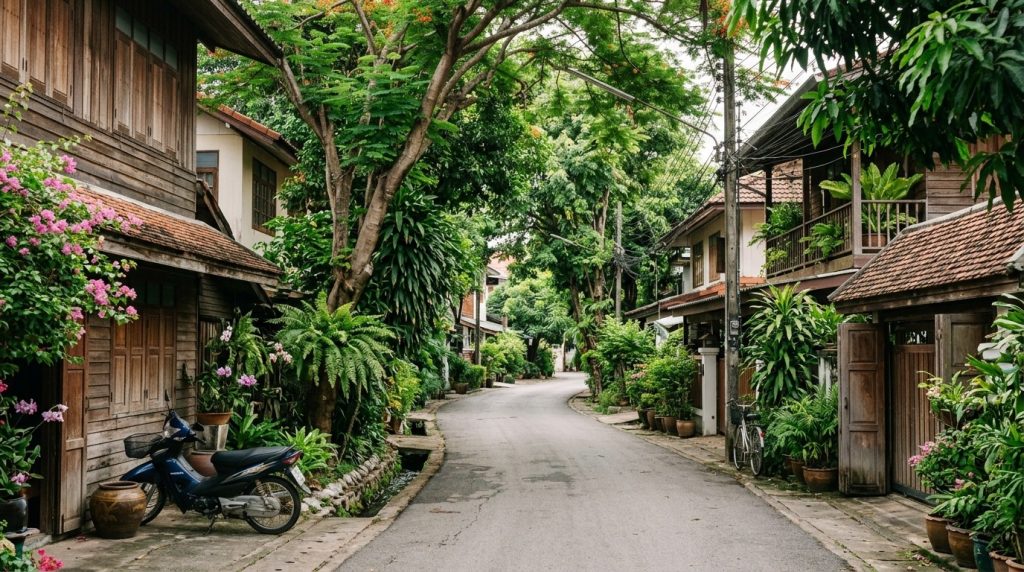
A base in the Old City or Nimman puts you within walking distance of restaurants, cafes and the sights covered in a things to do in Chiang Mai guide, cutting down on evening motorbike trips altogether, while a room out on the ring road means more traffic exposure after dark just getting back.
Compare neighbourhoods in a where to stay in Chiang Mai guide before booking, and factor burning-season air filtration into the choice if you’re travelling February-April.
Find your Chiang Mai hotel on the map
Live prices from Booking, Airbnb and more — move the map or change dates to compare stays across Chiang Mai.