Disclosure: Some links in this guide are affiliate links. If you book or buy through them, we may earn a small commission at no extra cost to you — it helps keep our guides free.
Yes, Cebu is worth visiting: the province strings together more than 160 islands and islets, holds one of the only year-round thresher shark cleaning stations on the planet, and fits a genuine multi-island route into 7-10 nights flying out of a single international airport. The trade-off is transfer time between highlights, not a shortage of things to do.
| Experience | Why it earns the trip | Typical cost |
|---|---|---|
| Thresher shark diving, Malapascua | Kimud Shoal is one of the few places worldwide with reliable year-round sightings | AUD 51 · USD 37 (PHP 2,300) per day dive |
| Sardine run and turtle snorkel, Moalboal | Shore-entry, no boat required, shoals swirl metres from the sand | AUD 11 · USD 8 (PHP 500) guided half-day |
| Kawasan Falls canyoneering, Badian | Cliff jumps and rock slides into turquoise pools, licensed guides only | AUD 44 · USD 32 (PHP 2,000) per person |
| Whale shark watching, Oslob | Near-guaranteed sighting, though the feeding method is genuinely contested | AUD 22 · USD 16 (PHP 1,000) foreign-tourist rate |
| Osmeña Peak sunrise hike, Dalaguete | Grass-ridge views nicknamed Cebu’s “little Switzerland” | AUD 3 · USD 2 (PHP 150) entrance with guide |
| Cebu City heritage circuit | Magellan’s Cross, Basilica del Santo Niño, Taoist Temple, lechon stalls | Free to low-cost, half a day |
More than 160 islands, one flight in
Cebu’s appeal starts with geography. The province is built around a long central island fringed by upward of 160 smaller islands and islets, including Mactan, Bantayan, Malapascua, Sumilon and the Camotes group, which means a single base can open onto beach islands, dive islands and a genuine city all within a few hours’ travel.
Mactan-Cebu International Airport sits minutes from Mactan’s resort strip and roughly an hour from Cebu City proper, so a trip here skips the multi-flight logistics that a Palawan or Siargao itinerary usually demands. That convenience is the real difference between Cebu and the Philippines’ other headline islands: fewer travel days spent getting to the good parts, more spent in them.
A Cebu itinerary built around this hub-and-spoke layout typically covers Cebu City, Moalboal or Badian in the south, and Malapascua or Bantayan in the north across 7-10 nights without feeling rushed.
Diving and snorkelling that punches above its region
Cebu’s underwater scene is the strongest argument for visiting, and it does not require an advanced dive certification to appreciate.
Off Malapascua, Kimud Shoal draws divers specifically for thresher sharks, a species rarely seen this consistently anywhere else, with day dives running around AUD 51 · USD 37 (PHP 2,300) and night dives closer to AUD 58 · USD 42 (PHP 2,650), plus a small daily marine park fee.
Moalboal offers something rarer still: a sardine shoal that schools so close to Panagsama Beach that snorkellers wade in from the sand rather than boarding a boat, often alongside green sea turtles feeding on the reef a short swim further out.
A guided half-day covering both runs about AUD 11 · USD 8 (PHP 500), including mask, snorkel and life vest. Mactan itself adds an easier, resort-adjacent option, with house reef dives and muck diving sites that suit beginners staying near the airport rather than travelling south.
Kawasan Falls and the inland adventure side
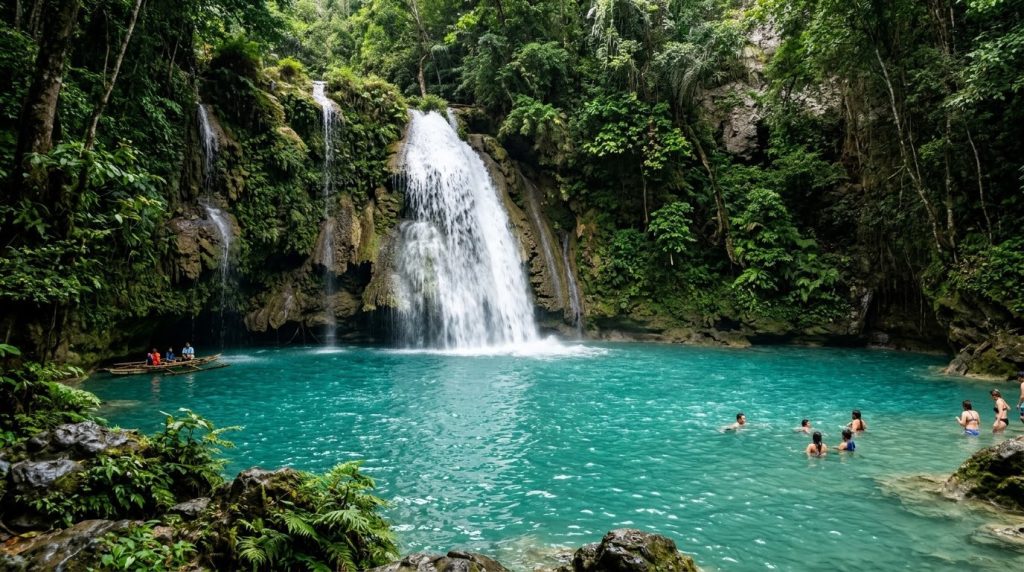
Inland Cebu earns its own visit separate from the coastline. Kawasan Falls in Badian is the province’s best-known adventure activity, a canyoneering route of cliff jumps, natural rock slides and swims through a turquoise river gorge that finishes at the main waterfall.
Licensed operators, required since a 2023 permit reform, charge around AUD 44 · USD 32 (PHP 2,000) per person including guide and life vest. Pair it with Osmeña Peak in Dalaguete, a grass-ridge hike nicknamed Cebu’s “little Switzerland” for its rolling green summits, entrance and guide included for roughly AUD 3 · USD 2 (PHP 150).
Both sit within a couple of hours of Moalboal, making the south of Cebu a natural two- or three-night adventure loop rather than a single day trip.
Oslob’s whale sharks, the honest picture
Oslob deserves a place on this list, and an honest one. Watching whale sharks from the water at Tan-awan costs around AUD 22 · USD 16 (PHP 1,000) for foreign visitors and delivers what is close to a guaranteed sighting, which is rare anywhere else in the world.
The catch is how it works: operators use provisioning, feeding small amounts of shrimp to keep the sharks circling near boats, and marine biologists have raised ongoing concerns about how that habituation affects the animals’ natural migratory feeding behaviour. Some travellers skip Oslob on principle and dive Malapascua or Donsol in nearby Bicol instead, where sightings happen without feeding.
Others go in with eyes open, keep the encounter brief, and follow the no-touch, no-sunscreen rules operators post at the dock. Neither choice is wrong, but a Cebu trip is more honest for naming the trade-off rather than pretending it doesn’t exist.
Bantayan and Sumilon, the slower islands
Not every day on Cebu needs to involve a wetsuit. Bantayan Island, off the province’s northern tip, delivers the long white-sand stretch and slow pace that a lot of Philippines trips are built around, without the crowds of Boracay or the transfer time of Palawan.
Sumilon, a small marine-protected sandbar island near Oslob, works well as a half-day add-on rather than an overnight, best combined with the whale shark stop given its short boat ride from the same stretch of coast.
Together they round out Cebu’s case as a multi-island hopping base rather than a single beach resort: divers get Malapascua and Moalboal, hikers get Osmeña Peak and Kawasan, and beach-first travellers still get a real island to slow down on.
Cebu City, heritage, food and a logistics hub
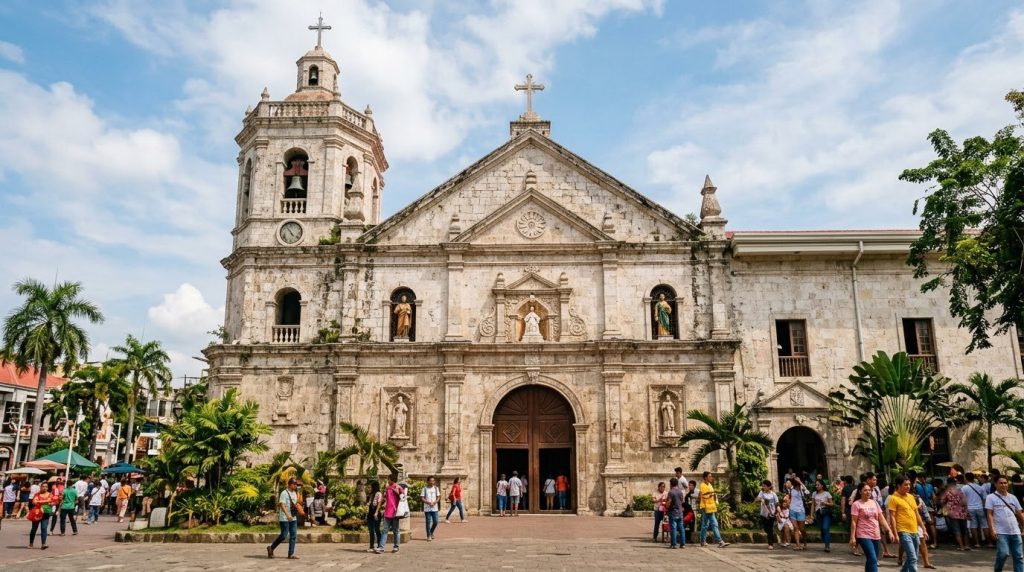
Cebu City is worth at least a full day, not just an airport layover. Magellan’s Cross marks the site of the Philippines’ first Catholic baptism in 1521, standing beside the Basilica del Santo Niño, the country’s oldest church, and both sit an easy walk from Fort San Pedro’s old Spanish garrison walls.
The Taoist Temple, perched in the Beverly Hills district with sweeping city views, is free to enter and funded by donations rather than a ticket fee.
Food is its own reason to stay a night in the city: Cebu’s lechon, whole roast pig seasoned and stuffed rather than basted, is widely regarded as the best version of the dish in the Philippines, and it is worth eating at a proper lechon house rather than a hotel buffet.
Staying centrally also matters for logistics, since Cebu City and Mactan are where inter-island ferries, buses south to Moalboal and Badian, and the ferry north to Malapascua’s jump-off point all originate.
A where to stay in Cebu guide is worth checking before booking, since a base near IT Park or Mactan cuts down on transfer time to most of the activities above.
Best time to go
Cebu rewards planning around the calendar more than most Philippine destinations, because its two headline activities, the Moalboal sardine run and Kawasan Falls canyoneering, both depend on calm water. December through May is the dry season and the more reliable window, with June through November bringing heavier rain, rougher inter-island ferry conditions, and periodic closures at Kawasan after storms.
A best time to visit Cebu guide breaks the shoulder months down further, since April and May combine dry conditions with lower accommodation rates than the December-to-February peak.
Budgeting for the trip is straightforward either way; a Cebu travel budget breakdown is a useful check before booking, since diving, canyoneering and inter-island ferries add up faster than food and accommodation do.
Who should skip Cebu
Cebu is not the right call for every kind of trip. Travellers who want a single compact beach resort with everything walkable from their room, Boracay’s White Beach or a Bali villa stay, will find Cebu’s best experiences spread across several islands and a genuine multi-hour transfer between them, not a five-minute stroll.
Anyone chasing nonstop nightlife should look at Boracay or Manila instead; Cebu City has a solid bar scene around IT Park, but the province’s real draw is daytime water activity, not late-night venues.
Travellers who won’t tolerate long transfers, a habal-habal or van ride to Moalboal, a ferry crossing to Malapascua, should not book a route that tries to cover the north and south of the province in one trip, since the connecting time between them eats into the days meant for diving or hiking.
And anyone who wants every wildlife encounter to be feeding-free should decide on Oslob before they land, rather than skip it grudgingly at the dock.
Find your Cebu hotel on the map
Live prices from Booking, Airbnb and more — move the map or change dates to compare stays across Cebu.