Da Nang vs Hanoi: Which Vietnam Base Wins for Your Trip? (2026)
By TravelguidestipUpdated 8 min readHow we earn
Hotel buttons open Stay22 (Booking.com, Agoda and others) and tour buttons open GetYourGuide. We may earn a commission at no extra cost to you.
Pick this if
Hanoi
You have 3 to 4 days for food, history and the limestone bays.
See hotels in Hanoi →
Da Nang wins for a 5–7 day beach-and-day-trip holiday, Hanoi wins for 3–4 days of food, history and the limestone bays of Ha Long and Ninh Binh. The deciding factors are what you want to do and when you fly.
Hanoi is cool and dry from December to February, while Da Nang takes its heaviest rain and flood risk in October and November. The two cities sit a 1h15–1h20 flight apart, so plenty of Australians simply do both.
| Factor | Da Nang | Hanoi |
|---|---|---|
| Best for | Beach, resorts, Hoi An, Ba Na Hills | Street food, Old Quarter, Ha Long Bay, Ninh Binh |
| Best months | Late January to mid-March (dry, mild) | Mid-March to mid-April, late October to November |
| Months to think twice | October–November (wettest, flood risk) | June–July (34°C highs, heavy rain) |
| Big day trips | Hoi An 30 km, Ba Na Hills 40 km | Ninh Binh 95 km, Ha Long Bay 130–150 km |
| Direct from Australia | VietJet lists Sydney, Melbourne, Brisbane, Adelaide | Vietnam Airlines from Sydney and Melbourne, plus VietJet |
| Pace | Relaxed, spread-out beach city | Dense, loud, walkable capital |
What Da Nang does better: beach days with Hoi An on the doorstep
Da Nang is a modern beach city. The sea at My Khe ranges from 23.5°C in February to nearly 30°C in July and August, and you can swim in the morning and be in Hoi An’s lantern-lit old town by afternoon. The 30 km trip takes 40–45 minutes in a Grab and costs about AUD 16–19 · USD 11.50–13.50 (VND 299,000–350,000).

The other big day out is Ba Na Hills, 40 km west and roughly an hour’s drive. It is home to the Golden Bridge held up by giant stone hands.
Expect to pay AUD 52 · USD 37 (VND 970,000) for a foreign adult ticket including the cable car, plus AUD 16–21 · USD 11.50–15.50 (VND 300,000–400,000) each way by Grab or taxi. Go early on a weekday to beat crowds.
For the Marble Mountains and Hai Van Pass, see our complete Da Nang travel guide.
What Hanoi does better: food, history and the northern landscapes
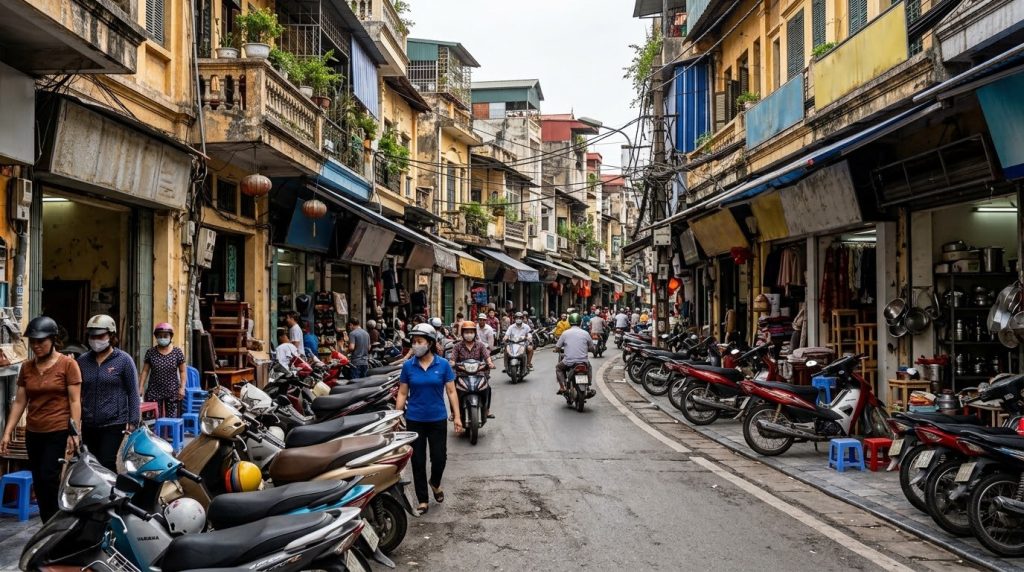
Most travellers base themselves in Hanoi’s Old Quarter, eating bun cha and pho on plastic stools, then walking to Hoan Kiem Lake and the Temple of Literature. Its street-food scene is denser and more walkable than Da Nang’s.
Hanoi is also the gateway to the north’s best scenery. Ha Long Bay is around 130–150 km away, 2–2.5 hours on the expressway, and most people do an overnight cruise rather than a rushed day trip. Ninh Binh, with its karst river valleys at Trang An and Tam Coc, is about 95 km south and takes roughly 1.5 hours by road.
If you are weighing up the two big cities rather than north versus centre, read our Hanoi vs Ho Chi Minh City comparison too.
The trade-off: Hanoi is loud, motorbike-heavy and has no beach.
Weather by month: the factor that decides most trips
The north and centre have almost opposite weather.
– December to February: Hanoi is cool and dry. January runs 14–20°C and many buildings lack heating. Da Nang is mild at about 25°C, but drier only from late January. – March to April: this is the sweet spot for both cities.
Hanoi warms to 24–28°C and Da Nang is at its driest, with only 20–35 mm of rain a month. – May to August: Da Nang is hot (33–35°C) but in beach season.
Hanoi is sticky, with June highs around 34°C and 250+ mm of rain a month. – September to November: Hanoi has one of its best stretches from late October through November. Da Nang has its worst. October averages about 650 mm of rain, typhoon season runs from September to early December, and low-lying areas can flood.
If your dates are locked into the October or November school holidays, Hanoi is the safer bet. Our month-by-month guides to the best time to visit Hanoi and the best time to visit Da Nang break down each month in more detail.
Getting between them, and from Australia
Hanoi (HAN) to Da Nang (DAD) is a 1h15–1h20 flight with frequent daily departures. VietJet runs most services, at around AUD 76–146 · USD 55–105 one way, while Vietnam Airlines covers the rest at about AUD 104–360 · USD 75–260.
From Australia, Vietnam Airlines flies direct from Sydney to Hanoi in about 10 hours, and from Melbourne to Hanoi in roughly 9h40. VietJet’s Australian route list includes Da Nang from Sydney, Melbourne, Brisbane and Adelaide. Perth flyers usually have to connect. The neat option is open-jaw: fly into one city and home from the other.
Visa requirements for Australians visiting Da Nang or Hanoi
Australians need a visa for Vietnam regardless of which city they fly into. The simplest route is the e-visa, applied for online through Vietnam’s official immigration portal, which costs a government fee of AUD 35 · USD 25 for a single entry and allows a stay of up to 90 days.

Apply at least a few days before you travel, since processing is not instant, and save a digital copy of the approval letter to show at check-in and on arrival.
The e-visa works the same whether you land in Da Nang or Hanoi, so it has no bearing on which city to fly into first.
What it does affect is an open-jaw trip: entering through one airport and leaving through the other is fine on a single-entry e-visa, as long as you do not exit and re-enter Vietnam by land or sea in between, which would need a multiple-entry visa instead.
Third-party visa services will process the paperwork for a fee on top of the government charge, which can be worth it if you are short on time, but the official portal is the cheaper route if you are comfortable filling in the form yourself.
Apply using a clear digital passport photo and a scan of your passport’s photo page, and double-check the arrival date and airport you enter, since errors on either can hold up approval. Print a paper copy of the approval letter as a backup even if you plan to show it on your phone, in case you land with no signal or a dead battery at immigration.
Getting around once you land: taxis, Grab and walkability
Hanoi’s Old Quarter rewards walking: the lake, the street-food lanes and most of the budget guesthouses sit within a compact grid, and Grab fills the gaps for anything further, such as the airport run or a trip out to a museum. Traffic is heavy and footpaths are often blocked by parked motorbikes, so crossing the road takes a slow, steady pace rather than a sprint.
Da Nang is far more spread out, with the beach strip, the Han River and Hoi An all a drive apart rather than a walk, so Grab or a rental scooter does more of the work here than in Hanoi. Grab is widely available and metered fairly in both cities, and it is the easiest way to avoid the fare haggling that can come with flagging down a street taxi.
Whichever city you base yourself in, download the Grab app and load a card before you land, since it saves time at the airport when you are tired and want the fastest route to your hotel.
Crossing the road is its own skill in both cities, with Hanoi’s Old Quarter the more intense version: traffic rarely stops for pedestrians, so the method locals use is a steady, predictable walking pace that lets motorbikes flow around you, rather than darting or stopping halfway.
Da Nang’s wider boulevards make crossing easier, but its beach-to-town distances mean you will spend more time in a vehicle overall than you would wandering Hanoi on foot.
Rental scooters are common in Da Nang for travellers comfortable riding one, since the city’s wide roads and beachfront layout suit it better than Hanoi’s denser, more chaotic traffic. A valid motorcycle licence is required by law, and travel insurance policies often exclude scooter injuries without one, so check your cover rather than treating a rental as a casual, licence-free option.
Verdict by traveller type
– Families with kids: Da Nang. Resort pools, a long beach and easy day trips; Hanoi traffic is hard work with a pram. – Couples: Da Nang for a beach-and-Hoi-An honeymoon, Hanoi plus a Ha Long Bay cruise for food and scenery. With 8+ days, do Hanoi first and finish on the beach. – Budget travellers: Hanoi.
Old Quarter street food and guesthouses stretch a dollar furthest, and you walk instead of paying for Grabs. – First-timers with under a week: pick one city. Choose Hanoi from October to April, and Da Nang from February to August. – Culture and history lovers: Hanoi, with Hoi An as a later add-on.
If you are deciding between the capital and the old town itself, our Hanoi vs Hoi An breakdown goes deeper.
Where to stay in Da Nang or Hanoi
My Khe Beach, Da Nang: suits families and beach lovers. You get a beachfront strip of mid-range and high-rise hotels, with the airport a short ride inland.
Han River / city centre, Da Nang: suits couples and short stays, close to the Dragon Bridge, riverside restaurants and night markets.
Old Quarter, Hanoi: suits first-timers and food lovers. You can walk to Hoan Kiem Lake and the street-food lanes, and most Ha Long Bay and Ninh Binh tours collect you from here.
Find your Da Nang hotel on the map
Live prices from Booking, Airbnb and more — move the map or change dates to compare stays across Da Nang.
Frequently Asked Questions
Is Da Nang or Hanoi better for a first trip to Vietnam?
For a first trip of under a week, choose by season. From October to April, Hanoi gives you the classic Vietnam of street food, the Old Quarter and Ha Long Bay. From February to August, Da Nang is better, combining beach time with Hoi An and Ba Na Hills. With 8 days or more, fly into one and out of the other.
How do you get from Hanoi to Da Nang?
Fly. The direct flight takes about 1h15–1h20, and VietJet and Vietnam Airlines run frequent daily services. One-way fares usually fall between AUD 76–146 · USD 55–105 on VietJet. The overnight train is scenic but takes most of a day, so it only suits travellers with time to spare.
Should I avoid Da Nang in October and November?
If a beach holiday is the main goal, yes, think twice. October is Da Nang’s wettest month at about 650 mm of rain, and typhoon season runs from September into early December, sometimes bringing floods. If you must travel then, base yourself in Hanoi, which has one of its best stretches of weather.
Is Hanoi cold in winter?
Cooler than most Australians expect. January highs average about 20°C, lows drop to about 14°C, and the damp air feels colder because most buildings have no heating. Pack a light jacket and long pants for December to February. Days are usually dry, which makes it good weather for walking the Old Quarter.
Can you do Ha Long Bay from Da Nang?
Not easily. Ha Long Bay is in the north, about 2–2.5 hours by road from Hanoi, so from Da Nang you would first fly to Hanoi and then drive. If Ha Long Bay or Ninh Binh is on your list, base yourself in Hanoi for at least 3 nights.