Disclosure: Some links in this guide are affiliate links. If you book or buy through them, we may earn a small commission at no extra cost to you — it helps keep our guides free.
Best Temples in Angkor Beyond Angkor Wat (2026 Guide)
The best temples in Angkor beyond Angkor Wat are Bayon, Ta Prohm, Banteay Srei, Preah Khan, Beng Mealea, and Pre Rup. Bayon greets you with 216 stone faces, Ta Prohm is the strangler-fig ruin from Tomb Raider, and Banteay Srei is carved from pink sandstone so fine it looks like woodwork. All six sit inside or near the Angkor Archaeological Park, which drew roughly 2.5 million visitors in a normal year (Cambodia Ministry of Tourism, 2024).
Most first-timers spend their whole trip photographing the famous five towers and then leave. That is a mistake. The single Angkor Pass that covers Angkor Wat also covers most of these temples at no extra charge, and the crowds thin out fast once you drive ten minutes past the main causeway. This guide breaks down each temple: what makes it special, where it sits, and how much time to give it. For the headline monument itself, see our full Angkor Wat temple guide.
Key Takeaways
– Bayon has 216 giant faces carved across 54 towers, each face about 4 metres tall, built by Jayavarman VII in the late 12th century.
– Ta Prohm was left to the jungle on purpose — its silk-cotton and strangler-fig trees are up to 400 years old, and it starred in Lara Croft: Tomb Raider (2001).
– Banteay Srei sits about 25-37 km northeast of Siem Reap, a 45-60 minute drive, and is the only major temple built from pink sandstone.
– One Angkor Pass covers all these temples except Beng Mealea: $37 for one day, $62 for three days, $72 for seven (Angkor Enterprise, 2026).
– Beng Mealea needs a separate small ticket (about $5) and a 60 km drive, because it sits outside the main park boundary.**** We spent three days circling these temples on an e-bike and a hired tuk-tuk, and the pattern was always the same: sunrise crowds at Angkor Wat, then near-silence by 8am at Preah Khan. On our last visit we reached Pre Rup at 5pm and shared the entire upper terrace with four other people while the sky went orange over the rice fields.
Why look beyond Angkor Wat?
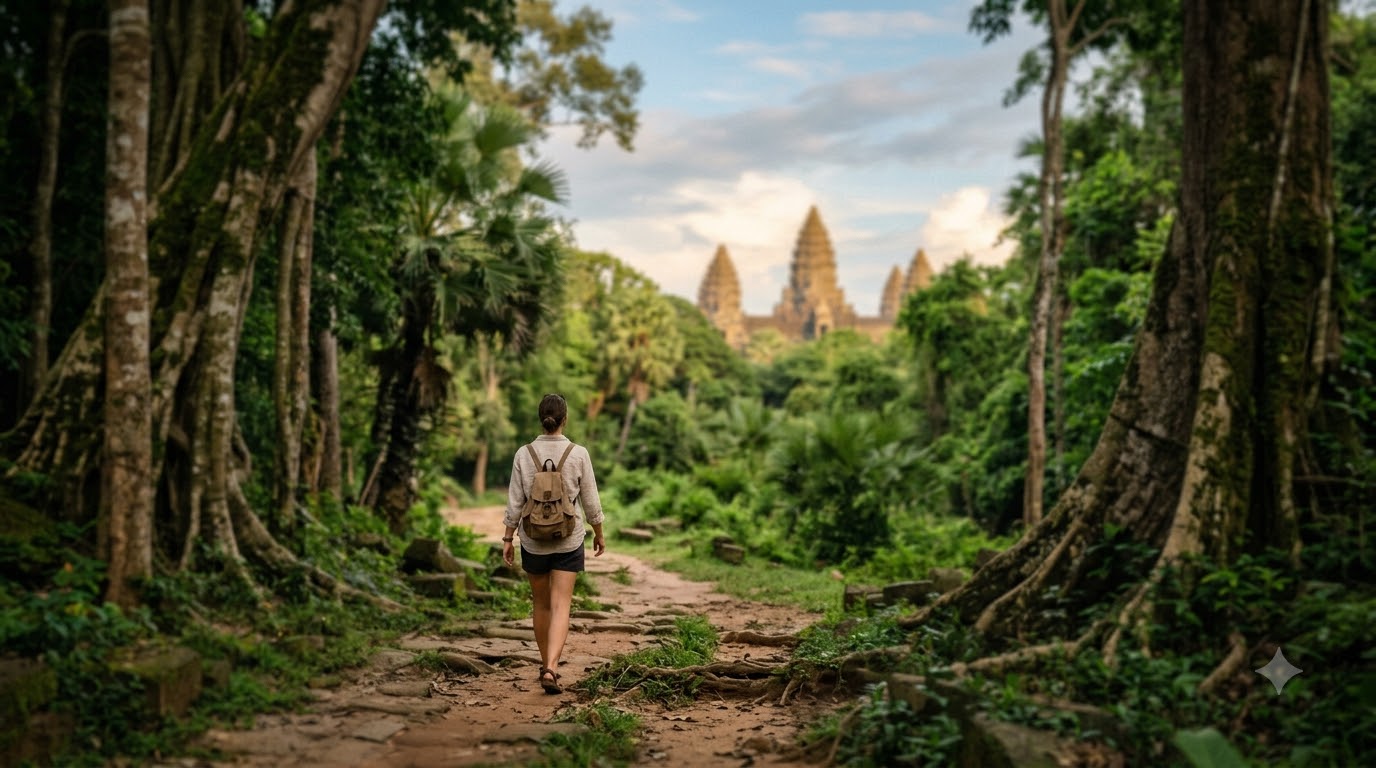
Look beyond Angkor Wat because the park holds more than 70 monuments, and the most memorable ones are often the quietest. Angkor Wat is the largest religious structure on Earth, but it is also where every tour bus stops first. Push a few kilometres deeper and you trade queues for atmosphere.
Here is why these six earn a place on any Angkor itinerary:
- They are already paid for. Bayon, Ta Prohm, Preah Khan, and Pre Rup are all inside the Angkor Pass zone — no second ticket needed.
- They tell different stories. You get Buddhist face-towers, a Hindu pyramid, a jungle ruin, and a delicate Hindu shrine, not six versions of the same layout.
- They spread across the day. Bayon works at midday, Ta Prohm before the tour groups, Pre Rup at sunset — so you rarely backtrack.
- They handle crowds better. Even in peak season, temples like Preah Khan and Banteay Srei feel calm compared with the Angkor Wat causeway.
If you only have limited time, our Angkor Wat itinerary shows how to slot these into a one, two, or three-day plan without rushing.
The 3-Day Angkor Itinerary
The plan we use ourselves — sent straight to your inbox.
- Day-by-day route
- Where to stay
- Real 2026 costs
Free · No spam · Unsubscribe anytime
Bayon: the temple of 216 smiling faces
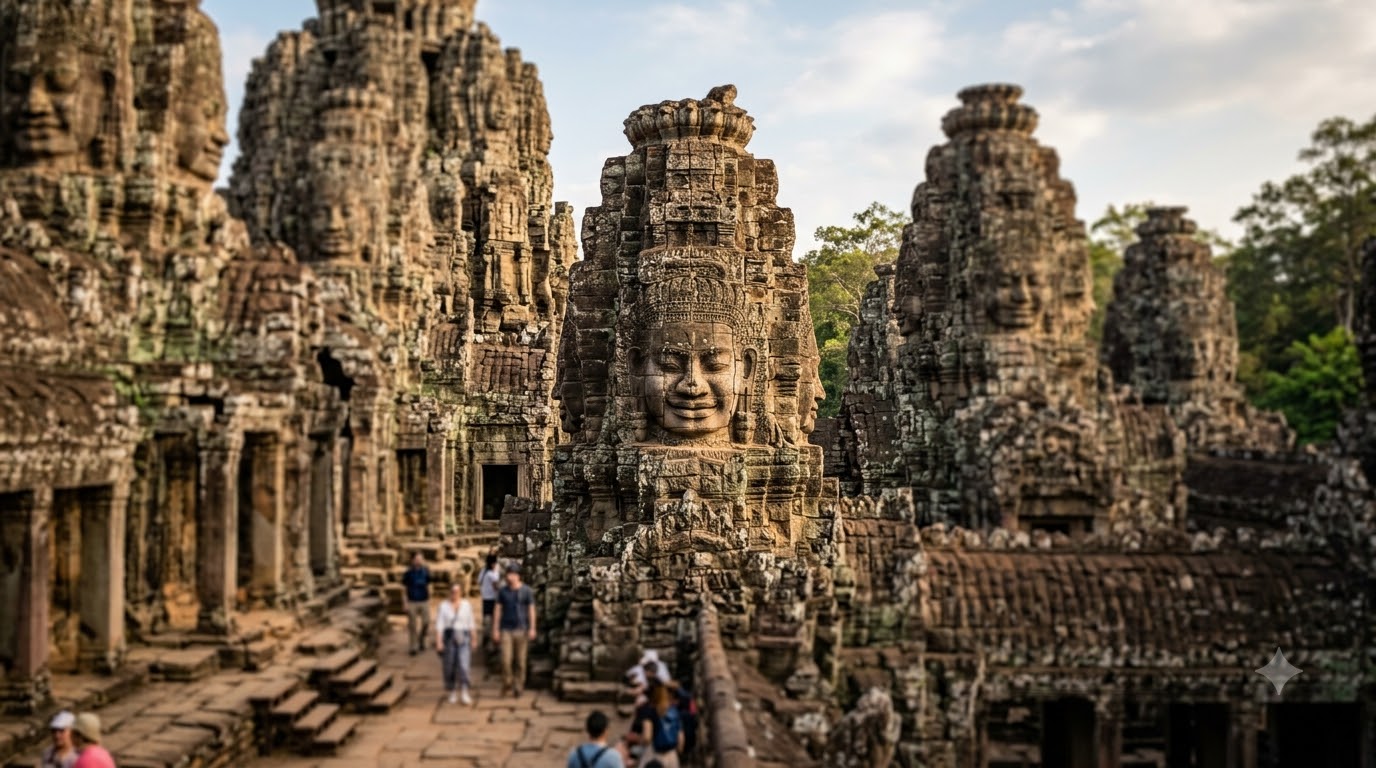
Bayon is the standout temple after Angkor Wat, famous for the 216 giant stone faces that gaze out in every direction. It sits at the exact centre of Angkor Thom, the last great capital of the Khmer Empire, and it was built as the state temple of King Jayavarman VII in the late 12th century.
The faces are the reason to come. Each of the 54 towers carries four serene faces, one per cardinal direction, and together they add up to 216 (Lonely Planet, 2024). Most scholars read them as Avalokiteshvara, the Bodhisattva of Compassion, though many believe they also carry the features of the king himself.
- What makes it special: 216 faces of Avalokiteshvara, each around 4 metres tall, plus almost a kilometre of bas-relief showing everyday Khmer life and naval battles.
- Location: Dead centre of Angkor Thom, about 1.5 km north of Angkor Wat on the small circuit.
- Time needed: 60-90 minutes; longer if you wait for soft late-afternoon light on the towers.
- Best time to visit: Mid-to-late afternoon, when the low sun throws shadows across the faces and the morning buses have moved on.
Ta Prohm: the Tomb Raider jungle temple
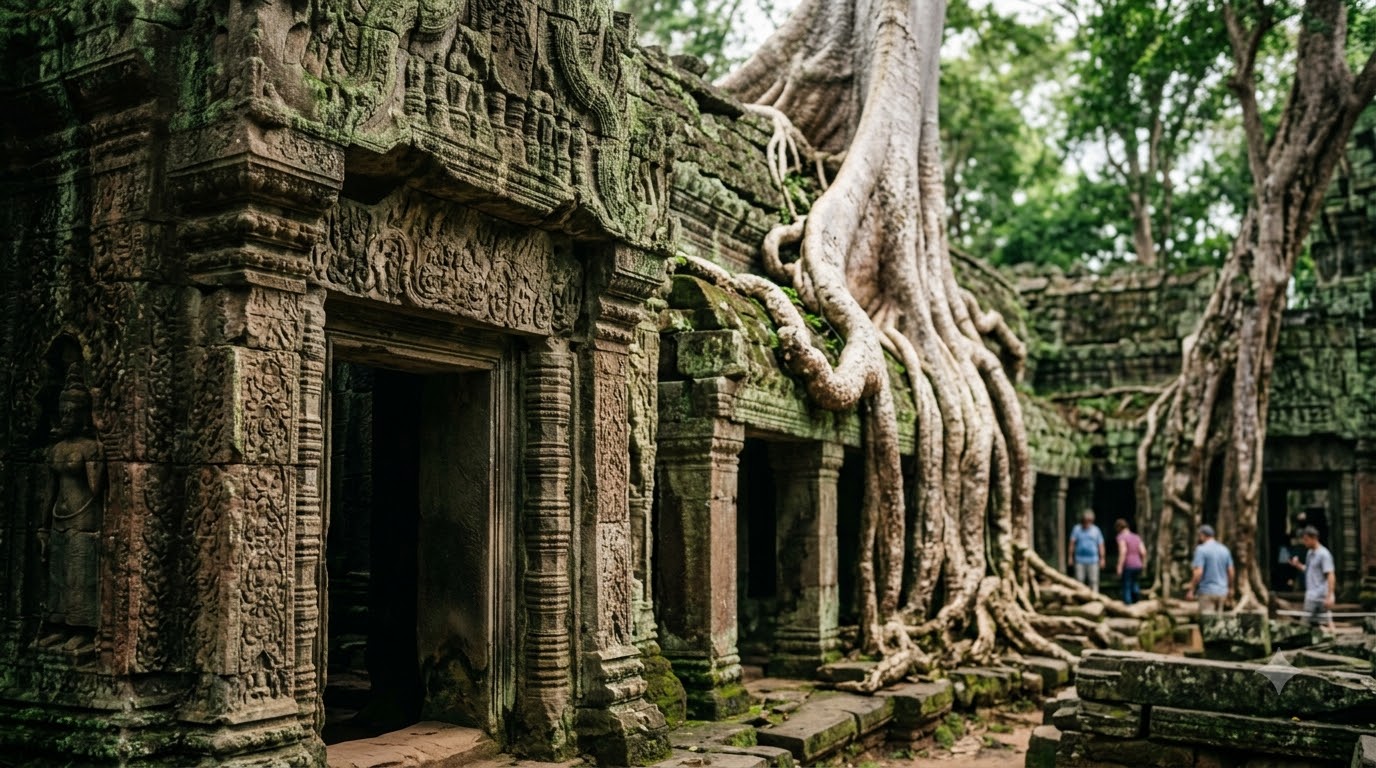
Ta Prohm is the temple where the jungle won, and it is the one most travellers photograph after Angkor Wat itself. Enormous silk-cotton and strangler-fig roots pour over the stone like melted wax, and conservators deliberately left it that way so visitors could see Angkor as 19th-century explorers first found it.
Built in 1186 by Jayavarman VII and originally called Rajavihara, it was dedicated to the king’s mother and once housed a community of more than 12,500 people, including 615 dancers (Hello Angkor, 2024). It reached global fame as a filming location for Lara Croft: Tomb Raider, which is why nearly every guide now calls it the Tomb Raider Temple.
- What makes it special: Centuries-old trees fused into the ruins; some silk-cotton trees are over 400 years old.
- Location: East of Angkor Thom on the small circuit, roughly a 10-minute drive from Bayon.
- Time needed: About 1 hour, or 90 minutes if you want the famous tree roots without a crowd in the frame.
- Best time to visit: First thing at opening (around 7:30am) — by mid-morning the main photo spot has a queue.
We arrived at Ta Prohm just after opening on our second morning and had the largest tree corridor almost to ourselves for ten minutes before the first tour group filed in.
The 3-Day Angkor Itinerary
Hour-by-hour plan, where to stay and what it really costs — free PDF.
Free · No spam · Unsubscribe anytime
Find your Siem Reap hotel on the map
Live prices from Booking & Airbnb — tap a pin to compare stays around Pub Street and the Old Market and beyond.
Banteay Srei: the pink sandstone jewel
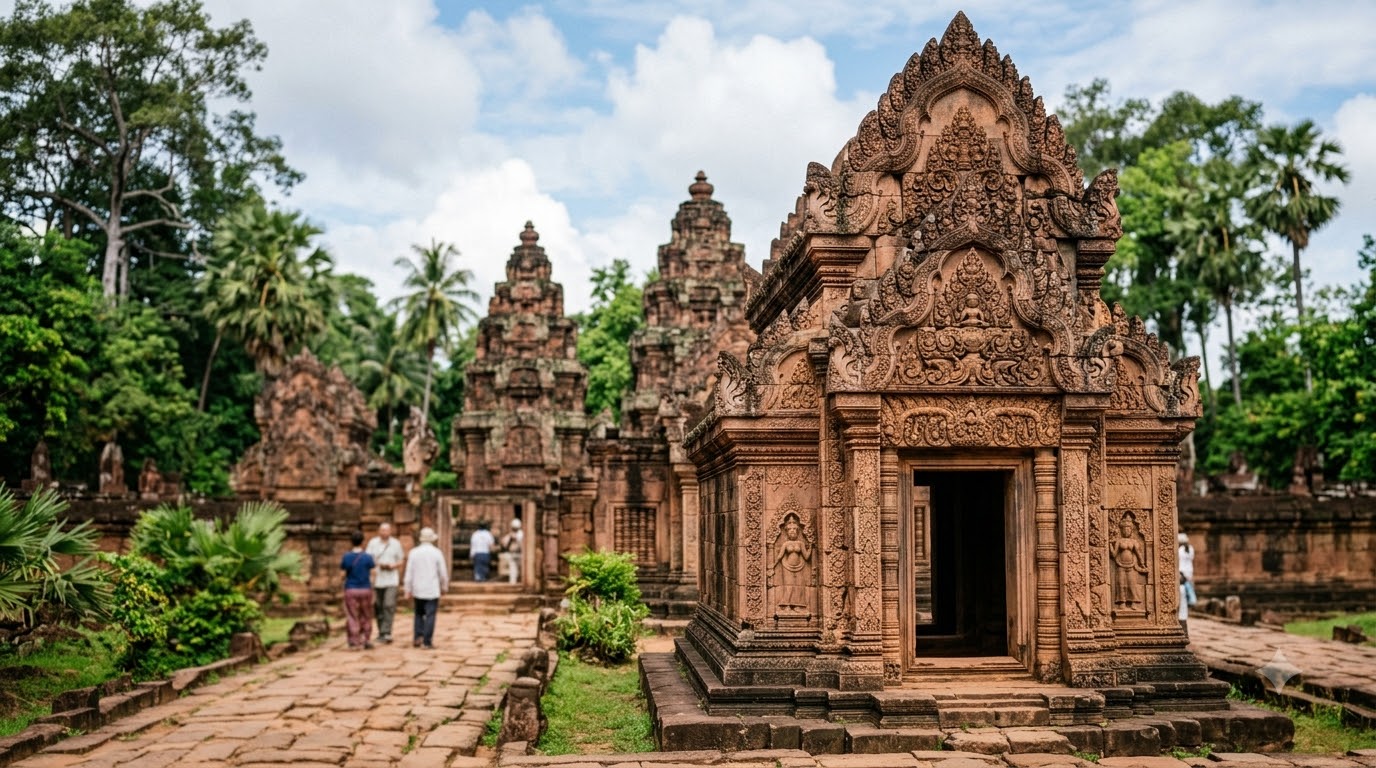
Banteay Srei is the finest carving in the whole Angkor region, cut into rose-pink sandstone that holds detail no other temple matches. It is small, and it is far — but it is the one temple experts tell you not to skip.
Dedicated in the 10th century to the Hindu god Shiva, its name translates loosely as “Citadel of the Women,” a nod to the delicacy of the reliefs. The pink stone is harder than the grey sandstone used elsewhere, which is why the floral panels and guardian figures still look freshly chiselled a thousand years on.
- What makes it special: Deep, near-perfect carvings in pink sandstone; widely called the jewel of Khmer art.
- Location: About 25-37 km northeast of Siem Reap, a 45-60 minute drive each way.
- Time needed: 45-60 minutes at the temple; budget a half-day round trip with travel.
- Best time to visit: Early morning or after 3pm, when the low sun makes the pink stone glow and the midday tour convoys have gone.
Because it sits so far out, Banteay Srei pairs well with a wider excursion — see our guide to the best day trips from Siem Reap for how to combine it with the countryside beyond the park.
Preah Khan: the sprawling monastery of the sword
Preah Khan is the best temple for wandering, a vast, half-collapsed monastery where you can walk a straight processional corridor for a couple of hundred metres. It is one of the largest complexes at Angkor, and it stays remarkably quiet.
Jayavarman VII built it in the late 12th century to honour his father, and it once functioned as a Buddhist university and monastery. Today its charm is the mix of tumbled stone, deep shade, and a curious two-storey building with round columns that looks out of place in the Khmer world.
- What makes it special: Long, atmospheric corridors and lichen-covered ruins with far fewer crowds than Ta Prohm.
- Location: On the grand circuit, just northeast of Angkor Thom, a short drive from Bayon.
- Time needed: 60-75 minutes to walk it end to end.
- Best time to visit: Late morning or midday, when harsh light elsewhere makes Preah Khan’s shaded corridors a relief.
Beng Mealea: the collapsed jungle giant
Beng Mealea is the wildest temple near Angkor, a largely unrestored ruin swallowed by forest and far off the main tourist track. Built in the 12th century under Suryavarman II — the same king behind Angkor Wat — it follows a similar floor plan and is ringed by a moat measuring roughly 1.2 km by 900 m.
Unlike the swept, ticketed temples closer in, Beng Mealea is a scramble over toppled blocks and through tree roots, with wooden walkways threading the collapse. It sits about 60 km northeast of Siem Reap, a 60-90 minute drive, and it falls outside the main park, so it needs its own small entrance ticket (about $5) rather than the Angkor Pass.
- What makes it special: A “lost temple” feel — massive, moss-covered, and mostly left as the jungle left it.
- Location: About 60 km northeast of Siem Reap; plan a full half-day for the round trip.
- Time needed: 60-90 minutes on site, plus 2-3 hours of driving in total.
- Best time to visit: Morning, to keep the long drive out of the afternoon heat.
Pre Rup: the sunset temple mountain
Pre Rup is the best temple for sunset in the eastern part of the park, a steep brick-and-laterite pyramid whose upper terrace looks across rice fields toward the distant towers of Angkor Wat. It is older than most temples on this list, dedicated in 961 to the Hindu god Shiva under King Rajendravarman.
Its name means “turn the body,” and local tradition links the temple to cremation rites. The warm red brick takes on a deep glow in late light, which is why it draws a small crowd each evening — smaller and calmer than the famous sunset scramble at Phnom Bakheng.
- What makes it special: A three-tier temple mountain topped with five towers; the top terrace sits about 12 m up.
- Location: On the grand circuit, in the eastern zone of the Angkor park.
- Time needed: 45 minutes, or longer if you stay for sunset.
- Best time to visit: Late afternoon into sunset, roughly 4:30-6pm depending on the season.
How much time do you need for each temple?
You need about 45 minutes to 90 minutes per temple, so a well-planned day fits three or four of them comfortably. The table below sums up location, time, and the single reason to go, so you can build a route that flows in one direction instead of backtracking.
| Temple | Distance from Siem Reap | Time needed | On the Angkor Pass? | Best for |
|---|---|---|---|---|
| Bayon | ~9 km (small circuit) | 60-90 min | Yes | 216 stone faces |
| Ta Prohm | ~10 km (small circuit) | 60-90 min | Yes | Tomb Raider tree roots |
| Preah Khan | ~11 km (grand circuit) | 60-75 min | Yes | Quiet corridors |
| Pre Rup | ~13 km (grand circuit) | 45-60 min | Yes | Sunset views |
| Banteay Srei | ~25-37 km | 45-60 min | Yes | Pink sandstone carving |
| Beng Mealea | ~60 km | 60-90 min | No (separate ~$5 ticket) | Jungle ruin adventure |
A simple rule: pair the four in-park temples (Bayon, Ta Prohm, Preah Khan, Pre Rup) on one Angkor Pass day, then treat Banteay Srei and Beng Mealea as a separate half-day or full-day trip because of the drive. Our step-by-step Angkor Wat itinerary maps out exactly which temples to see on each day of a three-day pass.
Which pass do you need for these temples?
For most of these temples you need the standard Angkor Pass, and the three-day option is the sweet spot for seeing them without a rush. The pass is sold only through the official operator, so buy it at the counters on Road 60, at the in-town kiosks, or online — never from a tuk-tuk driver reselling one.
| Pass type | Price (2026) | Validity | Good for |
|---|---|---|---|
| 1-day | $37 | Single day | Angkor Wat + Bayon + Ta Prohm only |
| 3-day | $62 | Any 3 days within a week | Small + grand circuit + Banteay Srei |
| 7-day | $72 | Any 7 days within a month | Slow, complete exploration |
A few practical facts worth quoting before you buy:
- Children under 12 enter free with a passport as proof of age (Angkor Enterprise, 2026).
- The 3-day pass ($62) does not need to be used on consecutive days, which suits travellers who want a rest day.
- Beng Mealea is not covered by any Angkor Pass and charges its own small fee at the gate.
- Keep your pass on you — rangers check it at every temple entrance, and Bayon and Ta Prohm are strict about it.
For the full breakdown of where to buy and how to avoid scalpers, read our dedicated Angkor Wat ticket guide.
Frequently Asked Questions
What is the best temple in Angkor after Angkor Wat?
Bayon is widely considered the best temple after Angkor Wat, thanks to its 216 giant carved faces at the centre of Angkor Thom. Ta Prohm is a close second for its jungle-swallowed ruins made famous by Tomb Raider. If you value fine art over scale, Banteay Srei’s pink sandstone carving is the connoisseur’s pick.
Are these temples included in the Angkor Wat ticket?
Bayon, Ta Prohm, Preah Khan, Banteay Srei, and Pre Rup are all included in the standard Angkor Pass, which costs $37 for one day, $62 for three days, or $72 for seven days in 2026. Beng Mealea is the exception — it sits outside the main park and charges a separate ticket of around $5.
How many temples can you see in one day at Angkor?
You can comfortably see three to four temples in one day at Angkor, allowing roughly 45-90 minutes at each plus travel time. A classic full day is Angkor Wat at sunrise, Bayon and Ta Prohm mid-morning, then Pre Rup for sunset. Trying to cram in more usually means rushing past the details that make each temple worth the trip.
Is Banteay Srei worth the long drive from Siem Reap?
Banteay Srei is worth the 45-60 minute drive for travellers who appreciate craftsmanship, because its pink sandstone carvings are the most detailed in the entire Angkor region. It works best combined with the countryside or Beng Mealea on a half-day trip rather than as a standalone stop.
Which Angkor temple is best for sunset?
Pre Rup is one of the best Angkor temples for sunset, offering open views across rice fields toward Angkor Wat’s towers from its upper terrace. It is usually calmer than the famous sunset crowd at Phnom Bakheng, though you should still arrive by 4:30pm to claim a good spot on the top tier.
Final thoughts
Angkor Wat deserves its fame, but it is the opening act, not the whole show. Give Bayon an afternoon, catch Ta Prohm before the crowds, drive out to Banteay Srei’s pink stone, and finish a day watching the sun drop behind Pre Rup, and you will understand why people come back to Siem Reap again and again. Plan your days around the pass you buy, keep the far-flung temples grouped together, and the best temples in Angkor will reward you with the quiet that the main causeway never can. If you have not locked in your ticket yet, start with our Angkor Wat ticket guide and build out from there.