Disclosure: Some links in this guide are affiliate links. If you book or buy through them, we may earn a small commission at no extra cost to you — it helps keep our guides free.
Angkor Wat Tickets 2026: Prices, Passes & Where to Buy
Angkor Wat tickets cost US$37 for one day, US$62 for three days, and US$72 for seven days in 2026, sold only through the government operator Angkor Enterprise (angkorenterprise.gov.kh). There is one pass, called the Angkor Pass, and it covers the entire Angkor Archaeological Park, not just the main temple. Children under 12 enter free with a passport as proof of age.
This guide walks through every price, the one legitimate place to buy, opening hours for the park and the individual temples, whether you need a photo, and how to decide between the 1-day, 3-day, and 7-day options. We have run these ticket counters on three separate trips, and the details below reflect what the queues and rules actually look like on the ground in 2026.
Key Takeaways
– The Angkor Pass costs US$37 (1 day), US$62 (3 days), or US$72 (7 days) in 2026, with US$2 of every ticket going to the Kantha Bopha children’s hospital.
– The 3-day pass is valid on any 3 days within a 10-day window, and the 7-day pass on any 7 days within 30 days, so you do not have to use them on consecutive days.
– Buy only from Angkor Enterprise at the Road 60 ticket office or angkorenterprise.gov.kh; every “cheaper” reseller is either the same price with a markup or a scam.
– Angkor Wat opens at 5:00 AM and closes at 6:00 PM daily, while most other temples run 6:00 AM to 6:30 PM.
– Children under 12 are free with a passport, and there are no group rates, partial-day tickets, or advance-purchase discounts.**** We bought our first 3-day pass at the Road 60 counter at 4:40 AM in the dark, then drove straight to the moat for sunrise, and the whole ticket stop took under ten minutes because we arrived before the tour buses. On a later trip we tested the online option instead and skipped the counter entirely, which mattered on a morning when the queue had already backed up past the car park.
How much do Angkor Wat tickets cost in 2026?

Angkor Wat tickets come in exactly three tiers, and the prices below have held steady into 2026. The pass is priced in US dollars, which is the working currency for tourism across Siem Reap, and you can pay cash or by card at the official counters.
| Pass | Price (USD) | Valid for | Best suited to |
|---|---|---|---|
| 1-Day Pass | $37 | 1 calendar day | A single sunrise-plus-highlights visit |
| 3-Day Pass | $62 | Any 3 days within 10 days | Most travelers; covers the small and grand circuits |
| 7-Day Pass | $72 | Any 7 days within 30 days | Photographers, slow travelers, repeat visitors |
Source: Angkor Enterprise (official operator), 2026.
A few pricing facts worth pinning down before you buy:
- One-day pass: US$37, valid only on the printed date, with no early-evening carryover.
- Three-day pass: US$62, usable on any three separate days inside a 10-day window.
- Seven-day pass: US$72, usable on any seven days inside a 30-day window.
- US$2 from every pass is donated to the Kantha Bopha children’s hospital.
- There are no discounts for buying in advance, no group or student rates, and no half-day tickets.
The math tends to push people toward the 3-day pass. Jumping from one day to three days adds only US$25 but nearly triples your temple time, and the 7-day pass costs just US$10 more than the 3-day. If you plan to see Angkor Wat at sunrise and any of the outer temples, the 3-day is almost always the better value.
The 3-Day Angkor Itinerary
The plan we use ourselves — sent straight to your inbox.
- Day-by-day route
- Where to stay
- Real 2026 costs
Free · No spam · Unsubscribe anytime
Find your Siem Reap hotel on the map
Live prices from Booking & Airbnb — tap a pin to compare stays around Pub Street and the Old Market and beyond.
Where do you buy the official Angkor Pass?

You buy Angkor Wat tickets from Angkor Enterprise, the state-run operator, and nowhere else is official. There are exactly two legitimate channels: the physical ticket office and the government website. Everything else adds a fee or is fraudulent.
The main ticket office sits on Apsara Road, better known as Road 60 or Street 60, roughly 4 km from the center of Siem Reap on the way to the park. It opens at 5:00 AM and closes at 5:30 PM every day with no days off, which is why it is possible to buy a pass and reach the Angkor Wat moat in time for a 5:45 AM sunrise.
Your official options in 2026:
- Road 60 ticket office: the main counter, open 5:00 AM to 5:30 PM daily, cash or card.
- Official website angkorenterprise.gov.kh: buy online at least 24 hours ahead, then show the QR code on your phone.
- Self-service kiosks in town and your licensed guide can also issue passes at the same official price.
Buying online is the single easiest way to skip the morning line. On a busy sunrise day the counter queue can eat 30 to 45 minutes, and a phone QR code walks past all of it. We now default to the website the night before and only use the counter as a backup.
One warning we repeat to every friend heading to Siem Reap: ignore tuk-tuk drivers or “agencies” offering discounted Angkor passes. The price is fixed by the government, so a discount is impossible, and a fake pass gets you turned away at the first checkpoint. For sunrise logistics and the exact checkpoint layout, our Angkor Wat sunrise guide breaks down where the ticket scanners sit.
What does the Angkor Pass actually cover?
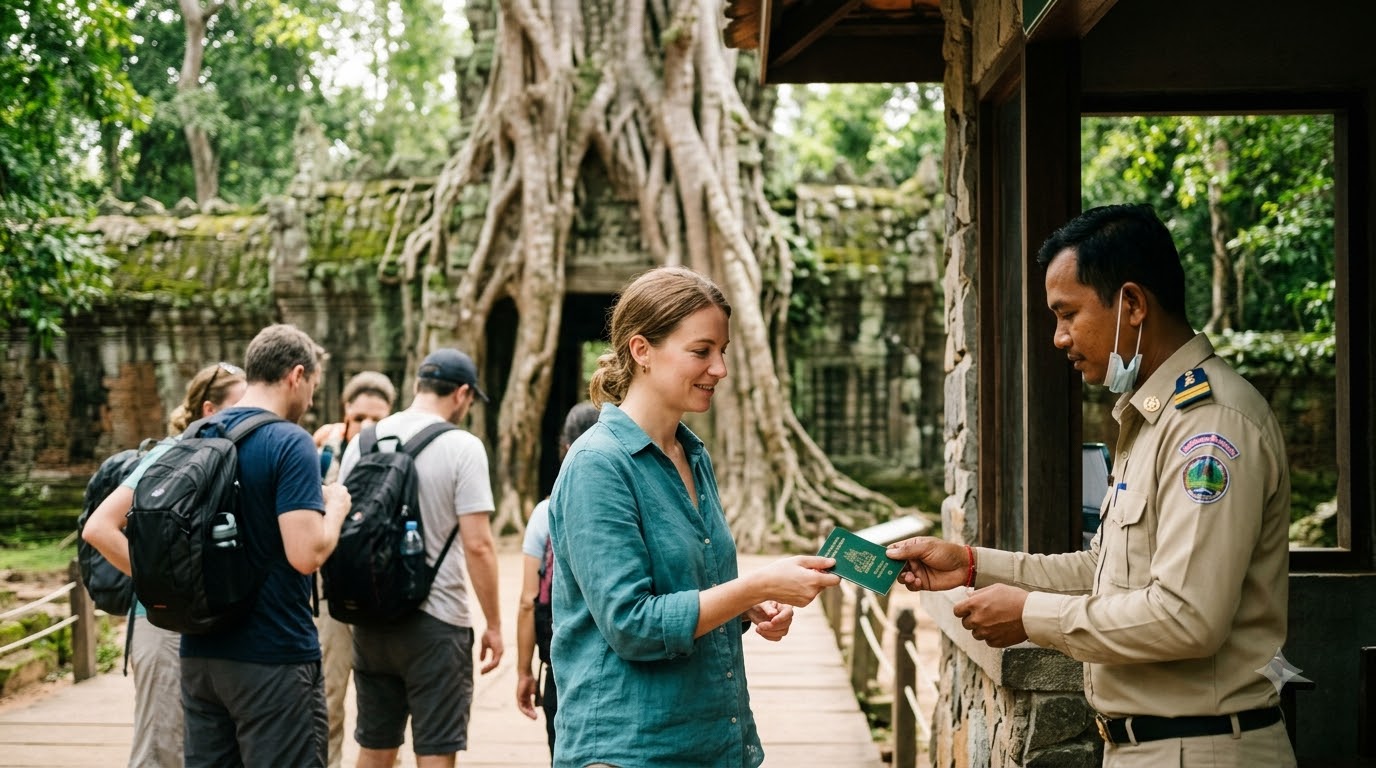
The Angkor Pass covers Angkor Wat plus every temple inside the Angkor Archaeological Park on a single ticket, including the far-flung sites most day-trippers never reach. There is no separate ticket for individual temples inside the park; one pass scans you through every checkpoint.
Temples and sites included with the pass:
- Angkor Wat, the main five-tower temple and its moat.
- Angkor Thom, including the Bayon (the face temple), Baphuon, and the Terrace of the Elephants.
- Ta Prohm, the “jungle temple” wrapped in strangler-fig roots.
- Banteay Srei, the pink-sandstone temple 25 km north, accessible only with the full Angkor Pass.
- Outlying sites such as Beng Mealea, Kbal Spean, and Chau Srei Vibol.
Two paid sites do sit outside this system. Phnom Kulen National Park and the Koh Ker temple group both charge their own separate entrance fees and are not part of the Angkor Pass. Everything most visitors put on a temple itinerary, though, is covered. If you are mapping out which temples to prioritize, our Angkor Wat temple guide ranks the highlights by circuit.
The 3-Day Angkor Itinerary
Hour-by-hour plan, where to stay and what it really costs — free PDF.
Free · No spam · Unsubscribe anytime
What are the Angkor temple opening hours?
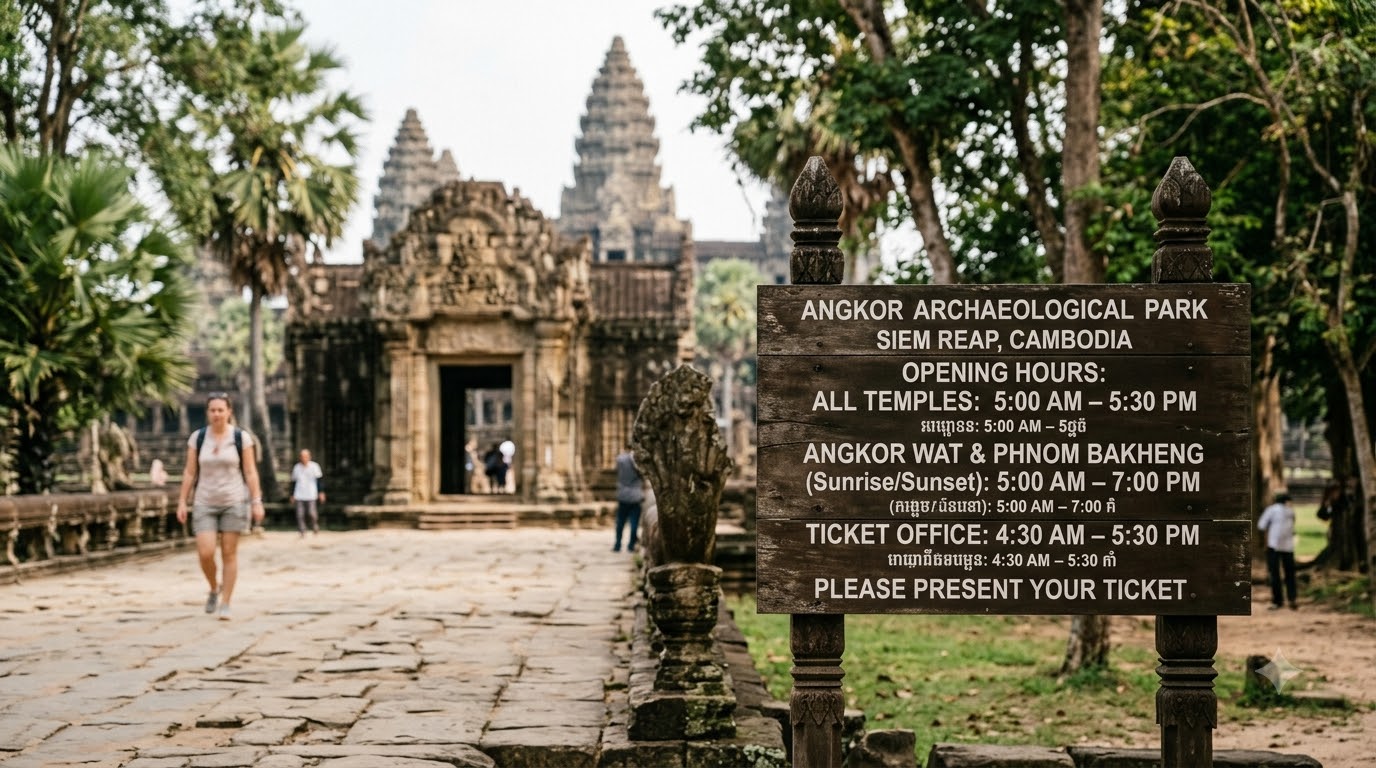
Angkor Wat itself opens at 5:00 AM and closes at 6:00 PM every day of the year, which is earlier than the rest of the park because of its famous sunrise. Most other temples open an hour later and a handful of sunset spots stay open past dusk.
| Temple / site | Opens | Closes | Note |
|---|---|---|---|
| Angkor Wat | 5:00 AM | 6:00 PM | Sunrise access from 5:00 AM |
| Most park temples (Bayon, Ta Prohm) | 6:00 AM | 6:30 PM | Standard circuit hours |
| Phnom Bakheng | 5:00 AM | 7:00 PM | Popular sunset hill, later close |
| Pre Rup | 5:00 AM | 7:00 PM | Alternative sunset temple |
| Banteay Srei | 6:00 AM | 5:00 PM | Furthest temple, closes earliest |
Source: Angkor Enterprise / APSARA National Authority, 2026.
A practical reading of those hours:
- For sunrise, be inside the Angkor Wat gate by 5:15 AM to claim a spot at the reflecting pond.
- For sunset, Phnom Bakheng and Pre Rup hold their gates open until 7:00 PM.
- Banteay Srei closes earliest at 5:00 PM, so slot it into the morning if it is on your list.
We usually build the day around this rhythm: Angkor Wat at dawn, the shaded interiors of Bayon and Ta Prohm through the hot midday hours, then a sunset temple. Our full day-by-day breakdown lives in the Angkor Wat itinerary if you want a ready-made plan.
Do you need a photo for the Angkor Pass?
You do not need to bring a photo, because Angkor Enterprise takes it for you. A camera at the counter snaps your portrait and prints it onto the pass, and this happens in seconds. The photo is how the checkpoints confirm the ticket belongs to you.
The photo rules by pass type:
- 1-day pass: no photo is printed on the ticket.
- 3-day and 7-day passes: a photo is required, taken at the counter or uploaded during online checkout.
- Online buyers upload a headshot during the purchase flow, then the QR code links to it.
Keep the pass on you at all times inside the park. Rangers scan it at the entrance to each major temple, and Angkor Wat, Angkor Thom, and Banteay Srei all have their own checkpoints. Lose the pass and you buy a new one, so we keep ours in a zipped pocket rather than loose in a bag.
Which Angkor Pass should you choose?
Choose the 3-day pass unless your schedule is genuinely locked to a single day, because it is the best balance of price and access for most travelers. The one-day pass suits only the tightest layovers, and the 7-day pass is aimed at photographers and slow travelers.
Here is how the three options tend to shake out by trip type:
- Choose the 1-day pass (US$37) if you have a single morning and want Angkor Wat, Bayon, and Ta Prohm only.
- Choose the 3-day pass (US$62) if you want sunrise plus the small and grand circuits at a relaxed pace.
- Choose the 7-day pass (US$72) if you are shooting photography, revisiting favorites, or spreading temples across a longer Siem Reap stay.
Because the 3-day pass spreads across a 10-day window, you can take a rest day, run a food-and-market day in town, or take a side trip and still return to the temples without losing a day of validity. Many travelers pair their temple days with the rest of the region using our Siem Reap 3-day itinerary, which balances temples with the town, the lake, and the night market.
Practical ticket tips for 2026
The single best money-and-time move is buying online the night before and treating the counter as a fallback. Beyond that, a handful of on-the-ground habits save real hassle.
Tips we use on every visit:
- Buy online at angkorenterprise.gov.kh at least 24 hours ahead to skip the counter queue entirely.
- Arrive at the Road 60 office before 5:00 AM on sunrise days, as buses fill the lot from about 5:15 AM.
- Carry small US-dollar bills; card works, but the counters move faster with cash.
- Screenshot your QR code in case the park’s mobile signal drops near the far temples.
- Do not photograph your pass and lend it out, since the printed portrait must match the holder at each checkpoint.
One more thing on validity: the clock on a multi-day pass runs from your first entry, not from the purchase date, so you can buy a 3-day pass and start it the next morning. That flexibility is exactly why we recommend the multi-day tiers over the single day for anyone staying more than one night.
Frequently Asked Questions
How much is an Angkor Wat ticket in 2026?
An Angkor Wat ticket in 2026 costs US$37 for one day, US$62 for three days, or US$72 for seven days. All three are the same “Angkor Pass” sold by Angkor Enterprise, and US$2 of each ticket funds the Kantha Bopha children’s hospital.
Where is the only official place to buy Angkor Wat tickets?
The only official sellers are the Angkor Enterprise ticket office on Road 60, about 4 km from central Siem Reap, and the government website angkorenterprise.gov.kh. Any discounted pass offered by a driver or agency is not legitimate, because the price is fixed by the government.
Does the Angkor Pass cover all the temples?
Yes. One Angkor Pass covers Angkor Wat, Angkor Thom, Bayon, Ta Prohm, Banteay Srei, and outlying sites like Beng Mealea and Kbal Spean. Phnom Kulen and Koh Ker are the main exceptions and charge separate entrance fees.
What time does Angkor Wat open for sunrise?
Angkor Wat opens at 5:00 AM every day, specifically to allow sunrise visits, and closes at 6:00 PM. Most other temples in the park open at 6:00 AM and close at 6:30 PM, while Phnom Bakheng and Pre Rup stay open until 7:00 PM for sunset.
Do children need an Angkor ticket?
Children under 12 enter the Angkor Archaeological Park free, but you must carry the child’s passport to prove their age at the checkpoint. Anyone 12 and over pays the full adult pass price, as there are no discounted youth or student rates.
Angkor Wat tickets are refreshingly simple once you know the three prices, the one official seller, and the opening hours. Decide how many temple days you want, buy the matching Angkor Pass from Angkor Enterprise, and keep the photo pass on you at every checkpoint. Get those basics right and the only thing left to plan is which sunrise you want to stand in front of first.