Best Things to Do in Zermatt: Top Sights for 2026
By TravelguidestipUpdated 10 min readHow we earn
Hotel buttons open Stay22 (Booking.com, Agoda and others) and tour buttons open GetYourGuide. We may earn a commission at no extra cost to you.
In short
- Gornergrat railway costs CHF 132 return in summer and CHF 96 in winter; Swiss Travel Pass and Half Fare Card holders pay 50 percent less (CHF 66 / CHF 48).
- Matterhorn Glacier Paradise runs CHF 207 return in July-August high season, CHF 183 in shoulder months, and CHF 143 in winter; the top station sits at 3,883 m.
- Sunnegga funicular starts at about CHF 19, while the full return to Rothorn reaches CHF 89 in the July 1-August 31 peak.
- Gorner Gorge is the cheapest highlight at CHF 5.50 per adult (cash only), open June to mid-October.
- The Peak Pass bundles Gornergrat, Glacier Paradise, Sunnegga-Blauherd and the local bus from CHF 212 for one day, cheaper per day the longer you stay.
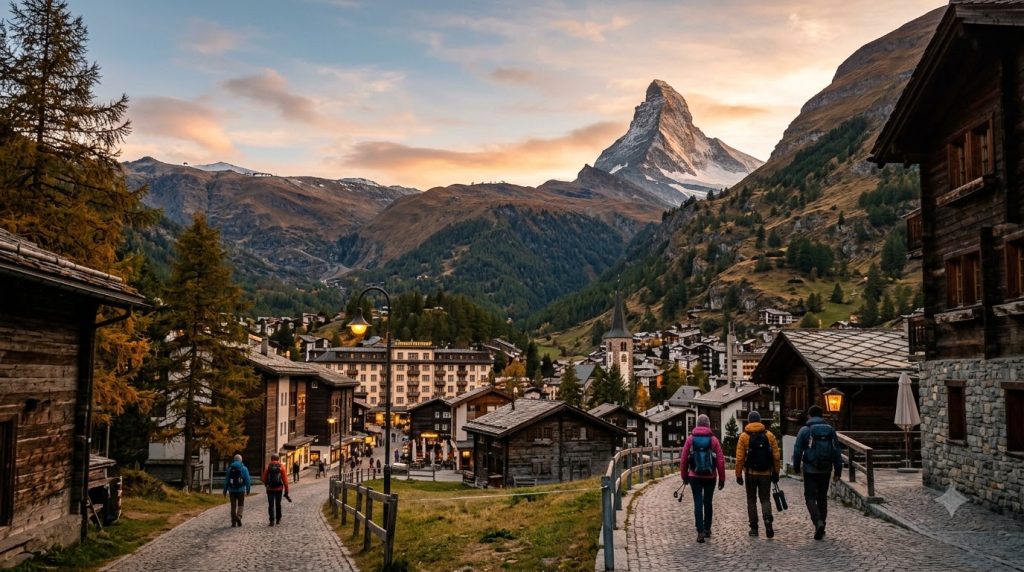
The best things to do in Zermatt in 2026 revolve around three high-mountain excursions and the trails that connect them: the Gornergrat cog railway (3,089 m), Matterhorn Glacier Paradise (3,883 m, Europe’s highest cable car station), and the Sunnegga-Rothorn area with its Five Lakes Walk.
Add the short, cool detour through the Gorner Gorge and a day or two of easy hiking, and you have a full itinerary framed by one mountain: the 4,478 m Matterhorn.
Zermatt is car-free, so every visit starts with a train. You arrive on the Matterhorn Gotthard Bahn, either changing at Täsch (a 12-minute shuttle ride) or riding straight in from Visp. This guide covers the four viewpoints most visitors prioritise, what each costs in 2026, when they open, and how to string them together without overpaying for lift tickets you will not use.
Our best Matterhorn view came not from the highest station but from Rotenboden, one stop below Gornergrat, where the peak mirrored perfectly in the Riffelsee at 8 in the morning before the wind picked up. Buy the first train of the day and plan to be back down by lunch, when clouds usually swallow the summit.
What are the best things to do in Zermatt?
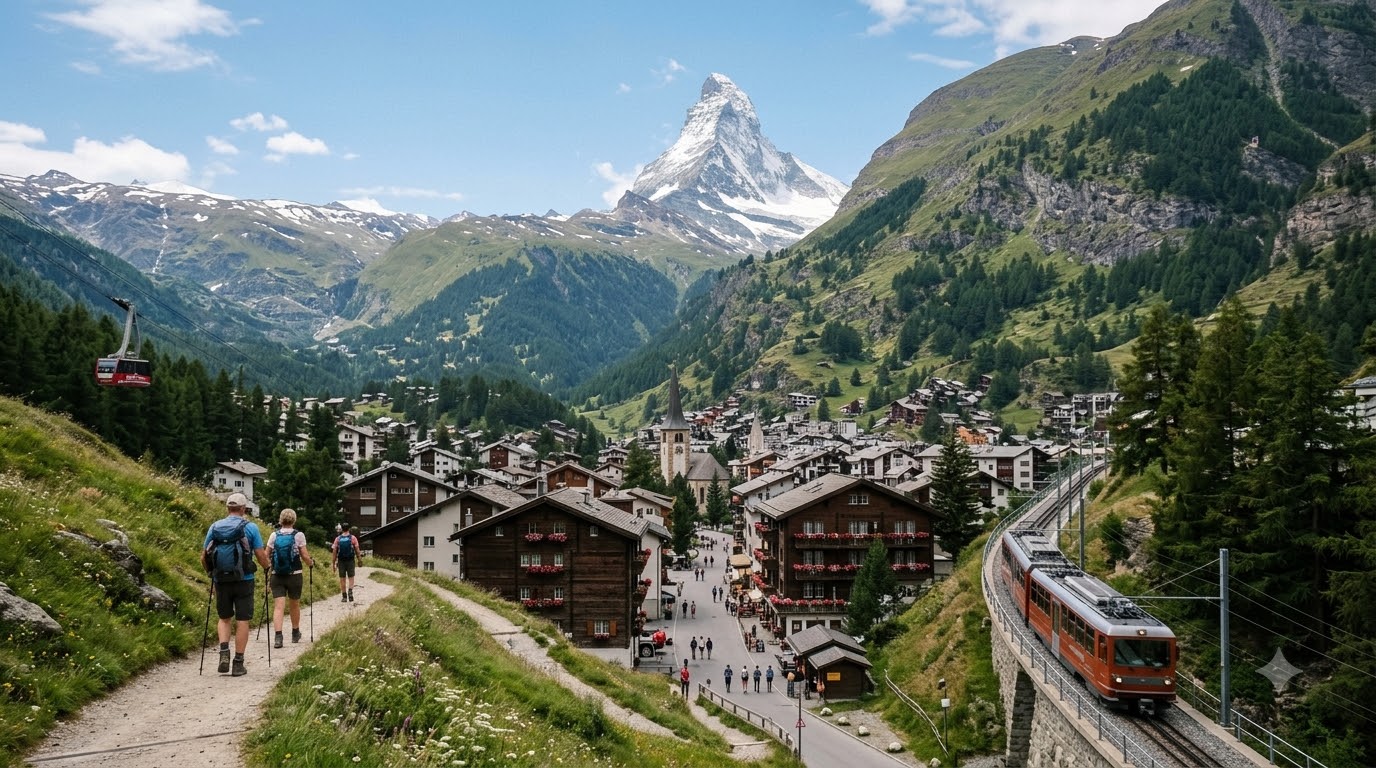
The best things to do in Zermatt combine one summit railway, one glacier cable car, one lakeside hike, and one gorge walk. If you have limited time, prioritise Gornergrat for the postcard Matterhorn view and the Five Lakes Walk for reflections. Here is the short list, ranked by how often first-time visitors put them at the top:
- Ride the Gornergrat railway to 3,089 m for the widest Matterhorn panorama reachable without hiking.
- Ascend Matterhorn Glacier Paradise (3,883 m) for glaciers, the Glacier Palace ice cave, and 38 nearby four-thousand-metre peaks.
- Walk the Five Lakes Walk from Blauherd, where the Stellisee reflects the Matterhorn on calm mornings.
- Follow the wooden walkways of the Gorner Gorge, a shaded 20-minute detour on a hot afternoon.
- Stroll the Kirchbrücke and old Hinterdorf hamlet in Zermatt village for weathered timber granaries and the classic Bahnhofstrasse Matterhorn view.
For where these fit into a longer trip, our Zermatt travel guide sets out a three-to-five-day framework.
Ride the Gornergrat Railway for the classic Matterhorn view
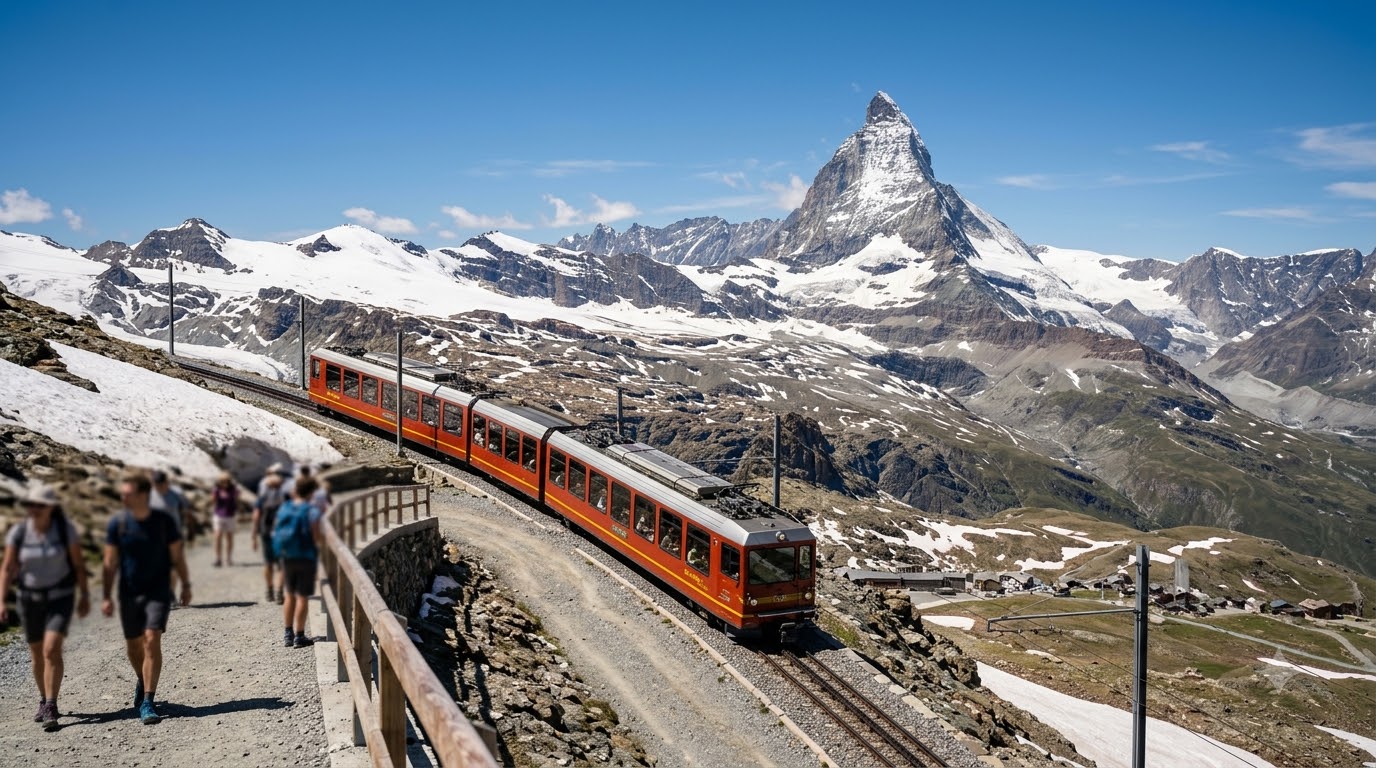
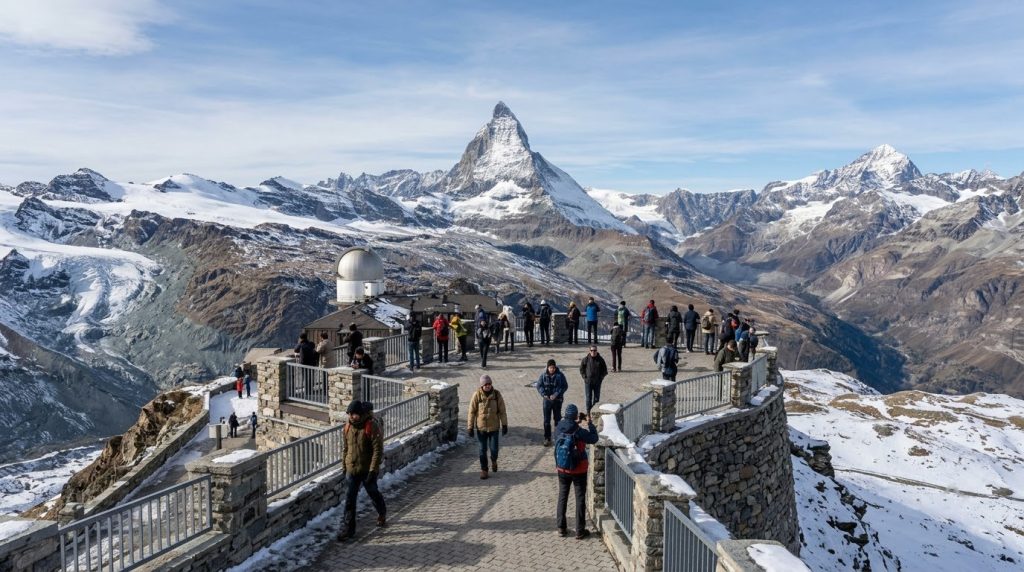
Gornergrat delivers the single best Matterhorn view you can reach without hiking, and it is the excursion we send first-timers to. The open-air cog railway climbs from Zermatt village at 1,620 m to the Gornergrat ridge at 3,089 m in about 33 minutes, gaining nearly 1,500 vertical metres past forest, alpine meadow, and finally bare rock.
From the top terrace the Matterhorn, Monte Rosa massif, and the Gorner Glacier fan out in a single sweep.
The train runs year-round and departs roughly every 24 minutes in peak periods. The first departure is around 8am; an hour later the terrace is already busy with tour groups.
| Detail | 2026 figure |
|---|---|
| Summit elevation | 3,089 m |
| Journey time (one way) | ~33 minutes |
| Return fare, summer (May-Oct) | CHF 132 |
| Return fare, winter (Nov-Apr) | CHF 96 |
| Swiss Travel Pass / Half Fare fare | CHF 66 summer, CHF 48 winter |
Practical notes we wish we had known before boarding:
- Sit on the right-hand side going up for the Matterhorn views the whole way.
- Get off at Rotenboden, one stop below the top, and walk five minutes to the Riffelsee for the best reflection shot.
- The last section to the summit hotel is exposed and cold; bring a layer even in July.
- Trains fill fastest between 10am and noon, so an early or late ride is calmer.
Prices confirmed via Gornergrat Bahn and MySwissAlps for the 2026 season.
Go high at Matterhorn Glacier Paradise
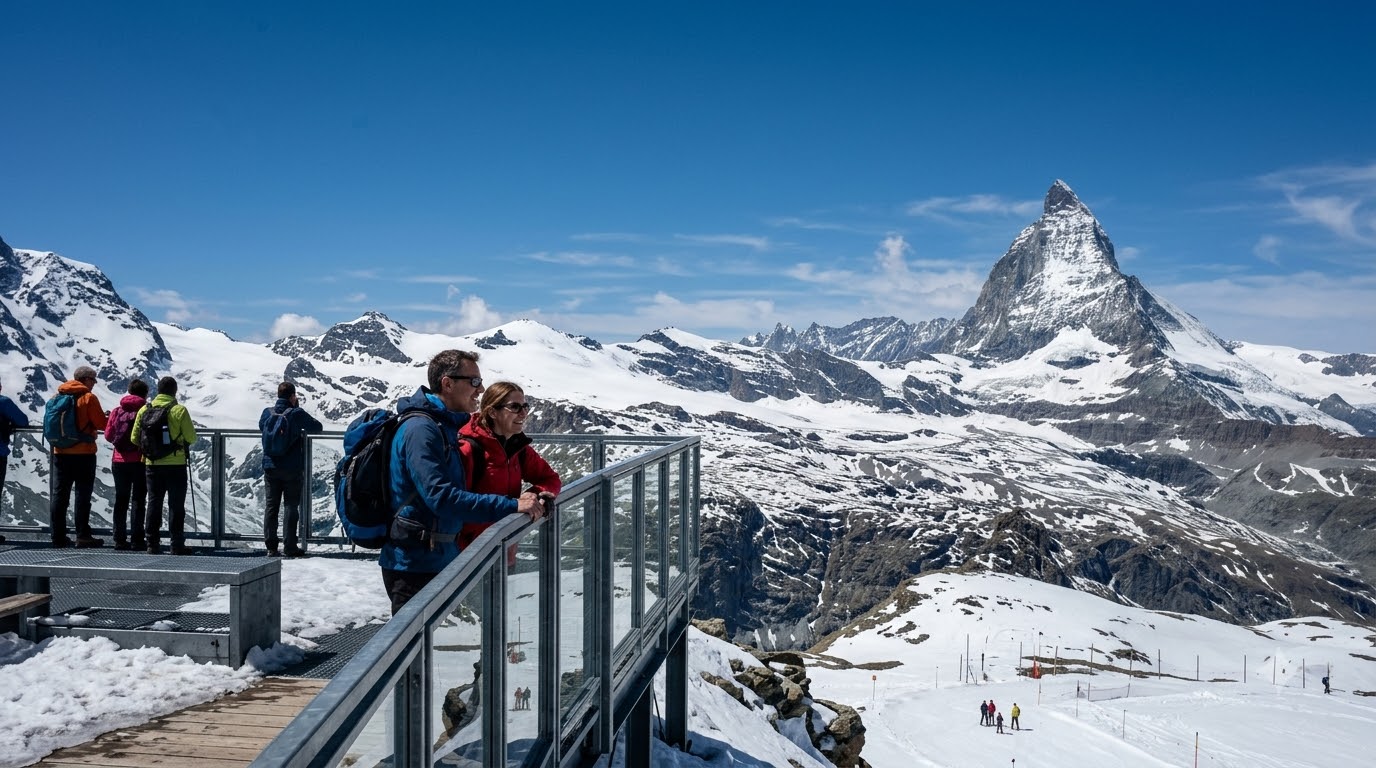
Matterhorn Glacier Paradise is the highest cable car station in Europe at 3,883 m, and it is the excursion to choose if you want glaciers and snow underfoot in any season. From the valley you ride a series of gondolas and the 3S cableway up to the Klein Matterhorn, where a lift and tunnel lead to a viewing platform.
On a clear day the platform takes in 38 peaks above 4,000 m and 14 glaciers, plus the “back side” of the Matterhorn.
The ticket includes the Glacier Palace, an ice cave carved 15 m below the surface with sculptures and a short ice slide. Even in July, the summit air is near freezing and the platform windy, making this the coldest thing to do in Zermatt no matter the calendar.
| Season 2026 | Return fare from Zermatt |
|---|---|
| Winter low (Nov 2025-Apr 2026) | CHF 143 |
| Shoulder (May-Jun, Sep-Oct) | CHF 183 |
| Summer high (Jul-Aug) | CHF 207 |
What to keep in mind before you commit to the top station:
- Adults with a Swiss Travel Pass, Travel Pass Flex, or Half Fare Card receive 50 percent off.
- Children under 9 travel free, and 6-to-15-year-olds ride free with the Swiss Family Card when a parent holds a valid pass.
- The 3,883 m altitude can cause light-headedness; move slowly on the stairs to the platform.
- Ride up early, as afternoon cloud builds against the high glaciers and can erase the view entirely.
Pricing verified against Zermatt Bergbahnen and MySwissAlps.
Sunnegga, Rothorn and the Five Lakes Walk
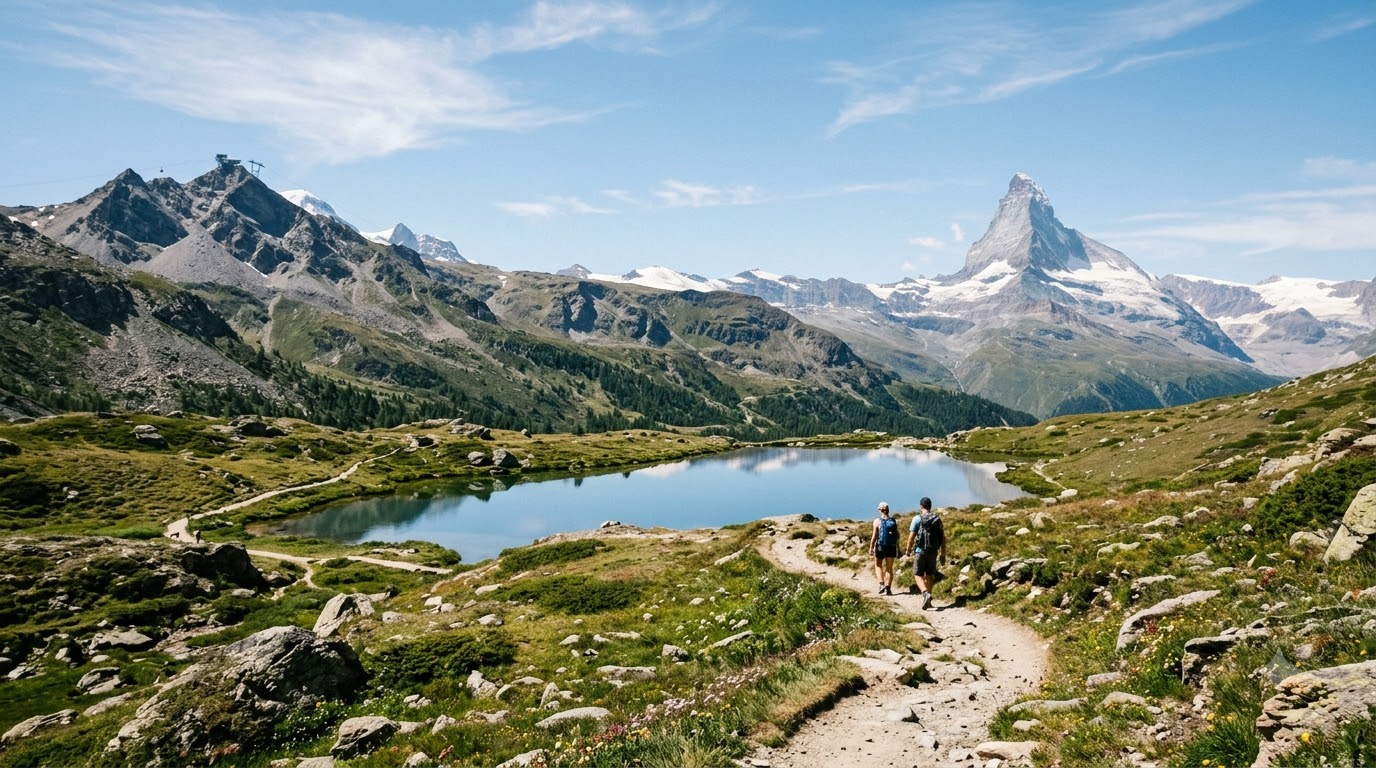
Sunnegga is the easiest high viewpoint to reach and the gateway to Zermatt’s most photographed hike, the Five Lakes Walk. An underground funicular climbs from the village to Sunnegga (2,288 m) in about three minutes, and from there a gondola and a summer-only cable car continue to Blauherd and the Rothorn viewpoint (Unterrothorn, roughly 3,100 m).
We used this side of the valley for a full morning of walking rather than a single up-and-down trip.
The Five Lakes Walk (5-Seenweg) links Stellisee, Grindjisee, Grünsee, Moosjisee, and Leisee over roughly 9 km and two to three hours, with the Stellisee giving the cleanest Matterhorn reflection when the water is still. Start at Blauherd and walk downhill toward Sunnegga to keep it gentle.
| Sunnegga-Rothorn 2026 | Figure |
|---|---|
| Funicular to Sunnegga (from) | about CHF 19 |
| Return to Rothorn, peak (Jul 1-Aug 31) | CHF 89 |
| Rothorn viewpoint elevation | ~3,100 m |
| Blauherd-Rothorn cable car season | Jun 27-Oct 4, 2026 |
Reasons we rate this the best value morning in Zermatt:
- The funicular alone is cheap and puts you on the sunny east side of the valley within minutes.
- Leisee, just below Sunnegga, has a swimming area and is a short walk for families with young children.
- The downhill Blauherd-to-Sunnegga route avoids the steepest climbs while still passing four of the five lakes.
- Calm air before mid-morning gives the sharpest reflections, so we started walking by 9am.
Data cross-checked with Zermatt tourism and MySwissAlps.
Walk through the Gorner Gorge
The Gorner Gorge (Gornerschlucht) is the cheapest and coolest thing to do in Zermatt, and a good option for a hot afternoon or a rest day between big lifts. Wooden galleries bolted to the rock lead you along the Gornervispa river as it cuts through polished green serpentinite, a 20-to-30-minute out-and-back walk from the entrance near Furi.
It is reachable on foot from the village in about 30 minutes or by taking the Furi gondola partway.
Entry is CHF 5.50 per adult and payment is cash only, so carry coins or small notes. The gorge opens from June to mid-October and closes for winter when the walkways are unsafe.
Quick facts worth quoting before you go:
- Adult entry: CHF 5.50; children roughly CHF 2.50; cash only at the gate.
- Open season: June to mid-October, weather permitting.
- Allow 20-30 minutes inside, plus walking time to and from Furi.
- The galleries are shaded and can be slippery, so wear grippy shoes.
What are the best easy hikes around Zermatt?
The best easy hikes around Zermatt let you trade a lift ticket for a trail while keeping the Matterhorn in view the whole way. Beyond the Five Lakes Walk, two routes stand out for scenery relative to effort, and both link to stations so you can ride one direction and walk the other.
The Riffelberg descent sees only a handful of people once the tour groups have gone back down.
- Riffelberg to Riffelalp: a mostly downhill 1.5-2 hour walk on the Gornergrat line with constant Matterhorn views and two stations to bail out at.
- Blauherd to Sunnegga via the Five Lakes: about 9 km and two to three hours, gentle if walked downhill.
- Zermatt to Furi and the Gorner Gorge: a valley-floor stroll of roughly 30-40 minutes each way with almost no climbing.
- Riffelsee circuit from Rotenboden: 30-45 minutes around the reflection lake, ideal in early morning light.
For planning around snow-free trails and daylight, see our guide to the best time to visit Zermatt, and for the mountain’s climbing and geology background, the Zermatt Matterhorn guide goes deeper.
Which Zermatt mountain ticket or pass is worth it?
A single Peak Pass is worth it once you plan two or more high excursions in the same trip, because separate return tickets add up quickly. The Peak Pass gives unlimited travel on Gornergrat, Matterhorn Glacier Paradise, Sunnegga-Blauherd, and the Furi-Riffelberg lift, plus the Glacier Palace and the local bus. It starts at CHF 212 for one day, and the per-day cost falls the longer you hold it.
Here is the simple math we used to decide. A summer Gornergrat return (CHF 132) plus a high-season Glacier Paradise return (CHF 207) already totals CHF 339, so if you want both plus Sunnegga, a multi-day Peak Pass usually wins. If you only want one big view, buy the single return instead.
Pass-buying rules we followed:
- Buy single returns if you plan just one summit; the Peak Pass rarely pays off for a single ride.
- Choose the Peak Pass for three or more consecutive high-mountain days.
- Add the glacier ski option for CHF 40 per day only if you actually intend to ski.
- Hold a Swiss Travel Pass or Half Fare Card? Compare it against the Peak Pass, since it already halves most single fares.
Where you base yourself affects how much lift travel you do each day; our where to stay in Zermatt guide breaks down neighbourhoods by walking distance to the three valley stations.
How to plan a car-free Zermatt visit
Zermatt bans combustion cars, so plan to leave your vehicle in Täsch and finish the journey by train. From the Täsch parking terminal, shuttle trains run to Zermatt in about 12 minutes; long-distance trains also reach the village directly from Visp and Brig, and Zermatt is the mountain terminus of the Glacier Express.
Inside the village, electric taxis and small e-buses handle luggage, and most hotels sit within a 10-minute walk of the station.
Because the big attractions sit at very different altitudes, we treated weather as the deciding factor each morning. On clear days we went straight to the highest open station; on cloudy days we saved money by walking the gorge or the lower trails. That flexibility, more than any single ticket, is what made the trip work.
If you are still choosing dates, the best time to visit Zermatt guide explains which months give the clearest Matterhorn mornings.
Frequently Asked Questions
How many days do you need in Zermatt?
Three full days cover the four headline sights comfortably: one for Gornergrat, one for Matterhorn Glacier Paradise, and one for the Sunnegga Five Lakes Walk plus the Gorner Gorge. Add a fourth or fifth day if you want unhurried hiking or a weather buffer, since high-altitude views depend heavily on clear mornings.
What is the best thing to do in Zermatt for first-time visitors?
The Gornergrat railway is the best first excursion. At CHF 132 return in summer it delivers the widest Matterhorn panorama reachable without hiking, runs year-round, and takes about 33 minutes each way. Ride the first train of the day and stop at Rotenboden for the Riffelsee reflection.
Is Matterhorn Glacier Paradise worth the price?
Matterhorn Glacier Paradise is worth its CHF 207 summer fare if you specifically want glaciers, snow, and Europe’s highest cable car station at 3,883 m. If your main goal is the classic Matterhorn profile, Gornergrat gives a comparable view for far less, so choose Glacier Paradise for the high-alpine experience rather than the peak view alone.
Can you see the Matterhorn without paying for a lift?
Yes. The Matterhorn is visible free from Zermatt village, especially from the Kirchbrücke bridge and the top of Bahnhofstrasse at sunrise. Short valley walks toward Furi and the Gorner Gorge keep the peak in view, and the CHF 5.50 gorge entry is the cheapest paid attraction in town.
When do Zermatt’s cable cars and gorge open in 2026?
The Gornergrat railway and Matterhorn Glacier Paradise run year-round. The Blauherd-Rothorn cable car operates from June 27 to October 4, 2026, and the Gorner Gorge opens from June to mid-October. Always check the day’s operating status in bad weather, as high lifts close in strong wind.
Where to stay in Zermatt: compare live prices and availability before you lock in dates.
Find your Zermatt hotel on the map
Live prices from Booking, Airbnb and more — move the map or change dates to compare stays around Zermatt.
Final thoughts
The best things to do in Zermatt reward an early alarm and a flexible plan. Ride high on clear mornings, walk the lakes and the gorge when clouds roll in, and let the Matterhorn set the day’s schedule rather than a fixed ticket.
Whether you spend CHF 5.50 at the Gorner Gorge or CHF 207 at Europe’s highest cable car station, the mountain stays the constant, framing every viewpoint from the valley floor to 3,883 m. For the full trip framework around these sights, return to our Zermatt travel guide.