Is Fiji Expensive? Daily Budget by Travel Style in FJD
By TravelguidestipUpdated 9 min readHow we earn
Hotel buttons open Stay22 (Booking.com, Agoda and others) and tour buttons open GetYourGuide. We may earn a commission at no extra cost to you.
What a day costs
| Per day | Backpacker | Mid-range | Resort |
|---|---|---|---|
| Accommodation | FJD 45-90 (USD 20-40) dorm | FJD 170-280 (USD 75-125) | FJD 1,100-2,500 (USD 490-1,100) |
| Food and drink | FJD 40-70 (USD 18-31) | FJD 100-180 (USD 45-80) | FJD 250-500 (USD 110-220) |
| Transport | FJD 15-30 (USD 7-13) | FJD 60-120 (USD 27-53) | FJD 100-300 (USD 45-135) |
| Activities | FJD 0-60 (USD 0-27) | FJD 120-250 (USD 53-110) | FJD 100-300 (USD 45-135) |
| Daily total (approx.) | FJD 120-250 (USD 55-110) | FJD 450-800 (USD 200-355) | FJD 1,500-3,500+ (USD 670-1,550+) |
The resort row assumes a couple sharing one room, so per-person costs are lower than the headline figure.
In short
- Budget stays start near FJD 110 (USD 50) a night, while luxury resorts begin around FJD 1,100 (USD 500) and peak-season oceanfront rooms can pass FJD 3,400 (USD 1,500).
- Daily totals swing about 10x between a dorm-bed backpacker and a private-island resort guest.
- Shoulder months (May and October) can save roughly 15-25% on stays with dry-season weather.
- Day tours cost about FJD 175-430 (USD 77-190) per person, which is where mid-range budgets quietly balloon.
- Food and local transport are cheap; accommodation and boat transfers drive nearly all the cost.
Fiji is a mid-to-premium destination: cheap on the ground, expensive in the resort. A backpacker can get by on roughly FJD 120-250 a day (about USD 55-110), while a mid-range traveler should plan on FJD 450-800 (USD 200-355). Resort stays push well past FJD 1,200 (USD 530) per person once meals and boat transfers are added.
All prices below exclude international flights and are approximate. Operator pricing changes with the season and the exchange rate, so treat every figure as a planning range, not a quote. We convert at roughly FJD 2.25 per USD. If you’re still deciding where to go, our guide to things to do in Fiji shows what the money actually buys.
On our last trip we split ten nights between a Nadi guesthouse and a small island resort. The guesthouse days cost a fraction of the resort days, even though we ate the same fish and rice. What stung wasn’t the room rate. It was the all-in extras: boat transfers, resort-priced drinks, and a pre-paid meal plan we couldn’t skip.
So, is Fiji expensive compared with other islands?
Fiji sits in the middle of the Pacific price spectrum. Mid-range stays run about USD 75-125 a night and luxury starts at around USD 125 and climbs steeply, according to a 2026 travel-money guide (OrbitRemit, 2026). It’s cheaper than French Polynesia at the top end, but dearer than Southeast Asia almost everywhere.
The honest answer is that it depends on where you sleep. On the main island of Viti Levu, local buses, markets, and roadside curries cost very little. On outer islands, everything arrives by boat, so prices jump.
A rough rule we’ve found useful: mainland Fiji feels like a budget trip, and island Fiji feels like a splurge. Most travelers mix the two, and that mix is what decides your average daily spend.
How much does a day in Fiji cost by travel style?
Daily costs in Fiji range from about FJD 120 for a dorm-bed backpacker to FJD 3,000 or more for a luxury resort guest, excluding flights. Budget hotels start around USD 50 a night, while luxury resorts begin near USD 500 (radicalstorage, 2026). The table below shows how the full day breaks down.
| Travel style | Accommodation | Food and drink | Transport | Activities | Daily total (approx.) |
|---|---|---|---|---|---|
| Backpacker | FJD 45-90 (USD 20-40) dorm | FJD 40-70 (USD 18-31) | FJD 15-30 (USD 7-13) | FJD 0-60 (USD 0-27) | FJD 120-250 (USD 55-110) |
| Mid-range | FJD 170-280 (USD 75-125) | FJD 100-180 (USD 45-80) | FJD 60-120 (USD 27-53) | FJD 120-250 (USD 53-110) | FJD 450-800 (USD 200-355) |
| Resort | FJD 1,100-2,500 (USD 490-1,100) | FJD 250-500 (USD 110-220) | FJD 100-300 (USD 45-135) | FJD 100-300 (USD 45-135) | FJD 1,500-3,500+ (USD 670-1,550+) |
Source: Operator and accommodation pricing, 2026 (approximate, check current rates)
The resort row assumes a couple sharing one room, so per-person costs are lower than the headline figure. The other rows are per person. Always compare like with like when you read other Fiji budgets.
What does a backpacker budget look like?
A backpacker budget works because of Fiji’s hostels, market food, and public buses. A dorm bed in Nadi or on the Coral Coast runs about FJD 45-90 (USD 20-40). Meals from a local cafe or market stall cost FJD 10-25 (USD 4-11). Bus fares between towns are low, and short rides cost only a few dollars.
The catch is the islands. Yasawa backpacker lodges usually sell bundled packages that include meals and a boat pass, so your daily cost there is higher than on the mainland. Budget for it separately.
What does a mid-range budget buy?
A mid-range budget gets you a private room with air conditioning, a mix of restaurant and cafe meals, and one or two organized activities. Expect FJD 450-800 (USD 200-355) per person per day. That covers a comfortable hotel in Nadi or Denarau, a rental car now and then, and a day cruise.
Mid-range is where the choices matter most. One extra island day trip adds FJD 250-300 (USD 110-135) in a single stroke, so pick carefully.
What does a resort budget look like?
Resort budgets start where hotel budgets end. Luxury rooms begin near FJD 1,100 (USD 500) a night, and peak July and August oceanfront rooms can pass FJD 3,400 (USD 1,500), based on approximate published rates (fijipocketguide, 2026). Meal plans, spa treatments, and transfers are often extra.
Many island resorts are all-inclusive or have mandatory meal plans because there’s nowhere else to eat. That removes surprise bills but locks in the price.
What drives the cost of a Fiji trip?
Accommodation drives most of the cost of a Fiji trip, followed by boat transfers and organized tours. Day tours run about USD 80-190 per person, and car rental can start near USD 50 a day (radicalstorage, 2026). Food and local buses add comparatively little, so the room you choose sets your whole budget.
Here’s what moves the total most, in rough order:
- Where you sleep: a dorm bed and an overwater villa can differ by 30x or more per night.
- Island versus mainland: outer islands add ferry or seaplane costs and resort-priced food.
- Season: July and August carry the highest rates.
- Tours: reef and island day trips are priced per person, so they add up fast for families.
- Transport style: buses are cheap, taxis and rental cars are not.
We’ve found that travelers underestimate boat transfers more than anything else. Check whether your resort includes them before you compare nightly rates.
How much do activities and day tours cost in Fiji?
Most Fiji day tours cost between FJD 175 and FJD 430 (USD 77-190) per person, with island cruises at the higher end. A Mamanuca Islands cruise with snorkeling and lunch runs about USD 110-140, according to operator listings (tour operator from-prices, 2026). Inland and cultural tours cost noticeably less.
| Activity | Typical price (approx.) | Time needed |
|---|---|---|
| Mamanuca Islands day cruise with lunch | FJD 250-315 (USD 110-140) | Full day |
| Monuriki and Mana sand bar snorkel cruise | From FJD 305 (USD 136) | Full day |
| Mamanuca snorkeling (incl. shark snorkel) | FJD 175-430 (USD 77-190) | Half to full day |
| Cloud 9 floating platform | From FJD 300 (USD 132) | 5-7 hours |
| Sigatoka River cruise | From FJD 190 (USD 84) | About 4.5 hours |
| Sigatoka jet boat with lunch | About FJD 425 (USD 188) | Half day |
| Garden of the Sleeping Giant and mud pool combo | About FJD 215 (USD 96) | 4.5-5.5 hours |
Source: Tour operator from-prices, 2026 (approximate, prices change)
Tours are the easiest place to trim. The Sigatoka sand dunes are a low-cost half-day option, and the orchid garden combo costs far less than a reef cruise. Entry fees are sometimes extra, so read the inclusions before booking.
If you want to see what’s worth paying for, our guide to things to do in Fiji ranks the main options.
Does the time of year change what you pay in Fiji?
Yes, season changes Fiji prices by a wide margin. Shoulder months of May and October can save about 15-25% on stays while still offering dry-season weather, per approximate guidance from travel-cost sites (radicalstorage, 2026). Peak July and August cost the most, and low season from November to March is cheapest, excluding holidays.
Fiji’s dry season runs from May to October, with temperatures around 26-28 C, low humidity, and calm seas. That’s the most popular time, so prices rise to match. The wetter months bring more rain and a cyclone risk, which is why resorts discount them. Some sources disagree on the exact month boundaries, so check your resort’s own rate calendar.
For a deeper look at weather trade-offs, read our guide to the best time to visit Fiji.
The cheapest-feeling months aren’t always the cheapest overall. A November discount on the room can be erased if rain cancels a FJD 300 reef cruise you can’t rebook. For short trips, we think shoulder months give better value than the deepest low-season deals.
How much is food, transport, and a rental car in Fiji?
Food and local transport are Fiji’s cheapest costs. A meal at a local cafe or market stall runs about FJD 10-25 (USD 4-11), while a sit-down restaurant dinner is FJD 40-90 (USD 18-40). Car rental can start near FJD 110 (USD 50) a day (radicalstorage, 2026), and fuel is extra.
Resort food is another story. Island resorts import most supplies, so expect two to three times the price of mainland restaurants. A beer or cocktail by the pool can cost as much as a full local meal.
Transport options and approximate costs:
- Local buses: very cheap on Viti Levu and the simplest way to cover the Coral Coast.
- Taxis: reasonable for short trips in towns, pricey for long distances.
- Rental car: from about FJD 110 (USD 50) a day, useful for the Coral Coast and Sigatoka area.
- Boat transfers: the big-ticket item for outer islands, often FJD 100-300 (USD 45-135) per person.
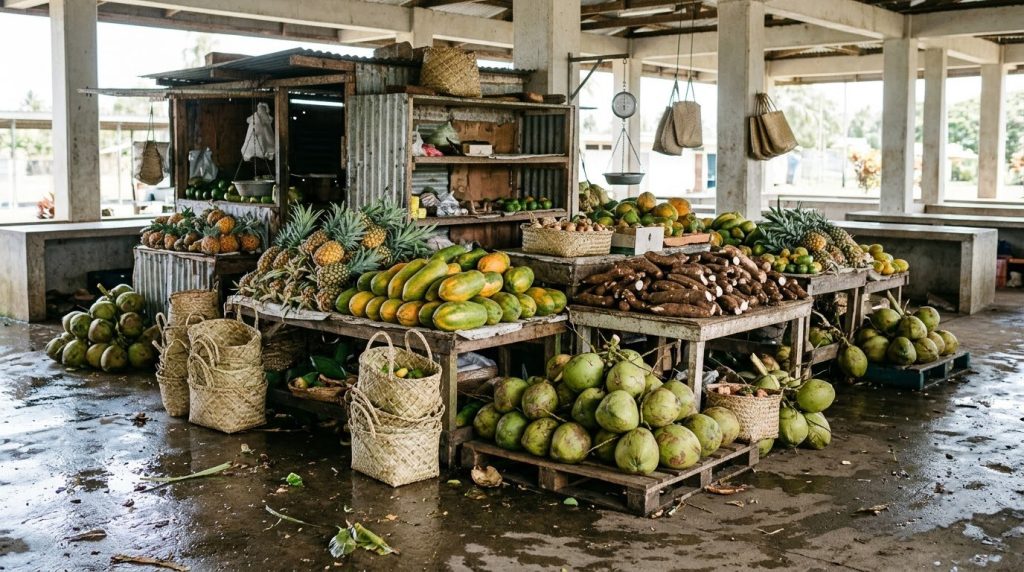
Self-catering helps. Local markets sell fruit, vegetables, and fresh fish at low prices, and many guesthouses have shared kitchens.
How can you save money in Fiji?
You can save the most in Fiji by traveling in May or October, mixing mainland and island stays, and choosing fewer, better tours. Shoulder months cut stay costs roughly 15-25% (radicalstorage, 2026). Eating locally and using buses saves another few hundred FJD over a week.
Our own shortlist, based on what has worked for us:
- Travel in the shoulder months. May and October give dry weather without July prices.
- Split your stay. Spend a few nights on the mainland, then a short island stay.
- Skip mandatory meal plans where you can. Guesthouses with kitchens cost less.
- Book one big tour, not three. A single reef day delivers most of the payoff.
- Eat where locals eat. Market food is cheap and good.
- Compare the all-in resort price. Include transfers, meals, and activities before judging a rate.
- Rent a car only for the days you need it.
Is Fiji worth the price?
For most travelers, yes, if you pick a style that matches your budget. Fiji’s draw is its reefs, calm lagoons, and warm welcome, and those don’t depend on a luxury room rate. A mid-range trip of 7-10 days commonly lands between FJD 3,000 and FJD 8,000 (USD 1,350-3,550) per person, excluding flights, per our estimate from the table above.
If you want to see Fiji on a tight budget, stay on the mainland and book one island cruise. If you want to be pampered, a resort is where the premium goes. There’s no wrong answer, only a gap between expectation and bill.
Find your Fiji hotel on the map
Live prices from Booking, Airbnb and more — move the map or change dates to compare stays across Fiji.
Frequently Asked Questions
Is Fiji cheaper than Hawaii or Bali?
Fiji sits between the two. Bali is usually cheaper on food and accommodation, while Hawaii is generally dearer at mid-range. Fiji’s costs depend heavily on whether you stay on the mainland or outer islands. Compare the all-in daily total, not just the nightly room rate.
How much money do I need per day in Fiji?
Plan on roughly FJD 120-250 (USD 55-110) as a backpacker, FJD 450-800 (USD 200-355) mid-range, and FJD 1,500 or more (USD 670+) at a resort. These figures exclude flights and are approximate. Check current operator rates before you book.
What is the cheapest time to visit Fiji?
Low season from November to March is the cheapest, excluding holiday periods. Shoulder months such as May and October offer about 15-25% savings on stays with better weather. Peak July and August carry the highest rates.
Is it expensive to eat out in Fiji?
Not on the mainland. Local cafe and market meals run about FJD 10-25 (USD 4-11). Resort restaurants on outer islands cost two to three times more because supplies are shipped in. Self-catering and eating locally keeps costs down.
Can you visit Fiji on a budget?
Yes. Hostels, local buses, market food, and one or two chosen tours keep a budget trip to FJD 120-250 (USD 55-110) a day. Yasawa lodges with bundled meals cost more per day, so plan those stays separately.
Fiji isn’t a cheap destination, but it isn’t uniformly expensive either. Choose your style, pick your season, and the numbers become manageable. Start with the things to do in Fiji to decide what to pay for, then check the best time to visit Fiji to lock in your dates.