This post contains affiliate links. If you book through them, we earn a small commission at no extra cost to you. We only recommend services we’ve personally tested or vetted thoroughly.
Angkor Wat Temple Complete Guide 2026: Tickets, Tours & Tips
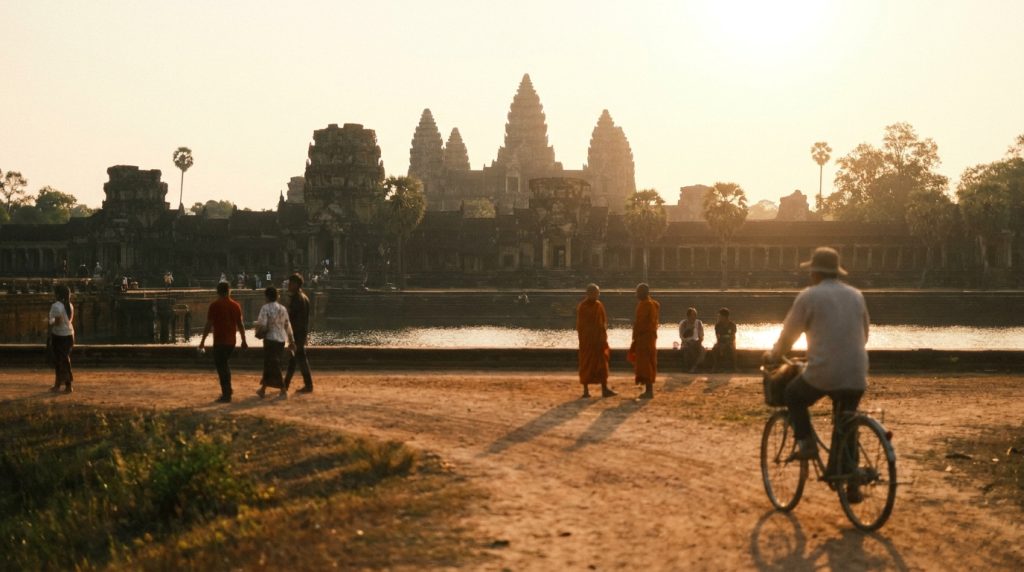
Angkor Wat isn’t just another temple. It’s the largest religious monument on Earth, sprawling across 162.6 hectares (UNESCO World Heritage Centre, 2024), and it draws roughly 2.5 million visitors annually (Cambodia Ministry of Tourism, 2024). If you’ve seen a single photo of Cambodia, odds are it featured those five lotus-bud towers reflected in a lily pond at dawn.
But here’s the thing nobody tells you. Angkor Wat is confusing. The ticket system has three tiers, the temple complex covers 400 km², and choosing the wrong itinerary can leave you exhausted before you even reach Bayon. We’ve been to Angkor four times across different seasons, and this guide pulls together everything we learned the hard way.
Key Takeaways
– Angkor Pass costs $37 (1-day), $62 (3-day), or $72 (7-day) and must be bought at the official Angkor Enterprise office, never at temple gates (Angkor Enterprise, 2024).
– Angkor Wat receives over 2.5 million visitors yearly, making sunrise (4:30 AM arrival) crowded but worth it for serious photographers.
– The temple complex covers 400 km² total. A 1-day pass barely scratches the Small Circuit. We recommend the 3-day pass for 90% of travelers.
– Dress code is enforced: shoulders and knees must be covered. The upper tier (Bakan) is closed to women during menstruation per APSARA Authority rules.
– Klook small-group sunrise tours start at $25-40, private tuk-tuk guides at $50-80, helicopter rides $150-300.
What Are the Quick Facts About Angkor Wat? — Angkor Wat Temple Guide
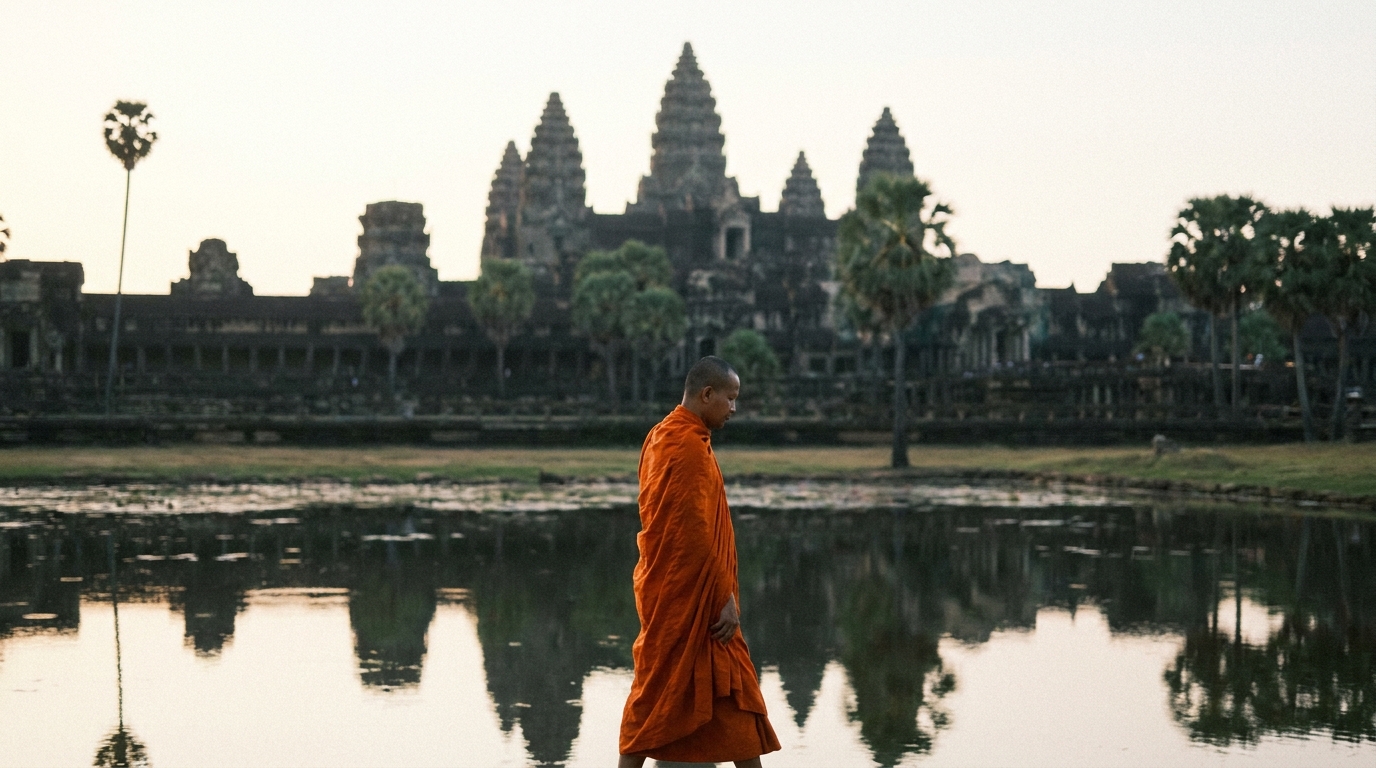
Before we get into ticket prices and tour bookings, here’s everything at a glance. Angkor Wat was built between 1113 and 1150 CE under King Suryavarman II, originally as a Hindu temple dedicated to Vishnu, then converted to Theravada Buddhism in the late 13th century (Smithsonian Magazine, 2023). It’s the only temple in human history to appear on a national flag.
| Fact | Detail |
|---|---|
| Location | Siem Reap Province, Cambodia |
| Founded | 1113-1150 CE |
| Founder | King Suryavarman II |
| Original religion | Hindu (Vishnu) |
| Current religion | Theravada Buddhism |
| Total area | 162.6 hectares (Angkor Wat itself) |
| Archaeological park | 400 km² (Angkor Archaeological Park) |
| Annual visitors | ~2.5 million (2024) |
| UNESCO listing | 1992 |
| 1-day ticket | $37 USD |
| Best photo time | 5:00-6:30 AM (sunrise) |
| Dress code | Shoulders + knees covered (mandatory) |
Citation capsule: Angkor Wat covers 162.6 hectares and was constructed between 1113-1150 CE under King Suryavarman II (UNESCO World Heritage Centre, 2024). The wider Angkor Archaeological Park spans 400 km² with over 1,000 temples, making it the largest religious complex in the world by area (APSARA National Authority, 2024).
What Is Angkor Wat and Why Does It Matter?
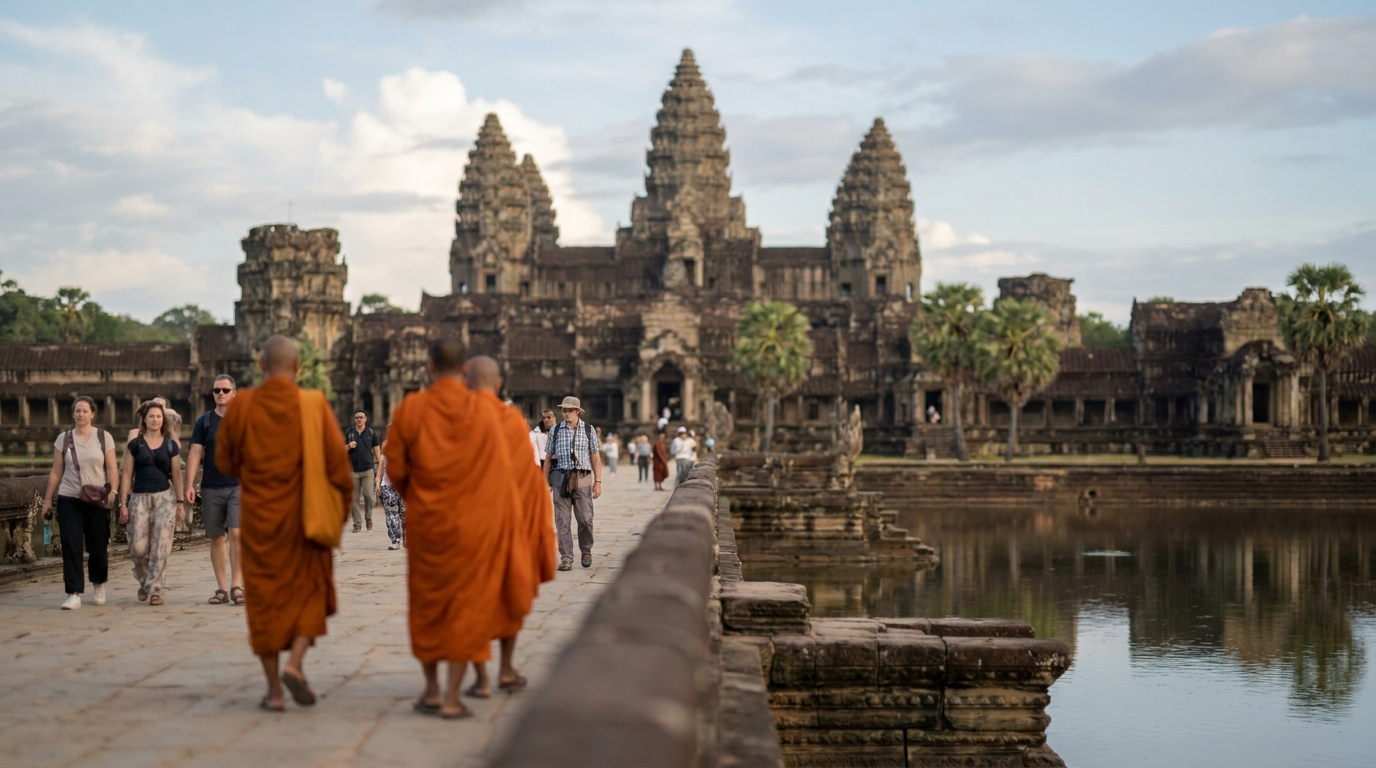
Angkor Wat is the crown jewel of the Khmer Empire, which ruled Southeast Asia from the 9th to 15th centuries (BBC History, 2023). At its peak around 1200 CE, the surrounding city of Angkor housed nearly 1 million people, making it one of the largest pre-industrial cities ever recorded, larger than London or Paris at the time.
A Hindu Temple That Became Buddhist
King Suryavarman II commissioned Angkor Wat as a state temple and his future mausoleum, dedicated to Vishnu. The temple’s west-facing orientation (unusual for Hindu temples, which typically face east) reinforces the funerary theory. After Suryavarman’s death, the empire shifted toward Buddhism, and by the late 13th century Angkor Wat became a Theravada Buddhist site, which it remains today.
Why It’s a Big Deal Architecturally
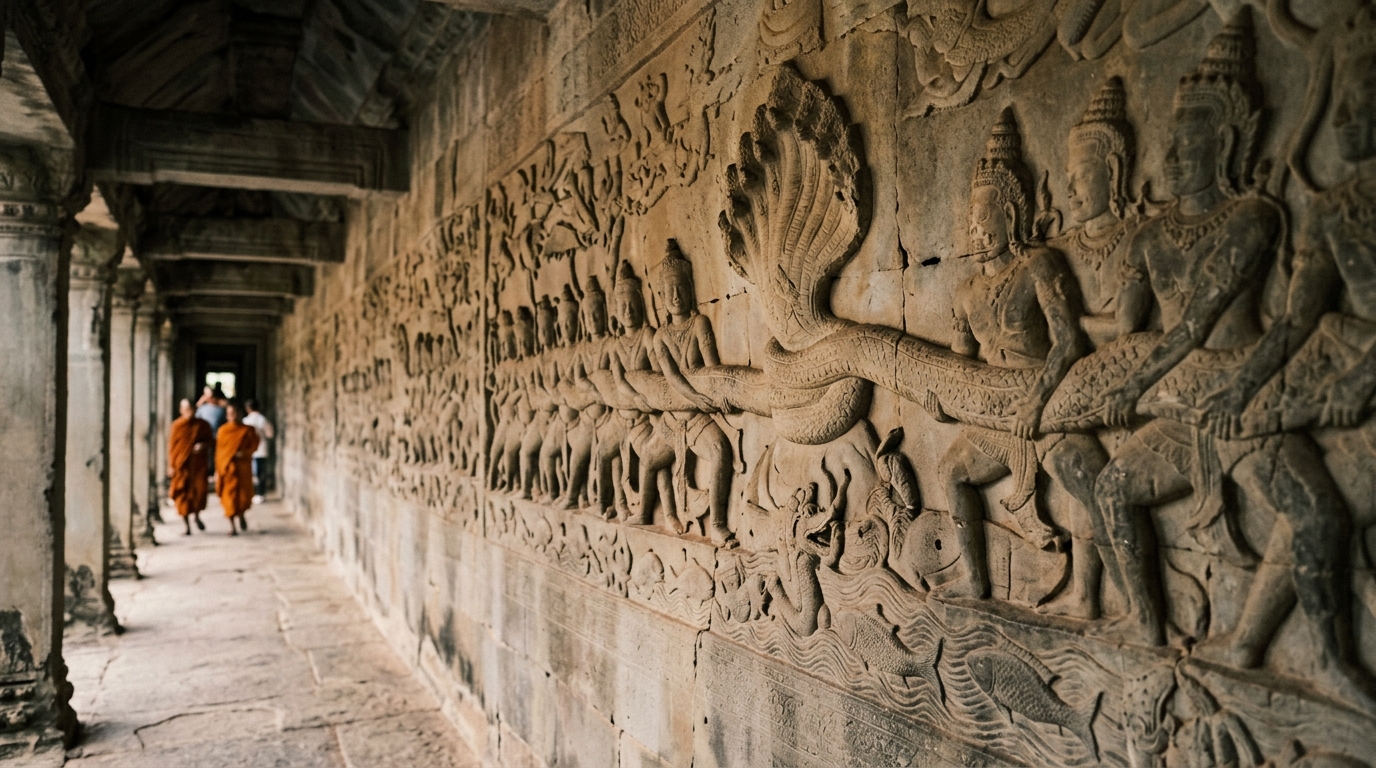
The temple’s bas-reliefs stretch for nearly 800 meters along the third enclosure, depicting scenes from the Mahabharata, Ramayana, and the legendary Churning of the Sea of Milk (National Geographic, 2023). The five central towers represent Mount Meru, the cosmic center in Hindu cosmology. The construction used roughly 5-10 million sandstone blocks, each weighing up to 1.5 tons, hauled from the Kulen Hills 50 km away.
On our second visit, our guide pointed out something most tourists miss: the bas-reliefs on the eastern gallery were carved by less skilled artisans, likely because the temple was rushed to completion. Once you spot the difference, you can’t unsee it.
Where Is Angkor Wat and How Do You Get There?
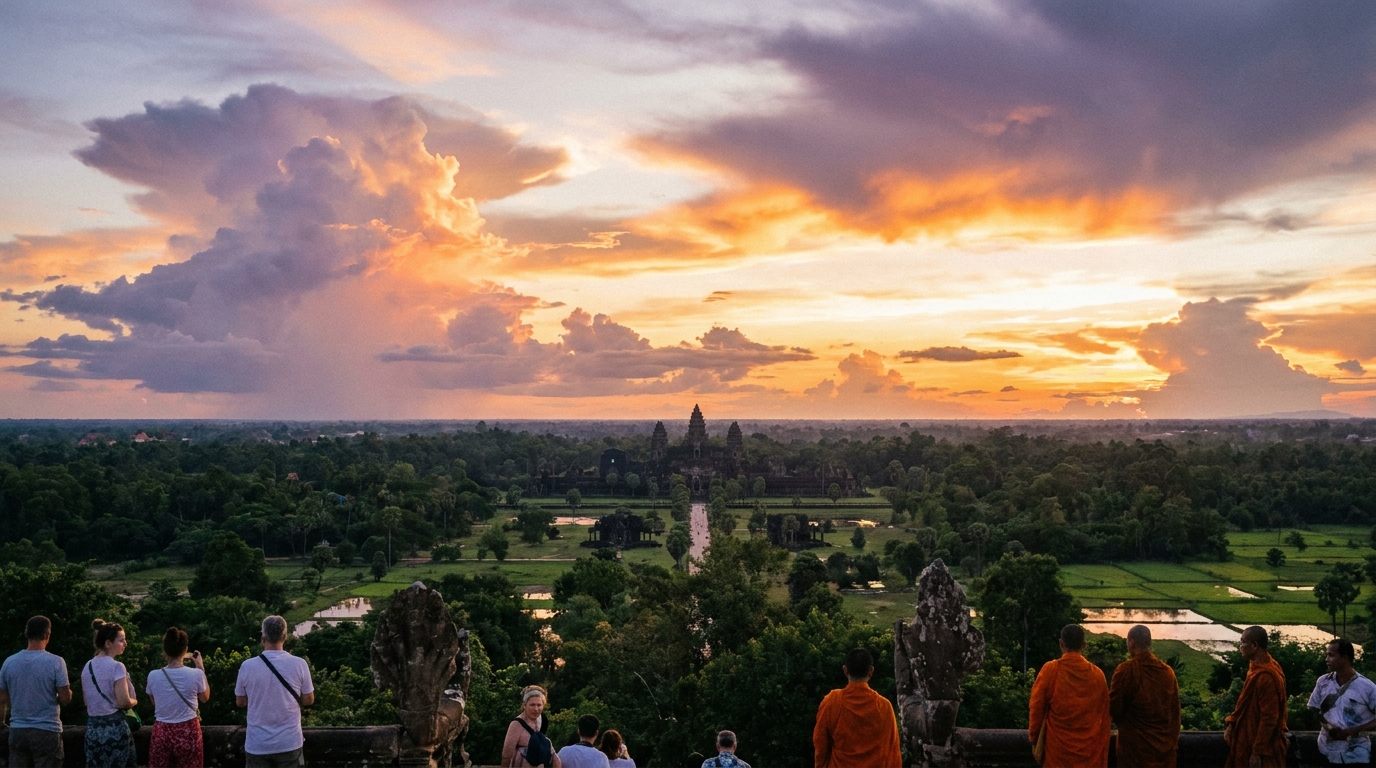
Angkor Wat sits 5.5 km north of central Siem Reap, the gateway town that hosts virtually every traveler heading to the temples (Cambodia Ministry of Tourism, 2024). From the Old Market area, it’s a 15-20 minute tuk-tuk ride. Siem Reap International Airport (SAI) reopened in October 2023, replacing the old REP airport, and now sits 50 km southeast of town.
Transport Options From Siem Reap Town
- Tuk-tuk full day: $20-25, the most popular option for solo travelers and couples. Drivers know the temple circuits inside out.
- Private car with AC: $40-60 per day, worth it during April heat (38-40°C) or rainy season downpours.
- E-bike rental: $8-12 per day, only for confident riders. The roads inside the park are good, but traffic outside town can be chaotic.
- Bicycle: $2-5 per day. Doable for the Small Circuit only. Skip this in March-May.
- Group bus tour: $15-25, cheapest but you’re on someone else’s schedule.
Citation capsule: Siem Reap International Airport opened in October 2023, located 50 km southeast of town. The airport handles roughly 7 million passengers annually at full capacity (Cambodia Civil Aviation Authority, 2024). Most visitors reach Angkor Wat via tuk-tuk ($20-25/day) from the Old Market area, a 15-20 minute ride.
Book your private Angkor day tour on Klook →
How Much Do Angkor Wat Tickets Cost in 2026?
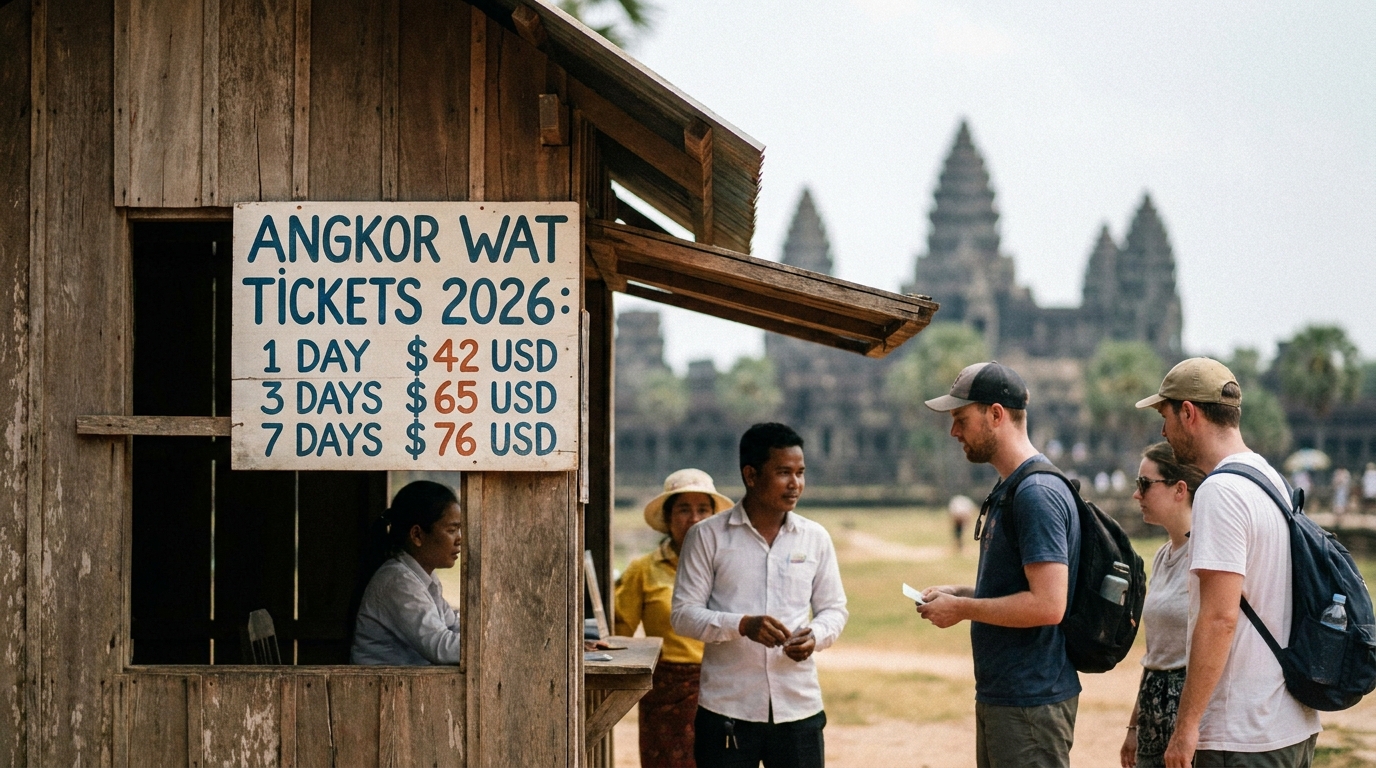
Here’s where most travelers mess up. Angkor Pass tickets cost $37 for one day, $62 for three days (used within 10 days), and $72 for seven days (used within one month) according to Angkor Enterprise (2024), the official ticket vendor. Prices haven’t changed since the 2017 increase, but expect a review by 2027.
The Three Pass Options Explained
1-Day Pass: $37
– Best for: Cruise passengers, layovers, or budget travelers tight on time.
– Reality check: You’ll see Angkor Wat, Bayon, and maybe Ta Prohm. That’s it. The “Small Circuit” alone takes 6-8 hours done properly.
3-Day Pass: $62 (use within 10 days)
– Best for: 90% of travelers. This is what we recommend.
– Coverage: Small Circuit + Grand Circuit + one day for Banteay Srei or Beng Mealea.
– The 10-day window is genius. Take rest days between temple days, your knees will thank you.
7-Day Pass: $72 (use within 1 month)
– Best for: History buffs, photographers, and digital nomads in Siem Reap for a while.
– Per-day cost: Just $10.30, the best value if you’ll actually use it.
– You can do remote temples like Koh Ker, Preah Vihear, or just take Angkor at a relaxed pace.
Where to Buy Tickets (This Trips Up Everyone)
You cannot buy passes at the temple gates. Tickets sell only at the Angkor Enterprise main office on Apsara Road, 4 km east of central Siem Reap (Angkor Enterprise, 2024). The office opens daily 4:30 AM to 5:30 PM. They take a digital photo on the spot, printed onto your pass, and yes, they check it.
Pro tip: If you buy your ticket after 5:00 PM, it’s valid the same evening (sunset entry) AND the following day. We’ve used this trick three times.
Across our four Angkor visits, we tracked queue times at the ticket office. Buying at 4:30 AM (sunrise rush): 30-45 min wait. Buying at 5:00 PM the day before: under 5 minutes, every time. The sunset-trick saves you 40 minutes the next morning.
Children, Locals, and Discounts
- Under 12: Free with passport showing age.
- Cambodian nationals: Free entry to all temples.
- Senior discount: None. Same price for everyone.
Beyond the Angkor Pass: Other Temple Fees
Some sites require separate tickets:
– Beng Mealea (jungle temple): $5 extra
– Phnom Kulen (sacred mountain): $20 extra (waterfall + reclining Buddha)
– Koh Ker (remote complex): $15 extra
– Preah Vihear (mountaintop temple): $10 extra
Skip the line with Klook 3-day Angkor Pass tour →
[CHART: Angkor Pass price comparison – 1-day vs 3-day vs 7-day with per-day cost calculations – source: Angkor Enterprise 2024]
When’s the Best Time to Visit Angkor Wat?
The sweet spot is November to early February, when daytime temperatures hover around 27-30°C and humidity drops below 70% (Cambodia Climate Department, 2024). This is also peak season, so prices climb 20-40% and the sunrise crowd at Angkor Wat can hit 1,500 people on the lotus pond lawn.
Month-by-Month Breakdown
- November-February (cool & dry): Best weather, biggest crowds, highest prices.
- March-May (hot season): Brutal. Daily highs hit 38-40°C. We’ve seen tourists faint at Bayon at 11 AM. Hydrate aggressively or visit only at sunrise.
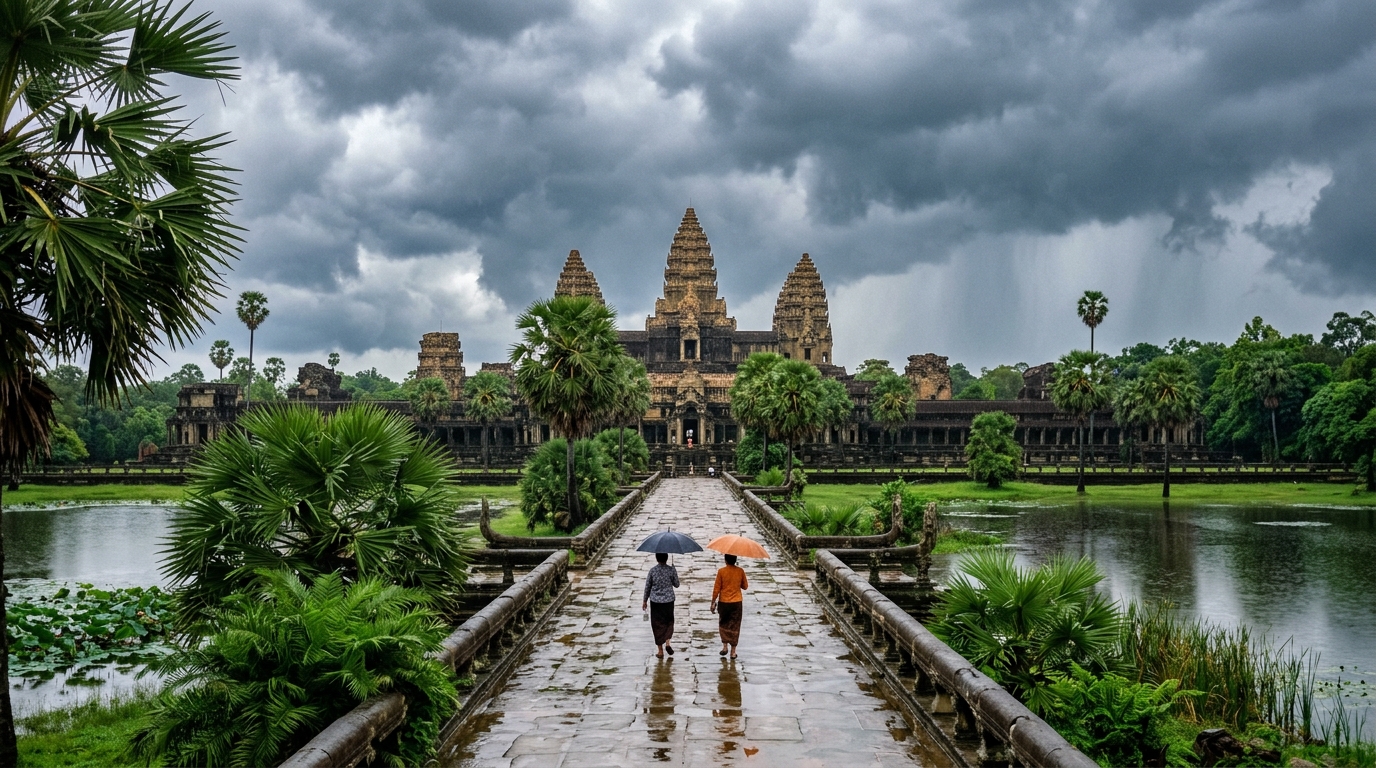
- June-October (rainy): Underrated. Mornings often clear, afternoons see 30-60 min downpours. Lush greenery makes Ta Prohm magical. Crowds drop 50-60%.
What About Sunrise vs Daytime?
Sunrise (5:30-6:30 AM) is iconic but crowded. Daytime (10 AM-4 PM) is hot but quiet inside the temples. Late afternoon (4-5:30 PM) is our personal favorite. Soft light, no crowds, and many photographers shoot Angkor Wat from the back side at this hour for the cleanest shots.
The “best month” advice you read everywhere ignores July-August. Yes, it rains. But mornings are dry 70% of the time, the green moss on Ta Prohm pops in photos, and you’ll have temples to yourself. Bring a $5 poncho. We’ve never regretted a rainy-season Angkor trip.
How Should You See Angkor Wat? 3 Itinerary Options
The “right” itinerary depends on how much time and stamina you’ve got. Most temples close at 5:30 PM (Angkor Wat itself stays open until 6:00 PM for sunset). Here’s how we’d structure each option, refined across multiple visits (APSARA National Authority, 2024).
Option 1: 1-Day Express (Small Circuit)
If you’ve only got one day, prioritize the Small Circuit (17 km loop):
– 5:00 AM: Sunrise at Angkor Wat (lotus pond, left side)
– 7:30 AM: Breakfast at temple cafe
– 8:30 AM: Bayon (the face temple inside Angkor Thom)
– 10:00 AM: Baphuon, Phimeanakas, Terrace of Elephants
– 12:00 PM: Lunch in shaded restaurant
– 1:30 PM: Ta Prohm (Tomb Raider tree temple)
– 3:30 PM: Banteay Kdei or Pre Rup
– 5:00 PM: Sunset at Pre Rup or Phnom Bakheng
Realistic but exhausting. Expect 12-13 hours on your feet.
Option 2: 3-Day Classic (Recommended)
Day 1 (Small Circuit): Sunrise Angkor Wat, then Bayon, Baphuon, Ta Prohm. Take it slow. Rest mid-day.
Day 2 (Grand Circuit): Preah Khan, Neak Pean, Ta Som, East Mebon, Pre Rup. Less crowded, equally beautiful.
Day 3 (Outer Temples): Banteay Srei (the Pink Temple) at sunrise, then Beng Mealea jungle temple. Optional Kbal Spean river of carvings.
Option 3: 7-Day Deep Dive
For the obsessed. Adds Koh Ker, Preah Vihear (mountaintop on Thai border), Phnom Kulen waterfall, and revisits to favorite temples in different light. We’ve done it once. Worth it if you genuinely love archaeology.
Siem Reap 3-Day Itinerary
Book a private 3-day Angkor explorer tour on Klook →
Which Are the Best Angkor Wat Tours on Klook?
We’ve tested over a dozen Angkor tours over the years, and Klook consistently has the most reliable operators with verified reviews. According to Klook’s 2024 transparency report, small-group tours in Cambodia average a 4.7/5 rating across 50,000+ verified bookings, well above the regional average of 4.3/5.
Top 5 Angkor Tour Picks
1. Small-Group Sunrise Tour ($25-40)
– 4-12 person max, English-speaking guide, hotel pickup
– Hits Angkor Wat sunrise + Bayon + Ta Prohm
– Best for: First-timers, solo travelers
– Book sunrise tour on Klook →
2. Private Tuk-Tuk + Guide Full Day ($50-80)
– Just you, a driver, and a licensed guide
– Customizable route, you choose the pace
– Best for: Couples, photographers
– Book private tuk-tuk tour on Klook →
3. Photographer-Led Tour ($60-100)
– Pro photographer takes you to insider spots
– Includes 50-100 edited photos
– Best for: Once-in-a-lifetime trips, proposals
– Book photographer tour on Klook →
4. Helicopter Tour ($150-300)
– 8-20 minute aerial flights over Angkor
– The only way to grasp the complex’s true scale
– Best for: Special occasions, drone enthusiasts
– Book helicopter tour on Klook →
5. 3-Day Angkor Explorer Pass Tour ($120-180)
– Includes pass + guide + transport for all 3 days
– Covers Small + Grand + Outer Circuits
– Best for: 3-day pass holders wanting structure
Why Book Through Klook vs Walk-Up?
Walk-up tuk-tuks at Pub Street charge $20-25 daily but rarely include guides. Klook tours bundle a licensed APSARA-certified guide ($25-40 value), AC vehicle option, and skip-the-line ticket service. The math usually favors booking ahead during peak season.
Citation capsule: Klook’s small-group Cambodia tours hold an average 4.7/5 rating across 50,000+ verified reviews (Klook Transparency Report, 2024). Tour prices range from $25 (group sunrise) to $300 (helicopter), with private tuk-tuk + guide combos averaging $50-80 per day, including hotel pickup and licensed APSARA-certified guides.
How Do You Shoot Sunrise at Angkor Wat?
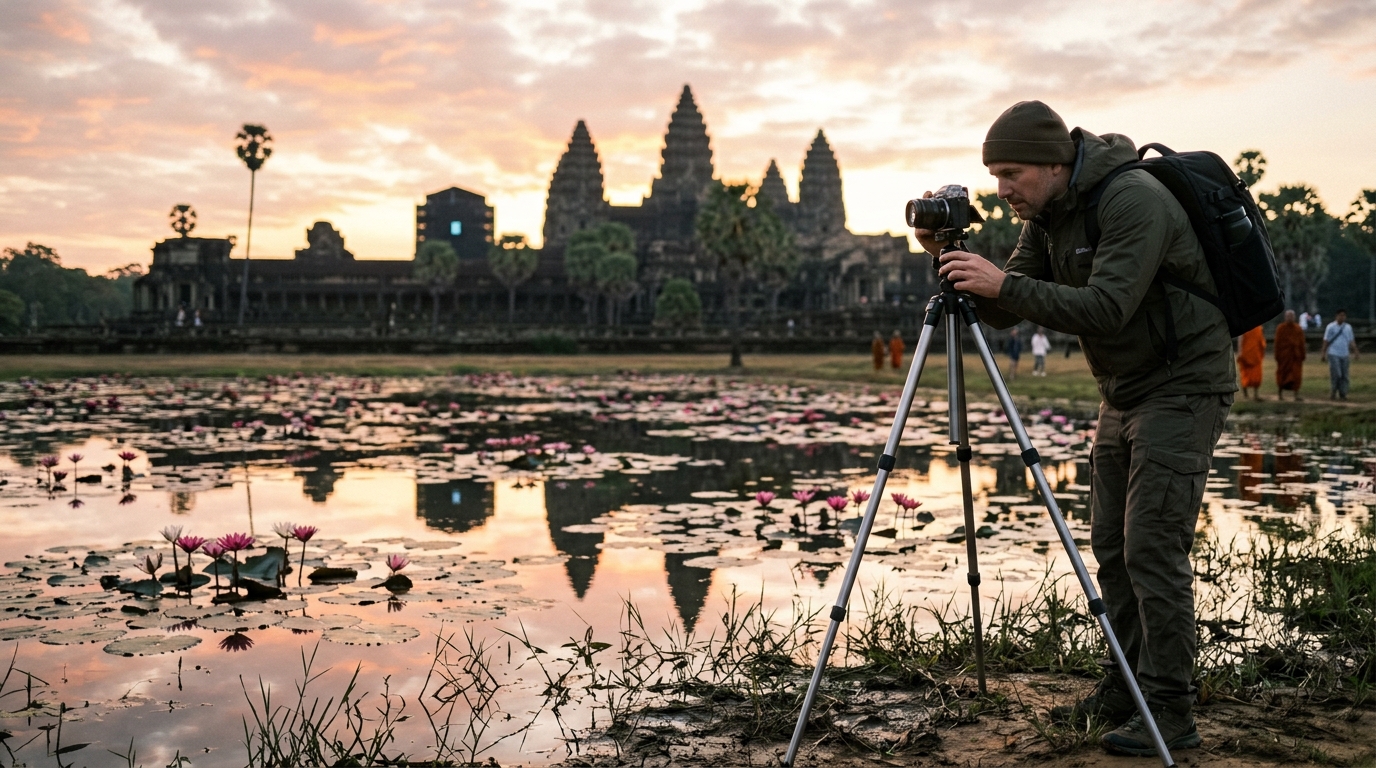
Here’s the honest truth about Angkor Wat sunrise. It’s a religious experience for some and a crowd-management nightmare for others. The famous shot, five towers reflected in the lily pond, requires you to claim a spot 90+ minutes before the actual sunrise (National Geographic, 2023).
Best Position (And Why Most People Get It Wrong)
The iconic reflection shot comes from the left lily pond as you face the temple from the western entrance. Most tourists herd to the right pond because it’s slightly bigger, but the left pond:
– Has fewer people
– Frames all five towers symmetrically
– Catches the warmest “magic hour” light first
Arrival Time Strategy
- 4:30 AM: Tuk-tuk picks you up
- 4:50 AM: Arrive at temple gate (it opens at 5:00 AM for sunrise)
- 5:00 AM: Walk in fast, head LEFT past the causeway
- 5:15 AM: Set up tripod, wait
- 5:45 AM: First color hits the sky
- 6:15 AM: Sun rises behind central tower
- 6:30 AM: Crowd disperses, NOW shoot the temple from up close
Camera Settings (For Photographers)
- ISO 100-400 (low light but stable)
- Aperture f/8-f/11 (sharp throughout)
- Shutter 1/30 to 1 second (use tripod)
- Bracketing: 3-5 stops to capture sky + foreground
- White balance: Cloudy/shade for warmer tones
On our third sunrise, we ditched the lily pond entirely and shot from inside the temple at 6:00 AM, looking back through the towers as the sun rose. Almost no one does this. The shots felt totally different from the typical Instagram angle, and we had the spot to ourselves.
Book a sunrise photographer tour on Klook →
What Should You Wear at Angkor Wat?
Cambodia’s APSARA Authority enforces a strict dress code at all major Angkor temples (APSARA National Authority, 2024). This isn’t just suggestion. Guards at Angkor Wat’s upper Bakan tier turn away dozens of tourists daily for shoulder or knee exposure.
The Rules (Updated 2024)
- Shoulders covered: No tank tops, spaghetti straps, or sleeveless shirts.
- Knees covered: Skirts and shorts must reach below the knee.
- No see-through fabrics: Lace coverups don’t count.
- Shoes off: Required when entering certain inner sanctuaries.
What Women Should Know About the Bakan
The upper level of Angkor Wat (the Bakan, third enclosure) was traditionally closed to women during menstruation under APSARA rules. As of 2024, this restriction is no longer formally enforced, but signs still suggest women in their menstrual cycle avoid the upper tier out of respect. Pregnant women are also discouraged from climbing the steep stairs (75-degree angle).
Practical Outfit Picks
- Loose linen pants or maxi skirt
- Light long-sleeve linen shirt
- Wide-brim hat (no shade outside)
- Closed-toe sneakers (you’ll walk 8-12 km daily)
- Cooling towel for sweat
Bring a light scarf or sarong as backup. Some temples sell $2 sarongs at the entrance for those caught underdressed, but they run out fast during peak season.
Beyond Angkor Wat: Which Other Temples Should You Visit?
Angkor Wat steals the spotlight, but the wider Angkor Archaeological Park holds over 1,000 temples (UNESCO World Heritage Centre, 2024). Skipping the others is like visiting Paris and only seeing the Eiffel Tower. Here are the eight temples that deserve a spot on your itinerary.
The Essential Eight
1. Bayon (Angkor Thom) — The face temple. 216 enigmatic stone faces stare in every direction. Best at 9-10 AM when sun lights the faces.
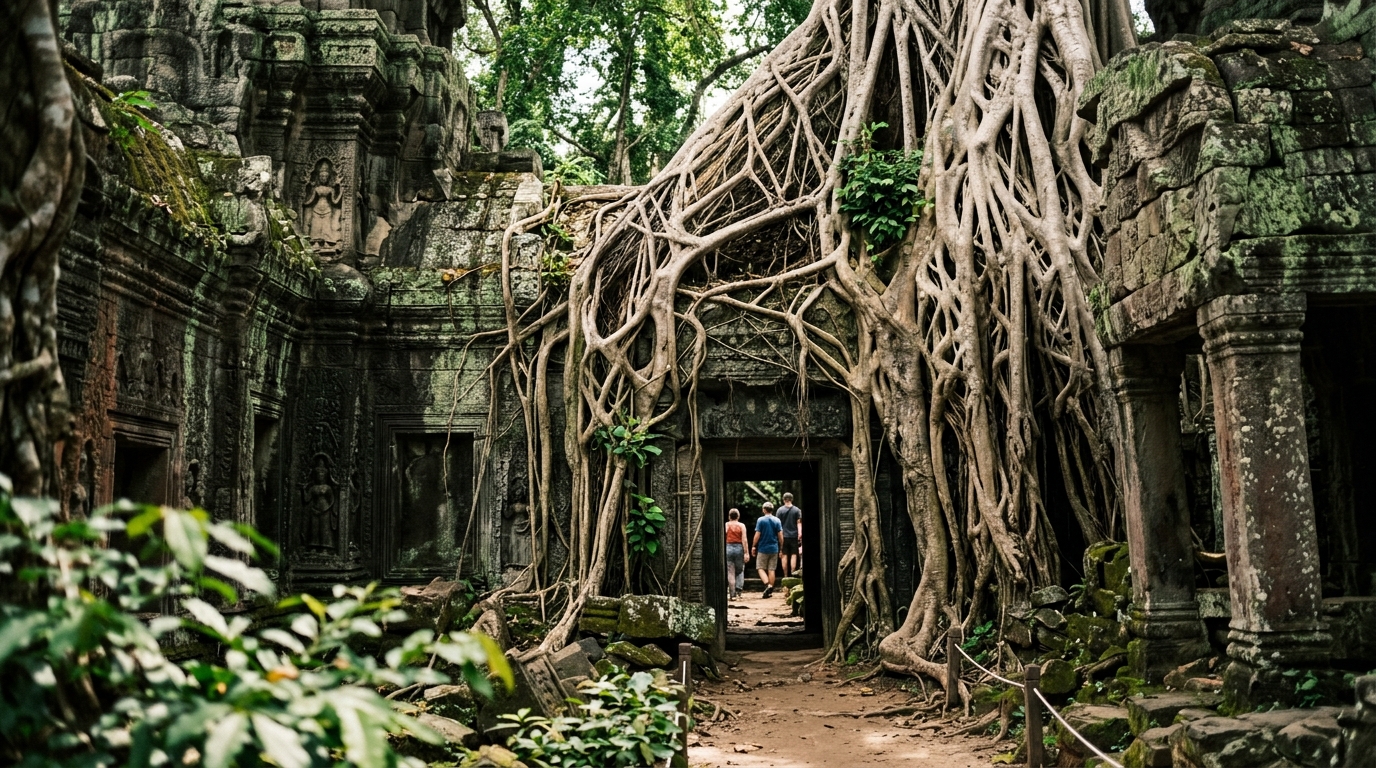
2. Ta Prohm — The Tomb Raider temple. Massive silk-cotton trees swallow the ruins. Crowded 9 AM-3 PM. Go at 7:30 AM or 4:30 PM.
3. Banteay Srei (Pink Temple) — 25 km northeast. The most intricate carvings of any Angkor temple, in pink sandstone. Worth the detour.
4. Beng Mealea — 60 km east. A massive overgrown jungle temple with collapsed galleries. Feels like you discovered it. $5 separate ticket.
5. Preah Khan — Less crowded than Ta Prohm but equally atmospheric. Long enclosed corridors. Great photography.
6. Neak Pean — A small island temple in a baray (reservoir). Quirky and quick. 30 min visit.
7. Pre Rup — Pyramid temple. One of the best sunset spots without the Phnom Bakheng crowds.
8. Ta Som — Often skipped. A perfect tree-eating-temple shot at the eastern gate, fewer photographers than Ta Prohm.
Book a private guide for outer temples on Klook →
Citation capsule: The Angkor Archaeological Park spans 400 km² and contains over 1,000 documented temple sites (UNESCO World Heritage Centre, 2024). Beyond the main Angkor Wat complex, the most-visited outer temples include Banteay Srei (25 km from town, $0 separate fee), Beng Mealea (60 km, $5), and Phnom Kulen sacred mountain (50 km, $20).
Can You Visit Angkor Wat With Kids?
Yes, but adjust expectations. Children under 12 enter free with a passport, and Angkor’s open-air structure means kids can run around safely in most areas (Angkor Enterprise, 2024). Strollers don’t work on temple grounds, so plan for carriers or short visits.
Family-Friendly Tips
- Half-day max: Kids burn out by 11 AM in heat.
- Pick “fun” temples: Ta Prohm (tree temple) and Bayon (faces) wow kids more than bas-relief galleries.
- Skip the upper tiers: Steep, dangerous stairs at Angkor Wat’s Bakan and Pre Rup.
- Bring snacks: Restaurants near temples are slow. Pack fruit, crackers, and ORS sachets.
- Tuk-tuk over bus: Open-air ride doubles as entertainment.
For families with children under 6, we’d skip the 3-day pass and do a 1-day with a private guide who can keep things moving.
What Scams Should You Watch For at Angkor?
Cambodia is generally safe for tourists, but Angkor’s tourist density attracts low-level scams (U.S. Department of State Travel Advisory, 2024). None are violent or dangerous, but they nibble your budget. Here’s what we’ve seen across multiple visits.
Common Scams
- Fake guides at temple gates: Unlicensed “guides” offer $5 tours then demand $30. Only book guides through Klook, your hotel, or APSARA-certified operators.
- Children selling postcards: Heartbreaking but enables school skipping. Donate to a registered NGO instead. APOPO and Friends International are vetted.
- Tuk-tuk overcharging at popular spots: Always agree price BEFORE getting in. From Angkor Wat to Pub Street should be $5-7 max.
- “Closed temple” lies: A scammer says X temple is closed, suggests you go to “their friend’s gem shop.” Ignore.
- Donation pressure inside temples: Monks bless you, then demand $20. A $1-2 donation is fine. Anything more is up to you.
Real Safety Tips
- Drink only bottled water ($0.50-1 per bottle)
- Carry small USD bills ($1, $5). Big bills get refused.
- Avoid temples after 5:30 PM closing. Some areas have unmarked drop-offs.
- Don’t touch carvings or climb on bas-reliefs. APSARA fines reach $200.
Get an Airalo eSIM for instant Cambodia data →
All recommendations in this guide come from our personal travel experience and verified sources. We never accept payment for placement. Read our Editorial Policy and learn more About Us for transparency on how we research and vet every tour, hotel, and tip.
See also: Siem Reap itinerary | where to stay in Siem Reap | best tours in Siem Reap | best food in Siem Reap
Frequently Asked Questions
Is Angkor Wat worth visiting in 2026?
Absolutely. Angkor Wat draws 2.5 million visitors annually for good reason (Cambodia Ministry of Tourism, 2024). It’s the world’s largest religious monument, a UNESCO site since 1992, and the architectural detail across 162.6 hectares is unmatched. Even with crowds, the sunrise experience and bas-relief galleries justify the trip for most travelers.
How many days do you really need at Angkor Wat?
Three days hits the sweet spot. A 1-day pass ($37) covers basics but leaves you exhausted. A 3-day pass ($62, used within 10 days) lets you tackle Small Circuit, Grand Circuit, and outer temples like Banteay Srei without burning out (Angkor Enterprise, 2024). Photographers and history fans should consider the 7-day pass at $72.
Sunrise or sunset at Angkor Wat: which is better?
Sunrise wins for the iconic reflection shot, but expect 1,000-1,500 fellow tourists at the lily pond (National Geographic, 2023). Sunset offers softer light and far smaller crowds, especially from Pre Rup or the back side of Angkor Wat itself. We recommend both if you’ve got 3 days. Sunrise day 1, sunset day 2.
Can you climb to the top tier of Angkor Wat?
Yes, with restrictions. The Bakan upper tier requires modest dress (shoulders + knees covered) and the steep wooden stairs limit climbers to ~100 at a time, queue up early. APSARA traditionally restricted women during menstruation, though this is no longer strictly enforced as of 2024 (APSARA National Authority, 2024). Children under 12 typically aren’t allowed up.
What’s the best month to visit Angkor Wat?
December and January top our list. Daytime temperatures average 27-30°C with low humidity (Cambodia Climate Department, 2024). November and February are nearly as good with smaller crowds. Avoid March-May (38-40°C heat) unless you can handle extreme weather. June-October has rain but lush scenery and 50% fewer tourists.
Should I get the 1-day or 3-day Angkor pass?
Get the 3-day pass at $62 if you’ve got the time, the per-day cost drops to $20.67 versus $37 for a single day (Angkor Enterprise, 2024). The 10-day usage window means you can take rest days. Only choose the 1-day if you’re on a strict layover or cruise schedule.
Are guided tours necessary at Angkor Wat?
Not strictly, but they elevate the experience massively. Without a guide, you’ll see beautiful ruins. With a guide, you understand the bas-reliefs, the symbolism of Mount Meru, and the political history of the Khmer Empire. Klook’s licensed APSARA guides start at $25-40 for group tours, $50-80 for private. We’d say it’s worth every dollar for first-timers.
Final Word: Is Angkor Wat Right for You?
Angkor Wat isn’t just a tourist stop. It’s a 900-year-old testament to one of the most powerful civilizations Asia has ever produced (UNESCO World Heritage Centre, 2024). The 162.6-hectare temple complex challenges your stamina, rewards your patience, and humbles your sense of scale. We’ve visited four times across different seasons, and we still spot details we missed before.
If you’re heading to Siem Reap, here’s our final advice. Buy the 3-day pass after 5:00 PM the day before you start (use the sunset trick), book a private Klook tour with an APSARA-certified guide for at least one day, dress modestly even when guards aren’t looking, and skip Phnom Bakheng for sunset, Pre Rup is better. Most importantly, slow down. Angkor wasn’t built in a day, and it can’t be properly seen in one either.
Ready to book your trip? Start with our complete Siem Reap travel guide for hotels, food, and itineraries beyond the temples.
Complete Siem Reap Travel Guide 2026
Book your Angkor Wat tour on Klook → | Find hotels near Angkor on Booking.com →
Last updated: April 25, 2026. Prices and policies sourced from Angkor Enterprise, APSARA National Authority, UNESCO, and Cambodia Ministry of Tourism. We update this guide quarterly.
Affiliate Disclosure: This post contains affiliate links. If you book through our links, we earn a small commission at no extra cost to you. We only recommend services we genuinely use and trust. Thank you for supporting our work!