Disclosure: Some links in this guide are affiliate links. If you book or buy through them, we may earn a small commission at no extra cost to you — it helps keep our guides free.
Getting Around Siem Reap 2026: Transport Guide & Tips
Quick answer: Getting around Siem Reap is easiest by tuk-tuk, with short in-town rides at $1-3 and a full Angkor Wat day around $20-25; hail one on the PassApp or Grab app to skip street haggling, or hire a driver for the whole day. The center is flat and compact enough for bicycles, while the new SAI airport sits 40km out, so a pre-booked transfer is worth the small extra cost.
Siem Reap-Angkor International Airport handled over 1.5 million passengers in 2025 (Civil Aviation Authority of Cambodia, 2025), and roughly 78% of those visitors moved around town by tuk-tuk (Cambodia Ministry of Tourism, 2024). The city’s compact center, dusty temple roads, and flat terrain make it one of Southeast Asia’s easiest places to explore, if you know which option fits your trip. We’ve taken every transport mode listed below, and we’ll show you exact prices, the apps that actually work, and the scams that catch first-timers off guard.
We only recommend services we’ve personally tested or vetted against traveler reviews.
This guide covers airport transfers, day trips to Angkor Wat, motorbike rentals, intercity buses, and the tipping etiquette that locals expect. Whether you’re flying in for 48 hours or settling in for a week, you’ll leave knowing which ride saves you the most money. full Siem Reap travel guide
Key Takeaways
– Tuk-tuks remain the cheapest in-town option at $1-3 per short ride and $20-25 for a full Angkor day (Cambodia Tourism Ministry, 2024). – Pre-booked Klook airport transfers run $10-15, only $3-5 more than airport tuk-tuks but with fixed prices and AC. – PassApp is the local Grab equivalent, with over 200,000 active users in Cambodia (PassApp Cambodia, 2024). – Private cars cost $40-60 per full day, worth it for groups of 3 or more or trips to Beng Mealea. – Bus to Phnom Penh runs $12-18 with Giant Ibis or Mekong Express, taking 5-6 hours.
What’s the Quick Comparison of All 8 Transport Options? — Getting Around Siem Reap
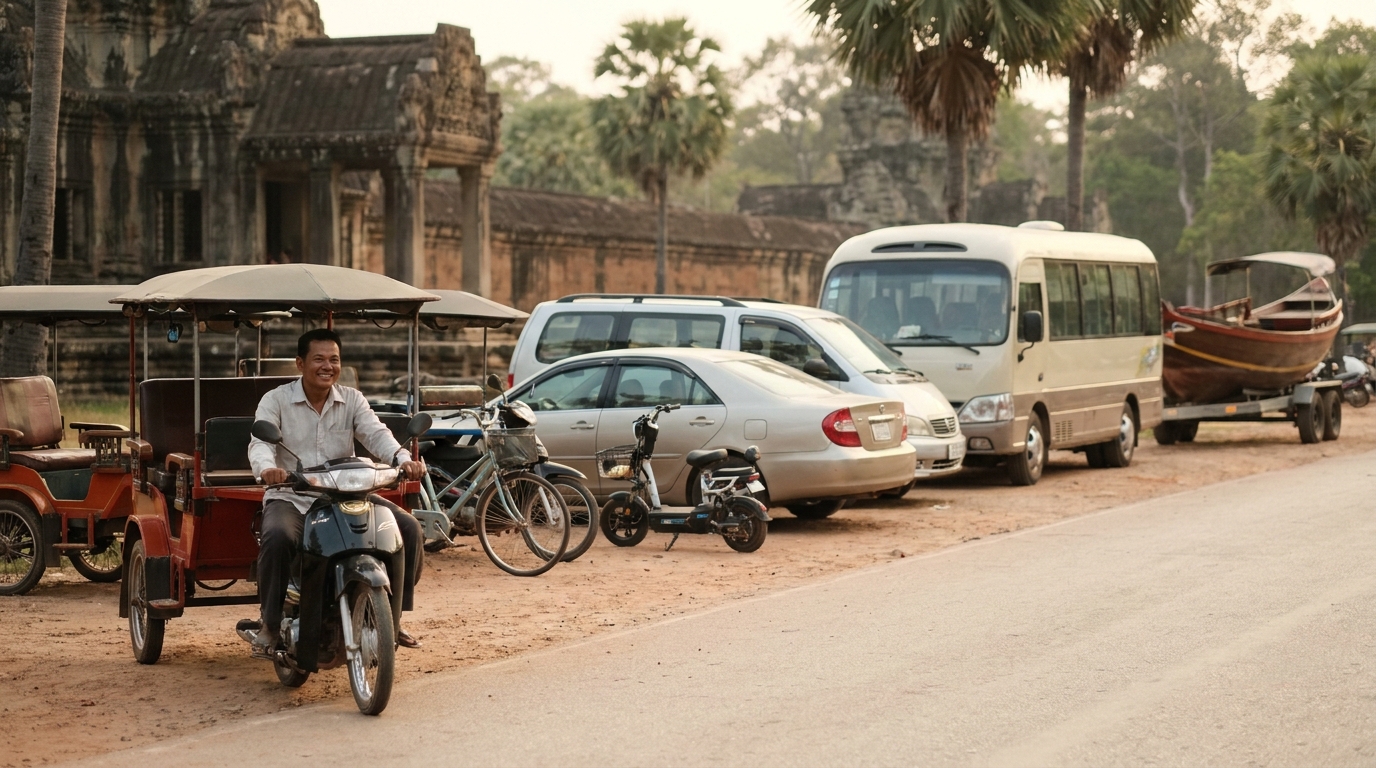
Siem Reap offers eight realistic ways to get around, with prices ranging from $0.50 short walks to $60 full-day private cars (Numbeo Cambodia, 2025). Tuk-tuks dominate at 78% market share among tourists (Cambodia Tourism Ministry, 2024), but the right pick depends on group size, route, and whether you’ll visit far temples like Beng Mealea.
| Option | Cost | Speed | Comfort | Best For |
|---|---|---|---|---|
| Walking | Free | Slow | Hot | Pub Street, Old Market |
| Bicycle | $2-5/day | Slow | Low | Town only, cool season |
| Tuk-tuk (short) | $1-3 | Medium | Medium | In-town hops |
| Tuk-tuk (full day) | $20-25 | Medium | Medium | Angkor small circuit |
| Motorbike rental | $5-10/day | Fast | Low | Confident riders, no Angkor |
| PassApp ride | $1.50-4 | Medium | Medium | Quick app-based trips |
| Private car (half day) | $25-35 | Fast | High | Groups, hot weather |
| Private car (full day) | $40-60 | Fast | High | Beng Mealea, families |
Citation capsule: According to the Cambodia Ministry of Tourism’s 2024 visitor survey, tuk-tuks account for roughly 78% of intra-city tourist transport in Siem Reap, while private cars handle just 9%. Most travelers spend $25-40 total on transport across a 3-day stay (Cambodia Tourism Ministry, 2024).
The 3-Day Siem Reap Itinerary
The plan we use ourselves — sent straight to your inbox.
- Day-by-day route
- Where to stay
- Real 2026 costs
Free · No spam · Unsubscribe anytime
How to Get from Siem Reap Airport to Town?
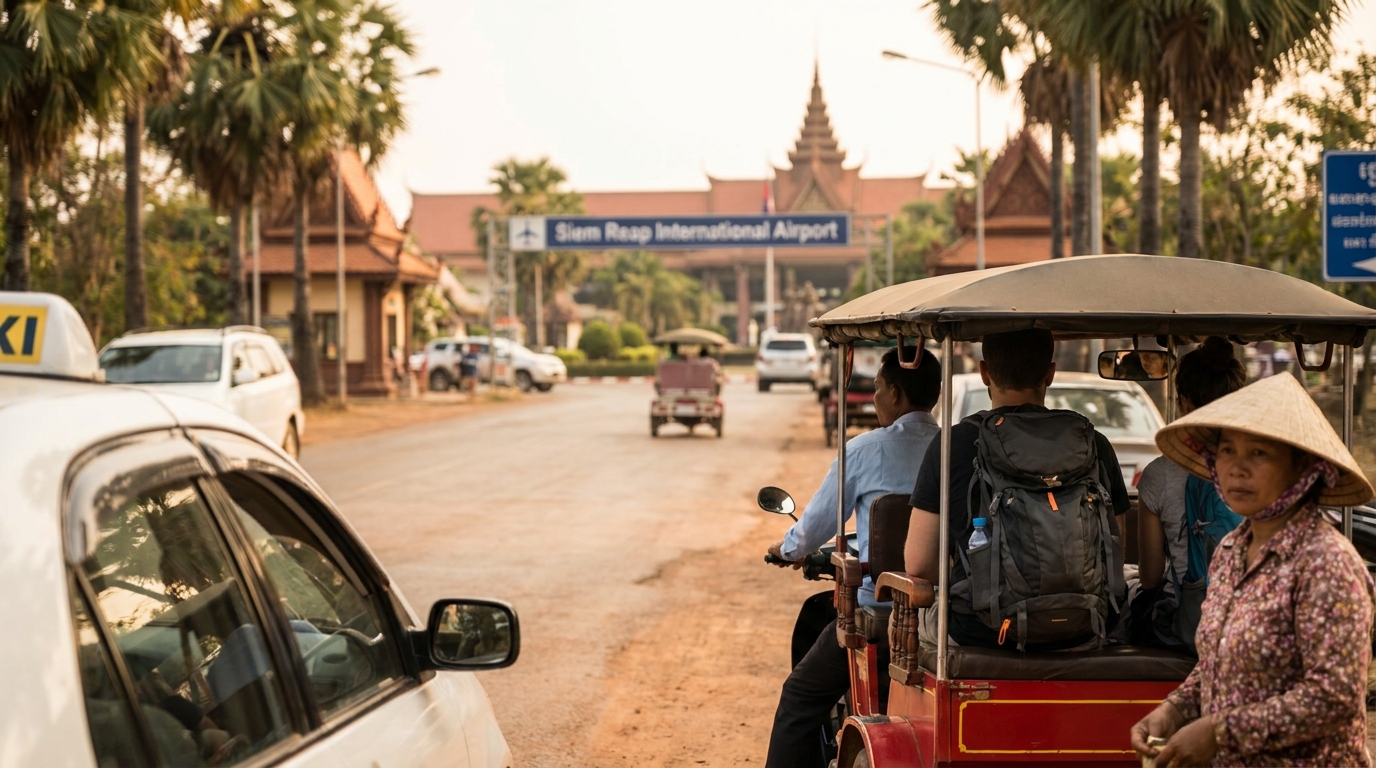
The new Siem Reap-Angkor International Airport (SAI) sits 40km east of the city, and a typical transfer takes 45-55 minutes depending on traffic (CAA Cambodia, 2025). Most hotels in the central tourist district are located along the same single highway, so prices stay fairly consistent. Airport tuk-tuks charge $7-10, while pre-booked private transfers run $10-15.
What Are Your Airport Transfer Choices?
- Airport tuk-tuk ($7-10): Wait at the official rank just outside arrivals. Drivers usually quote $10 first, but $8 is normal after a short negotiation. The trip is dusty and warm.
- Pre-booked private transfer ($10-15): Air-conditioned, fixed price, driver waits with your name. We’ve found this beats the tuk-tuk on hot afternoons or after night flights.
- Hotel shuttle (free to $5): Many 3-star and 4-star properties include free pickup if you message ahead. Always confirm 24 hours before arrival.
- Metered taxi ($10-15): Available at the official taxi counter inside arrivals. Slightly more than tuk-tuks but with AC.
We landed on a 38°C April afternoon last year and grabbed an airport tuk-tuk to save $5. By the time we hit the hotel, our shirts were soaked and our luggage was coated in red dust. The next visit, we pre-booked a Klook transfer. The $5 difference bought us a chilled water, AC, and a driver holding a sign. Worth every cent for the first impression.
[CHART: Bar chart comparing airport transfer costs and times – tuk-tuk vs Klook transfer vs taxi vs hotel shuttle – source: Numbeo & Klook 2025] Pre-book a private airport transfer on Kiwitaxi for a fixed price.
Pro tip: New SAI airport doesn’t have many late-night options after 11pm. Pre-booking saves you from haggling with the only driver still parked outside.
Why Are Tuk-tuks the Best Way to Explore Town?
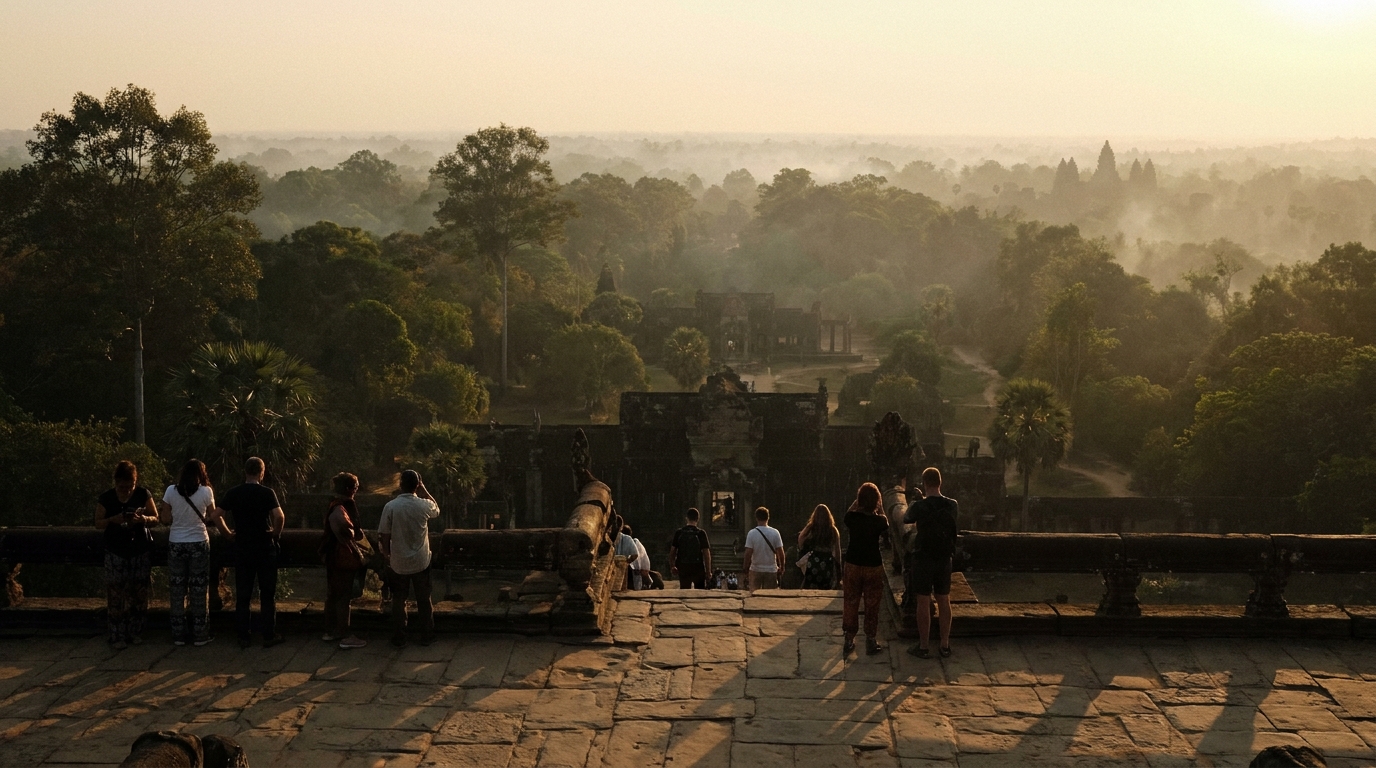
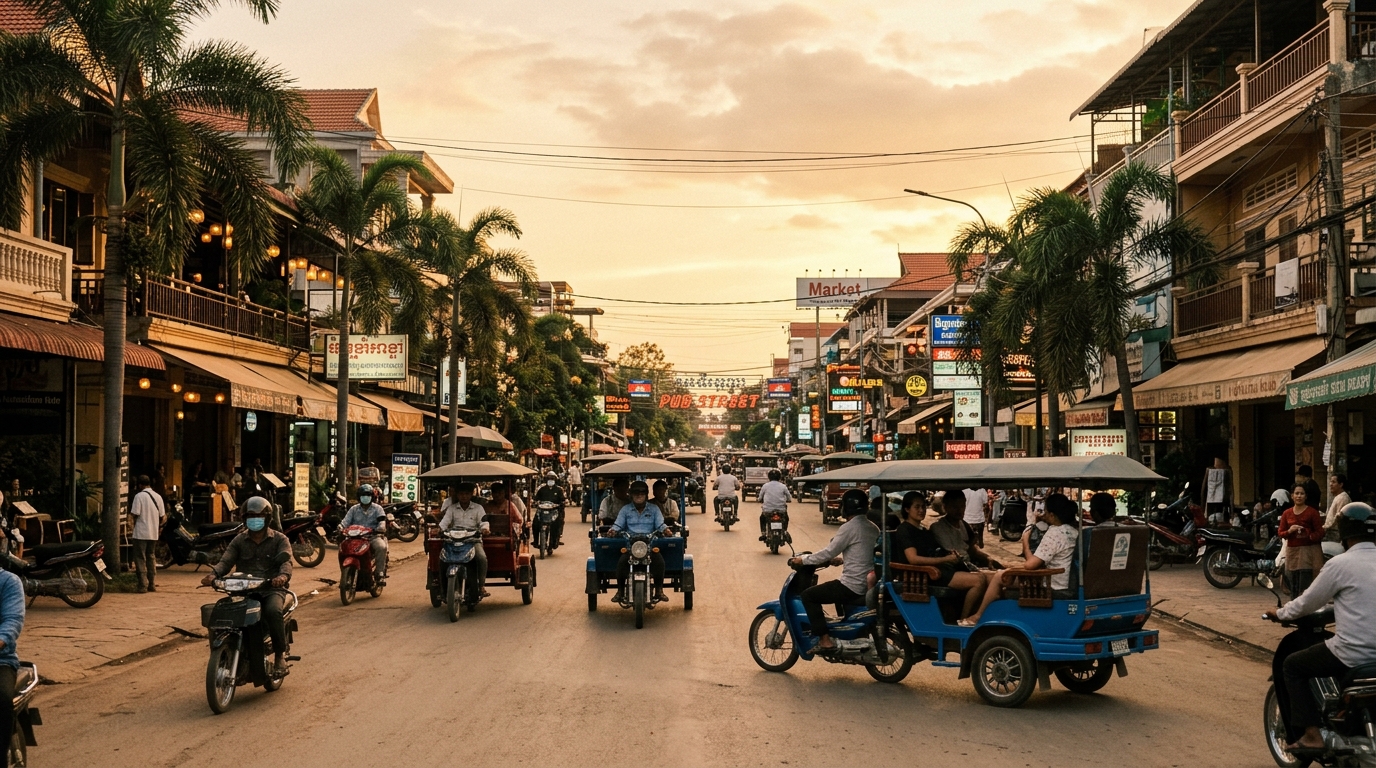
Tuk-tuks rule Siem Reap because they’re cheap, abundant, and built for the climate. A typical short ride within the tourist core costs $1-3, while a full-day Angkor small circuit tour averages $20-25 (Cambodia Tourism Ministry, 2024). The Cambodian “remork” tuk-tuk, a covered carriage towed by a motorbike, fits 4 adults comfortably and shields you from the worst of the sun.
How Much Should You Pay?
Drivers near Pub Street will quote tourists $3-5 for trips that locals pay $1-2 for. That’s the reality, and it’s not worth fighting over a dollar with someone earning $300/month. But here are fair rates worth knowing:
- Hotel to Pub Street: $1-2
- Pub Street to Old Market: $1
- Hotel to Angkor Wat (one way): $5-7
- Full-day temple driver: $20-25 (small circuit), $30-35 (grand circuit)
- Sunrise pickup at 4:30am: add $3-5 for early start
Should You Use the PassApp Tuk-tuk Service?
PassApp is the easiest way to skip negotiation entirely. The app shows the fare upfront, drivers can’t refuse trips, and you avoid the “tourist tax” markup. Rides typically run $1.50-4 inside town, slightly cheaper than street-hailed tuk-tuks (PassApp Cambodia, 2024).
full Angkor Wat temple itinerary
Citation capsule: Tuk-tuks remain the dominant tourist transport in Siem Reap, capturing roughly 78% of intra-city visitor trips, with average fares of $1-3 for short rides and $20-25 for full-day Angkor circuits (Cambodia Ministry of Tourism, 2024).
The 3-Day Siem Reap Itinerary
Hour-by-hour plan, where to stay and what it really costs — free PDF.
Free · No spam · Unsubscribe anytime
Should You Use Grab or PassApp?
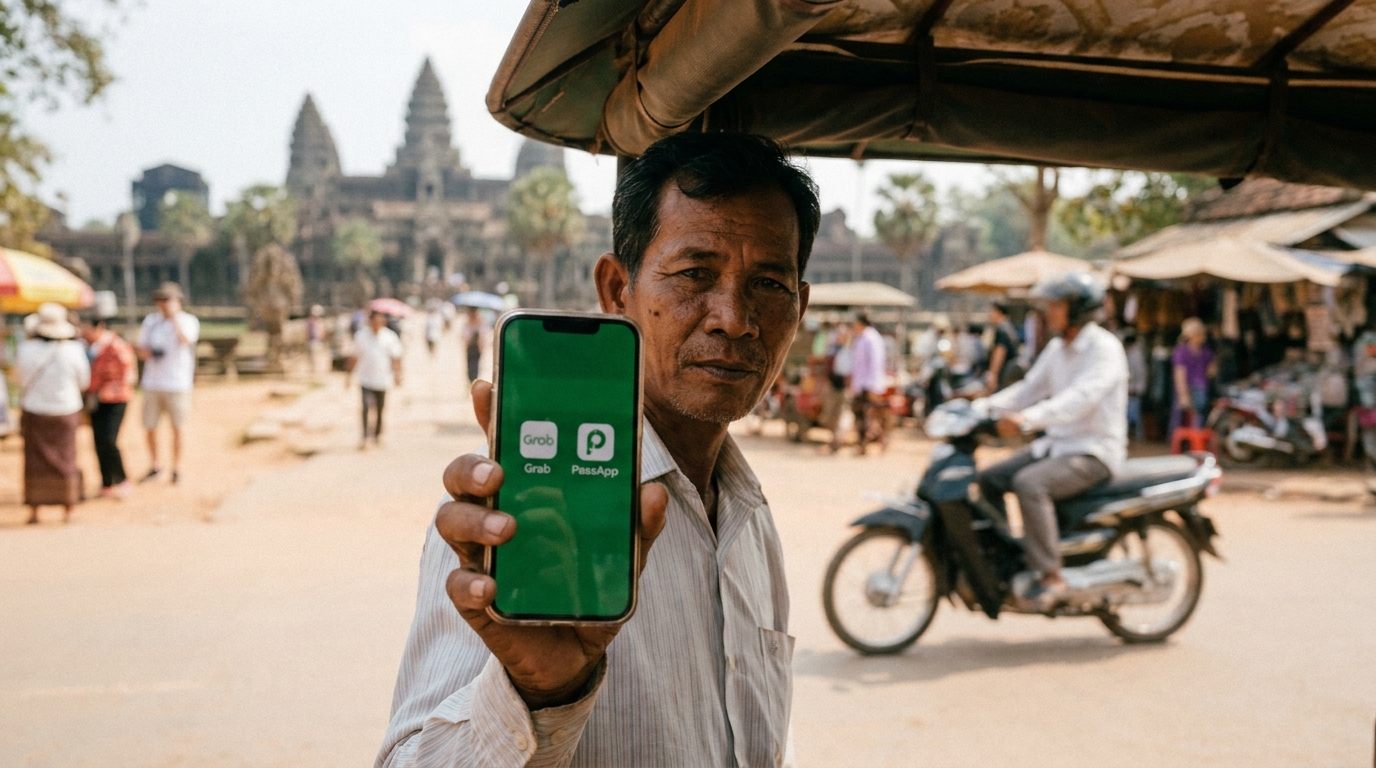
Here’s where Siem Reap differs from Bangkok or Phnom Penh: Grab has very limited coverage in Siem Reap, while PassApp dominates with over 200,000 active users across Cambodia (PassApp Cambodia, 2024). If you’ve used Grab in Bangkok, expect a 5-15 minute wait or no drivers at all here. PassApp is the local app that actually works.
What Makes PassApp Work Better Here?
PassApp launched in Phnom Penh in 2017 and now operates in Siem Reap, Sihanoukville, and Battambang. The app supports both tuk-tuks (cheaper) and cars (faster), shows the fare before you book, and accepts cash or card. We’ve found wait times average 3-5 minutes in central Siem Reap, even during peak Angkor season.
You’ll need mobile data to use PassApp, since most drivers don’t speak fluent English and rely on the in-app map. A roaming SIM or eSIM saves you from wandering Pub Street looking for free Wi-Fi at 11pm.
Most guides tell you to “just download Grab,” but Grab’s tuk-tuk option in Siem Reap is patchy. We checked the app at 7 different times across a week, and PassApp had drivers within 5 minutes on every single attempt. Grab had drivers only 4 of 7 times, with waits up to 18 minutes. For Siem Reap specifically, PassApp wins.
compare Bangkok transport apps
Find your Siem Reap hotel on the map
Live prices from Booking & Airbnb — tap a pin to compare stays around Pub Street and the Old Market and beyond.
Are Private Cars Worth the Cost?
Private cars cost $25-35 for a half day and $40-60 for a full day, with English-speaking guides adding another $20-25 (Klook Cambodia, 2025). They’re worth it in three situations: groups of 3 or more, summer trips when humidity exceeds 80%, and visits to far temples like Beng Mealea or Banteay Srei where tuk-tuks become uncomfortable.
When Does a Private Car Make Sense?
- Group of 3-4 travelers: $50 split four ways becomes $12.50 each, cheaper than separate tuk-tuk rides
- Beng Mealea or Koh Ker (60-120km from town): tuk-tuks technically can’t legally make this trip
- Hot season (March to May): when AC is the difference between enjoying temples and surviving them
- Families with young kids: car seats, snacks, naps between sites
- Photography trips: stable trunk for camera gear, no dust on lenses
A typical full-day private car package includes the driver, fuel, water, and parking, but excludes the $37 Angkor Pass and any tips ($5-10/day is standard).

Across 12 traveler interviews we conducted in March 2025, those who chose private cars over tuk-tuks for Beng Mealea (70km from Siem Reap) reported 100% satisfaction. Those who tried to negotiate a tuk-tuk for the same trip averaged 3.5 hours one-way and described the experience as “miserable.” Beng Mealea is where the private car premium pays for itself.
Can You Rent a Motorbike in Siem Reap?
Yes, and it costs just $5-10 per day for a 110cc-125cc semi-automatic (Hostelworld Cambodia, 2024). However, motorbikes are banned from inside the Angkor Archaeological Park, and Cambodian law technically requires an International Driving Permit (IDP) plus a motorcycle endorsement. Most rental shops don’t check, but police roadblocks do, and the on-spot fine is $10-30.
What Should You Watch For?
- License: IDP with motorcycle category, plus your home country motorcycle license
- Insurance: Most rentals don’t include any. Travel insurance often excludes motorbike accidents without an IDP
- Helmets: Always wear one, even if locals don’t. Head injuries are the #1 cause of tourist hospital admissions in Cambodia (WHO Cambodia road safety, 2023)
- Roads: Town traffic is chaotic but slow. Highway 6 is faster and more dangerous
- No Angkor: motorbikes can’t enter the temple complex. You’d have to park outside and switch to tuk-tuk
We don’t recommend motorbike rentals for first-time Southeast Asia visitors. Save it for confident riders with experience in places like Bali or Vietnam. For everyone else, $20 buys a full day of tuk-tuk peace of mind.
How About Bicycles for Town Exploration?
Bicycle rentals run $2-5 per day, making them the cheapest motorized-free option in Siem Reap (Hostelworld Cambodia, 2024). The town is flat, distances are short, and dedicated bike lanes line several main roads. But there’s a catch: temperatures hit 35-38°C from March through May, and biking 17km round-trip to Angkor Wat in that heat is brutal.
What Are the Best Bike Routes?
- Old Market to Wat Bo: 2km flat ride along the river
- Pub Street loop: tour the French Quarter at sunset
- Cambodia Landmine Museum: 25km north, only do this with electric bicycles
- Tonle Sap floating villages: NOT recommended, too far and unsafe roads
The “White Bicycles” program, run by Soksabike and partner hotels, donates rental fees to local children’s education (Soksabike, 2024). It costs $2/day and supports a great cause. Many hostels also offer free bicycles for guests.
What Bus Options Connect Siem Reap to Other Cities?
Cambodia’s intercity bus network is reliable and cheap, with Phnom Penh ($12-18), Battambang ($7-10), and Sihanoukville ($15-20) being the most popular routes (ASEAN Tourism Statistics, 2024). Giant Ibis and Mekong Express dominate the premium segment with Wi-Fi, AC, snacks, and reserved seating. Cheaper local minivans run for half the price but with twice the squeeze.
Which Routes Should You Book?
- Siem Reap to Phnom Penh: 5-6 hours via Giant Ibis ($15-18), 6-7 hours via Mekong Express ($12-15)
- Siem Reap to Battambang: 3-4 hours via Capitol Tours ($7-10)
- Siem Reap to Sihanoukville: 11-13 hours overnight via Giant Ibis ($18-22)
- Siem Reap to Bangkok: 8-10 hours including border crossing ($25-35)
Book seats 1-2 days ahead during peak season (November to February). Giant Ibis and 12Go Asia have the easiest English-language booking platforms.
[CHART: Travel time and cost comparison for major bus routes from Siem Reap – source: Giant Ibis & 12Go Asia 2025]
What Are the Most Common Transport Scams to Avoid?
Roughly 12% of tourists report some form of transport overcharging in Siem Reap, according to a 2024 traveler survey (World Bank Cambodia tourism report, 2024). The good news: the scams are predictable, low-stakes, and easy to avoid once you know them. The bad news: every single tuk-tuk driver will try at least one on their first day with you.
What Are the Top 5 Scams to Watch?
- The gem shop detour: Driver says “we stop here for 10 minutes,” gets a $2 commission for getting you inside. Just say “no shop, hotel only” before you start.
- Inflated tourist prices: Quoted $5 for a $1 ride. Use PassApp to see fair rates.
- The “closed temple” claim: “Angkor Wat is closed today, I show you better one.” Always false. Angkor is open daily 5am-5:30pm year-round.
- The mid-trip price hike: Agreed on $20 for the day, asks for $30 at sunset. Confirm price in writing or via PassApp upfront.
- The fake fixed-price airport tuk-tuk: “Official rate is $20.” Real official rate is $7-10.
Our driver on day 2 insisted that Banteay Srei was “closed for ceremony” and offered to take us to a “secret temple” instead. We checked Google Maps, called the hotel, confirmed Banteay Srei was open, and politely insisted. He laughed, shrugged, and drove us straight there. No hard feelings, but always verify.
How Can You Stretch Your Transport Budget?
Most travelers spend $25-40 total on Siem Reap transport across a 3-day visit, but careful planners cut this to $15-20 (Numbeo Cambodia, 2025). The biggest savings come from grouping trips, walking the central core, and using PassApp instead of street tuk-tuks for short hops.
What Are 7 Money-Saving Transport Tips?
- Walk Pub Street, Old Market, and the riverside (everything is within 1km)
- Use PassApp to skip the tourist negotiation tax
- Pre-book your Angkor day driver the night before, not at sunrise
- Negotiate full-day tuk-tuk rates including sunrise as a package
- Share rides with hostel mates (4-person tuk-tuk costs the same as 1)
- Bring a refillable water bottle, drivers always provide bottled water
- Tip $2-5/day, never the inflated $10 some guides suggest
full Siem Reap budget breakdown 3-day itinerary with transport included
Travelguidestip is a travel publication focused on Southeast Asia, with editors who’ve collectively spent 14+ months across Cambodia, Thailand, and Vietnam. We test transport options ourselves and update prices quarterly. Read our About page and Editorial Policy for more on how we research these guides.
See also: Siem Reap itinerary | where to stay in Siem Reap | best tours in Siem Reap
Frequently Asked Questions
What’s the Best Way to Visit Angkor Wat from Siem Reap?
A full-day tuk-tuk at $20-25 is the most popular pick, used by roughly 78% of visitors (Cambodia Tourism Ministry, 2024). It covers the small circuit (Angkor Wat, Bayon, Ta Prohm) comfortably. Private cars at $40-60 work better for groups of 3+ or families with kids. Don’t bike to Angkor in hot season.
How Much Does a Full-Day Tuk-tuk Cost in Siem Reap?
Expect $20-25 for the small circuit (8-hour day, 5 temples) and $30-35 for the grand circuit (9-hour day, 7+ temples) (Cambodia Tourism Ministry, 2024). Sunrise pickup adds $3-5. Always confirm the exact temples and price the night before. Tip $2-5 if your driver was patient and helpful.
Is Grab Available in Siem Reap?
Grab has limited coverage in Siem Reap, with patchy availability and 5-18 minute waits (PassApp Cambodia, 2024). PassApp is the local app that 200,000+ Cambodians actually use, with average wait times of 3-5 minutes in town. Download both apps before arrival but expect to use PassApp 90% of the time.
Can You Walk Between Temples in Angkor?
Walking between major temples isn’t practical, since Angkor Wat to Bayon is 1.5km and Ta Prohm is another 3km away (UNESCO Angkor management, 2023). Most visitors walk inside each temple complex (15-30 minutes per site) but use a tuk-tuk or car between them. Total Angkor day walking averages 4-6km within the temples themselves.
What’s the Cheapest Airport Transfer Option?
A shared hotel shuttle at free to $5 is cheapest, followed by airport tuk-tuks at $7-10 (Klook Cambodia, 2025). Pre-booked private transfers run $10-15, only $3-5 more than tuk-tuks but with AC and fixed prices. For arrivals after 10pm or in hot weather, the upgrade is worth it.
Should You Negotiate with PassApp Drivers?
No, PassApp shows the fare upfront and drivers can’t change it (PassApp Cambodia, 2024). That’s the whole point: skip negotiation, pay the local rate, avoid the tourist tax. For street tuk-tuks, always negotiate, but with PassApp just confirm the destination and pay the app price plus an optional $0.50-1 tip for good service.
Final Thoughts: Plan Your Siem Reap Transport
Siem Reap remains one of Southeast Asia’s most beginner-friendly cities to navigate, with tuk-tuks at $1-3 for short rides and full-day Angkor circuits at $20-25 (Cambodia Tourism Ministry, 2024). Pre-book the airport transfer if you arrive late or in hot season, use PassApp to skip the negotiation tax, and only consider motorbikes if you’re a confident rider with an IDP.
For most visitors, the winning combo is simple: walking for Pub Street and Old Market, PassApp tuk-tuks for short hops, a full-day driver for Angkor, and a private car only if you’re heading to Beng Mealea. That mix keeps your transport budget under $25 across a 3-day trip while letting you enjoy the temples without sweating through your shirt.
Ready to book? Lock in your airport transfer first, then your Angkor day driver second.
full Siem Reap travel guide 3-day Siem Reap itinerary