Is Sanur Good for Families? An Honest Verdict for Parents
By TravelguidestipUpdated 8 min readHow we earn
Hotel buttons open Stay22 (Booking.com, Agoda and others) and tour buttons open GetYourGuide. We may earn a commission at no extra cost to you.
- Beachfront path
- 5–6 km paved, flat, away from traffic
- Airport transfer
- 25–40 minutes by car from Ngurah Rai Airport
- Swimming
- Near high tide within about 2 hours either side
- Nusa Lembongan
- 30–40 minutes one-way AUD 13–21 · USD 9–15
The short answer
Yes, one of Bali’s best family bases for kids under 10: a reef turns the surf into a calm lagoon and a 5–6 km beachfront path suits prams. The catch is the tide.
Yes, Sanur is one of Bali’s best family bases for kids under 10: a reef sitting 300–800 metres offshore turns the surf into a calm lagoon, and a 5–6 km beachfront path is flat enough for prams and kids’ bikes. The catch is the tide.
At low water the sea pulls back and exposes reef and seagrass, so swimming runs on a timetable. Teenagers chasing surf or nightlife will find it slow.
| Family factor | Reality in Sanur | What to do |
|---|---|---|
| Swimming | Reef-protected, gentle lagoon at high tide | Swim within about 2 hours either side of high tide |
| Low tide | Water retreats, reef and seagrass exposed | Go reef-walking in reef shoes instead of swimming |
| Getting around | 5–6 km paved beachfront path, away from traffic | Bring the pram or hire bikes |
| Airport transfer | 25–40 minutes | Pre-book a car with a child seat |
| Teens | Few big attractions, quiet nights | Plan day trips or split the stay |
Why the water suits toddlers and young kids
Bali’s west coast, from Kuta to Canggu, has proper surf and rips. Sanur faces east, and the offshore reef breaks the swell, so what reaches the sand is gentle ripples, not dumping shore-break.
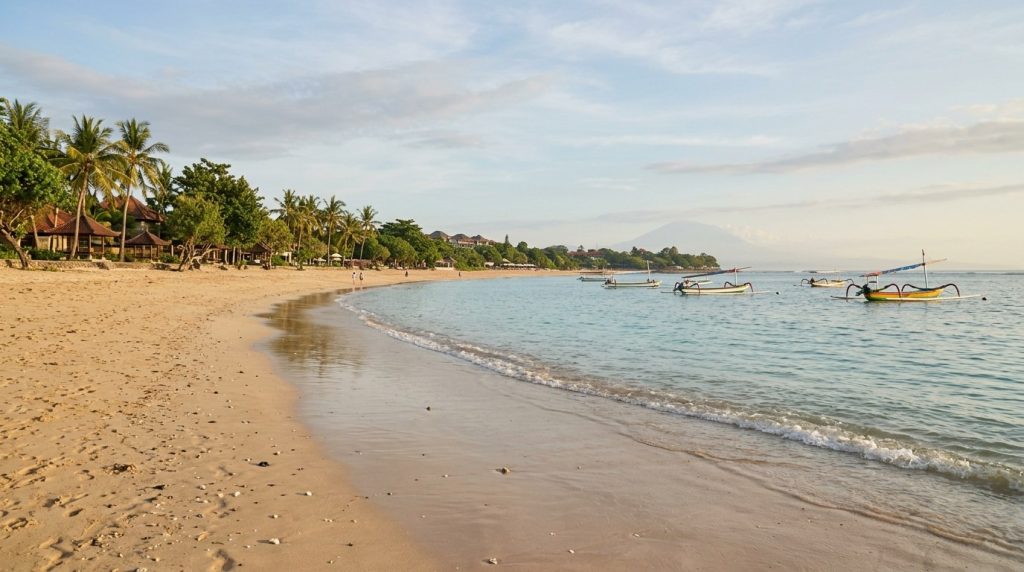
At high tide the lagoon behaves like a wide, shallow pool where toddlers can sit in the water and parents can relax. Pack rash vests: the UV index sits at 11 or higher at midday most of the year.
If you are still weighing up the area as a whole rather than just for the kids, our guide on whether Sanur is worth visiting covers the wider pros and cons.
The low-tide problem nobody puts in the brochure
This is the one thing that catches families out. Sanur’s tide range is often 1.5–2 metres, and at low tide the water retreats hundreds of metres, leaving a flat shelf of seagrass and coral rubble. You cannot swim then, full stop.
The fix is simple once you know:
– Check a tide chart each evening and plan beach time around high water. – Treat low tide as “reef walk” time. Kids love poking around for small fish, crabs and starfish in the pools. Reef shoes are essential, as the rubble is sharp. – Book a hotel with a pool, so the afternoon still works when the sea disappears.
The beachfront path: prams, scooters and bikes
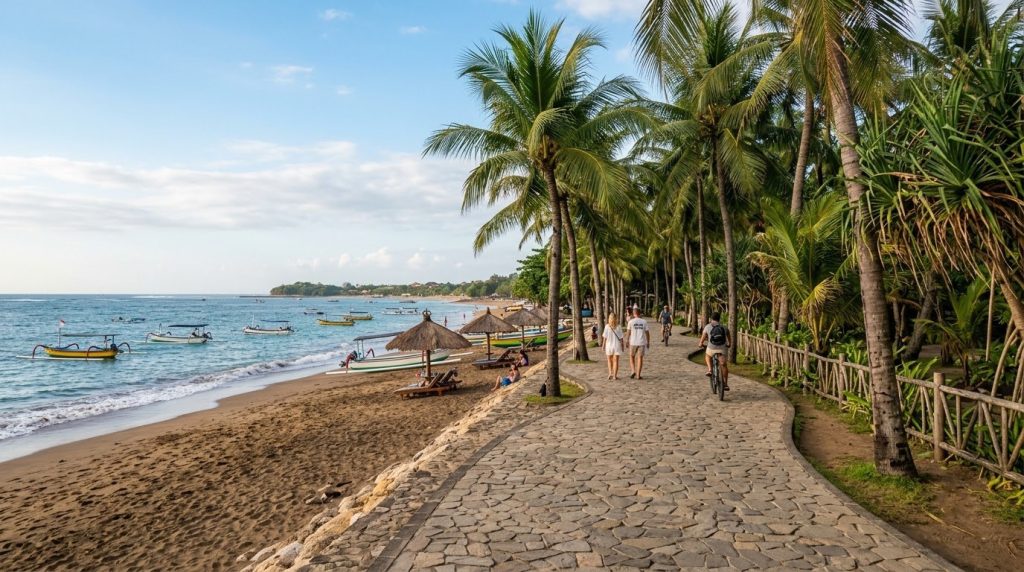
Sanur’s best family feature is not the beach itself but the paved path running along it. It stretches roughly 5–6 km from the Mertasari end in the south to the harbour end in the north, it is flat, wide enough for two prams to pass, and separated from road traffic. In a destination where footpaths often vanish into drains and scooters, that matters.
Bike hire is easy to find along the path by the hour or day, and a slow ride end to end, with stops for juice and a swim, fills a morning nicely.
Kite season, day trips and kid-friendly food
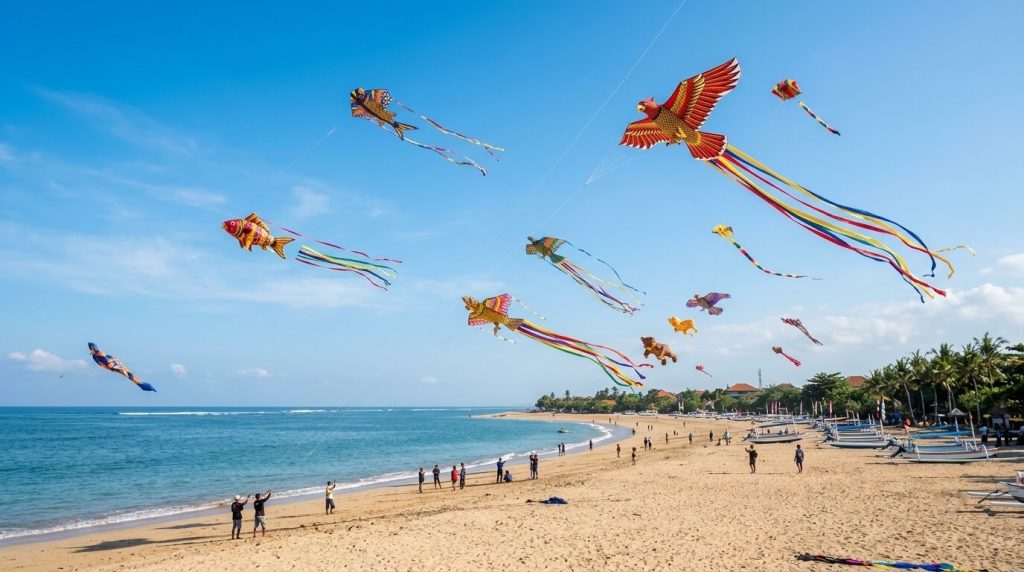
Bali Kite Festival. If you travel in the Australian winter school holidays, you land in kite season. The festival is held in July, within the dry, windy months of June to August, at Padang Galak on Sanur’s northern shore (festival background). Village teams of 70–80 people launch giant kites nearly 10 metres long, some with tails over 100 metres.
In 2026, events ran 18–19 July at Padang Galak and 23–26 July at Mertasari Beach. Go early, and confirm dates each year.
Nusa Lembongan by fast boat. Sanur is the jumping-off point for the Nusa islands, which makes it the easiest family base for a day trip. The crossing to Nusa Lembongan takes about 30–40 minutes, and one-way tickets typically run AUD 13–21 · USD 9–15 (IDR 150,000–250,000).
The newer harbour has a proper jetty, so you are no longer wading out to the boats with a toddler on your hip (harbour details). Organised family day trips of about 10 hours start from AUD 143 · USD 103 (IDR 1,700,000). Choose a calm day; speedboats can be rough.
Food kids will actually eat. Beachfront warungs and cafes along the path do toasties, pasta and smoothies alongside Indonesian dishes. For dinner, Sindhu Night Market opens after 5pm with around 20 food carts. A portion of chicken satay costs about AUD 1.70–2.50 · USD 1.20–1.80 (IDR 20,000–30,000), and satay with rice is a reliable crowd-pleaser for fussy eaters.
Who should skip Sanur (or think twice)
Sanur is not the right call for every family:
– Teenagers who want action. There is no surf break for beginners on the beach, few big-ticket attractions and very little nightlife. Surf-keen teens will be happier in Canggu or Uluwatu. – Families who want all-day swimming without planning. If tide charts sound like homework, a beach with less tidal exposure may suit you better.
Our Sanur vs Nusa Dua comparison breaks down that trade-off in detail. – Travellers wanting to be near rice terraces and temples. Ubud is 45 minutes to an hour away by car, which is fine for a day trip but not a daily commute with small kids.
For many families the best answer is a split stay: a week in Sanur for the toddler-friendly beach, then a few nights elsewhere. Our where to stay in Bali guide maps out how the areas fit together.
Getting there from Australia
Jetstar flies non-stop to Denpasar, with Perth about 3 hours 40 minutes away and Sydney about 6 hours 35 minutes. From Ngurah Rai Airport, Sanur is 25–40 minutes by car depending on traffic. A pre-booked private transfer with a child seat starts from about AUD 44 · USD 32 (IDR 505,600). Bali’s wet season, roughly November to March, brings more mosquitoes, so pack repellent if you travel then.
Nearest hospital and health basics for families
Bali International Hospital sits in Sanur itself, in the Sanur Health and Wellness zone, and runs a 24-hour emergency department with its own ambulance service, which matters more with young kids than with adults, since reef cuts, fevers and tummy bugs tend to hit holidaying children harder and faster. Its emergency line is reachable by phone and WhatsApp around the clock.
Beyond the reef shoes and sun cover already covered above, pack a basic kit for the inevitable scraped knee or upset stomach: children’s rehydration sachets, a thermometer and any regular medication in its original packaging.
Dengue and rabies are both present in Indonesia, so keep repellent on for evening walks along the beach path and treat any dog or monkey bite or scratch as a same-day clinic visit rather than a wash-and-wait situation, whatever the child’s age.
Travel insurance that explicitly covers children, including any pre-existing conditions you have already disclosed, is worth checking before you fly rather than after a clinic visit. Keep a card with the hospital’s number, your hotel’s address and your child’s blood type or allergies written in simple English in your day bag, in case someone other than you needs to explain the situation quickly.
Rainy-day activities for kids in Sanur
When the tide or the weather rules out the beach, Sanur has a handful of easy backups. A kayak or outrigger paddle along the calm lagoon works at most tide levels and tires young kids out for an afternoon nap. Icon Bali Mall, inland from the beach path, has air-conditioned relief, a supermarket for holiday essentials and casual food courts that are forgiving of fussy eaters.
The Le Mayeur Museum, a small former artist’s house near the main beach, is an easy half-hour stop that works even with short attention spans, since it is compact rather than a sprawling gallery.
For a dedicated play break, look for one of Sanur’s indoor kids’ play cafes, which combine a ball pit or climbing frame with coffee for parents, a useful card to hold for a wet or overheated afternoon between other plans.
A family bicycle ride along the promenade doubles as a rainy-morning option once a shower passes, since the path dries quickly and is covered in parts by overhanging trees. None of these need the tide to cooperate, which makes them an easy fallback on the low-tide afternoons described earlier, when the beach is out of action for an hour either side of the lowest point.
Where to stay in Sanur with kids
– Central Sanur (around Sindhu Beach): best for first-timers and families with toddlers. You are walking distance to cafes, the night market and the calmest stretch of lagoon. – South Sanur (towards Mertasari): quieter, with wider sand and more space for kids to run around.
Good for longer stays and families who want peace. – North Sanur (near the harbour): handy for early Nusa Lembongan boats and the kite-flying grounds at Padang Galak, though a little further from the main eating strip.
For specific picks, see our list of the best hotels in Sanur.
Find your Sanur hotel on the map
Live prices from Booking, Airbnb and more — move the map or change dates to compare stays across Sanur.
Related guides: best family resorts in Bali, best villas in Sanur.
Frequently Asked Questions
Is Sanur beach safe for toddlers?
Yes, at the right time of day. The offshore reef breaks the waves, so the lagoon is calm and shallow at high tide, which is ideal for toddlers. At low tide the water retreats and exposes sharp reef and seagrass, so swap swimming for reef walking in proper shoes, and always supervise closely near the water.
When is the best time to swim in Sanur?
Swim within about two hours either side of high tide. The tide range in Sanur is often 1.5–2 metres, so at low tide the water can sit hundreds of metres out. Check a tide chart the night before and plan beach sessions around it, with pool time in between.
Is Sanur boring for teenagers?
Often, yes. Sanur is quiet, with calm water, few headline attractions and limited nightlife. Teens who surf or want energy usually prefer Canggu or Uluwatu. You can keep them busy with a Nusa Lembongan day trip, snorkelling and bike rides, or split the holiday between Sanur and a livelier area.
When is the Bali Kite Festival in Sanur?
The Bali Kite Festival is held in July, during the windy dry season of June to August, at Padang Galak beach in Sanur. In 2026, events ran on 18–19 July at Padang Galak and 23–26 July at Mertasari Beach. Arrive early in the morning, when giant traditional kites launch on the best winds.
Can you do a day trip to Nusa Lembongan from Sanur with kids?
Yes. Fast boats leave Sanur harbour throughout the day, and the crossing takes about 30–40 minutes. The new jetty means no wading to board. Pick a calm-sea day and allow a full day if you book an organised trip.