Is Chiang Mai Worth Visiting? An Honest Verdict for Australians (2026)
By TravelguidestipUpdated 9 min readHow we earn
Hotel buttons open Stay22 (Booking.com, Agoda and others) and tour buttons open GetYourGuide. We may earn a commission at no extra cost to you.
Yes, 3 to 4 nights in Chiang Mai is worth it for most Australians, as long as you come between November and early February and not in the smoke season, when PM2.5 topped 300 µg/m³ in parts of the city in April 2026.
You get temples on every block, Thailand’s best noodle soup, real ethical elephant sanctuaries and cool mountain air. You don’t get a beach. If sand and swimming are the whole point of your trip, spend those nights on the islands.
| Factor | Reality | What to do |
|---|---|---|
| Temples and old city | Walkable, cheap, mostly free or THB 40–50 entry | Spend 1 full day on foot inside the moat |
| Food | Khao soi from AUD 1.70–2.90 · USD 1.20–2.10 (THB 40–70) a bowl | Eat lunch at noodle shops, dinner at markets |
| Elephants | Hands-off sanctuaries from AUD 105 · USD 75 (THB 2,500) | Book a no-riding, no-bathing programme |
| Air quality | Burning season runs January to April and peaks in March | Visit November to early February |
| Beaches | None. The nearest sea is a 2-hour flight away | Pair it with Phuket or Krabi |
| Getting there | No direct flights from Australia | Connect via Bangkok (about 1h10 to 1h20) |
Why Chiang Mai is worth it: the short case
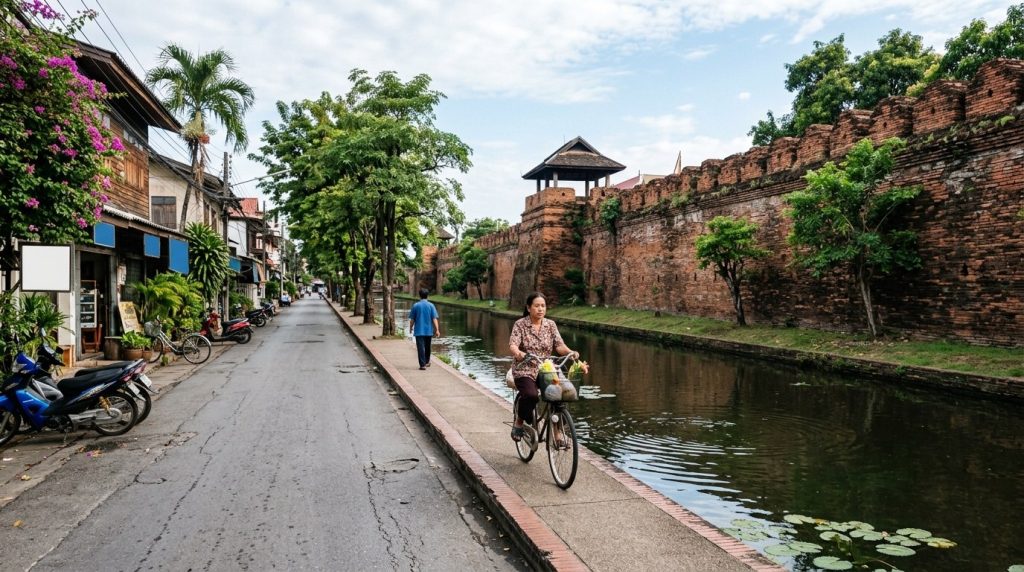
Chiang Mai is the slow, cultural half of a Thailand trip. The old city sits inside a square moat, and you can walk between its big temples, Wat Chedi Luang and Wat Phra Singh, past smaller wats the tour buses skip. Wat Chedi Luang charges foreigners THB 40–50, which is pocket change.
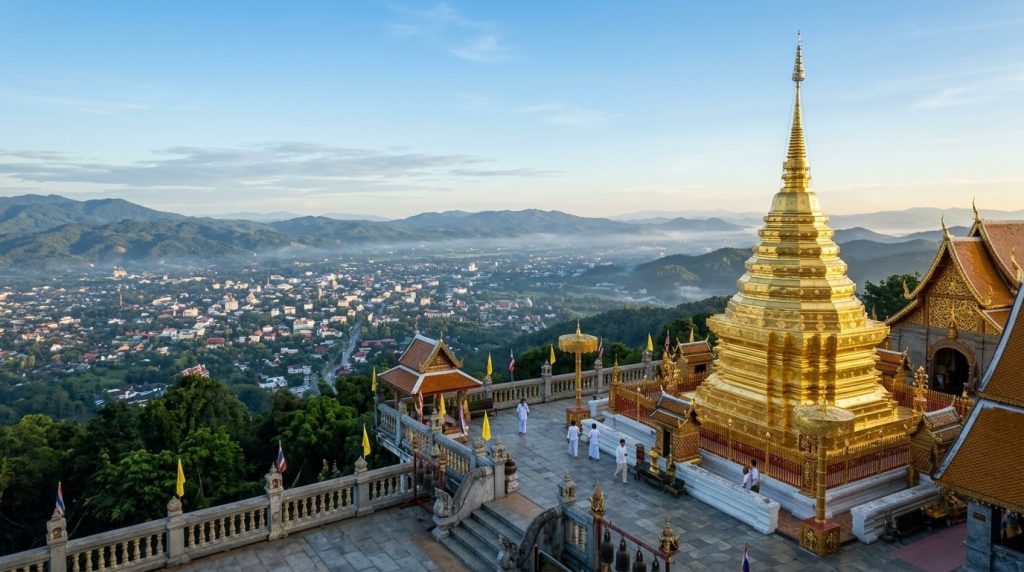
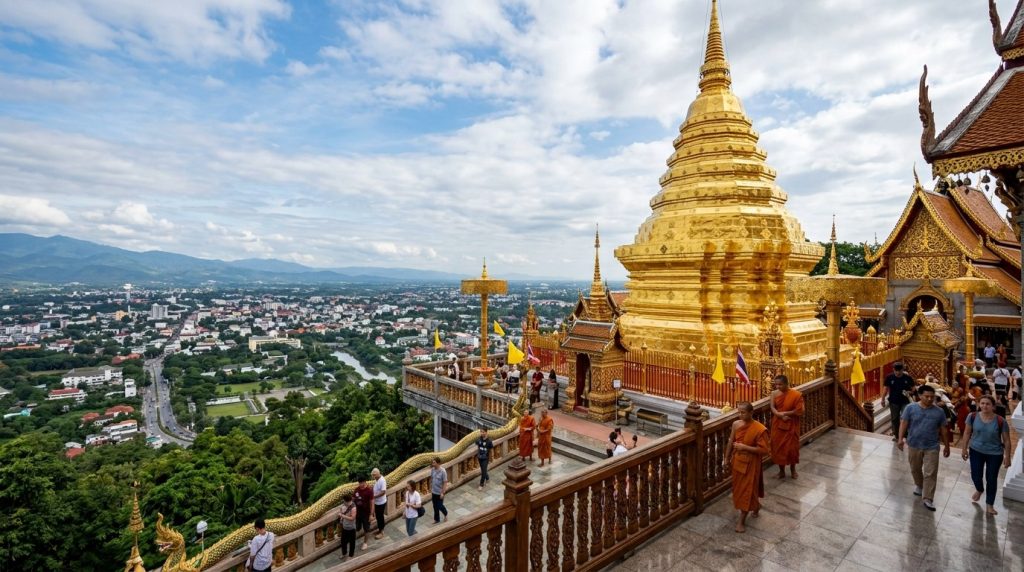
Up on the mountain, Wat Phra That Doi Suthep has 306 naga steps (or a funicular) and the best view over the city. You can walk the stairs and the lower terrace for free and pay a small fee only for the gold chedi precinct.
The food alone justifies the flight. Khao soi, the curried egg-noodle soup of the north, costs THB 40–70 at local shops, and it tastes nothing like the versions served in Sydney or Melbourne. Sunday evening’s walking street market on Ratchadamnoen Road turns the old city into one long food court.
If you want the full list of what to fill your days with, our rundown of the best things to do in Chiang Mai goes deeper than this verdict can.
The three experiences that make the trip
Ethical elephant sanctuaries. Riding camps still exist around Chiang Mai, so choose carefully. Elephant Nature Park runs a no-riding policy across all its programmes. Its half-day visits cost THB 2,500 (AUD 105 · USD 75) with hotel pickup, and its full-day “SkyWalk” and “Walking with Elephants” programmes cost THB 3,500 (AUD 146 · USD 105). If a camp sells rides, painting or “bathing with elephants”, walk away.
Doi Inthanon. Thailand’s highest peak, at 2,565 metres, is roughly 90 km and 1.5 to 2 hours by road from the city. According to the park’s visitor information, foreign adults pay THB 300 (AUD 13 · USD 9).
The Royal Twin Pagodas cost another THB 100 (AUD 4.20 · USD 3), and the Kew Mae Pan trail needs a THB 200 guide. Bring a jacket, because the summit averages 10–15°C. Bring cash too, as there are no ATMs inside the park.
A cooking class. This is the one activity almost everyone rates. Half-day classes with a market stop and 4 to 6 dishes cost THB 900–1,400 (AUD 38–59 · USD 27–42). Full-day farm classes cost THB 1,200–1,800 (AUD 50–75 · USD 36–54), and booking direct with the school is usually cheaper than booking through an app.
The smoke problem: when not to go
This is the part most “worth it” articles bury. Northern Thailand’s burning season, from crop burning and forest fires, typically runs from January to April and peaks in March, and the city sits in a basin that traps the smoke. In 2026 it was severe.
IQAir reported Chiang Mai’s AQI above 150 (“unhealthy”) on 4 March. On 1 April, parts of the province were declared disaster zones after district readings exceeded 300 µg/m³, almost 10 times the Thai safety standard. For the rest of the year the air is usually fine: Chiang Mai’s 2025 average was 18.2 µg/m³, in the moderate band.
Our Chiang Mai travel guide covers each season month by month. The short version is November to early February for cool 25–30°C days and clear skies, with the Yi Peng lantern festival on the late-November full moon. If you have asthma, a heart condition or young kids, don’t book anything from mid-February to April.
How many nights you actually need
– 2 nights: the old city temples, Doi Suthep and one night market. It’s rushed, but it works as a Bangkok add-on. – 3 to 4 nights: the sweet spot. Add an elephant sanctuary, a cooking class and Doi Inthanon.
Our 4-day Chiang Mai itinerary sets this out day by day. – 5+ nights: worth it only if you add Pai or Chiang Rai. If you’re torn between the two northern cities, our Chiang Mai vs Chiang Rai comparison settles it.
There are no direct flights from Australia, so most travellers connect through Bangkok. The domestic hop takes about 1 hour 10 to 1 hour 20 minutes, and the overnight sleeper train takes 12 to 13 hours if you’d rather enjoy the journey.
Who should skip Chiang Mai for the islands
Be honest about why you’re going. Skip Chiang Mai if:
– You want a beach holiday. The so-called Chiang Mai beaches are lakes, reservoirs and quarry swimming spots. They’re pleasant on a hot afternoon, but they won’t replace the Andaman coast.
Phuket and Krabi are each about a 2-hour direct flight from Chiang Mai. – You have only 7 days and it’s your first Thailand trip with kids. One base on the coast beats an extra domestic flight. – You can only travel in March or early April. Go south instead and leave the north for a cooler, cleaner month. – You want nightlife. Nimman has bars, but it’s not Phuket’s Bangla Road, and that’s a large part of the appeal.
Getting around Chiang Mai: songthaews, Grab and scooters
Chiang Mai is more spread out than the old city’s moat suggests, so most short trips to a sanctuary, a cooking class or Nimman need some kind of wheels.
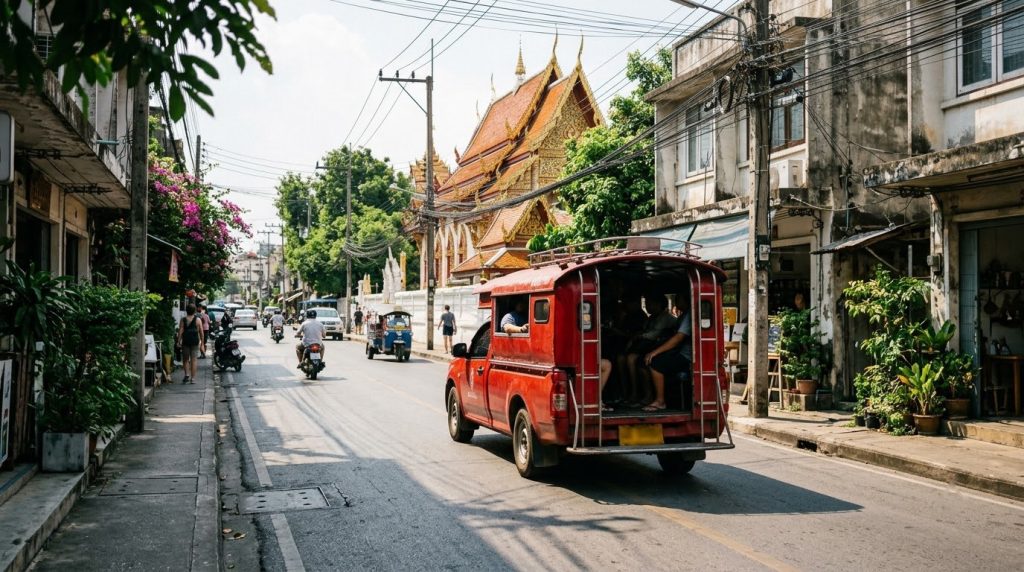
Red songthaews, the shared pickup trucks with benches in the back, cover the old city and nearby neighbourhoods and are the cheapest option for a short hop, but confirm the price with the driver before you climb in rather than after, since fares are not metered.
Grab, the regional ride-hailing app, is the simplest fallback if you would rather not negotiate: fares start from a base charge of about THB 60 plus roughly THB 5 per kilometre, according to Chiang Mai fare estimates, which keeps most trips across the old city and out to Nimman in the AUD 2.50–6.25 · USD 1.80–4.50 range.
Renting a scooter is the most flexible option for reaching Doi Suthep or the elephant sanctuaries independently, and a standard 125cc scooter with insurance typically costs AUD 6–10 · USD 4.50–7.50 (THB 150–250) a day, cheaper again if you rent for a full month.
An international driving permit covering motorcycles is technically required and worth carrying, since insurance claims can be refused without one if you are involved in an accident.
Common scams in Chiang Mai and how to avoid them
Chiang Mai is relatively low-crime by big-city standards, but a handful of scams target visitors specifically and are worth knowing before you arrive.
- The gem or souvenir detour. A friendly local, sometimes near a temple, claims it is closed for a ceremony or a holiday and offers to take you somewhere better, which usually ends at a gem or tailor shop paying the guide a commission. Walk to the gate and check for yourself.
- Scooter rental damage disputes. Some shops claim pre-existing scratches or damage were caused by you and withhold part of the deposit. Photograph the bike from several angles, including close-ups of any existing marks, before you ride off.
- Songthaew and tuk-tuk overcharging. Without a fixed fare agreed up front, some drivers quote a high price once you are already on board or at your destination. Agree the fare, or confirm it is metered, before the ride starts.
- Fake or overpriced day-trip bookings. Street-side tour desks sometimes sell elephant sanctuary or trekking trips that differ from what was promised. Book directly with the operator’s own website or a well-reviewed platform where you can check recent reviews first.
None of this is specific to Chiang Mai, but the gem detour and scooter deposit disputes come up often enough in traveller reports to be worth a sentence of warning before your trip.
Staying connected: SIM cards and practical money tips
A local SIM or eSIM is worth sorting out before you leave the airport, since Grab, maps and translation apps all do heavy lifting on a short Chiang Mai trip.
Tourist SIM cards from AIS or True are sold at the airport and at 7-Eleven stores across the city.
Short plans covering 5 to 8 days of data run roughly AUD 12–21 · USD 9–15 (THB 299–499), while a SIM covering a full month of unlimited data costs closer to AUD 50 · USD 36 (THB 1,199), based on current AIS and True tourist plan pricing.
Airport kiosks are the most convenient option on arrival; 7-Eleven stores in town are usually cheaper for the same plan if you would rather wait until the next day.
Cash still matters outside malls and chain cafes. Markets, songthaew drivers and smaller family-run restaurants are often cash only, so carry small denominations of baht rather than relying on cards everywhere. ATMs charge a flat withdrawal fee per transaction regardless of the amount, so withdraw larger sums less often rather than making several small withdrawals through your trip.
Markets beyond the Sunday walking street
The Sunday walking street on Ratchadamnoen Road gets most of the attention, but it is not the only market worth building an evening around.
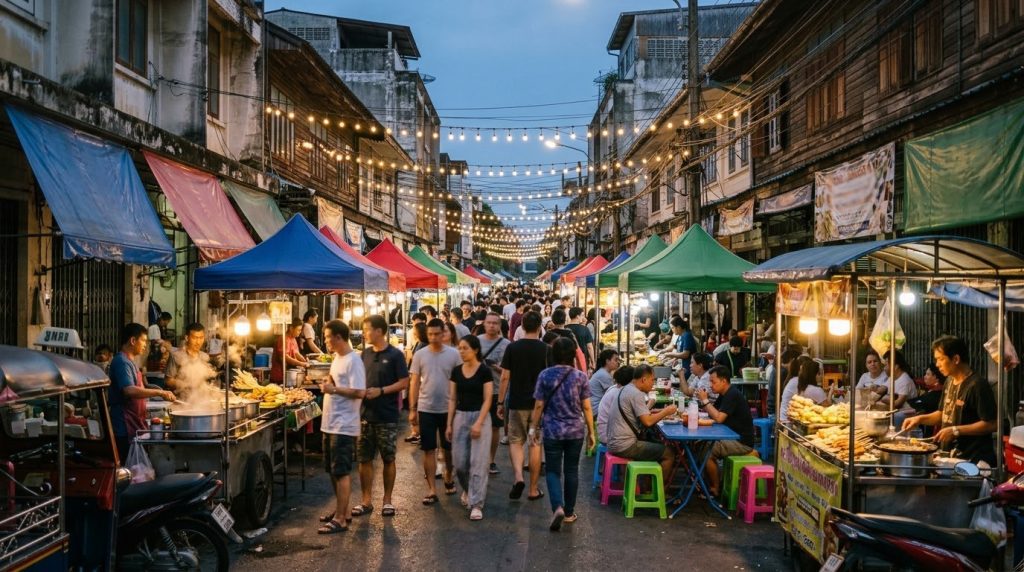
The Saturday walking street on Wua Lai Road, near Chiang Mai Gate, is a smaller, less crowded alternative that runs roughly 5 or 6pm until about 11pm, with free entry, silverwork from the surrounding Wua Lai silversmith community, and the same northern Thai street food you will find at the Sunday equivalent.
It suits travellers who want the market atmosphere without the Sunday night crowds, or who only have a Saturday evening free.
Warorot Market, often called Kad Luang by locals, is the everyday option: a multi-storey covered market open daily, with food stalls starting at dawn and textile, spice and homeware stalls running through the day. It is less photogenic than the walking streets but far more useful if you want to see how residents actually shop, or pick up dried fruit, northern Thai sausage or fabric at local, not tourist, prices.
Between the two walking streets and Warorot, most visitors get a representative slice of Chiang Mai’s market culture without needing to chase every stall listed in older guidebooks.
Where to stay in Chiang Mai
– Old City (inside the moat): best for first-timers and temple walkers. Everything is on foot, and the Sunday market is at your door. – Nimmanhaemin (Nimman): cafes, co-working spaces and newer hotels.
It suits couples and repeat visitors, and it’s a short Grab ride to the old city. – Riverside (Ping River, east of the old city): quieter, with bigger resort-style hotels. It suits families and anyone who wants a pool and calm evenings.
Find your Chiang Mai hotel on the map
Live prices from Booking, Airbnb and more — move the map or change dates to compare stays across Chiang Mai.
Frequently Asked Questions
Is Chiang Mai worth visiting in the burning season?
Generally, no. From February to April, crop and forest fires fill the Chiang Mai basin with smoke. In March and April 2026 the city ranked among the world’s most polluted, and some districts passed 300 µg/m³ of PM2.5. Views from Doi Suthep disappear and outdoor days become uncomfortable. If those are your only dates, choose the southern islands.
How many days do you need in Chiang Mai?
Three to four nights covers the essentials: a day in the old city temples, Doi Suthep, an ethical elephant sanctuary, a cooking class and a day trip to Doi Inthanon. Two nights is possible but rushed. Stay five or more only if you’re adding Pai or a trip to Chiang Rai.
Does Chiang Mai have beaches?
No. Chiang Mai is a landlocked mountain city in northern Thailand, and the nearest sea beaches are a flight away. Locals swim at reservoirs and old quarry lakes such as the Grand Canyon water park area. For real sand, fly direct to Phuket or Krabi, which takes about 2 hours.
Are elephant sanctuaries in Chiang Mai actually ethical?
Some are and some aren’t. Look for strict no-riding, no-painting and no-performance policies, and ideally hands-off observation rather than bathing. Elephant Nature Park is the best-known no-riding operator, with half-day visits from THB 2,500. If a camp advertises rides or tricks, it’s not a sanctuary, whatever its name says.